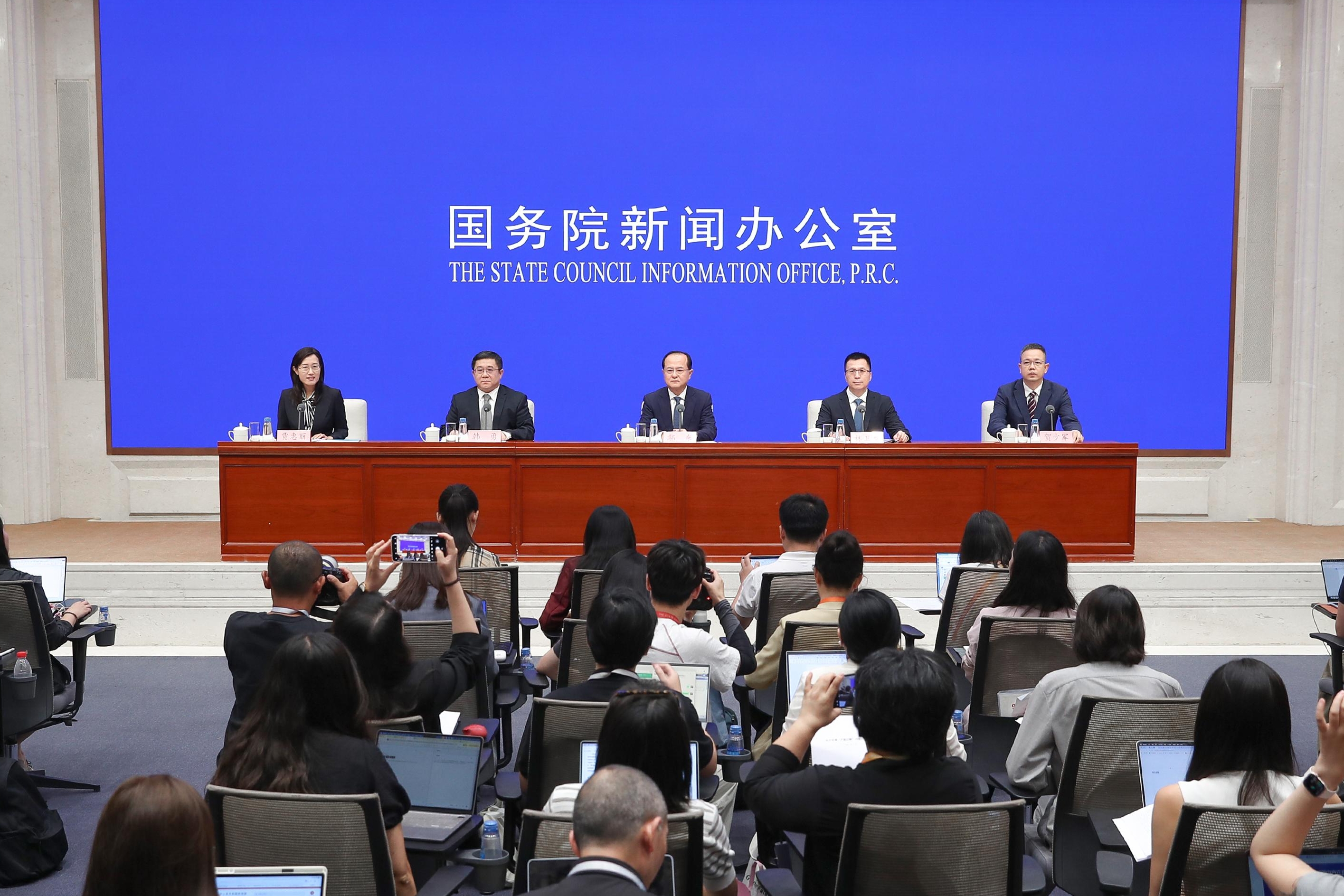
China.org.cn | September 22, 2026


Daxiang News:
Emerging industries in China, such as artificial intelligence, new energy vehicles and lithium-ion batteries, are developing rapidly, and their export momentum is strong. What are the key factors of China's industrial advantages and growth drivers? Thank you.
Yan Dong:
Thank you for your question. I would like to invite Mr. He to answer this question.
He Shaojun:
Thank you. We have also noted that in recent years, China's electric vehicle, lithium-ion battery and artificial intelligence industries have developed rapidly, with strong export growth. According to customs statistics, in the first half of this year, China's exports of electric vehicles and lithium-ion batteries increased by 68.7% and 37.6% respectively; exports of AI-related products such as industrial robots and 3D printers performed exceptionally well, growing by 18.6% and 109.3%, respectively, becoming a "new brand" for China's foreign trade. In summary, it is the result of multiple factors, including China's solid industrial foundation, market-driven iteration, enterprise innovation breakthroughs, and international openness and cooperation. These can be summarized as four major advantages.
First, the advantage of a complete industrial system. At present, China has established a complete and efficient new energy vehicle industry system covering the entire chain, including basic materials, components, complete vehicles and manufacturing equipment. Its supply chain response efficiency, cost control and delivery speed are among the best in the world. In the Yangtze River Delta region, through the coordinated development of industrial clusters, a new energy vehicle manufacturer can solve the supply of necessary supporting parts within a 4-hour driving distance.
Second, the advantage of a super-sized market. China boasts the world's largest consumer market, which serves as a testing and training ground for new technologies, products and services. China's new energy vehicle sales have ranked first globally for 11 consecutive years, with product technology level significantly improved through fierce domestic competition. Massive user demand and diverse application scenarios are accelerating the iteration of artificial intelligence (AI) technology, enabling rapid verification of the technology's feasibility and diluting R&D costs.
Third, the advantage of innovation-driven development. China remains committed to innovation-driven development, leveraging scientific and technological innovation to guide industrial development and continuously enhancing industrial competitiveness. China's national R&D intensity increased from 1.91% in 2012 to 2.8% in 2025. It has ranked first in the world in international patent applications for seven consecutive years, and accounts for 60% of the world's AI patents. Technological breakthroughs have been achieved in fields such as power batteries and general-purpose large models. By 2025, the energy density of power batteries has increased by more than 50% compared to 2018, and the production cost has decreased by more than 60%. Many domestic large models such as DeepSeek and Qwen have risen to prominence.
Fourth, the advantage of an open and cooperative environment. The global energy system is undergoing profound transformation, and AI is developing rapidly, creating enormous potential for economic and trade cooperation. According to industry estimates, the global market size for products and technologies such as electric vehicles, solar and wind power will reach $2.1 trillion by 2030, and the AI data center market size will grow at an average annual rate of 45% over the next five years, indicating a promising market prospect. China promotes international cooperation based on the principle of mutual benefit and win-win cooperation, and supports competitive new energy vehicle and lithium battery companies in carrying out cross-border production and supply chain deployments in a reasonable and orderly manner to empower the green transformation and industrial upgrading of all countries.
The development of China's modern industries and the enhancement of its foreign trade competitiveness rely on innovation-driven development and the continuous deepening of reforms. Going forward, we will continue to promote high-quality development of trade, further support enterprises in relevant industries in deeply integrating into global industrial and supply chain system, so as to inject more vitality into the global digital, intelligent, and green transformation. Thank you.
Jia Huili:
Thank you for the introduction. Now for the last question.