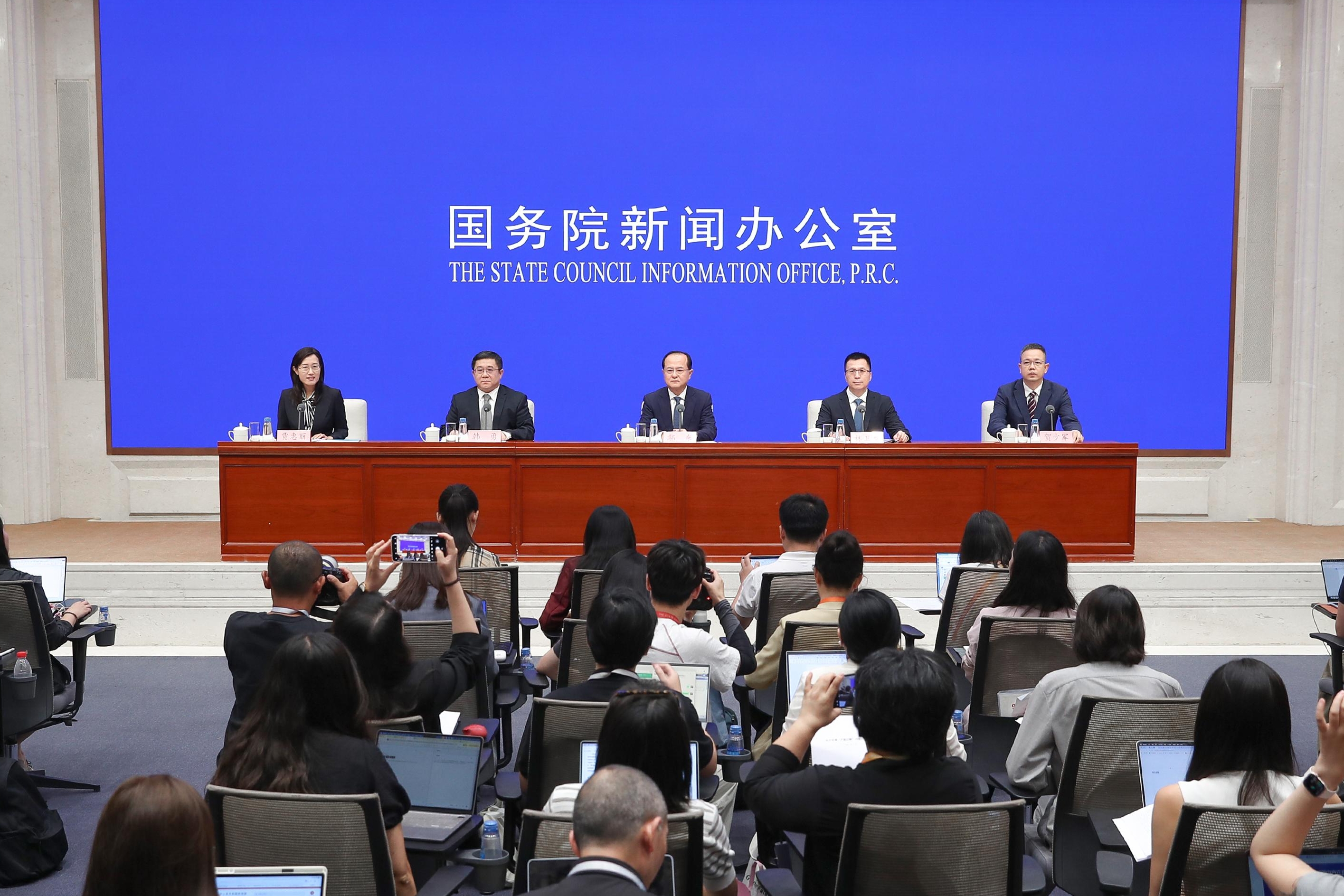
China.org.cn | September 22, 2026


South China Morning Post:
The E.U. recently proposed new trade defense instruments and the U.S. launched a Section 301 investigation into production capacity. What is MOFCOM's comment on this? Given that domestic supply in the sectors concerned continues to exceed domestic demand, what measures is the ministry taking to prevent export spillover effects from triggering further trade restrictions? Thank you.
Yan Dong:
Thank you for your questions. I would like to invite Mr. Lin to answer them.
Lin Weilong:
Thank you for your questions. As I understand it, your questions involve three issues: trade measures taken by the E.U. and the United States, China's domestic demand, and global economic imbalances caused by the spillover effects of exports.
Let me first address the E.U.'s trade defense instruments and the U.S. Section 301 investigations into production capacity. China has repeatedly made its position clear on both. The E.U. has recently rolled out a series of protectionist measures against China, severely undermining the confidence of Chinese enterprises in cooperating with the E.U. Given the enormous scale of China-E.U. cooperation, disagreements and frictions are inevitable. However, such differences should not be used as grounds for fabricating baseless accusations, let alone as a pretext for imposing restrictions and pressure that hinder practical cooperation. China is willing to work with the E.U. to properly handle differences and frictions through dialogue and consultation. The U.S. launch of a Section 301 investigation targeting overcapacity is a typical act of unilateralism that severely disrupts the international economic order. The U.S. can not arbitrarily define production capacity that merely exceeds domestic demand as "overcapacity" and slap on such a label at will. The U.S. side has no authority to unilaterally determine whether its trading partners have "overcapacity" through a Section 301 probe, nor to impose unilateral restrictive measures based on such a determination. China urges the U.S. to correct its wrongdoings and return to the proper path of resolving differences through dialogue and consultation. China will closely follow the developments and reserves the right to take all necessary actions to firmly defend its legitimate rights and interests.
The second question concerns China's domestic demand. The position paper states that the argument that "China's inadequate domestic demand gives rise to excess capacity" runs counter to facts. China is not only a manufacturing powerhouse, but also a major consumer. Domestic demand has always served as a main engine of China's economy. From 2013 to 2024, domestic demand on average contributed 93% of the country's economic growth. Specifically, consumption and investment contributed 55% and 38%, respectively. Between 2013 and 2025, China's total retail sales of consumer goods doubled from 23.8 trillion yuan to 50.1 trillion yuan. Measured by the World Bank's purchasing power parity (PPP) conversion factor, China's total retail sales of consumer goods in 2025 were 1.7 times that of the U.S., making China the de facto largest consumer market in the world. For example, in terms of food consumption, China's Engel coefficient has dropped to 29.8%; and the per capita protein supply has reached more than 130 grams per day, exceeding that of many developed countries. In terms of industrial product consumption, the annual per capita consumption of some industrial products such as air conditioners, refrigerators, cellphones and automobiles, has approached the levels of OECD countries.
Currently, China faces inadequate effective demand, which aligns with the country's economic transition from high-speed growth to a phase of high-quality development. In the long term, however, China's consumption potential remains enormous and dynamic, and its role as a major engine of growth will become even more prominent. Over the coming decade, China's middle-income population will exceed 800 million, and per capita GDP is expected to reach the level of moderately developed countries. Structurally, it is accelerating the shift from commodity consumption to a balance between commodity and service consumption, with service consumption developing rapidly. It is expected that by 2030, the proportion of service consumption will exceed half. China's 15th Five-Year Plan has a dedicated section on bolstering domestic demand, underscoring the need to adhere to the strategy of expanding domestic demand, complete with measures for expanding effective investment, vigorously boosting consumption, advancing special initiatives to boost consumption, expanding and upgrading goods consumption, unleashing the potential of services consumption, cultivating and strengthening new types of consumption, so that new demand drives new supply, and new supply helps create fresh demand. This will foster positive interactions between consumption and investment and between supply and demand, so as to strive to achieve a higher-level equilibrium between supply and demand.
The third question concerns global economic imbalance. Global economic imbalance has always existed and is a historical norm. Under the global economic landscape and international economic governance system formed after the Second World War, the global economy has experienced a major wave of imbalance roughly every decade, at times even triggering international economic and financial crises. When analyzing the causes of global economic imbalance, the focus of discussion by the international community keeps shifting, ranging from market factors such as savings and investment and division of labor along industrial and supply chains, to institutional factors including the international financial system and macroeconomic policies. Economic imbalance has complex root causes.
In recent years, global economic imbalance has taken on new features. The International Monetary Fund (IMF) and other institutions believe that the macroeconomic policies of countries, fiscal policies in particular, are the dominant driver of the current global economic imbalance. The U.S. has accumulated a huge debt imbalance and needs to improve its finances; Europe has insufficient investment and needs to raise its productivity; China needs to expand its domestic demand. This viewpoint is just one opinion, but it reflects the systemic and complex nature of global economic imbalance. Some views that link global imbalance with so-called "excess capacity" are overly simplistic, deliberately misleading and malicious. On the contrary, China's high-quality production capacity not only meets domestic demand but also makes significant contributions to global development and plays an important role in promoting global economic balance. Thank you.