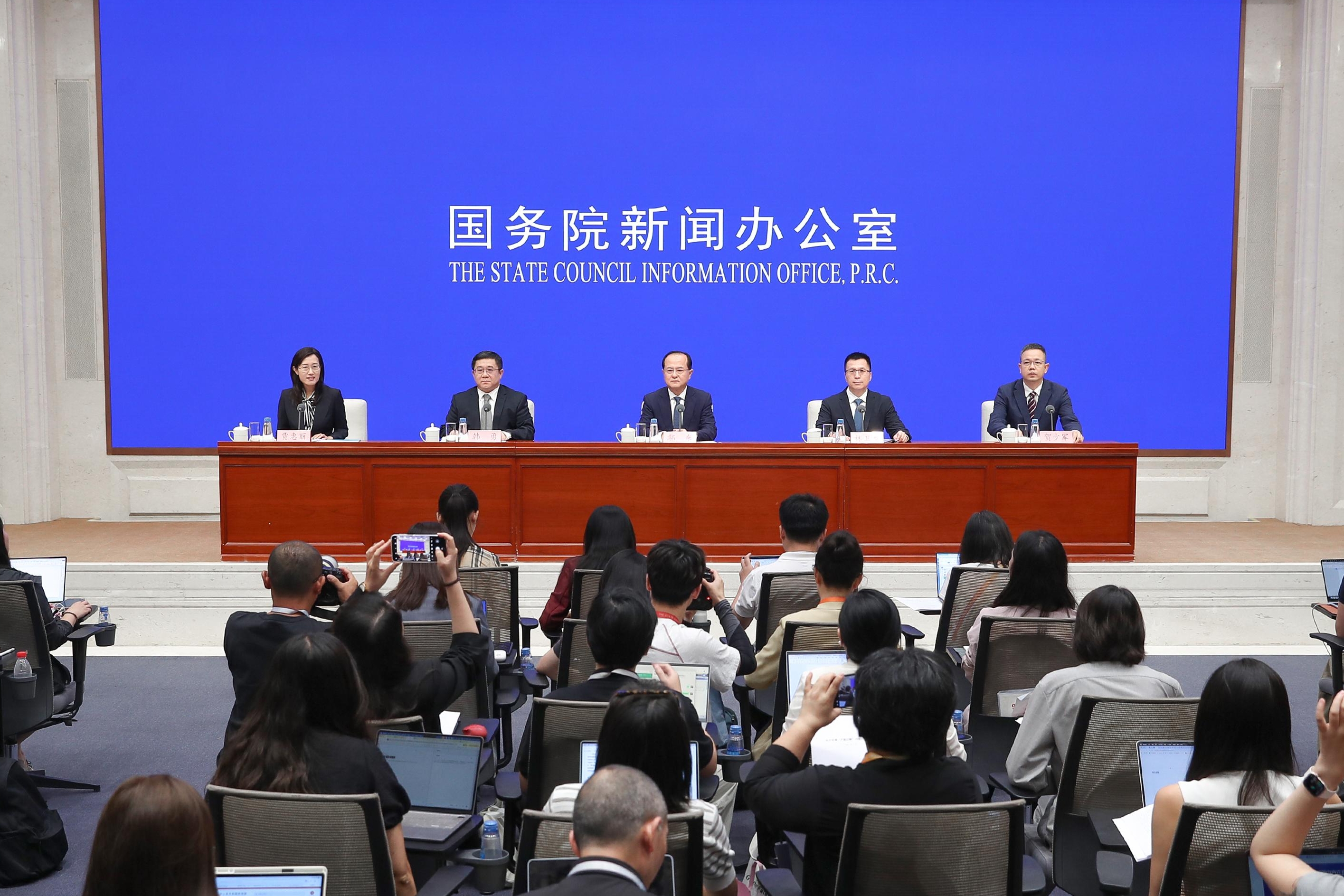
China.org.cn | September 22, 2026


Speakers:
Mr. Yan Dong, vice minister of commerce
Mr. Lin Weilong, director general of the Policy Research Office of the Ministry of Commerce (MOFCOM)
Mr. Han Yong, director general of the Department of WTO Affairs of the MOFCOM
Mr. He Shaojun, deputy director general of the Department of Foreign Trade of the MOFCOM
Chairperson:
Ms. Jia Huili, deputy director general of the Press Bureau of the State Council Information Office (SCIO) and spokesperson of the SCIO
Date:
July 28, 2026
Jia Huili:
Ladies and gentlemen, good afternoon. Welcome to this press conference held by the State Council Information Office (SCIO). Today, the Ministry of Commerce (MOFCOM) released a document titled "China's Position on the So-called Excess Capacity Issue." We have invited Mr. Yan Dong, vice minister of commerce, to brief you on the document, and to answer your questions. Also present today are Mr. Lin Weilong, director general of the Policy Research Office of the MOFCOM; Mr. Han Yong, director general of the Department of WTO Affairs of the MOFCOM; and Mr. He Shaojun, deputy director general of the Department of Foreign Trade of the MOFCOM.
First, I'll give the floor to Mr. Yan for his introduction.
Yan Dong:
Thank you, Ms. Jia. Friends from the media, good afternoon. As Ms. Jia just said, today, the MOFCOM released a document titled "China's Position on the So-called Excess Capacity Issue." I would like to take this opportunity to brief you on the background and main content of this document.
In recent years, global economic growth has remained sluggish, drawing widespread attention and discussion across the international community regarding global supply-demand balance and production capacity. In particular, some economies, concerned about their own industrial competitiveness and market position, have politicized economic and trade issues by hyping up the so-called "excess capacity" issue against China. They have even deliberately confused concepts, linking industrial subsidies, trade surplus, economic imbalance, market competition and other issues with "excess capacity." They have put forward claims such as the so-called "China Shock 2.0" and introduced various protectionist measures under the pretext of the so-called "excess capacity" issue.
President Xi Jinping pointed out: "One will not be seen in a more favourable light after blowing out others' lamp; nor will they go farther by blocking others' paths." China believes that the issue of capacity should be viewed in a comprehensive, objective and impartial manner, and should not be used as an excuse for protectionism. Such practices will only disrupt the global economic and trade order as well as the stability of industrial and supply chains, exacerbate conflicts and differences, and pose long-term risks to global economic growth. We have compiled this position paper to clarify relevant facts and elaborate on China's views and position on the so-called "excess capacity" issue.
The Chinese version of the paper contains more than 10,000 Chinese characters, and the English version has also been published simultaneously on the MOFCOM's website. The full text consists of a preface, main body and conclusion. The main body consists of four chapters.
Chapter I: "Global capacity and the so-called excess capacity should be viewed in a rounded and objective manner." This section reviews the evolution of the global capacity landscape from a historical perspective, explaining that the gradual shift in the global industrial landscape from a single center to multiple centers is a result of international industrial labor division. Excess capacity is a dynamic phenomenon in the market economy. Given varying perspectives on this concept, its measurement in different economies and industries should take into account their respective development stages and levels.
Chapter II: "Perspectives and positions on four relationships concerning excess capacity." This section objectively analyzes the relationships between industrial subsidies, trade surplus, economic imbalance as well as market competition and excess capacity, emphasizing that there is no necessary connection between industrial subsidies and excess capacity, that large exports or trade surpluses are not synonymous with excess capacity, that global economic imbalance is a historical norm with complex root causes, and that market competition provides an important guarantee for capacity optimization and adjustment.
Chapter III: "China's commitment to building a modern industrial system through opening-up and cooperation." This section focuses on China's policy practices and future directions, clarifying that the rapid growth of China's modern industries is driven by innovation, and that the stable, healthy industrial performance relies on deepening reform. It also explains that China's industrial modernization is "China Opportunity 2.0" to the world, not "China Shock 2.0."
Chapter IV: "We should jointly pursue open and inclusive cooperation on global industrial and supply chains." This section puts forward China's principles and proposals, calling on the international community to jointly shoulder responsibilities and move toward the same direction. China advocates promoting mutually beneficial and win-win cooperation, respecting the laws of the market, strengthening coordination of industrial policies, expanding market openness and jointly creating cooperation opportunities, and upholding multilateralism and building a more just and equitable international economic order.
That concludes my introduction. Next, my colleagues and I are ready to take your questions. Thank you.
Jia Huili:
Thank you, Mr. Yan. The floor is now open for questions. Please identify the media outlet you represent before asking questions.