China.org.cn | September 22, 2026


CCTV:
Given the current turbulent international landscape, maintaining the stability and smooth flow of global industrial and supply chains faces many challenges, requiring joint efforts and concerted actions from all countries. What suggestions does the Ministry of Commerce have for better promoting the building of an open and inclusive global industrial and supply chain cooperation framework? Thank you.
Yan Dong:
Thank you for your question. I will take it. Currently, the international landscape is volatile and protectionism is rampant. Maintaining the stability and smooth flow of global industrial and supply chains is not only in the interest of all parties, but also an urgent aspiration of the international community. As President Xi Jinping pointed out, economies make progress through exchange and inter-connectivity and fall behind because of seclusion and closeness. China stands ready to work with all parties to safeguard the global free trade system, maintain an open and cooperative international environment, and jointly pursue open and inclusive cooperation on global industrial and supply chains.
We must adhere to the principle of mutual benefit and win-win cooperation to make the pie of global development bigger. As the pie of the global economy expands, conflicts over interest distribution diminish. All parties should jointly seize the opportunities brought by the new round of industrial revolution and technological transformation, enhance international cooperation on green and low-carbon sectors, AI and biomanufacturing, and overcome growth bottlenecks by sharing technological dividends to continuously inject new impetus into the global economy. All parties should pay greater attention to the "real imbalances" existing between developed and developing economies, strengthen cooperation in industry, trade and investment, promote the integration of more developing countries and regions into the international division of labor, accelerate the process of industrialization and modernization, and unlock a "new blue ocean" for global industrial cooperation.
We must uphold openness and integration to promote a virtuous cycle in global industrial and supply chains. The division of labor and cooperation in the global industrial and supply chains were not built overnight; arbitrary and forced intervention will only backfire. All parties should remain committed to expanding market access, promoting trade and investment liberalization and facilitation, improving the efficiency of factor resource allocation, and jointly building and safeguarding an open and innovative global ecosystem to maximize the benefits of international industrial cooperation. All parties should oppose politicizing or over-stretching security concepts over economic issues, respect market principles, lower trade barriers, reduce obstacles to investment and cooperation, promote full market competition, stimulate business vitality, and facilitate a more rational and orderly flow of factor resources and industrial division of labor.
We must uphold policy coordination to build a stable and predictable cooperation environment. The world economy is closely interconnected, and the spill-over effects of industrial policies in different countries are significant. Communication and coordination must be strengthened, with major countries playing an exemplary role. All parties should adhere to equal-footed consultation, properly manage differences, reject unilateralism and protectionism, and oppose discriminatory and exclusionary practices. All parties should strengthen multilateral and bilateral dialogues on industrial policies, adhere to openness and transparency, enhance exchanges and discussions on industrial policies within the framework of the WTO, and take more coordinated and effective measures to better pool the strength for global economic growth.
We must uphold multilateralism to build a more just and equitable international economic order. The multilateral trading system with the WTO at its core serves as the cornerstone of economic globalization and international trade. All parties should adhere to equality and mutual benefit in economic and trade exchanges, respect each other's development stage and national conditions and strive to excel through fair competition rather than tripping others up, while jointly resisting bullying and coercion. All parties should uphold genuine multilateralism, adhere to the basic principles and rules of the WTO, advance WTO reform in line with the times, safeguard the authority and effectiveness of the WTO. We should better leverage the role of multilateral and regional cooperation mechanisms such as the G20, BRICS, and APEC to jointly uphold fairness and justice, and foster a more just and equitable global economic governance system. Thank you.
Jia Huili:
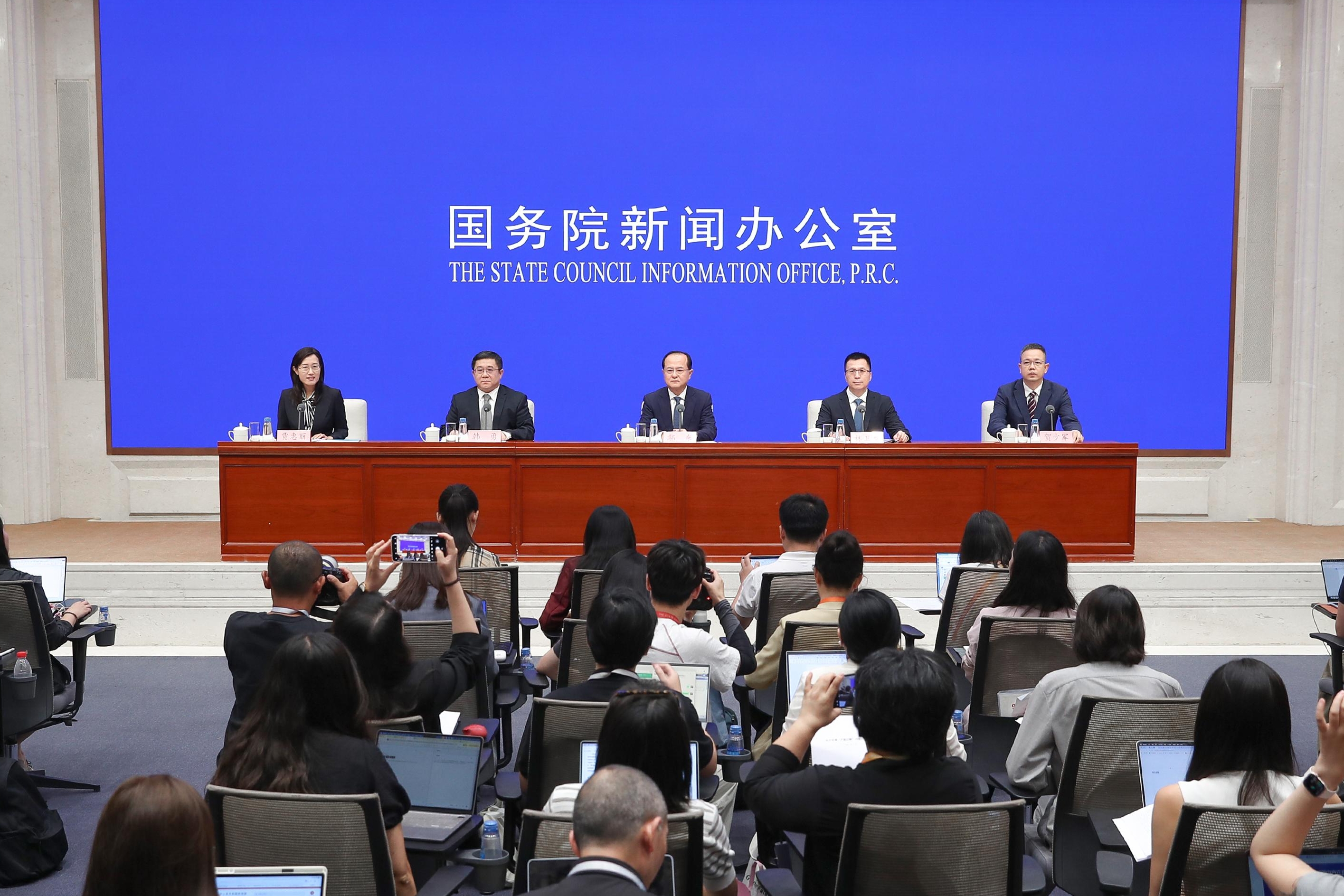
This concludes today's press conference. Thanks to our speakers and to all participating journalists. Goodbye.
Translated and edited by Xu Xiaoxuan, Zhang Yuxin, Li Xiao, You Jiaxin, Yang Xi, Wang Mengru, Wang Xingguang, Yuan Fang, Zhang Junmian, Fan Junmei, Liu Qiang, Gong Yingchun, Huang Shan, Li Huiru, David Ball, Jay Birbeck, and Tudor Finneran. In case of any discrepancy between the English and Chinese texts, the Chinese version is deemed to prevail.