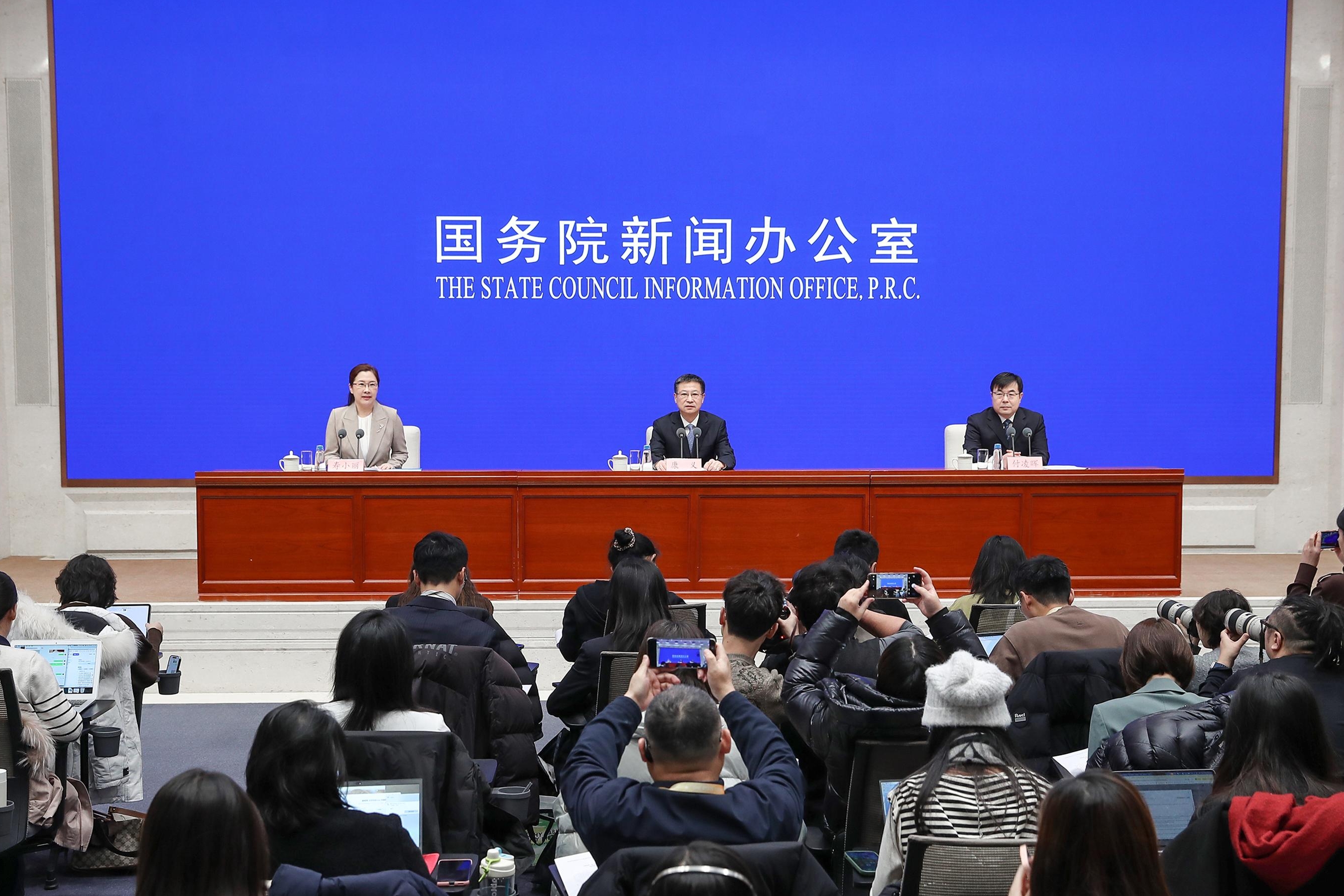
China.org.cn | January 26, 2026


CNBC:
What were the highlights of service consumption in the past year? How did the share of service consumption change relative to goods retail in overall consumption in the fourth quarter? Thank you.
Kang Yi:
Thank you for your questions. Service consumption was indeed a significant highlight of economic performance in 2025. Given the widespread interest in consumption trends, I'd like to take this opportunity to briefly introduce some relevant statistics.
In terms of consumption type, there are two main categories: goods consumption and services consumption. The corresponding key statistical indicators are total retail sales of consumer goods, which primarily reflect goods consumption, and total retail sales of services, which track services consumption. Both indicators are collected from the enterprise sales side, that is, the supply side. In addition, there are statistical indicators that reflect consumption from the demand side, such as per capita consumption expenditure. This metric is derived from household surveys on income and expenditure. I'll briefly introduce some statistical indicators related to consumption. When it comes to consumption, we need to consider it from multiple perspectives. Generally speaking, total retail sales of consumer goods are used more frequently, but service consumption is now an indicator that also deserves greater attention. This question is very important.
In terms of consumption, China continued to expand domestic demand in 2025. With the implementation of special actions to boost consumption taking effect, the consumer market steadily expanded, its structure continued to optimize, and new consumption hotspots continued to emerge.
First, the role of consumption as a cornerstone became increasingly prominent. Total retail sales of consumer goods for the whole year exceeded 50 trillion yuan, an increase of 3.7% over the previous year, 0.2 percentage point faster than in 2024, ranking among the top in global retail markets. As the reporter just mentioned, service retail sales grew by 5.5% year on year. In recent months, the growth rate has accelerated month by month. The contribution of final consumption expenditure to economic growth was 52%, more than half, and 5 percentage points higher than the previous year. Consumption was the main driving force and stabilizing anchor of economic growth.
Second, the vitality of service consumption was unleashed. As living standards improve, residents' consumption is shifting from being primarily focused on goods to emphasizing both goods and services, with the potential of service consumption being continuously unleashed. In terms of enterprise sales, service retail sales in 2025 grew 5.5% over the previous year, 1.7 percentage points faster than retail sales of consumer goods. The share of services in total retail sales rose. As the reporter mentioned, the fourth-quarter share also rose. Service retail's share of total retail increased across the board, reflecting this trend. In terms of household consumption, per capita spending on services accounted for 46.1% of per capita consumption expenditure in 2025. Consumption scenarios continued to be innovated, and consumption environments were optimized. Sectors such as culture, tourism, entertainment and sports events achieved breakthroughs across the country. In 2025, retail sales of tourism consulting and rental services, transportation services, and cultural and sports leisure services all maintained double-digit growth, and total domestic box office revenue increased by more than 20% over the previous year.
Third, new types of consumption flourished. E-commerce, livestreaming marketing, and online entertainment drove rapid growth in online consumption. In 2025, online retail sales increased 8.6% year on year, with online retail sales of physical goods up 5.2%, accounting for 26.1% of total retail sales of consumer goods. New retail models, such as unmanned stores and warehouse membership stores, maintained double-digit retail sales growth. Green consumption also grew steadily, and production and sales of new energy vehicles ranked first in the world for 11 consecutive years. Digital technologies such as AI have become deeply integrated into consumption scenarios, effectively driving the improvement and expansion of information consumption. In 2025, retail sales of communication information services grew more than 10% year on year. Meanwhile, the silver economy, the ice and snow economy, and the debut economy continued to heat up, increasingly becoming new drivers of consumption growth.
Fourth, commodity consumption continued to grow. In 2025, retail sales of goods increased 3.8% year on year, 0.6 percentage point faster than the previous year. Sales of basic necessities such as grain, oil and food grew relatively rapidly, while sales of discretionary goods such as sports and entertainment products and communication equipment showed strong momentum. The scope and scale of consumer goods trade-in programs were expanded, using tangible financial incentives to bring high-quality durable consumer goods into people's daily lives. In 2025, retail sales of cultural and office supplies by enterprises above designated size climbed 17.3% over the previous year, furniture grew 14.6%, and household appliances and audiovisual equipment rose 11%, all achieving double-digit growth.
Looking ahead to 2026, despite pressures and challenges, many positive factors still support continued consumption growth, and the consumer market is expected to grow steadily. Several conditions support this: First, consumption upgrading holds huge potential. China has a population of over 1.4 billion and a large middle-income group, making it a super-large market with global influence. Currently, residents are increasingly prioritizing quality, with growing demand for personalized, diversified and premium products, which holds enormous potential. Second, policies to boost consumption continue to take effect. This year, we will thoroughly implement the special campaign to boost consumption and formulate and implement plans to increase urban and rural residents' incomes. The trade-in policy will continue in 2026 and is being continuously optimized. The first batch of 62.5 billion yuan in ultra-long-term special treasury bonds has been allocated in advance, and the removal of unreasonable restrictions in the consumption sector is being gradually advanced. These policies will support consumption growth. Third, the consumption environment is improving. The construction of a unified national market is helping to continuously optimize the consumption environment. Meanwhile, the application of new technologies and innovations will increase the supply of high-quality consumption. Immersive and experiential consumption scenarios are also being cultivated. Consumer rights protections are being continuously strengthened. All of these factors will help unleash greater consumption potential.
Thank you.