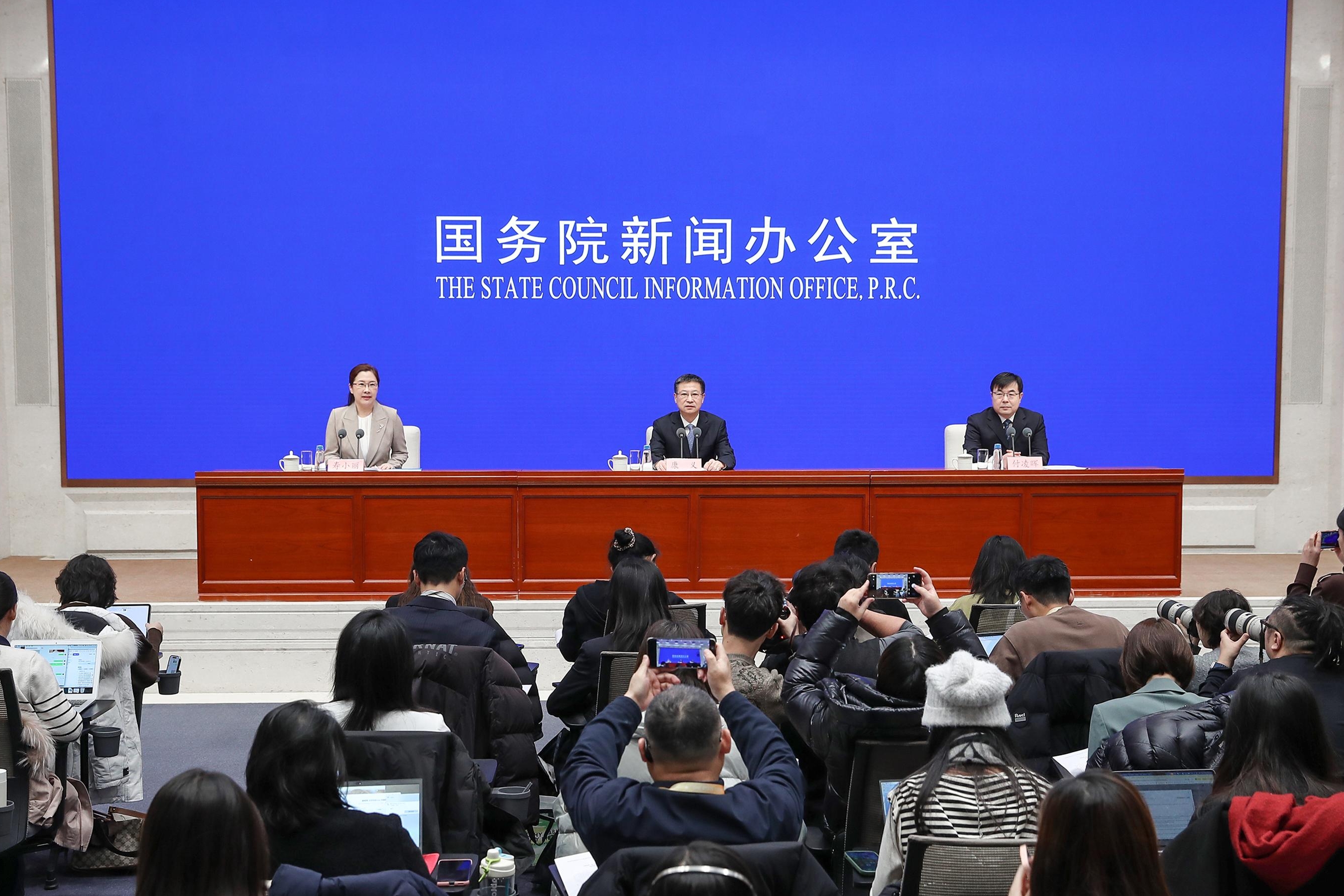
China.org.cn | January 26, 2026


Shou Xiaoli:
Let's continue with the questions. We have many journalists waiting, but due to time constraints, we'll take the last two questions.
Zhonghongwang.com:
The 14th Five-Year Plan period was a crucial stage for China's transition toward high-quality development. What new progress and achievements have been made in economic and social development during this period? In addition, what is the outlook for the 15th Five-Year Plan period? Thank you.
Kang Yi:
Thank you for your questions. The 14th Five-Year Plan period has indeed been a truly remarkable and extraordinary part of China's development journey. We faced challenges head-on and forged ahead with determination, effectively responding to a series of major risks and challenges. We achieved new and significant accomplishments in economic and social development. Specifically, this was reflected in the following areas:
First, economic development achieved a new leap forward. During the 14th Five-Year Plan period, China's economy grew at an average annual rate of 5.4%, outperforming the world average. It continued to lead among the world's major economies and served as a major driver of global economic growth. As previously mentioned, total economic output crossed four thresholds, exceeding 140 trillion yuan. Converted at the average annual exchange rate, China's per capita GDP increased from $10,632 in 2020 to $13,953 in 2025, exceeding $13,000 for three consecutive years.
Second, innovative development achieved new breakthroughs. During the 14th Five-Year Plan period, R&D investment grew at an average annual rate of 10%, and the proportion of basic research expenditure reached 7.08% in 2025, a record high. China has topped the global rankings for three consecutive years in the number of top 100 sci-tech innovation clusters. The NBS also publishes an innovation index. In 2024, China's innovation index increased 25.5% compared to 2020, with the innovation environment and innovation output indices both rising 33.8%. Value added of the new industries, new formats, and new business models accounted for 18% of GDP, and value added of patent-intensive industries accounted for 13.38% of GDP. New-generation information technologies such as AI flourished, and the integration of digital technologies and the real economy continued to deepen. The proportion of computer, communication and other electronic input during production increased by about 1 percentage point, significantly higher than during the 13th Five-Year Plan period. In 2024, the value added of China's digital economy rose to 33.1% of GDP, with the core industries of the digital economy accounting for 10.5%.
Third, new strides were made in reform and opening up. During the 14th Five-Year Plan period, the construction of a unified national market was advanced, the business environment was continuously optimized, and the negative list for market access was reduced to 106 items. The third plenary session of the 20th CPC Central Committee rolled out more than 300 reform measures, and the fourth plenary session of the 20th CPC Central Committee also made arrangements for further deepening comprehensive reforms, pushing reform forward in both breadth and depth. China continued to expand high-standard opening up, with deeper and more substantive advances in Belt and Road cooperation and the accelerated construction of free trade zones. All restrictions on foreign investment access in the manufacturing sector were fully lifted, and the new Catalogue of Encouraged Industries for Foreign Investment was released, continuously enhancing the substance of institutional opening up. From 2021 to 2025, China's total goods import and export volume grew at an average annual rate of over 7%, with the share of imports and exports with Belt and Road countries rising to 51.9%.
Fourth, new progress was achieved in the green transition. During the 14th Five-Year Plan period, China built the world's largest and fastest-growing renewable energy system, with the share of non-fossil energy consumption increasing from 16% in 2020 to over 20% in 2025. Energy consumption per unit of GDP continued to decline, making China one of the countries with the fastest decline in energy intensity globally. The world's largest and most complete new energy industrial chain was established, with the output of green products such as solar cells and wind turbines growing at an average annual rate of 39.6% and 31.3%, respectively. Forest coverage exceeded 25%, making China the global leader in afforestation by both area and growth rate.
Fifth, new improvements were made in people's livelihoods. During the 14th Five-Year Plan period, the number of newly added urban jobs held steady at over 12 million per year, and the overall employment situation remained stable. Nationwide per capita disposable income grew at an average annual real rate of 5.4%, in line with economic growth. The achievements in poverty alleviation were consolidated and expanded, and the per capita disposable income of rural residents in counties lifted out of poverty continued to grow rapidly. The world’s largest education, health care and social security systems continued to strengthen, and education availability at all levels reached or exceeded the average of middle- and high-income countries. In 2025, the working-age population (aged 16-59) had an average of 11.3 years of education. Social programs in culture, tourism and sports have flourished, further enriching people's spiritual and cultural lives. In 2024, the value added of cultural and related industries accounted for 4.61% of GDP, while tourism and related industries accounted for 4.35%.
Sixth, new progress was made in safeguarding security. During the 14th Five-Year Plan period, the country's comprehensive grain production capacity steadily improved. China's total grain output increased from 1.37 trillion jin in 2021 to 1.43 trillion jin in 2025, ensuring that the country's food security remained firmly in its own hands. China established a diversified energy supply system, with total primary energy production growing at an average of 5% annually. The resilience and security of industrial and supply chains steadily improved. Manufacturing value added grew at an average annual rate of 5.5%. The domestic production rate of equipment manufacturing continued to rise, and domestically produced electrical machinery and transportation equipment each accounted for more than 95% of the total supply.
"What seems ordinary is often the most extraordinary, and what appears easy is actually incredibly difficult." During the 14th Five-Year Plan period, China achieved significant development achievements. These achievements came amid a complex international situation, the growing pains of economic restructuring, industrial upgrading and transformation of growth drivers, as well as various risks and challenges. They were hard-won. These achievements are fundamentally attributable to the leadership of the CPC Central Committee with Comrade Xi Jinping at its core, and to the sound guidance of Xi Jinping Thought on Socialism with Chinese Characteristics for a New Era. During the 15th Five-Year Plan period, China's development environment will face profound and complex changes, but the fundamental trend of the country's long-term economic growth will remain unchanged. The advantages of its system, market, industrial system and human resources have become more prominent, innovation-driven momentum has strengthened, and reform and opening-up have advanced further. These will support China in achieving new results in high-quality development. As long as we maintain strategic resolve, actively recognize, adapt to and embrace changes, and focus on doing our own work well, we will surely continue to create a new chapter for Chinese modernization.
Thank you.