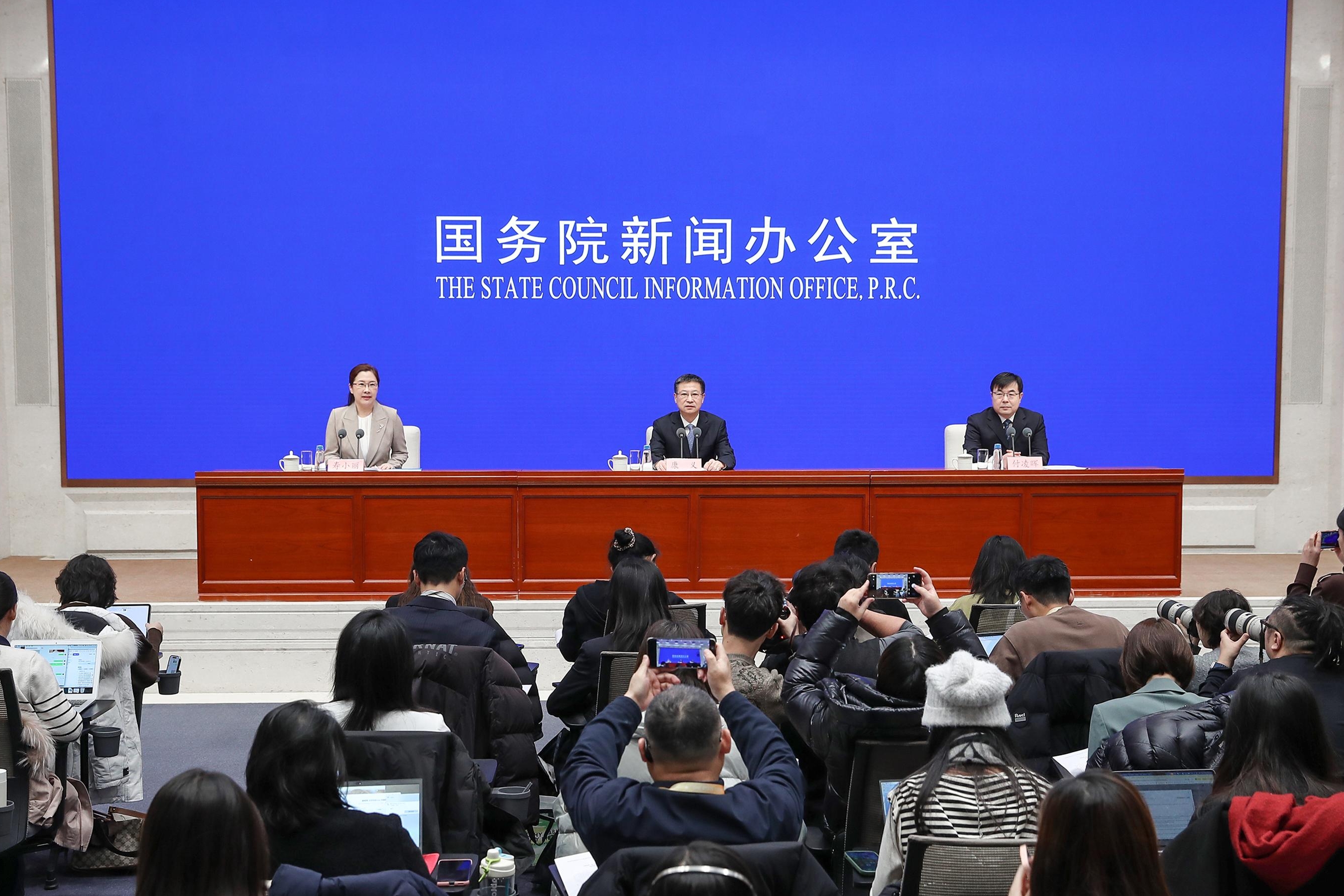
China.org.cn | January 26, 2026


Shou Xiaoli:
The last question, please.
National Business Daily:
In 2025, China implemented a series of more proactive and effective macroeconomic policies, including support for major national strategies, security capacity building in key areas, and consumer goods trade-in programs. How effective were these macroeconomic policies? What role did they play in promoting steady and healthy economic development? Thank you.
Kang Yi:
Thank you for your questions. In 2025, all regions and departments accelerated the implementation of more proactive and effective macroeconomic policies, effectively implemented existing policies, and vigorously introduced new ones. They made every effort to stabilize employment, enterprise operations, markets and expectations. These efforts effectively ensured stable and positive economic performance and provided solid support for achieving the year's main economic and social development goals and tasks. The achievements were reflected in the following areas:
First, stable economic operations were promoted. In 2025, China strengthened and improved macroeconomic regulation, introduced measures to stabilize employment, stabilize the economy and promote high-quality development, and made coordinated use of ultra-long-term special treasury bonds, local government special bonds and central budget investment. It intensified efforts to expand large-scale equipment upgrades and consumer goods trade-in programs, increased support for major national strategies and security capacity building in key areas, and leveraged the role of new policy-based financial instruments, effectively offsetting the downward pressure on the economy and ensuring the smooth achievement of the annual targets. Retail sales of six categories of goods related to trade-in programs increased 4.1% year on year, 2 percentage points faster than the previous year, contributing 0.6 percentage point to total retail sales growth. Investment in equipment and tools rose 11.8%, contributing 1.8 percentage points to investment growth.
Second, structural optimization and upgrading were promoted. While promoting stable economic growth, macroeconomic policies placed greater emphasis on fostering high-quality development. In 2025, nine government departments rolled out a package of measures to augment service consumption to further boost service consumption and unleash its potential. In 2025, service retail sales increased 5.5% year on year. Since September, cumulative service retail sales growth has rebounded for four consecutive months. Trade-in programs for consumer goods have driven more high-quality durable consumer goods into people's lives, with high-efficiency home appliances and smart home products proving popular among consumers. In the digital product replacement market, mid-to-high-end models accounted for a large share. By the end of 2025, the number of private cars owned per 100 households in the country reached 52.9, an increase of 1.7 from the previous year. Large-scale equipment upgrade policies accelerated the pace of industrial upgrading and drove rapid output growth in related industries. In 2025, the value added of equipment manufacturing enterprises above designated size increased 9.2% year on year, 1.5 percentage points faster than the previous year, and its share of the total rose to 36.8%.
Third, new development momentum was cultivated. Technological innovation and industrial innovation became deeply integrated, with intensified efforts in the "AI Plus" initiative. The pace of industrial innovation and the application of its achievements has accelerated, and emerging and future industries have been cultivated and strengthened, injecting vital momentum into stable economic growth. In 2025, the value added of intelligent unmanned aerial vehicle manufacturing and intelligent vehicle-mounted equipment manufacturing enterprises above designated size increased 57% and 26.2%, respectively. Meanwhile, the value added of integrated circuit manufacturing and optoelectronic device manufacturing enterprises increased 26.7% and 18.8%, respectively. More and more Chinese companies made their presence felt in emerging fields such as large AI models, quantum technology and embodied intelligence.
Fourth, economic circulation improved. The continued advancement of a unified national market and the optimization of market competition provided favorable conditions for a reasonable recovery in prices and improved corporate profits. In December, core CPI rose 1.2% year on year, the year-on-year decline in the producer price index narrowed, and the manufacturing PMI rose to 50.1%. In the first 11 months, profits of manufacturing enterprises above designated size increased 5.0%, compared with a decline of 4.6% in the same period last year.
Thank you.
Shou Xiaoli:
Thank you to all the speakers and journalists. That concludes today's press conference. Goodbye, everyone.
Translated and edited by Chen Xinyan, Liu Jianing, Liao Jiaxin, Yang Chuanli, Wang Mengru, Yan Xiaoqing, Xu Kailin, Yang Xi, Fan Junmei, Wang Yiming, Li Huiru, David Ball, Jay Birbeck, and Tudor Finneran. In case of any discrepancy between the English and Chinese texts, the Chinese version is deemed to prevail.