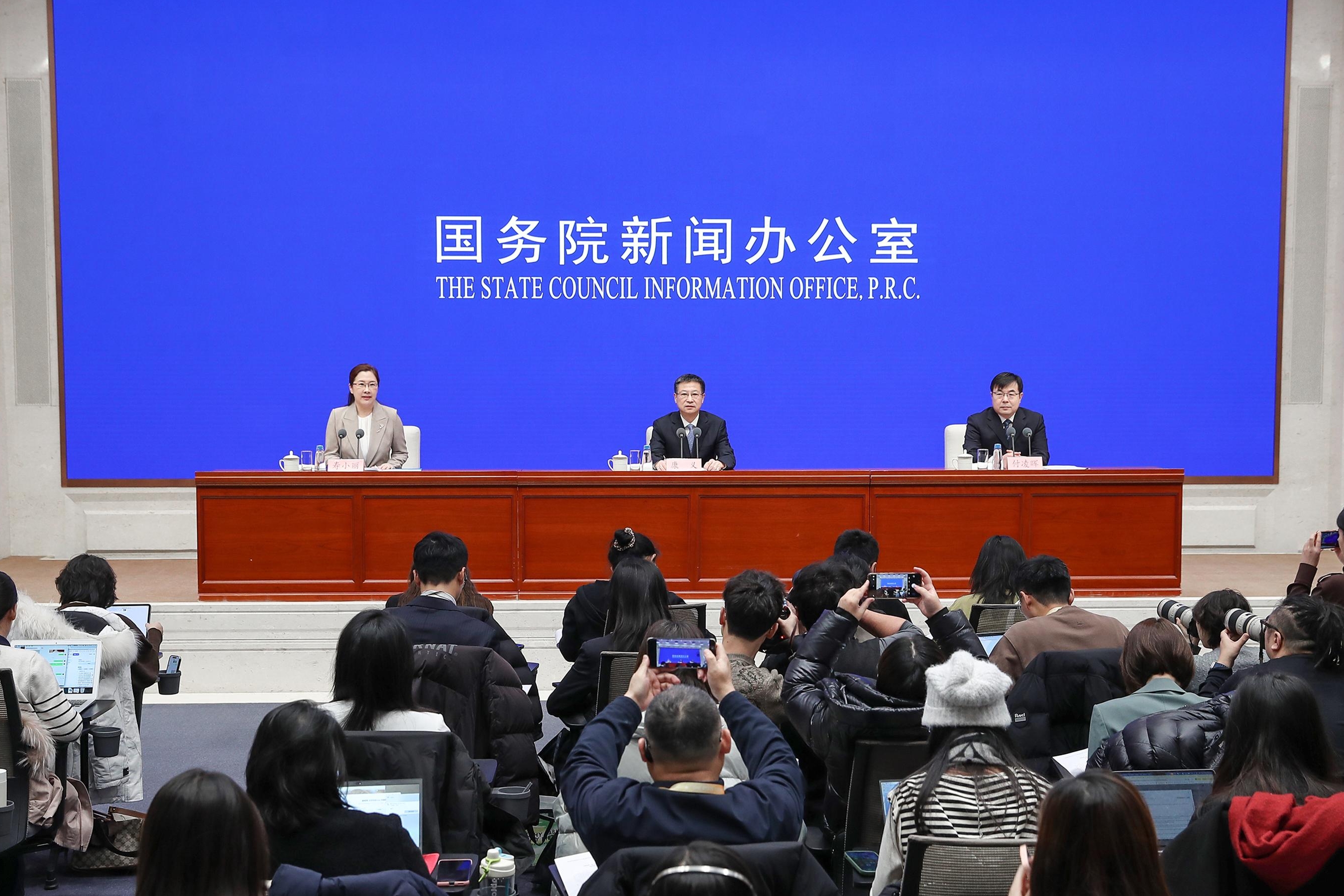
China.org.cn | January 26, 2026


Speakers:
Mr. Kang Yi, commissioner of the National Bureau of Statistics (NBS)
Mr. Fu Linghui, spokesperson and chief economist of the NBS and director general of the Department of Comprehensive Statistics of the NBS
Chairperson:
Ms. Shou Xiaoli, director general of the Press Bureau of the State Council Information Office (SCIO) and spokesperson of the SCIO
Date:
Jan. 19, 2026
Shou Xiaoli:
Ladies and gentlemen, good morning. Welcome to this press conference held by the State Council Information Office (SCIO). This is a regular briefing on economic data. Today, we have invited Mr. Kang Yi, commissioner of the National Bureau of Statistics (NBS), and Mr. Fu Linghui, spokesperson of the NBS and director general of the Department of Comprehensive Statistics of the NBS, to brief you on China's economic performance in 2025 and answer your questions.
Now, I'll give the floor to Mr. Kang for his introduction.
Kang Yi:
Good morning, everyone. I am very pleased to be part of this SCIO briefing, and I would like to thank all friends from the media for your ongoing support of our work. Today marks the annual release of economic data, and there is significant interest in China's economic and social development over the past year. First, I will present the relevant data on China's economic performance in 2025, and then take your questions.
China's economy moved toward new growth drivers and higher-quality development in 2025, successfully achieving the expected goals.
In 2025, facing complex changes in the economic environment at home and abroad, all regions and departments, under the strong leadership of the Central Committee of the Communist Party of China (CPC) with Comrade Xi Jinping at its core, thoroughly implemented the decisions and plans of the CPC Central Committee and the State Council. We resolutely embraced the new development philosophy, promoted high-quality development, coordinated the domestic and international situations, and balanced development and security. Proactive and effective macro policies were enacted, and the construction of a unified national market was deepened. China's economy continued to embrace innovation and excellence despite challenges, achieving new outcomes in high-quality development. The main goals and tasks of economic and social development were achieved, and the 14th Five-Year Plan was successfully concluded.
According to preliminary estimates, the gross domestic product (GDP) was 140.1879 trillion yuan in 2025, an increase of 5.0% over the previous year at constant prices. By industries, the value added of the primary industry was 9.3347 trillion yuan, up by 3.9% over last year, that of the secondary industry was 49.9653 trillion yuan, up by 4.5%, and that of the tertiary industry was 80.8879 trillion yuan, up by 5.4%. By quarters, GDP increased by 5.4% year on year in the first quarter, 5.2% in the second quarter, 4.8% in the third quarter and 4.5% in the fourth quarter. GDP in the fourth quarter increased by 1.2% quarter on quarter.
First, grain output increased and production of animal husbandry grew steadily.
The total output of grain in 2025 was 714.88 million metric tons, an increase of 8.38 million metric tons over the previous year, or up by 1.2%. Of this total, the output of summer grain was 149.75 million metric tons, down by 0.1%, and that of early rice was 28.51 million metric tons, up by 1.2%. The output of autumn grain reached 536.62 million metric tons, up by 1.5%. By crop type, the output of wheat was 140.07 million metric tons, remaining basically unchanged; that of corn was 301.24 million metric tons, up by 2.1%; that of rice was 209.04 million metric tons, up by 0.7%; and that of soybeans was 20.91 million metric tons, up by 1.3%. The total output of pork, beef, mutton and poultry reached 100.72 million metric tons, up by 4.2% over the previous year, and marking the first time it has exceeded 100 million metric tons. Of this total, the output of pork was 59.38 million metric tons, up by 4.1%; beef, 8.01 million metric tons, up by 2.8%; mutton, 4.96 million metric tons, down by 4.2%; and poultry, 28.37 million metric tons, up by 6.7%. Milk production reached 40.91 million metric tons, up by 0.3% and that of eggs reached 34.98 million metric tons, down by 2.5%. A total of 719.73 million pigs were slaughtered throughout the year, up by 2.4%, and 429.67 million pigs were registered in stock at the end of the year, up by 0.5%.
Second, industrial production grew fast, with equipment manufacturing and high-tech manufacturing showing good growth momentum.
In 2025, the total value added of industrial enterprises above designated size increased by 5.9% year on year. In terms of sectors, the value added of mining was up by 5.6%, that of manufacturing was up by 6.4%, and that of production and supply of electricity, thermal power, gas and water was up by 2.3%. The value added of equipment manufacturing went up by 9.2%, and that of high-tech manufacturing up by 9.4%, which were 3.3 percentage points and 3.5 percentage points faster than that of industrial enterprises above designated size, respectively. In terms of ownership, the value added of state holding enterprises grew by 4.6%, that of share-holding enterprises was up by 6.3%, that of enterprises funded by foreign investors and investors from Hong Kong, Macao and Taiwan increased by 3.9%, and that of private enterprises was up by 5.3%. In terms of products, the outputs of 3D printing devices, industrial robots and new energy vehicles (NEVs) grew by 52.5%, 28.0% and 25.1% year on year, respectively. In December, the total value added of industrial enterprises above designated size grew by 5.2% year on year, or up by 0.49% month on month. In December, the Manufacturing Purchasing Managers’ Index stood at 50.1%, 0.9 percentage point higher than that of November; and the Production and Operation Expectation Index was 55.5%, up by 2.4 percentage points. In the first 11 months, the total profits made by industrial enterprises above designated size were 6.6269 trillion yuan, up by 0.1% year on year.
Third, the service sector grew steadily, and the modern service industry developed well.
The value added of the service sector went up by 5.4% over the previous year. Specifically, the value added of information transmission, software and information technology services grew by 11.1%, leasing and business services increased by 10.3%, transportation, warehousing and postal services grew by 5.2%, wholesale and retail trade increased by 5.0%, and accommodation and catering services grew by 4.9%. In December, the Index of Services Production grew by 5.0% year on year. Specifically, the Index of Services Production of information transmission, software and information technology services went up by 14.8%, leasing and business services went up by 11.3%, and financial intermediation went up by 6.5%. In the first 11 months, the business revenue of service enterprises above designated size grew by 7.8% year on year. In December, the Business Activity Index for Services was 49.7%, up by 0.2 percentage point compared with November; and the Business Activity Expectation Index for Services stood at 56.4%, up by 0.5 percentage point. Specifically, the Business Activity Index for sectors like telecommunication, broadcast, television and satellite transmission services, monetary and financial services, and capital market services stayed within the high expansion range of 60.0% and above.
Fourth, market sales expanded, and growth of service retail accelerated.
In 2025, the total retail sales of consumer goods reached 50.1202 trillion yuan, up by 3.7% over the previous year. Analyzed by different areas, retail sales in urban areas reached 43.2972 trillion yuan, up by 3.6%; and that in rural areas stood at 6.8230 trillion yuan, up by 4.1%. Grouped by consumption patterns, the retail sales of goods were 44.3220 trillion yuan, up by 3.8%; and the income of catering was 5.7982 trillion yuan, up by 3.2%. Sales of basic necessities and some upgraded goods showed good growth. Over the entire year, the retail sales of communication equipment, cultural and office supplies, sports and entertainment products, household appliances and audio-visual equipment, and grain, oil and food products by enterprises above the designated size increased by 20.9%, 17.3%, 15.7%, 11.0% and 9.3%, respectively. China's online retail sales reached 15.9722 trillion yuan, up by 8.6% over the previous year. Specifically, the online retail sales of physical goods were 13.0923 trillion yuan, up by 5.2%, accounting for 26.1% of the total. In December, the total retail sales of consumer goods rose 0.9% year on year, but fell 0.12% month on month. The retail sales of services in 2025 grew by 5.5% over the previous year. Specifically, the retail sales of cultural, sports and leisure services, communication information services, tourism consultation and rental services, and transportation services grew relatively quickly.
Fifth, investment in fixed assets declined year on year, while investment in the manufacturing sector maintained growth.
In 2025, investment in fixed assets (excluding rural households) reached 48.5186 trillion yuan, down by 3.8% over the previous year; and with real estate development investment deducted, the investment in fixed assets was down by 0.5%. Specifically, the investment in infrastructure declined by 2.2%; that in manufacturing grew by 0.6%; and that in real estate development fell by 17.2%. The floor space of newly-built commercial buildings sold was 881.01 million square meters, down by 8.7%; and the total sales of newly-built commercial buildings was 8.3937 trillion yuan, down by 12.6%. By industry, investment in the primary industry went up by 2.3%; that in the secondary industry went up by 2.5%; and that in the tertiary industry went down by 7.4%. The private investment went down by 6.4%. Deducting the investment in real estate development, the private investment decreased by 1.9%. In the high-tech industry, investment in the information service industry and the aviation, spacecraft and equipment manufacturing industry increased by 28.4% and 16.9%, respectively. In December, fixed-asset investment (excluding rural households) decreased by 1.13% month on month.
Sixth, imports and exports of goods grew steadily, and the trade structure continued to optimize.
In 2025, the total value of imports and exports of goods was 45.4687 trillion yuan, an increase of 3.8% over the previous year. The value of exports was 26.9892 trillion yuan, up by 6.1%, and the value of imports was 18.4795 trillion yuan, up by 0.5%. The imports and exports by private enterprises grew by 7.1%, accounting for 57.3% of the total value of imports and exports, 1.8 percentage points higher than that of the previous year. The imports and exports with Belt and Road partner countries grew by 6.3%, accounting for 51.9% of total imports and exports. Exports of high-tech products increased by 13.2%. In December, the total value of imports and exports of goods was 4.263 trillion yuan, up by 4.9% year on year. Specifically, the total value of exports was 2.5359 trillion yuan, up by 5.2%; and the total value of imports was 1.7271 trillion yuan, up by 4.4%.
Seventh, consumer prices were generally stable, and the core consumer price index (CPI) registered a moderate rebound.
In 2025, the Consumer Price Index (CPI) remained unchanged from the previous year. Grouped by commodity categories, prices for food, tobacco and alcohol went down by 0.7%; clothing up by 1.5%; housing up by 0.1%; articles and services for daily use up by 0.9%; transportation and communication down by 2.6%; education, culture and recreation up by 0.8%; medical services and health care up by 0.8%; and other articles and services up by 9.3%. In terms of prices for food, tobacco and alcohol, prices of pork went down by 6.1%, fresh vegetables down by 3.9%, grain down by 1.0%, and fresh fruits up by 1.2%. The core CPI, excluding the prices of food and energy, grew 0.7% year on year, 0.2 percentage point higher than that of last year. In December, the consumer price index was 0.8% higher year on year, with the growth rate widening by 0.1 percentage point from the previous month, or up 0.2% month on month. In 2025, the producer prices for industrial products went down by 2.6% over the previous year; in December, it went down by 1.9% year on year, or up by 0.2% month on month. In 2025, the purchasing prices for industrial producers went down by 3.0% over that of the previous year; in December, it went down by 2.1% year on year, or up by 0.4% month on month.
Eighth, employment was generally stable and the urban surveyed unemployment rate was steady.
In 2025, the urban surveyed unemployment rate averaged 5.2%. In December, the urban surveyed unemployment rate was 5.1%. The surveyed unemployment rate of population with local household registration was 5.3% and that of population with non-local household registration was 4.7%, of which, the rate of the population with non-local agricultural household registration was 4.4%. The urban surveyed unemployment rate in 31 major cities was 5.1%. Employees of enterprises worked 48.6 hours per week on average. In 2025, the number of rural migrant workers totaled 301.15 million, 1.42 million more than that of the previous year, or up by 0.5%. Specifically, local migrant workers totaled 121.09 million, up by 0.1%; and outbound migrant workers totaled 180.06 million, up by 0.8%.
Ninth, residents' income continued to increase and the incomes of rural residents grew faster than that of urban residents.
In 2025, the nationwide per capita disposable income of residents was 43,377 yuan, a nominal increase of 5.0% over that of the previous year, or a real growth of 5.0% after adjusting for price factors. In terms of permanent residence, the per capita disposable income of urban residents was 56,502 yuan, a nominal growth of 4.3% over the previous year or a real growth of 4.2% after adjusting for price factors. The per capita disposable income of rural households was 24,456 yuan, a nominal growth of 5.8% over the previous year or a real growth of 6.0% after adjusting for price factors. The median of the nationwide per capita disposable income nationwide was 36,231 yuan, a nominal increase of 4.4% over the previous year. Grouped by income quintile, the per capita disposable income of the low-income group reached 10,150 yuan, the lower-middle-income group 22,702 yuan, the middle-income group 35,536 yuan, the upper-middle-income group 55,586 yuan, and the high-income group 103,778 yuan. In 2025, the nationwide per capita consumption expenditure was 29,476 yuan, a nominal growth of 4.4% over the previous year or a real growth of 4.4% after adjusting for price factors. The per capita consumption expenditure on food, tobacco and alcohol accounted for 29.3% of the per capita consumption expenditure (Engel's coefficient), 0.5 percentage point lower than that of the previous year. The per capita consumption expenditure on services went up by 4.5%, accounting for 46.1% of the per capita consumption expenditure, the same with that of the previous year.
Tenth, total population declined and the urbanization rate continued to rise.
By the end of 2025, the national population was 1.40489 billion (including the population of 31 provinces, autonomous regions and municipalities directly under the central government and servicemen, but excluding residents of Hong Kong, Macao and Taiwan and foreigners living in the 31 provinces, autonomous regions and municipalities directly under the central government), a decrease of 3.39 million over the end of 2024. In 2025, the number of births was 7.92 million with a birth rate of 5.63 per thousand; the number of deaths was 11.31 million with a mortality rate of 8.04 per thousand; the natural population growth rate was minus 2.41 per thousand. In terms of gender, the male population was 716.85 million, and the female population was 688.04 million; and the sex ratio of the total population was 104.19 males to every 100 females. In terms of age structure, the population aged 16 to 59 was 851.36 million, accounting for 60.6% of the total population; and the population aged 60 and over was 323.38 million, accounting for 23.0% of the total population. Specifically, the population aged 65 and over was 223.65 million, accounting for 15.9% of the total population. In terms of urban-rural structure, the number of permanent residents in urban areas was 953.80 million, an increase of 10.30 million over the end of the previous year; and the number of permanent residents in rural areas was 451.09 million, a decrease of 13.69 million. The share of urban population in the total population (urbanization rate) was 67.89%, 0.89 percentage point higher than that at the end of the previous year. In terms of education level, the average years of schooling for the population aged 16-59 reached 11.3 years, an increase of 0.1 years from the previous year.
Overall, in 2025, the national economy withstood multiple pressures and maintained a steady growth with positive momentum, achieving new results in high-quality development. However, we must be aware that the impact of changes in the external environment has intensified, structural imbalances marked by strong supply and weak demand remain pronounced at home, and both long-standing issues and new challenges in economic development persist. In the next stage, we must take Xi Jinping Thought on Socialism with Chinese Characteristics for a New Eraas the guideline, fully implement the guiding principles of the 20th CPC National Congress, and plenary sessions of the 20th CPC Central Committee, and adhere to the arrangements made by the Central Economic Work Conference. We should adhere to the principle of seeking progress while maintaining stability and improving quality and efficiency, implement more proactive and effective macro policies, continuously expand domestic demand and improve the supply, optimize allocation of new resources and revitalize existing assets, develop new productive forces in accordance with local conditions, and further promote the construction of a unified national market. This will promote the effective improvement of both the quality and reasonable growth of the economy and ensure a good start to the 15th Five-Year Plan.
That concludes my introduction.
Shou Xiaoli:
Thank you, Mr. Kang, for your introduction. Now, the floor is open for questions. Please identify the media outlet you represent before asking your question.