China.org.cn | November 2, 2026


Jiefang Daily, Shanghai Observer:
The 15th Five-Year Plan calls for tapping distinctive resources and cultural connotations and actively promoting the integrated development of multiple business formats. Renowned traditional industries clearly cut across sectors. How will you break down industry boundaries and promote their diversified and integrated development? Thank you.
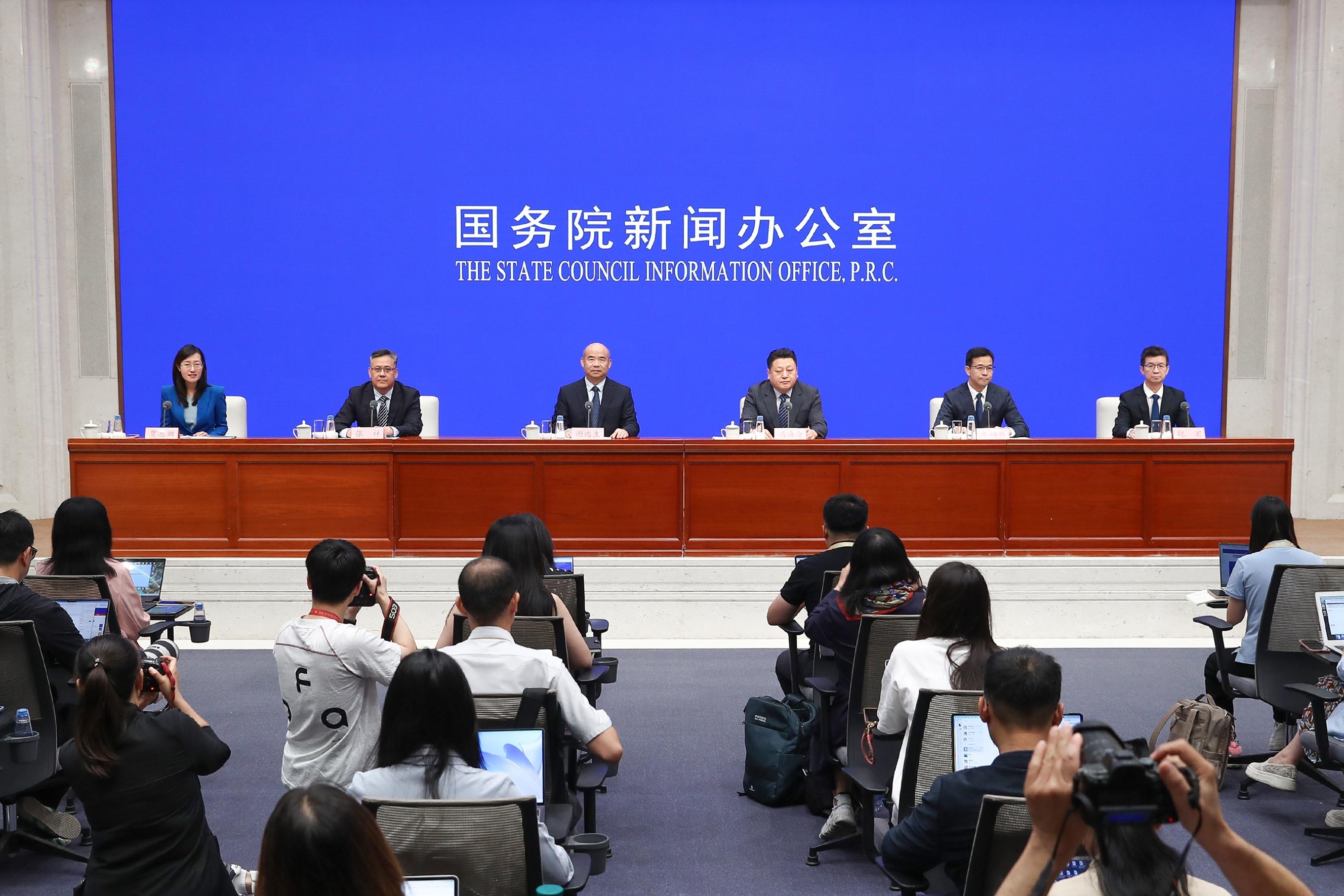
Feng Haicang:
Thank you for your question. Indeed, renowned traditional industries carry the imprint of Chinese civilization and are a concrete manifestation of the Chinese nation's way of life. Cross-sector integration is in their nature, and it is both necessary and inevitable. In practice, we have observed that in recent years, renowned traditional industries have integrated more deeply with culture and tourism, healthcare, education, rural revitalization and other fields. This has given rise to new business formats such as TCM healthcare services and new Chinese-style tea drinks, which have become increasingly popular and are widely recognized in the market. Looking ahead, we will strengthen interdepartmental collaboration in four areas to open up new possibilities for renowned traditional industries.
Regarding the integration of renowned traditional industries with culture and tourism, Mr. Shan from the MCT has already given an in-depth response, so I will not repeat it here.
In terms of the synergy between renowned traditional industries and healthcare, we will explore the value of TCM, tea and silk for health, as well as support time-honored enterprises in working with medical institutions and healthcare centers to develop innovative products such as wellness teas, TCM bath packs and silk products, helping to expand a trillion-yuan consumer market.
In terms of innovation in integrating renowned traditional industries with education, we will support study and practice activities related to these industries and encourage primary and secondary school students to visit the studios and workshops of ICH inheritors, arts and crafts masters, and famous rural craftsmen. We will regularly organize exhibitions of the work they produce, so that young people gain a sense of accomplishment and a stronger cultural identity through hands-on practice.
In terms of mutual promotion between renowned traditional industries and rural revitalization, our thinking is that these industries originated in agricultural civilization and remain rooted in the countryside. Tea is grown in the hills, silkworms are raised in the fields, medicinal herbs are planted in the mountains and forests, and traditional crafts are passed down in rural areas, but the products are used and traded mainly in urban areas. Based on these characteristics, we will work with relevant departments to explore and promote a model involving village collectives, family workshops and leading enterprises from renowned traditional industries. We will encourage leading enterprises to establish stable interest-sharing mechanisms with tea, medicinal herb and silkworm farmers through order-based procurement, guaranteed dividends and shareholding cooperation, so that farmers share in the value added along the industrial chain. Taking the TCM industry as an example, herbs such as manyprickle acanthopanax from Jixi, Heilongjiang province and notoginseng root from Wenshan, Yunnan province are now processed locally, which extends the chain into secondary and tertiary industry and lifts quality and efficiency throughout. Local people can raise their incomes close to home. Thank you.
Jia Huili:
This concludes today's press conference. Thanks to our speakers and to all participating journalists. Goodbye.
Translated and edited by Liu Sitong, Zhang Tingting, Xiang Bin, You Jiaxin, Li Xiao, Zhang Jiaqi, Xu Kailin, Jay Ian Birbeck, David Ball, Ma Yujia, Wang Yanfang, Zhou Jing, Zhang Junmian, Li Huiru, Yuan Fang, He Shan, and Guo Xiaohong. In case of any discrepancy between the English and Chinese texts, the Chinese version is deemed to prevail.