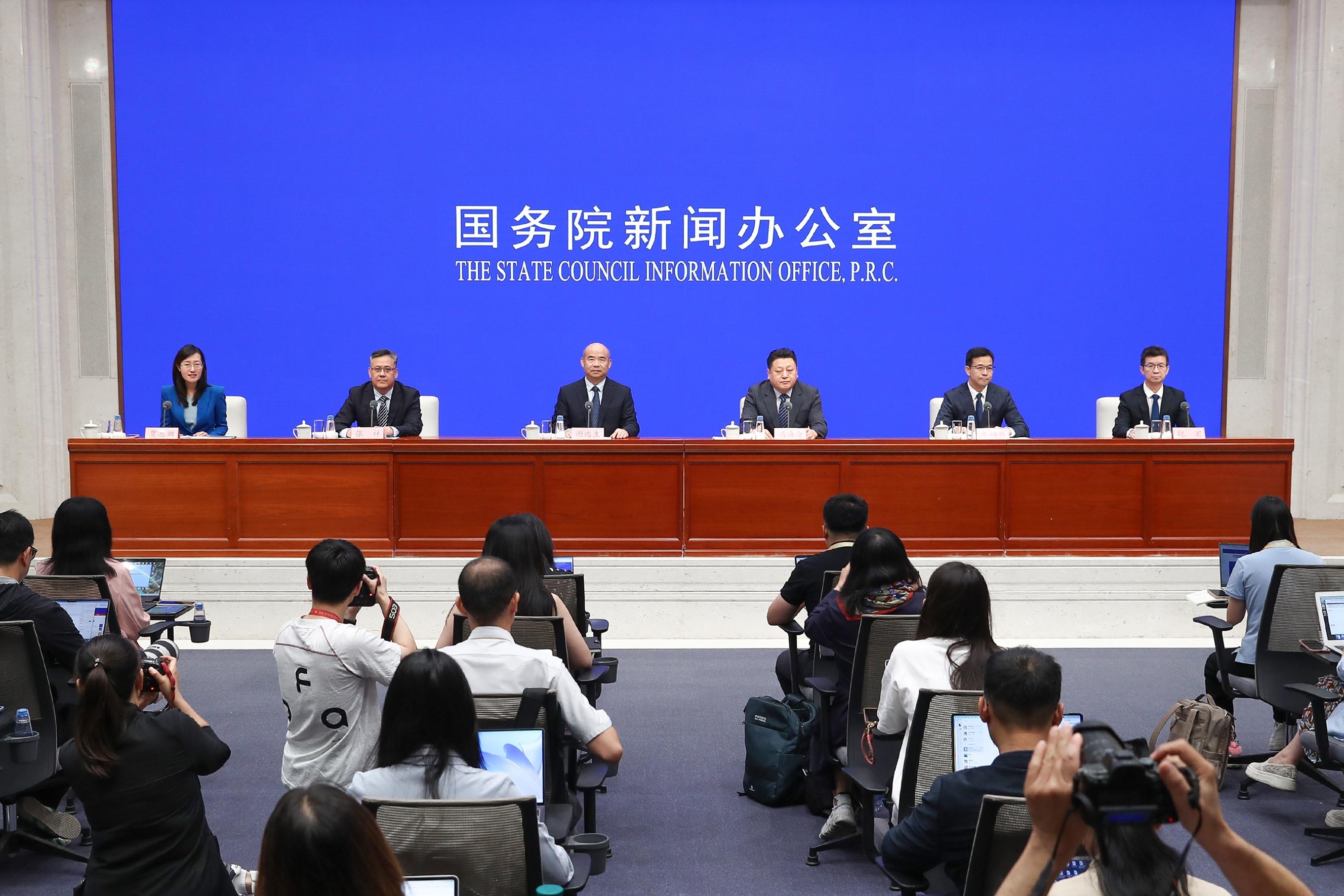
China.org.cn | November 2, 2026


Speakers:
Mr. Xie Yuansheng, vice minister of industry and information technology
Mr. Feng Haicang, first-level inspector of the Department of Consumer Products Industry of the Ministry of Industry and Information Technology (MIIT)
Mr. Zhang Xiang, first-level inspector of the Department of Circulation Industry Development of the Ministry of Commerce (MOFCOM)
Mr. Shan Gangxin, director general of the Department of Intangible Cultural Heritage of the Ministry of Culture and Tourism (MCT)
Mr. Wei Hong, director general of the Department of Standards Innovative Management of the State Administration for Market Regulation (SAMR)
Chairperson:
Ms. Jia Huili, deputy director general of the Press Bureau of the State Council Information Office (SCIO) and spokesperson of the SCIO
Date:
Sept. 7, 2026
Jia Huili:
Ladies and gentlemen, good morning. Welcome to this press conference held by the State Council Information Office (SCIO). The "Guidelines on Promoting the High-Quality Development of Renowned Traditional Industries" has now been officially released. Today, we have invited Mr. Xie Yuansheng, vice minister of industry and information technology, to introduce the relevant situation and answer your questions. Also present at today's press conference are Mr. Feng Haicang, first-level inspector of the Department of Consumer Products Industry of the Ministry of Industry and Information Technology (MIIT); Mr. Zhang Xiang, first-level inspector of the Department of Circulation Industry Development of the Ministry of Commerce (MOFCOM); Mr. Shan Gangxin, director general of the Department of Intangible Cultural Heritage of the Ministry of Culture and Tourism (MCT); and Mr. Wei Hong, director general of the Department of Standards Innovative Management of the State Administration for Market Regulation (SAMR).
Now, I'll give the floor to Mr. Xie for his introduction.
Xie Yuansheng:
Friends from the media, good morning. Thank you very much for your interest in and support for our work.
Renowned traditional industries refer to traditional Chinese industries with distinctive characteristics and profound cultural heritage, such as silk, tea, porcelain, traditional Chinese medicine (TCM), brewing, arts and crafts, and the Four Treasures of the Study (brush, ink, paper, and inkstone). They are the intellectual crystallization of Chinese civilization and our national treasures. To thoroughly implement the important decisions and plans of the Central Committee of the Communist Party of China (CPC) and the State Council on promoting the transformation and upgrading of traditional industries and accelerating the development of new quality productive forces, the MIIT, together with the Ministry of Human Resources and Social Security, the Ministry of Agriculture and Rural Affairs, MOFCOM, the MCT, and the SAMR, recently issued the "Guidelines on Promoting the High-Quality Development of Renowned Traditional Industries" with the approval of the State Council. Today, the full text of this document has been released to the public. Now, I will briefly introduce the background for its issuance and its main content.
General Secretary Xi Jinping attaches great importance to the development of renowned traditional industries, noting that fine traditional Chinese culture has survived uninterrupted since ancient times and that porcelain is both a treasure and calling card of the Chinese nation. Hailing TCM as a gem of Chinese civilization, Xi emphasized that its preservation and innovative development is a matter of great importance. According to available statistics, in representative sectors of renowned traditional industries, the number of enterprises above designated size has reached 25,000, with nearly 3.5 million employees and an annual operating income of approximately 8 trillion yuan. They have become an important vehicle for driving local economic development, expanding employment opportunities, and carrying forward Chinese civilization. Currently, major changes unseen in a century are accelerating across the globe. The global industrial landscape is being deeply restructured, and the international influence of Chinese civilization is constantly growing. Renowned traditional industries are entering a critical period of optimization and upgrading, unlocking new growth drivers, and creating new vitality. We formulated the guidelines with a focus on accelerating the protection, inheritance and innovative development of the industries. It is also the first industrial policy document formulated at the national level specifically for renowned traditional industries.
The guidelines outline two-stage development goals: The goal for 2028 is to cultivate 50 leading enterprises, each worth 10 billion yuan, create 100 famous Chinese consumer brands, and build a number of characteristic industrial clusters, each worth 100 billion yuan. The goal for 2030 is to cultivate a number of world-class enterprises and well-known brands, and to promote renowned traditional industries to the medium and high end of the global value chain.
In line with these two-stage development goals, the guidelines systematically lay out five key tasks: In terms of overall industrial planning, the document proposes tasks and measures such as consolidating the foundation for industrial development, optimizing the industrial planning and layout, building industrial clusters, and accelerating the categorized cultivation of enterprises, so as to solidify the foundation for industrial development. In terms of the sustainable development, innovation, transformation and upgrading of the industries, it proposes tasks and measures such as strengthening inheritance, protection and technological innovation and accelerating the transformation and upgrading of the industries toward high-end, intelligent and green directions so as to stimulate industrial vitality and innovation capabilities. In terms of industrial integration and development, it proposes tasks and measures such as promoting the diversified integration of renowned traditional industries with culture, tourism, healthcare, education, rural revitalization and other fields to cultivate new consumption scenarios and new growth points. In terms of fostering a sound ecosystem for high-quality industrial development, the document proposes tasks and measures such as strengthening trademark and brand development and promotion and enhancing quality improvement and standards-based guidance to continuously improve the driving force for sustainable industrial development. In terms of promoting the internationalization of the industries, it proposes accelerating the integration of these industries into global high-end consumer markets by building multi-channel globalization platforms and expanding outreach and promotion.
This year marks the start of the 15th Five-Year Plan. Working with relevant departments, the MIIT will draw up sound policies and measures for the development of renowned traditional industries, implement the guidelines and other recently released policy documents on upgrading the brewing, tea, and TCM industries, and explore innovative paths to promote high-quality development in renowned traditional industries. In late October, we will hold the first exposition of renowned traditional industries in Hangzhou, Zhejiang province, showcasing what the sector has achieved through innovation. You are welcome to follow the event and to join us in Hangzhou as visitors or exhibitors.
That concludes my introduction. My colleagues from the relevant departments and I will now take your questions. Thank you.
Jia Huili:
Thank you, Mr. Xie, for your introduction. The floor is now open for questions. Please identify the news outlet you represent before asking.