China.org.cn | March 17, 2026


Shandian News:
Vice Minister Liao Min, at a SCIO press conference in August last year, you introduced policies on interest subsidies for personal consumption loans and loans to service-sector business entities. This year, in what ways will these interest subsidy policies be further optimized to better respond to public expectations? Thank you.
Liao Min:
Thank you for your questions. I would like to add one more point to the issue just addressed by Director Yu Hong. As we all know, due to climate change, countries around the world are facing an increasing number of natural disasters. How to better leverage financial instruments, including insurance tools, to support disaster prevention and mitigation has drawn widespread international attention. When participating in various multilateral meetings, we have also shared our experiences in this regard. Mutual learning and reference among countries are very important for advancing development in this area.
As you just mentioned, in August last year I introduced the interest subsidy policies for personal consumption loans and loans to service-sector business entities, and I am very pleased to conclude today's press conference by addressing this important issue. Boosting consumption is an important measure to improve people's livelihoods and a sustained driver of economic growth. In August last year, we piloted the interest subsidy policy for loans to service-sector business entities and the interest subsidy policy for personal consumption loans. As I explained at the time, these policies target both the supply and demand, with residents and enterprises being able to enjoy interest subsidies equivalent to 1 percentage point of the total loan amount, and many restaurants, small shops, and households have received tangible support. During policy implementation, we closely monitored feedback from all parties. To better respond to public expectations, we have optimized these consumption-related interest subsidy policies in four key aspects, with a focus on making the policies more effective, more convenient, and more sustainable.
First, the intensity of interest subsidies has been increased. For individual consumers, the maximum interest subsidy per single transaction has been raised. A consumer can now receive up to 3000 yuan in interest subsidies from one bank compared with 500 yuan previously. This better meets the public's demand for large-value consumption and helps enhance purchasing power. For enterprises in the consumption and service sectors the maximum loan amount eligible for interest subsidies per entity has been significantly increased from 1 million yuan to 10 million yuan, with the corresponding maximum subsidy rising from 10,000 yuan to 100,000 yuan. This provides stronger support for enterprises with genuine financing needs.
Second, the scope of the consumption covered has been expanded. On the personal consumption side, taking full account of consumer habits, credit card installment services which cover a large number of people and are widely used have been included in the scope of interest subsidies, and restrictions on consumption categories under the previous policy have been removed. In other words, under the current policy, all types of consumption are eligible for interest subsidies. On the service consumption side, in addition to the existing eight sectors of catering and accommodation, healthcare, elderly care, childcare, domestic services, cultural and entertainment, tourism and sports, we have added three new key sectors, digital, green, and retail. For example, consumption activities in digitally transformed physical stores, environmentally friendly and energy-saving service providers, as well as retail outlets are all eligible for interest subsidies, as long as payment is made using loans or credit card installment services.
Third, the implementation period has been extended. The implementation period for both interest subsidy policies has been extended to the end of 2026. After the policies expires, we will review the implementation results and consider extending the period as appropriate. In practice, the extension of window period provides enterprises and individuals with sufficient time to make investment and consumption decisions and to apply for loans.
Fourth, more institutions have been covered. From the original more than 20 national level institutions, the program has now been extended to more than 500 participating institutions. The focus has shifted from supporting traditional consumption to serving new scenarios and new business models, achieving broad coverage across urban and rural areas and integrating online and offline channels, allowing the policies to benefit a wider range of business entities and the general public. We also hope that these participating institutions will actively publicize and clearly explain the policies to their clients and provide quality services to meet relevant credit needs.
We hope that through policy optimization and upgrading, by adopting more facilitative measures, we can further reduce the cost of consumer credit and, together with the continued implementation of the trade-in program, jointly foster a favorable environment for promoting consumption. During implementation, we will continue to refine the policies to ensure that they deliver real results and provide tangible support to more enterprises and residents.
Finally, the media representatives present are invited to offer opinions and suggestions on further improving the policies, particularly from the perspective of consumers. If any areas requiring improvement are identified, they may be raised for consideration. The objective is that once consumers take out loans, interest subsidies can be automatically credited to their accounts when interest payments are made. This will require the continuous accumulation of data and experience, and fiscal and financial coordination in supporting domestic demand will be steadily advanced.
Here, I would like to once again thank the media representatives for attending today's press conference. Thank you.
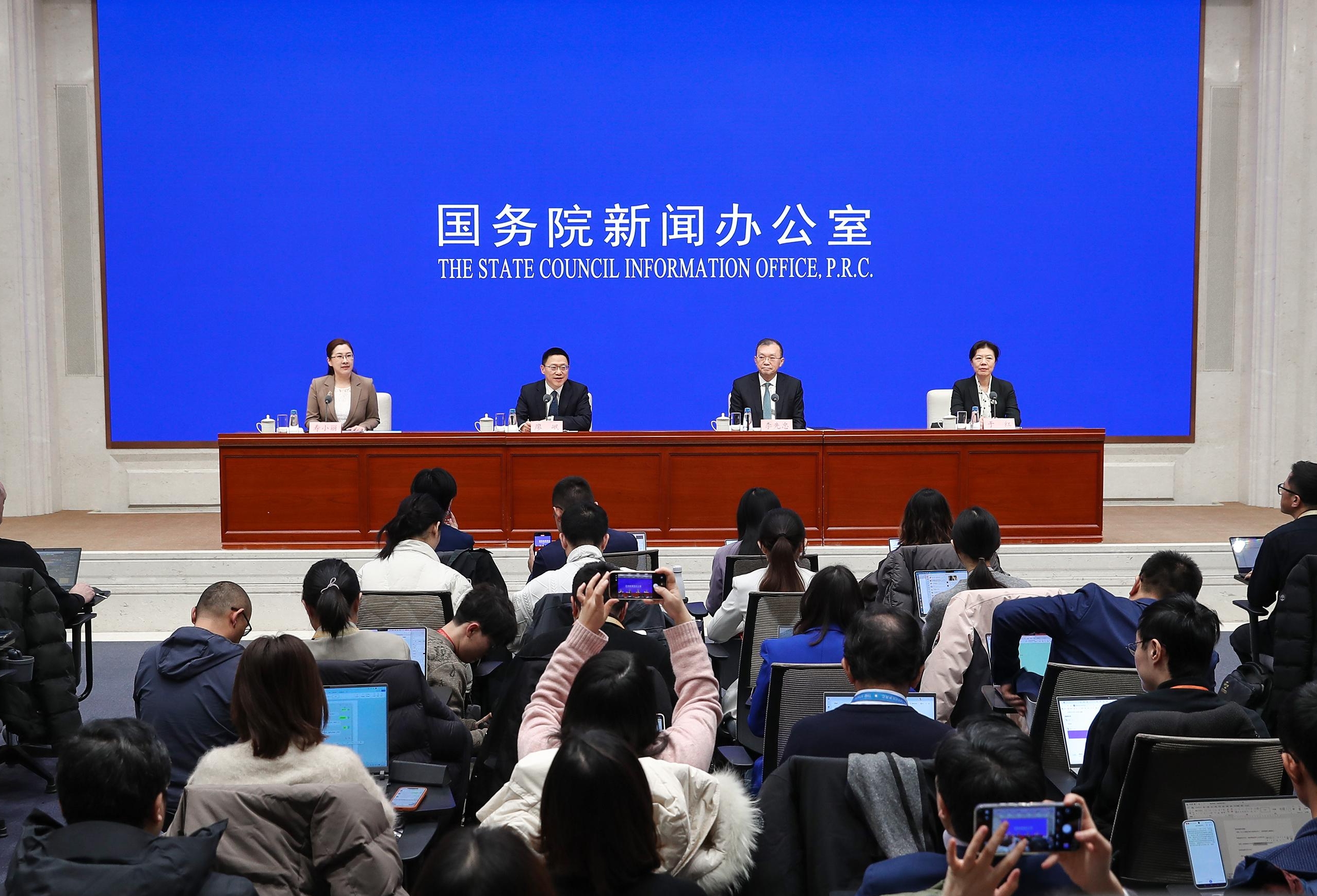
Shou Xiaoli:
Thank you, Vice Minister Liao Min. Thank you to all the speakers and all the journalists for your participation. This concludes today's press conference. Goodbye.
Translated and edited by Zhu Bochen, Yang Chuanli, You Jiaxin, Zhang Tingting, Liu Jianing, Xu Kailin, Liu Caiyi, Wang Wei, Li Huiru, Liu Sitong, Wang Qian, Li Xiao, Liu Qiang, Fan Junmei, David Ball, Jay Birbeck, and Tudor Finneran. In case of any discrepancy between the English and Chinese texts, the Chinese version is deemed to prevail.