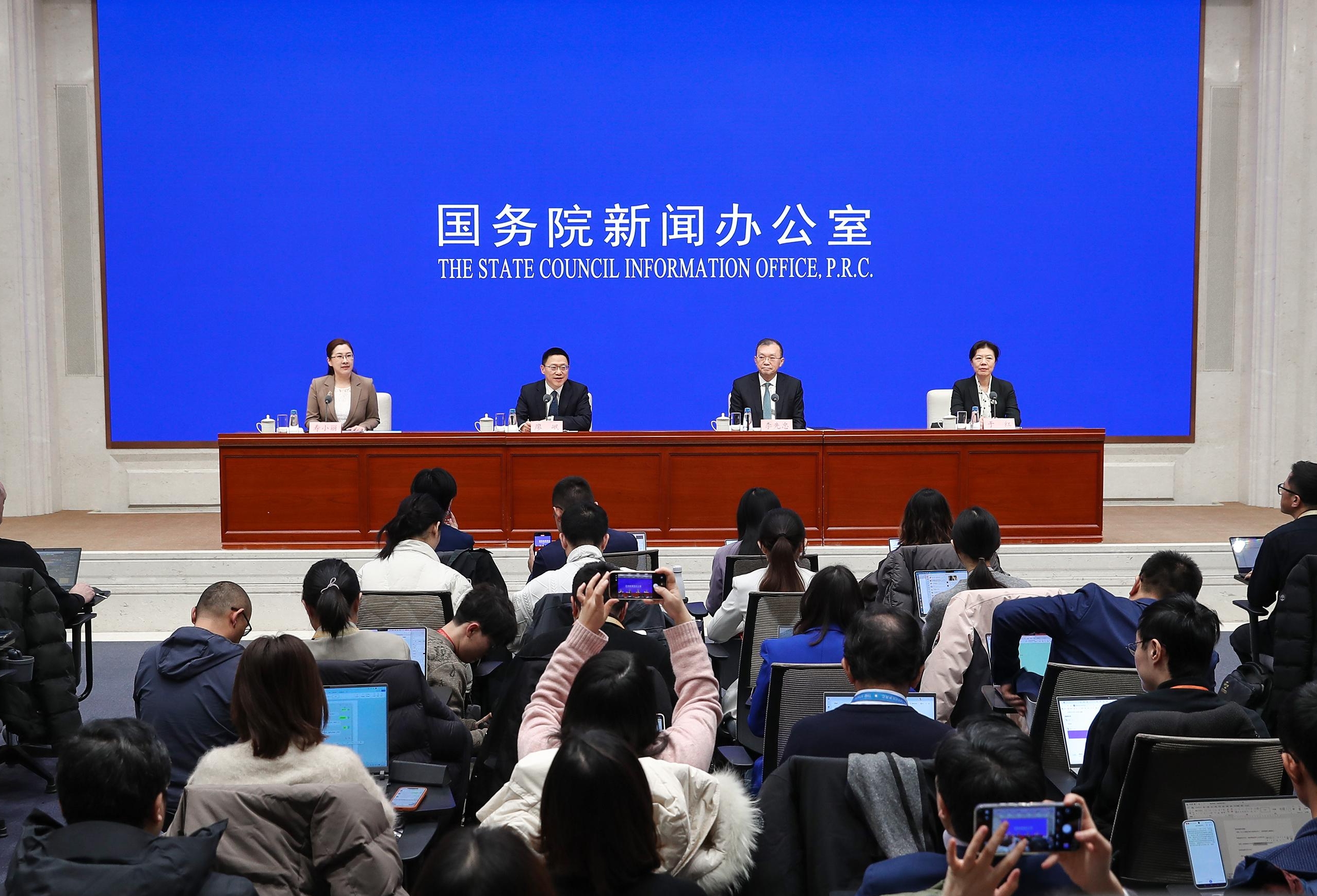
China.org.cn | March 17, 2026


Yicai:
The first executive meeting of the State Council this year studied and introduced a package of fiscal and financial policies to boost domestic demand, drawing widespread public attention. Could you introduce in detail the contents and key points of the policy package? Thank you.
Liao Min:
Thank you for your question. After the executive meeting of the State Council on Jan. 9, the relevant policies have already been made public through news reports. These policies have been released since noon today, and I believe people have seen the main contents of the policies. Last week, the MOF and relevant departments convened a nationwide video conference to instruct local governments and implementing agencies to promptly carry out the measures. The first quarter is typically a period of relatively high credit volume. At this time, greater effort should be made to better coordinate relevant policies with bank credit activities, so that policies can take effect at an earlier stage. The specific details have already been explained and made public in the policy documents. Today, I will focus on outlining the key points of the policy package.
The policies can be summarized as "one goal," "two priorities," "three principles" and "six policies."
The "one goal" mainly refers to expanding domestic demand, which aligns with the requirement set forth at the central economic work conference regarding domestic demand expansion. This is fully reflected in the policy's name.
The "two priorities" mainly refer to stimulating private investment and boosting household consumption with greater intensity. Both investment and consumption are important components of domestic demand.
The "three principles" mainly refer to the work principles that should be followed during the implementation process. First is upholding the principle of convenience and efficiency. When designing policies, we strive to streamline procedures wherever possible. Policy benefits are granted without the need for application, and fiscal interest subsidies are provided directly on a zero application basis, achieving a model in which interest subsidies are granted throughout the loan term once a loan is signed. Second is upholding the principle of precision and effectiveness, by focusing on supporting key areas and priority groups, reducing financing costs and thresholds for enterprises, and enhancing residents' consumption capacity. Third is upholding the principle of standardization and improved efficiency, mainly balancing the relationship between efficiency and norms. We need to fully deliver policy benefits while preventing fraudulent attempts to obtain fiscal funds.
Among the "six policies," four are designed to support private investment, and the other two are designed to promote consumption. The refinement of this policy package builds on the previously introduced supportive policies. Following extensive consultations with industry institutions as well as experts and scholars, a total of six policies have been introduced.
Next, I will introduce the policies to you one by one.
The first policy is an interest subsidy policy for loans to micro, small and medium-sized enterprises. This is a new policy to support the development of micro, small and medium-sized private enterprises. The policy mainly provides interest subsidies for loans to enterprises in relevant fields, focusing on 14 key industrial chains and related upstream and downstream industries, including new energy vehicles, industrial robots, medical equipment, and mobile communication equipment, as well as productive service fields such as technology, logistics, information and software, and also sectors such as agriculture, forestry, animal husbandry, sideline production and fishery. The interest subsidy is 1.5 percentage points of the total loan amount, with a maximum subsidy period of two years, while the upper limit for a single loan eligible for the subsidy policy is 50 million yuan.
The second policy is a special guarantee program for private investment. As I introduced earlier, this is also a new policy, mainly to provide guarantees for loans to micro, small and medium-sized private enterprises. Eligible enterprises can receive support for medium- and long-term loans needed for production-related activities such as the expansion, renovation and upgrading of production facilities, as well as for the expansion and refurbishment of factory buildings and storefront decorations. The guaranteed loan amount per enterprise is up to 20 million yuan. Let me elaborate on this. The traditional business of the government financing guarantee system mainly supports small businesses and agriculture. This newly established special guarantee program for private investment extends the support to include medium-sized enterprises. The single credit limit for supported micro, small and medium-sized enterprises has been significantly increased to 20 million yuan. Higher guarantor payment limits and risk-sharing ratios have also been set. As I illustrated earlier with an example, this represents a significant breakthrough from traditional business, and is meant to support more micro, small and medium-sized enterprises.
The third measure is to support the risk-sharing mechanism for private enterprise bonds. This is also a new policy. The central government has allocated special risk-sharing funds that will coordinate with existing policies of the central bank. These will provide credit enhancement support for bond issuances by private enterprises and private equity investment institutions and compensate investors for partial losses. This functions in a similar manner to the guarantee policy tools introduced earlier. By sharing part of the credit risk in the market, it helps enterprises lower their financing threshold.
The fourth measure concerns the interest subsidy policy for equipment renewal loans. This policy optimization expands the interest subsidy coverage, extending it from original equipment procurement projects to include fixed asset loans for equipment upgrades and sci-tech innovation loans. Relevant enterprises are eligible for an interest subsidy support of 1.5 percentage points on the total loan amount with a maximum term of 2 years. At the same time, we have expanded the beneficiary sectors, and the range of participating banks has also expanded.
Fifth, the interest subsidy policy for loans to service sector business entities. This is an optimization of the policy introduced last year. The loan cap per entity is hereby raised from the current 1 million yuan to 10 million yuan, with a 1-percentage-point interest subsidy for one year. A single enterprise can receive a maximum subsidy of 100,000 yuan. The scope of eligible consumption sectors has been expanded to 11 categories. The list of participating institutions now includes all city commercial banks, provincial rural commercial banks, capital-city rural commercial banks, and foreign banks with a regulatory rating of 3A or higher—totaling over 90 institutions. By broadening the institutional framework beyond existing policies, this initiative is instrumental in leveraging the 'capillary' function of financial services to effectively support a wide range of service sector business entities.
The sixth is the interest subsidy policy for personal consumption loans. This is also an optimization policy. Residents who use personal consumption loans for legitimate consumption purposes are entitled to a 1-percentage-point interest subsidy. The policy now extends interest subsidy support to credit card bill installment services. In earlier discussions, there was widespread support for extending consumption loan interest subsidies to credit card services, and therefore we have revised the policy to address the demand. To benefit consumers of all types in both urban and rural areas, over 500 new authorized handling institutions have been added this time. These include city commercial banks, rural commercial banks, foreign-funded banks, consumer finance companies and auto finance companies that hold a regulatory rating of 3A or above.
The fiscal expenditure required for these pro-business and people-centered policies has been fully earmarked in the 2026 budget. Local authorities and handling institutions can boost business initiatives with the rule of more work, more gains; Enterprises and residents may also access more loans and corresponding benefits based on their production and consumption demands. We will further enhance coordination with relevant departments, boost the vitality of micro market players via innovative macro-control, and spare no effort to deliver the above policies effectively. Thank you.