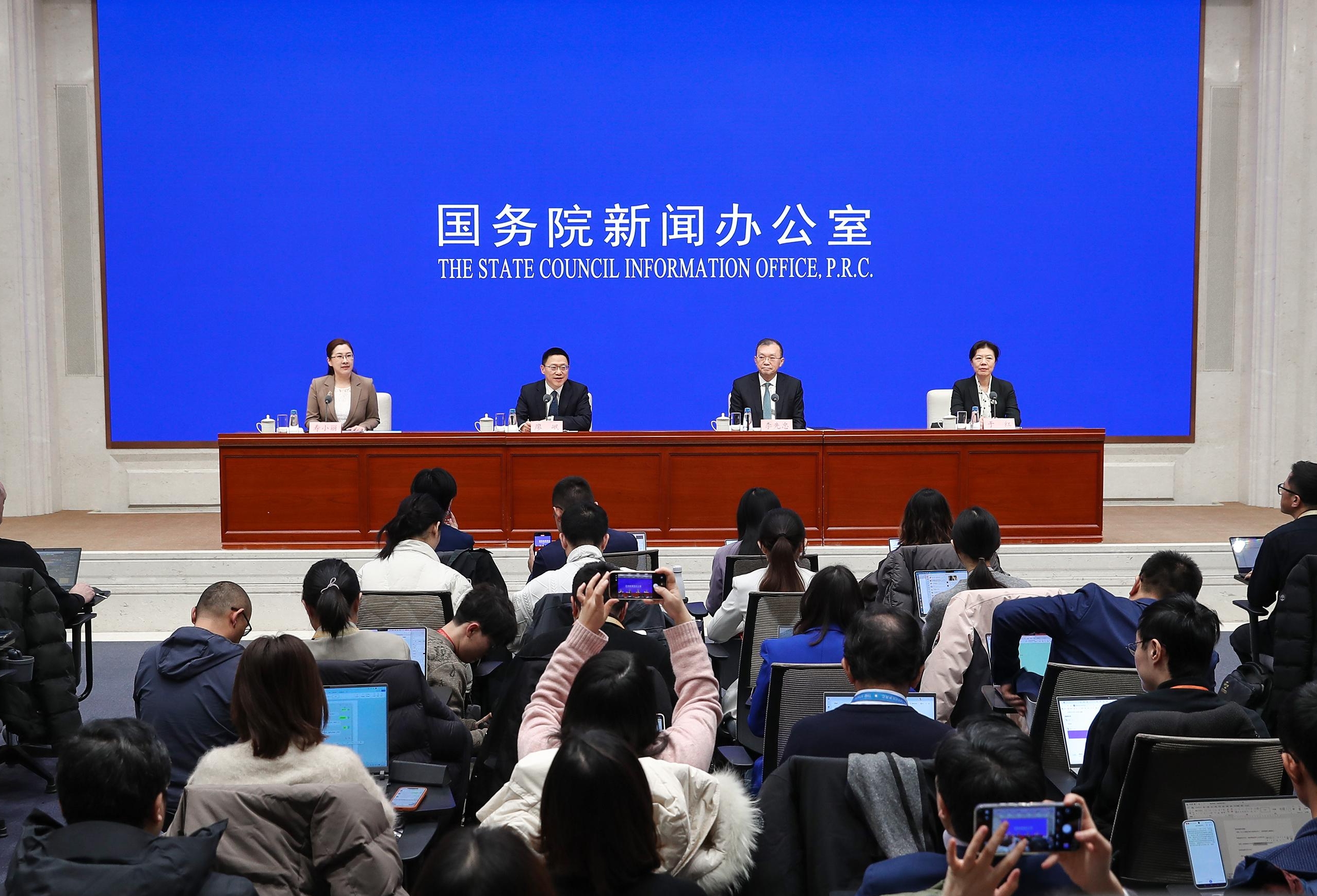
China.org.cn | March 17, 2026


Speakers:
Mr. Liao Min, vice minister of finance
Mr. Li Xianzhong, director general of the Comprehensive Department of the Ministry of Finance (MOF)
Ms. Yu Hong, director general of the Department of Finance of the MOF
Chairperson:
Ms. Shou Xiaoli, director general of the Press Bureau of the State Council Information Office (SCIO) and spokesperson of the SCIO
Date:
Jan. 20, 2026
Shou Xiaoli:
Ladies and gentlemen, good afternoon. Welcome to this press conference held by the State Council Information Office (SCIO). Today we are very pleased to be joined by Mr. Liao Min, vice minister of finance, who will brief you on implementing a proactive fiscal policy for high-quality economic and social development, and also take your questions. Also attending today's press conference are Mr. Li Xianzhong, director general of the Comprehensive Department of the Ministry of Finance (MOF); and Ms. Yu Hong, director general of the Department of Finance of the MOF.
Now, I'll give the floor to Mr. Liao for his introduction.
Liao Min:
Thank you. Friends from the media, ladies and gentlemen, good afternoon. Thank you for attending today's press conference. Over the past few days, the temperature has dropped in Beijing, yet we still see so many members of the press here today. On behalf of the MOF, I would like to first express our appreciation for your long-term support for and attention to fiscal work. I would like to take this opportunity to brief you on the outcomes of fiscal policies in 2025 and outline the overall considerations for the fiscal work in 2026.
As we know, the year 2025 was extraordinary. The Central Committee of the Communist Party of China (CPC) with Comrade Xi Jinping at its core balanced domestic and international imperatives and implemented more proactive and effective macro policies. As a result, China's economy has moved toward higher-quality and more innovative development, demonstrating strong resilience and vitality. Earnestly carrying out the decisions and deployments made by the CPC Central Committee and the State Council, the MOF implemented more proactive fiscal policies with sustained and strengthened efforts, and played a crucial role in helping achieve the annual economic and social development goals and tasks. In a nutshell, the more proactive fiscal policies adopted in 2025 struck a balance between immediate needs and long-term objectives. They provided strong support for current economic growth and delivered concrete improvements to people's living standards, while also effectively promoting the structural transformation of the Chinese economy and laying a solid foundation for medium- and long-term sustainable economic and social development. Specifically, our efforts in this regard lie in the following four aspects:
First, we intensified countercyclical adjustments. To begin with, the deficit-to-GDP ratio for 2025 was set at around 4%, which was 1 percentage point higher than the previous year. New government debt totaled 11.86 trillion yuan (about $1.71 trillion), an increase of 2.9 trillion yuan over the previous year. These figures both exceeded the average levels of recent years. In addition, 500 billion yuan of special treasury bonds were issued in 2025 to support large state-owned commercial banks in replenishing their core tier-1 capital, which effectively enhanced the capacity of the banking sector and the financial industry as a whole to support the real economy. Furthermore, 500 billion yuan was allocated within the local government debt ceiling to strengthen the overall fiscal capacity of local governments and expand effective investment. Although the deficit and the scale of government bonds increased, the government debt ratio still remained relatively low by international comparison, especially much lower than the average of G20 countries.
Second, we focused on boosting consumption. This involved several measures. For starters, 1.3 trillion yuan of ultra-long special treasury bonds were issued to continue supporting major national projects and programs, enhance security capacity in key areas, promote large-scale equipment renewals and boost trade-ins of old consumer goods. Of this amount, a total of 300 billion yuan was allocated to boost trade-ins of old consumer goods, providing real financial subsidies for consumption of every household. This also drove sales of related products to over 2.6 trillion yuan. As a result, a large number of green, low-carbon and smart products entered households at an accelerated pace, continuously improving people's quality of life while also facilitating economic transformation. Additionally, consumption potential was boosted through both the supply and demand sides. Subsidized interest payments were introduced to personal consumption loans as well as loans issued to business entities in the service sector. Support was also provided for pilot programs concerning new consumption modes, models and scenarios, as well as for the development of an internationalized consumption environment. Moreover, policies were adjusted and optimized concerning duty-free shops and departure tax refund, and more duty-free shops were established to encourage and expand related consumption.
Third, we made continuous efforts to ensure people's well-being. Our work was mainly carried out in the following five aspects. To begin with, we upheld the employment-first policy. The central government allocated 66.74 billion yuan in employment subsidies to reinforce policy tools for stabilizing employment. Policies were introduced to expand the coverage of social insurance subsidies and intensify efforts to refund unemployment insurance premiums for enterprises to keep jobs afloat. Reductions to premiums for unemployment insurance and workers' compensation were also extended. Next, the annual per capita government subsidies for medical insurance and basic public health services were increased to 700 yuan and 99 yuan, respectively. In 2025, the central government allocated a total of about 490 billion yuan in related subsidies. Furthermore, basic pensions for retirees were increased at a rate of 2% in general, and the minimum basic old-age benefits for rural and non-working urban residents were raised by 20 yuan per person per month. In 2025, the central government allocated approximately 1.2 trillion yuan in basic pension subsidies. Moreover, free pre-school education was gradually rolled out. The country waived care and education fees for children in the final year of kindergarten, benefitting approximately 14 million people. The standards of national scholarships and grants were raised, and their coverages were expanded. In addition, the nationwide child care subsidy program was introduced. A total of 100 billion yuan was allocated nationwide to provide child care subsidies for children under the age of 3, and the subsidies were exempt from individual income tax. As the aforementioned figures show, national fiscal spending in ensuring people's livelihood continued to increase and deliver tangible results. These inclusive policies, which directly benefited the public, helped enhance households' consumption capacity and stimulated their willingness to consume.
Fourth, we placed equal emphasis on risk prevention and development promotion. Fiscal sustainability is an inherent requirement for a major economy and remains a global challenge. With this in mind, we have been committed to building a stable and sustainable fiscal system. In 2025, we adhered to the principle of reducing debt through development while promoting development through debt reduction. To begin with, an amount of 2 trillion yuan was again allocated to replace outstanding hidden local government debt. In addition, 800 billion yuan of new special treasury bonds were issued to supplement fiscal capacity of local government funds and support debt reduction. Moreover, the full-process management of outstanding hidden debt replacement was strengthened, with guidance and supervision provided to local governments to ensure well-conceived classification and precise debt replacement. Following the debt replacement, the average interest cost of debt decreased by more than 2.5 percentage points, which significantly reduced the burden on local governments and enhanced their development momentum. As these measures were carried out on schedule and continued to take effect, local government debt risks gradually receded, and the positive interaction between economic growth and debt management was further strengthened. Last but not least, concrete efforts were made to see that, at the primary level, basic living needs were met, salaries were paid and governments functioned smoothly. The overall operation of local finances remained stable.
Overall, in 2025, the fiscal policy firmly served national priorities, took proactive and responsible actions, and fully reflected a more proactive policy orientation, providing important support for the macroeconomy to withstand pressures and maintain stable progress. This has been widely recognized by industry insiders both at home and abroad.
That concludes my briefing on the major outcomes of fiscal policy in 2025.
Considerations for fiscal policy in 2026.
In 2026, as outlined at the Central Economic Work Conference, finance departments will continue to implement a more proactive fiscal policy, which can be summarized as "increased volume, optimized structure, improved efficiency and stronger momentum."
"Increased volume" means expanding the scale of fiscal expenditure to ensure adequate spending intensity. In 2026, the fiscal deficit, total debt and total expenditure will be maintained at necessary levels, ensuring that overall spending keeps increasing and that support for key areas continues to strengthen. It should be emphasized that continuing to expand fiscal expenditure, building on the already more proactive stance in 2025, is itself a testament to just how proactive this policy is. At the same time, we have fully considered medium-to-long-term fiscal sustainability, with a focus on building momentum for future development.
"Optimized structure" primarily involves continuously optimizing spending allocations to ensure funds are directed where they're most needed. We will break away from the rigid "base figure plus growth" spending pattern, adopt zero-based budgeting principles, and substantially cut inefficient expenditures. More fiscal funds will be directed toward boosting consumption, investing in human capital, and safeguarding livelihoods, thereby raising household incomes through multiple channels. Through well-calibrated and considerate spending arrangements, we will steadily enhance people's sense of gain.
"Improved efficiency" means maximizing the impact of spending to ensure every penny delivers its due returns. In 2026, we will continue issuing ultra-long-term special treasury bonds to fund major national projects and initiatives, advance large-scale equipment upgrades and consumer goods trade-ins, and refine policy implementation. We will improve negative list management for special bond projects, deepen the local "self-review and self-issuance" pilot program, and maximize the impact of bond funds. At the same time, we will strengthen fiscal-financial coordination, develop innovative policy instruments, and amplify the multiplier effect of public funds and the spillover effects of public policies. I believe the journalists here have all seen the official circular on these policies, which was released across all platforms today.
"Stronger momentum" means deepening fiscal and tax reforms in key areas to further unleash the economy's internal dynamism. We will optimize the transfer payment structure, strengthen local governments' fiscal autonomy and coordination capacity, and improve the effectiveness of transfer payment funds. Through reform measures such as strengthening the coordination of fiscal resources and budgets, enhancing performance-based budgeting, optimizing export tax rebates, and standardizing tax incentives and subsidies, we will further invigorate local fiscal development and support the building of a unified national market.
In short, financial departments will provide solid and robust support in 2026 for stabilizing employment, businesses, markets and expectations, ensuring a solid start to the 15th Five-Year Plan period (2026-2030).
That concludes my opening remarks. My two colleagues and I will now be happy to take your questions. Thank you.
Shou Xiaoli:
Thank you, Mr. Liao. The floor is now open for questions. Please identify your news organization before asking. Please go ahead with your questions.