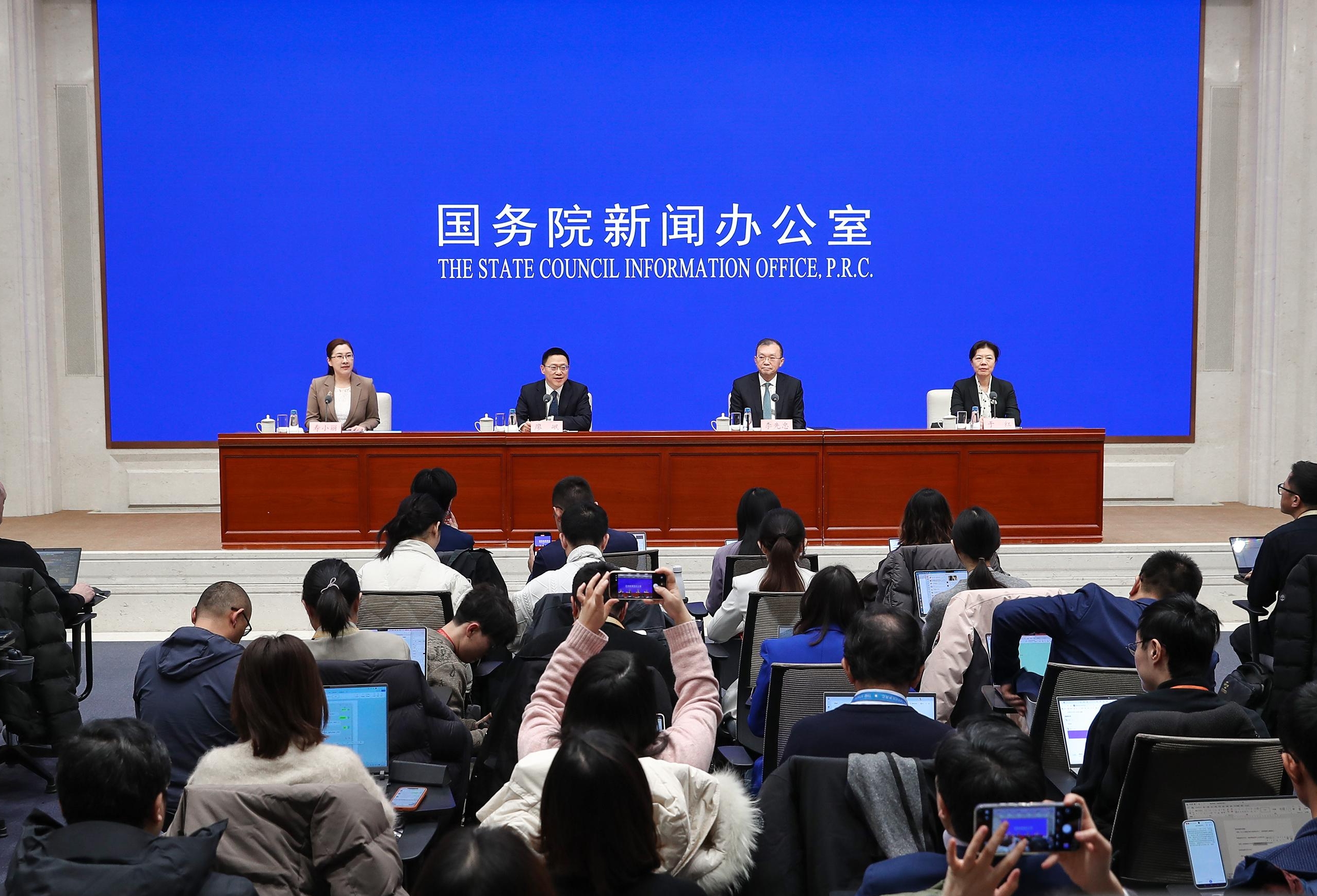
China.org.cn | March 17, 2026


Dazhong Daily:
As China accelerates its drive to build a strong agricultural sector, insurance is playing an increasingly important role. Could you give an update on the current development of agricultural insurance? What policy plans are there for the next step? Thank you.
Liao Min:
I would like to invite Ms. Yu to answer these questions.
Yu Hong:
Thank you for your questions. Since 2007, the central government has supported the development of agricultural insurance through premium subsidies, representing one of the earliest instances of fiscal-financial policy coordination. To illustrate how this works at a micro level: Suppose a farmer buys full-cost insurance for rice. On average, the premium per mu is about 50 yuan. The farmer pays only about 10 yuan, while the government covers the remaining 40 yuan. If a disaster occurs, the farmer can receive payouts ranging from several hundred to over a thousand yuan. This reflects the policy's mechanism: the government shoulders the bulk of the cost while the farmers pay a nominal share, together leveraging risk protection dozens of times greater than the initial investment. From a macro perspective, the scale of agricultural insurance premiums in China has remained the largest in the world, playing a positive role in stabilizing farmers' incomes and safeguarding national food security. It has underpinned our ability to maintain a steady grain output of above 700 million tons, serving as a crucial guarantee for China to feed nearly 20% of the world's population with only 9% of its arable land.
Next, I will outline the achievements of our agricultural insurance program. In short, it has seen both expanded scale and improved quality, embarking on a development path with Chinese characteristics. Specifically, it is reflected in "four continuations."
First, fiscal support has been continuously strengthened. Nearly 80% of China's agricultural insurance premiums are funded by fiscal subsidies. With premium subsidies from all levels of government growing at double-digit rates annually, we're providing substantial, tangible financial support to drive the development of the agricultural insurance sector. In 2025, China's agricultural insurance premiums exceeded 155 billion yuan, providing more than 5.2 trillion yuan worth of risk protection for 125 million farming household-times.
Second, the institutional system has been continuously improved. The departments of finance, agriculture and rural affairs, insurance supervision, forestry and grassland have worked in synergy to issue a series of policy documents on expanding coverage, raising standards, and enhancing standardized management. Together, these have established the "basic framework" of an agricultural insurance system suited to our national conditions.
Third, safeguarding capacity has continued to strengthen. We have adhered to the principles of high-level protection, broad coverage, and diversified approaches. For major agricultural commodities such as grain, edible oil, sugar, and natural rubber, high-coverage insurance schemes have basically been put in place, providing coverage for either full production costs or planting income. For regionally distinctive agricultural products, the central government, in order to achieve holistic agricultural development and build a diversified food supply system, has implemented incentives and subsidy policies nationwide.
Fourth, benefits to farmers have continued to increase. In response to various natural disasters, including prolonged rainfall during the wheat harvest season in Henan, floods in Northeast and North China, Super Typhoon Yagi and Super Typhoon Ragasa impacting Hainan, we have actively supported affected farmers in resuming agricultural production. During the 14th Five-Year Plan period, farmers have received cumulative insurance payouts exceeding 520 billion yuan.
Next, the Ministry of Finance will continue, together with relevant departments to advance efforts and improve the quality and efficiency of agricultural insurance and deepen reforms. In 2026, we will also issue a guiding document on accelerating the high-quality development of agricultural insurance. This document will focus on refined management and diversified collaboration in agricultural insurance, making greater contributions to stabilizing farmers' incomes, supporting comprehensive rural vitalization, and safeguarding national food security. Thank you.
Shou Xiaoli:
The last question, please.