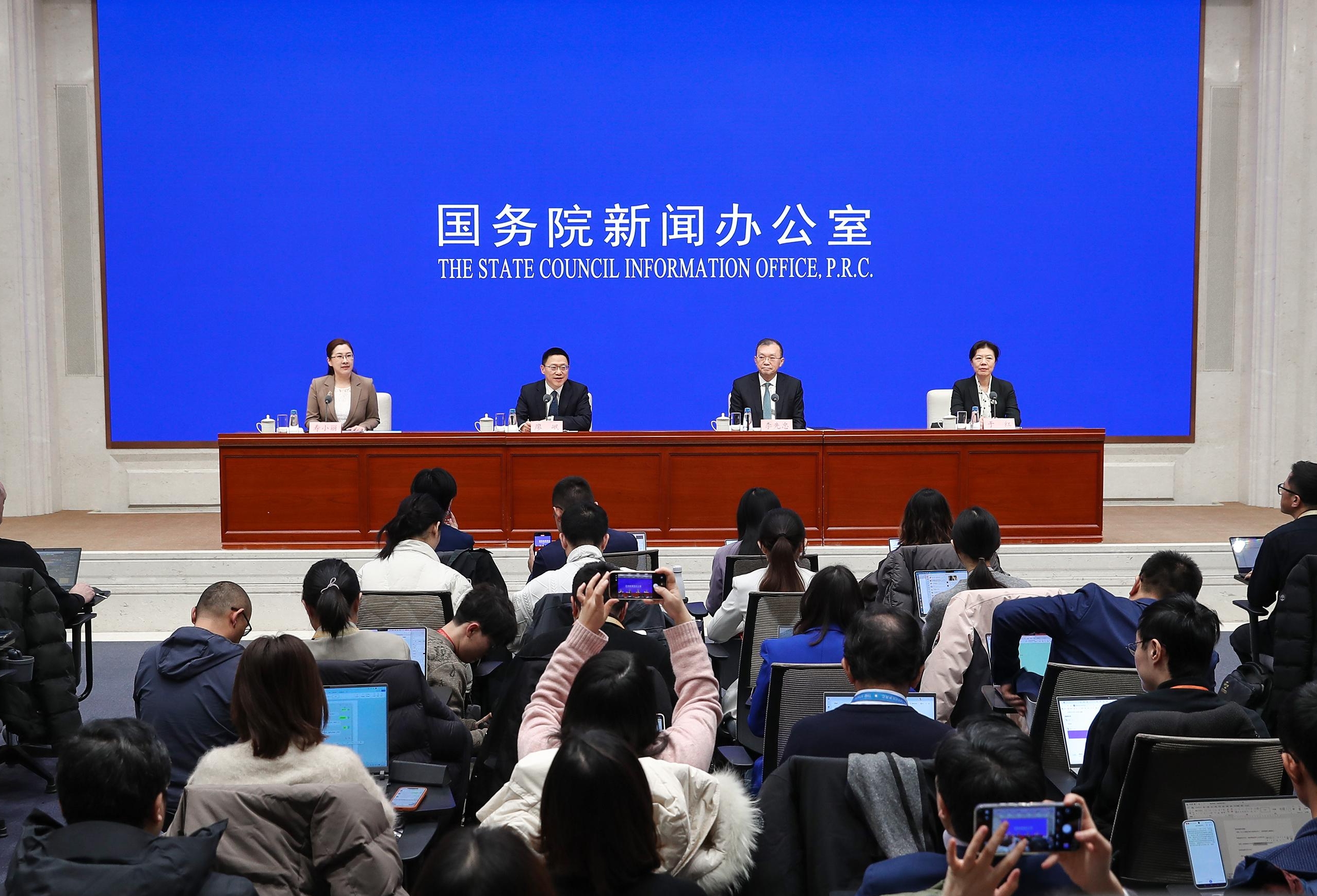
China.org.cn | March 17, 2026


CCTV:
The Central Economic Work Conference has made arrangements to boost smooth domestic economic circulation and build a unified national market. How will the Ministry of Finance promote effective implementation of work in some key areas in the future? Thank you.
Liao Min:
Thank you for your question. This is a very important issue. The Fourth Plenary Session of the 20th CPC Central Committee clearly proposed to "eliminate bottlenecks and obstacles hindering the development of a unified national market." The recent Central Economic Work Conference also set out specific arrangements in this regard. The Ministry of Finance will resolutely implement the decisions and arrangements of the CPC Central Committee and the State Council. Centering closely on establishing a unified, open, competitive, and orderly market system, the ministry will actively deliver its fiscal functions, and support the construction of the unified national market in three aspects.
First, we will continue to deepen the reform of the fiscal and taxation systems. The first is to further clarify the fiscal powers and expenditure responsibilities of the central and local governments in areas including basic public services, education, and healthcare, improve a central-local fiscal relationship with clearly defined powers and responsibilities, coordinated financial resources, and regional balance, and strive to build an institutional framework in line with national conditions. The Ministry of Finance is vigorously advancing efforts in this aspect. The second is to deepen tax system reform, standardize tax incentive policies, improve the local tax system, fully implement the principle of law-based taxation, and lay a solid institutional foundation for building a unified national market. The third is to study new conditions and problems in the taxation field arising from the emergence and development of new business forms, new industries, and new business models, which is also a global issue. I attended relevant G20 meetings, and various countries had quite a lot of discussions on how the development of these new problems and new business forms affects the tax system. For example, in order to address the tax challenges brought by economic digitalization, the international community is advancing reform of international tax rules through the two-pillar plan, and China is actively participating in the negotiations. Domestically, we need to continue researching and exploring, in practice, solutions to issues such as how to foster a fair and unified tax environment for both online and offline businesses, as well as for new and traditional business models. This morning, I met with personnel from an international organization, and we had an in-depth discussion on this issue. It truly is a new challenge faced by all countries.
Second, we have continuously regulated fiscal subsidies. Indeed, people are very concerned about this issue. Since joining the World Trade Organization (WTO) in 2001, China has always firmly adhered to the WTO rules and earnestly fulfilled all accession commitments. As of now, China has submitted eight submissions on subsidy policies at the central level and six at the local level. These figures were meticulously compiled based on actual data from China. The scale of China's fiscal subsidies notified to the WTO is far below the estimates from some international institutions. I want to emphasize that the technological progress and competitive advantages of Chinese enterprises stem not from subsidies, but from their own sustained R&D investment and the hard work of countless entrepreneurs.
The central government takes any potential subsidy violations in specific localities very seriously and is resolute in correcting them. In 2025, the Ministry of Finance joined forces with relevant departments to form an inter-agency task force to tackle local fiscal subsidy violations through a special initiative. Moving forward, we will continue to improve the working mechanism of task force, strengthen information sharing and regulatory coordination, and improve the system for regulating fiscal subsidies to deepen our efforts in cleanup and rectification. At the same time, we will also enforce the primary responsibilities of local authorities, strengthen supervision and regulation, and address every violation as soon as it is identified, while resolutely curbing cutthroat, disorderly competition.
Third, we have continuously optimized the government procurement environment. This is also an issue that people are very concerned about. First, we have cooperated to promote the amendment of the Government Procurement Law. We have actively worked with the National People's Congress Financial and Economic Affairs Committee to advance the amendment of the Government Procurement Law and the coordination and unification of the Government Procurement Law and the Tendering and Bidding Law. By aligning with high-standard international economic and trade rules, we have strengthened the policy functions of government procurement, optimized transaction rules, and reduced institutional transaction costs in an effort to build a complete, unified, and standardized legal system for government procurement. Second, we have implemented the domestic product policy in the field of government procurement. In September 2025, the Chinese government formulated and issued the domestic product policy in government procurement. This policy took effect on January 1, 2026. This is not only an important measure to improve the government procurement system, but also a concrete action to ensure national treatment for foreign-funded enterprises in the field of government procurement. In addition to clarifying domestic product standards, support policies, and categorized implementation arrangements, the policy particularly emphasizes equal treatment for all types of business entities. It prohibits any differential or discriminatory treatment of suppliers based on ownership structure, organizational form, equity structure, investor nationality, or other unreasonable criteria. Should any violations of the above provisions be identified during implementation, reports or complaints can be filed with the financial departments, and such cases will be strictly investigated and dealt with. Here, I would like to share a story. Some time ago, I received leads from friends in Europe and the United States flagging two specific cases. They expressed concerns that their products had been excluded from the scope of Chinese government procurement, citing potential discrimination. They wrote me a letter and attached information about the relevant products. My colleagues and I conducted verification and found that both products in question are imported goods manufactured abroad, rather than domestic products produced within China. Therefore, these products are not within the scope of Chinese government procurement, and there is no discriminatory treatment involved. I clarified the situation with my friends in Europe and the United States. We encourage anyone who identifies a violation of these provisions to file a report or complaint with the financial authorities. Third, we have continuously regulated the order of the government procurement market. To address obstacles to a unified national market and fair competition within the government procurement sector, the Ministry of Finance, together with the Ministry of Public Security and the State Administration for Market Regulation, has carried out targeted campaigns since 2024 to tackle prominent problems in government procurement. We conducted targeted inspections of over 80,000 government procurement projects managed by more than 19,000 agencies nationwide. While the findings indicate that the overall situation remains good, we have publicized several typical cases of non-compliance to maintain market competition order. Joint efforts are required to create and maintain a sound market environment. Moving forward, we will conduct a full review of the achievements from our special campaigns, improve a unified and standardized supervision and inspection mechanism, and resolutely penalize violations of laws and regulations to ensure the continuous optimization of the business environment for government procurement. Thank you for your questions.
Shou Xiaoli:
Let's continue with the questions. I see two more reporters with their hands up. We will take these as our final two questions.