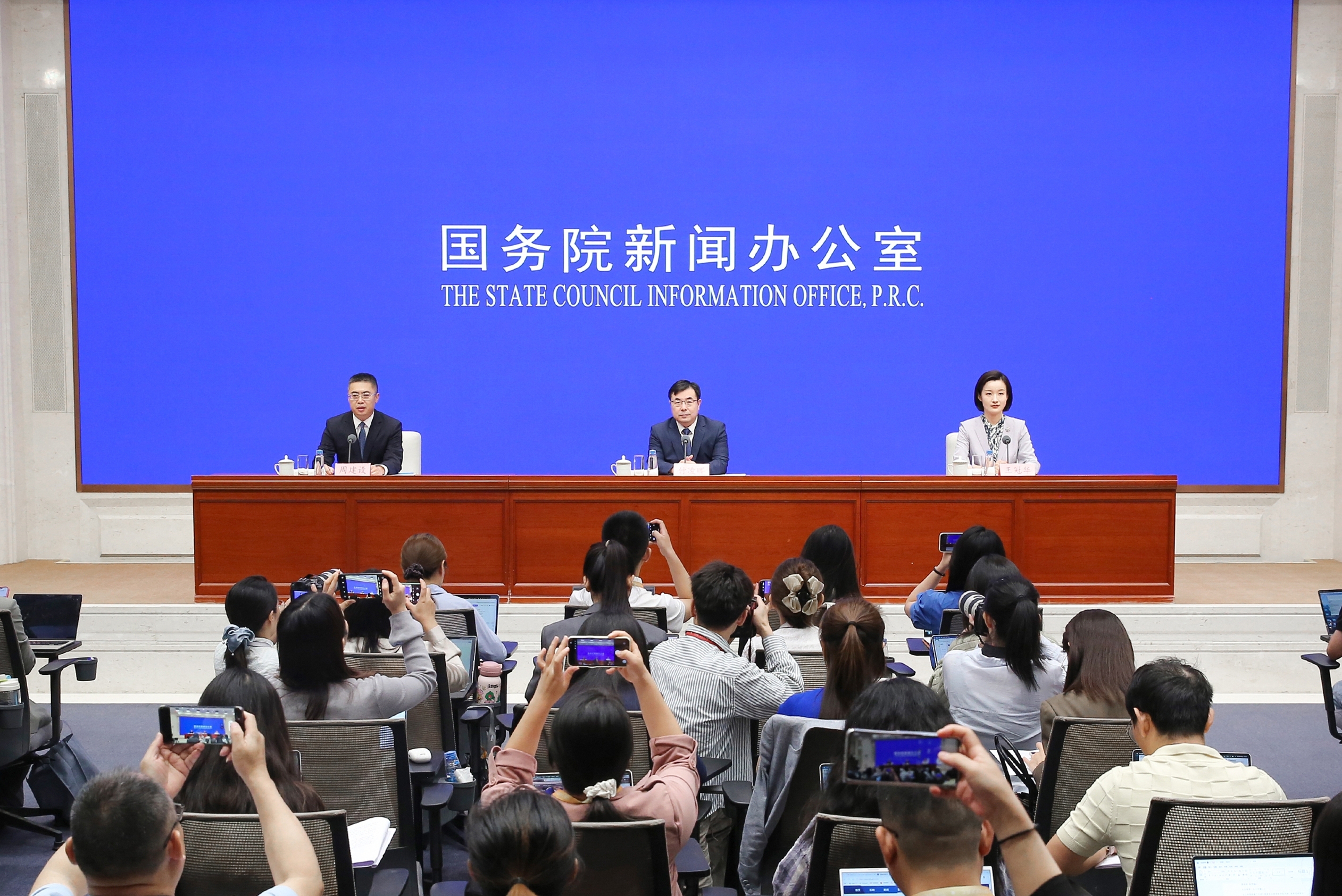
China.org.cn | November 3, 2026


Speakers:
Mr. Fu Linghui, spokesperson and chief economist of the National Bureau of Statistics (NBS) and director general of the Department of Comprehensive Statistics of the NBS
Ms. Wang Guanhua, spokesperson of the NBS and deputy director general of the Department of Comprehensive Statistics of the NBS
Chairperson:
Mr. Zhou Jianshe, deputy director general of the Press Bureau of the State Council Information Office (SCIO) and spokesperson of the SCIO
Date:
Sept. 15, 2026
Zhou Jianshe:
Ladies and gentlemen, good morning. Welcome to this press conference held by the State Council Information Office (SCIO). This is a routine release of economic data. Today, we are joined by Mr. Fu Linghui, spokesperson and chief economist of the National Bureau of Statistics (NBS) and director general of the Department of Comprehensive Statistics of the NBS, and Ms. Wang Guanhua, spokesperson of the NBS and deputy director general of the Department of Comprehensive Statistics of the NBS, to brief you on China's economic performance in August 2026 and then take your questions.
Now, I'll give the floor to Mr. Fu for his introduction.
Fu Linghui:
Ladies and gentlemen, good morning. As usual, I will start by briefing you on the main economic indicators for this August, and then my colleague and I will take your questions.
China's economy remained steady with innovation-led and high-quality development in August.
In August, under the strong leadership of the Communist Party of China (CPC) Central Committee with Comrade Xi Jinping at its core, all regions and departments earnestly implemented the decisions and arrangements made by the CPC Central Committee and the State Council, adhered to the general principle of seeking progress while ensuring stability, strived to make the macro policies more effective, deepened the reform and opening up, accelerated the transformation from traditional growth drivers to new ones, and pursued high-quality development. As a result, production and supply grew steadily, employment and prices remained generally stable, foreign trade registered rapid growth, and new growth drivers played a stronger underpinning role. The national economy maintained steady momentum with innovation-led and high-quality development.
First, industrial production accelerated, with equipment manufacturing and high-tech manufacturing growing rapidly.
In August, the total value added of industrial enterprises above designated size grew 5.2% year on year, 0.7 percentage point faster than that of the previous month, or upand increased 0.54% month on month. In terms of sectors, the added value of the mining industry fell 1.4% year on year; that of manufacturing rose 6.1%, and that of production and supply of electricity, thermal power, gas and water increased 4.9%. The value added of equipment manufacturing went up 12.1% year on year, and that of high-tech manufacturing increased 16.7%, 6.9 percentage points and 11.5 percentage points faster than that of industrial enterprises above designated size, respectively. In terms of ownership, the value added of state holding-owned enterprises went up 3% year on year; that of share-holding enterprises was up 5.7%; that of enterprises funded by foreign investors or investors from Hong Kong, Macao and Taiwan was up 3.4%; and that of private enterprises was up 3.7%. Regarding products, the production of lithium-ion batteries, industrial robots and 3D printing equipment increased 57.2%, 34.6% and 29.9% year on year, respectively. In the first eight months, the value added of industrial enterprises above designated size grew 5.3% year on year. In August, the Manufacturing Purchasing Managers' Index stood at 49.8%, and the Production and Operation Expectation Index was 53.8%. In the first seven months, the total profits made by industrial enterprises above designated size were 4.5821 trillion yuan, up 17.6% year on year.
Second, the service sector grew steadily, with modern services gaining momentum.
In August, the Index of Services Production grew 4.1% year on year. Specifically, that of information transmission, software and information technology services, of leasing and business services, and of transportation, storage and postal services grew 9.6%, 9% and 4.8%, respectively. In the first eight months, the Index of Services Production grew 4.7% year on year. In August, the Business Activity Index for Services stood at 49.3% and the Business Activity Expectation Index for Services was 55.5%. Specifically, the Business Activity Index for industries like postal services, telecommunication, broadcast, television and satellite transmission services, and internet software and information technology services stayed within the high expansion range of 55% and above. In the first seven months, the business revenue of service enterprises above designated size grew 5.7% year on year.
Third, market sales expanded and service retail saw rapid growth.
In the first eight months, the total retail sales of consumer goods and services rose 2.5% year on year, with retail sales of services increasing 4.9% and that of goods growing 1%. Specifically, retail sales of communication information services, tourism consultation and rental services, and cultural, sports and leisure services all grew rapidly. In the first eight months, the total retail sales of consumer goods reached 32.7569 trillion yuan, up 1.1 % year on year. In the first eight months, the online retail sales of goods and services reached 13.4766 trillion yuan, up 4.6% year on year. Specifically, the online retail sales of goods reached 8.4195 trillion yuan, up 4.3%; and the online retail sales of services reached 5.0571 trillion yuan, up 5.1%. In August, the total retail sales of consumer goods reached 3.9824 trillion yuan, up 0.4% year on year, or down 0.13% month on month. Analyzed by different areas, the retail sales of consumer goods in urban areas reached 3.4457 trillion yuan, up 0.2% year on year; and that in rural areas reached 536.7 billion yuan, up 1.6%. Grouped by consumption patterns, the retail sales of goods were 3.528 trillion yuan, up 0.3% year on year; and the income of catering was 454.4 billion yuan, up 1.1%. Sales of basic living goods and certain upgraded goods grew rapidly. The retail sales of beverages; of grain, oil and food; and of communication equipment by enterprises above designated size increased 4.9%, 4% and 27.3% year on year, respectively.
Fourth, investment in fixed assets declined, while that in intellectual property products grew rapidly.
In the first eight months, total fixed-asset investment (excluding rural households) reached 29.3092 trillion yuan, down 7.2% year on year; and fixed-asset investment (excluding real estate development) dropped by 4.2%. Specifically, investment in intellectual property products rose 9.2% year on year. Investment in high-tech industries increased by 5.2% year on year, with investments in information services, aircraft and spacecraft equipment manufacturing, and electronic and communications equipment manufacturing grew growing by 22.7%, 14.9% and 6.9%, respectively. By industry, investment in the primary industry decreased by 2.4% year on year, that in the secondary industry fell by 2.9%, and that in the tertiary industry fell by 9.9%. By sector, investment in infrastructure declined by 4.0% year on year; manufacturing investment fell by 2.3%, and real estate investment dropped by 19.9%. Private investment fell 10.1% year on year. Excluding real estate development, it declined 6.4%. The floor space of newly built commercial properties was 498.8 million square meters, down 12.1% year on year. Sales revenue from newly built commercial properties reached 4.7470 trillion yuan, down 13.0%. The floor area of existing-home transactions registered online-registered signed transaction area for second-hand housing was 549.23 million square meters, up 10.6% year on year. In August, fixed-asset investment (excluding rural households) fell 0.50% month on month.
Fifth, imports and exports of goods grew rapidly, while the trade structure continued to be optimized.
In August, the total volume of imports and exports reached 4.6455 trillion yuan, up 19.8% year on year, an increase of 0.6 percentage point from the previous month. Specifically, exports were 2.7274 trillion yuan, up 18.6%, while imports were 1.9181 trillion yuan, up 21.7%. From January to August, the total value of imports and exports of goods was 34.7753 trillion yuan, up 17.6% year on year. Specifically, exports were 20.1658 trillion yuan, up by 14.6%; and imports were 14.6095 trillion yuan, up 22.0%. In the first eight months, general trade imports and exports increased by 10.5% year on year. Imports and exports with Belt and Road partner countries grew by 15.9%. Imports and exports by private enterprises increased by 17.6%. Exports of machinery and electronic products grew by 21.9%.
Sixth, overall employment remained stable, while the surveyed urban unemployment rate saw a seasonal uptick.
In the first eight months, the average surveyed urban unemployment rate nationwide was 5.2%, unchanged from the same period last year. In August, the surveyed urban unemployment rate was 5.3%, 0.1 percentage point higher than that of the previous month. The surveyed unemployment rate for the population with local household registration was 5.3%; and that for the population with non-local household registration was 5.2%, of which the rate for those with non-local agricultural household registration was 5.0%. The surveyed urban unemployment rate in 31 major cities was 5.3%, up 0.1 percentage point from the previous month. Employees of enterprises worked 48.2 hours per week on average.
Seventh, the consumer price index (CPI) rose modestly, while producer prices for industrial products recorded a broader year-on-year increase.
In August, national CPI rose by 0.8% year on year, a growth rate 0.3 percentage point wider than in July, and grew by 0.4% month on month. By category, prices for food, tobacco, alcohol and catering services fell 0.7% year on year. Clothing prices rose 1.3%. Housing prices decreased by 0.3%. Household articles and services went up 0.7%. Transportation and communication prices rose 2.5%. Education, culture and recreation prices grew 1.4%. Medical services and healthcare prices went up 2.7%; and prices for other articles and services increased by 7.3%. Among food, tobacco, alcohol, and catering service prices, pork prices dropped by 11.8%, fresh vegetable prices fell by 2.8%, grain prices declined by 0.6% and fresh fruit prices easedwent down by 0.5%. The core CPI, excluding food and energy prices, grew by 1.0% year on year. In the first eight months, the CPI went up by 0.9% year on year.
In August, the producer price index (PPI) rose by 3.8% year on year, a growth rate 0.3 percentage point wider greater than in the previous month, and grew by 0.4% month on month. Purchasing prices for industrial producers increased by 5.8% year on year and 0.3% month on month. In the first eight months, the PPI and purchasing prices for industrial producers climbed 2.0% and 3.2% year on year, respectively.
Overall, the national economy maintained stable operations in August, with continued momentum toward new growth drivers and structural optimization. However, it should also be noted that the adverse impact of the external environment has intensified, the imbalance between strong supply and weak demand at home remains prominent, some enterprises face operational difficulties, and the foundation for sustained economic progress needs further consolidation. Going forward, we must adhere to the guidance of Xi Jinping Thought on Socialism with Chinese Characteristics for a New Era, uphold the general principle of pursuing progress while maintaining stability, and fully and faithfully implement the new development philosophy on all fronts. We must move faster to create a new pattern of development, deepen reform and opening up, step up macro-policy adjustment, intensify efforts to expand domestic demand, and promote industrial upgrading, so as to boost development momentum, stimulate social vitality, and foster sustained economic development driven by new growth drivers, structural optimization, and solid growth. Thank you.
Zhou Jianshe:
Thank you, Mr. Fu, for your introduction. The floor is now open for questions. Please identify the media outlet you represent before asking your questions.