China.org.cn | July 27, 2026


CNR:
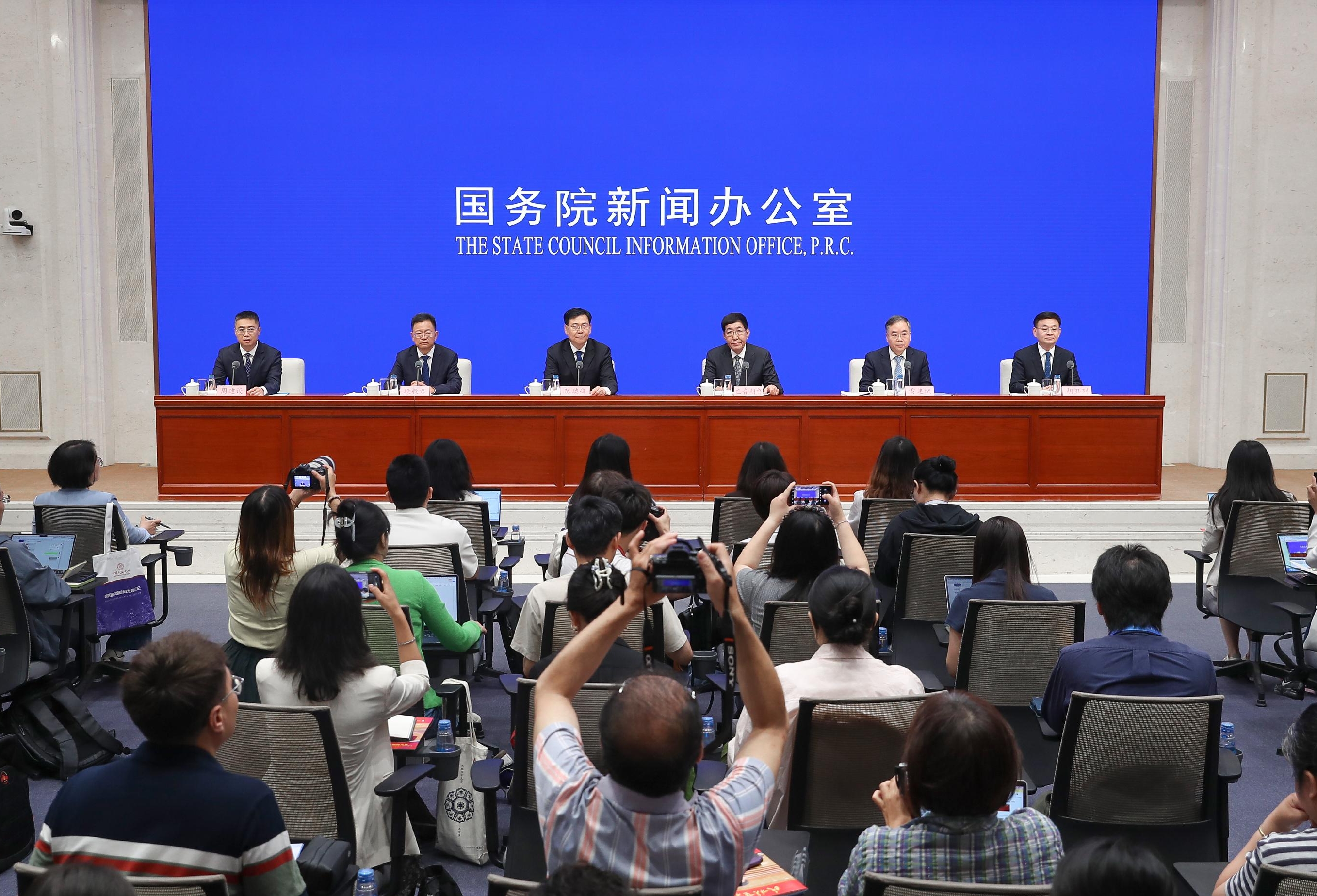
We know that advancing law-based governance in all respects requires building a sound and complete legal system. What progress has been made so far in building the legal system related to ethnic work? I believe there are two points everyone is watching closely. First, how is the Ethnic Unity and Progress Promotion Law positioned in relation to this? Second, what is its relationship with the Law on Regional Ethnic Autonomy, which we are all familiar with? Thank you.
Lei Jianbin:
Thank you for your questions. I'll answer them. The reporter's question just now touched on an important point. That is, the prerequisite and foundation of advancing law-based governance in all respects is a sound and complete legal system. As we know, through years of sustained effort, China has established a socialist legal system with Chinese characteristics with the Constitution at its core. Within this system, the laws and regulations related to ethnic work and ethnic affairs form a vital component of that broader framework. Like the broader socialist legal system with Chinese characteristics, the system of laws and regulations on ethnic affairs is centered on the Constitution, which serves as the fundamental legal basis for drafting laws and regulations. The Constitution's provisions trace the historical development of this system. Since the founding of the People's Republic of China, ethnic relations and ethnic affairs have always been a very important part of the Constitution. In 1949, when the People's Republic of China was founded, the Common Program of the Chinese People's Political Consultative Conference, which served as a provisional constitution at the time, set out ethnic policy in a dedicated section with clear provisions. In September 1954, the first session of the first NPC adopted the Constitution of the People's Republic of China, which included provisions regarding ethnic equality, ethnic unity, regional ethnic autonomy and common prosperity for all ethnic groups, laying the basic framework for China's ethnic theory and policies. In December 1982, the fifth session of the fifth NPC adopted the current Constitution, which contains more than 20 articles on ethnic affairs, further establishing guidelines to foster socialist ethnic relations and guarantee equal rights for all ethnic groups. Another very important law is the Law on Regional Ethnic Autonomy, enacted at the second session of the sixth NPC in May 1984. The Law on Regional Ethnic Autonomy, in accordance with the Constitution, makes basic provisions on the system of regional ethnic autonomy and lays an important legal foundation for governing ethnic affairs in accordance with the law. In particular, the 2018 constitutional amendment, adopted at the first session of the 13th NPC, enshrined the term "Chinese nation" in the Constitution for the first time and explicitly set forth the requirement to uphold?and promote relations of equality, unity, mutual assistance and harmony among all ethnic groups. This laid the fundamental legal basis for handling ethnic affairs and carrying out ethnic work in the new era. This is from a constitutional perspective.
Fully implementing the Constitution requires a scientific and comprehensive legal system that translates its provisions into practice through specific laws. Since the beginning of the new era, in accordance with the decisions and plans of the CPC Central Committee, the NPC and its Standing Committee have carried out legislative work related to ethnic affairs in an active and prudent manner, and have continuously achieved new progress and new accomplishments. In addition to the Ethnic Unity and Progress Promotion Law, which specifically addresses ethnic issues, many other laws also contain provisions related to ethnicity. For example, more than 10 laws — including the Land Border Law, the Organic Law of the Local People's Congresses and Local People's Governments, the Deputies Law, the Legislation Law, the Patriotic Education Law, and the Law on the Publicity and Education on the Rule of Law — have made clear provisions for forging a strong sense of community for the Chinese nation, continuously enriching and strengthening the work on ethnic affairs. In addition to national legislation, many localities have formulated local regulations to promote ethnic unity and progress in accordance with the Constitution and the Legislation Law. These regulations, together with the Constitution and laws, form a complete legal system concerning ethnic affairs. These are some of the achievements and progress made in ethnic legislation.
You asked how the Ethnic Unity and Progress Promotion Law is positioned. It's the first specialized law in the field of ethnic affairs in the new era. To sum it up in one sentence, it is the basic law for implementing the relevant provisions of the Constitution, handling ethnic affairs and carrying out ethnic work in the new era. Why does it hold such an important position? Specifically, it can be understood from two aspects. First, in terms of substance, ethnic relations and ethnic affairs have always been major constitutional issues. Enacting this law was an important legislative measure to implement the relevant provisions of the Constitution on ethnic issues and keep pace with the times. The Ethnic Unity and Progress Promotion Law, based on the Constitution's provisions on ethnic issues, systematically builds a legal framework for ethnic unity and progress. It provides a comprehensive, long-term foundation for handling ethnic affairs and carrying out ethnic work under the rule of law, as well as for promoting ethnic unity and progress on all fronts. People often talk about how much substance an object or achievement really has. By that measure, the Ethnic Unity and Progress Promotion Law is a basic law that carries significant constitutional weight, given its close grounding in the Constitution. That covers the substantive side.
Procedurally, the Constitution and the Legislation Law empower the NPC to formulate and amend basic laws covering criminal, civil and state institutional matters, among others. The Ethnic Unity and Progress Promotion Law was formulated by the NPC. Mr. Bayin Chaolu just walked through the entire legislative process. It was the Ethnic Affairs Committee of the NPC that submitted this legal proposal to the NPC Standing Committee. The Standing Committee reviewed it twice, made amendments based on various opinions, and then decided to submit it to the NPC for approval. The NPC passed the law with an overwhelming majority. So from a legislative-procedure standpoint, it's also a very important basic law of our country.
You just mentioned the relationship between the Ethnic Unity and Progress Promotion Law and the Law on Regional Ethnic Autonomy. Both are important specialized laws in the field of ethnic affairs, and both are important basic laws. As I just mentioned, the Law on Regional Ethnic Autonomy was enacted in 1984. It made relatively comprehensive provisions on the system of regional ethnic autonomy and laid an important legal foundation for governing ethnic affairs in accordance with the law. The Ethnic Unity and Progress Promotion Law is a basic law for implementing the Constitution's provisions on handling ethnic affairs, and carrying out ethnic work in the new era. Both laws are important basic laws formulated in different historical periods to address different historical tasks, and each covers a different scope with its own focus. The Ethnic Unity and Progress Promotion Law regulates ethnic relations nationwide. Article 8 of the law specifically stipulates that the state shall uphold and improve the system of regional ethnic autonomy. The Law on Regional Ethnic Autonomy governs ethnic autonomy, ethnic autonomous areas, the right of autonomy, and the relationship between ethnic autonomous areas and the central government. It also includes provisions on the central government's support for the common prosperity and development in ethnic minority areas. Therefore, the two laws complement each other. They are unified in the great cause of national rejuvenation and building China into a great country, running in parallel while forming an organic whole.
Thank you.