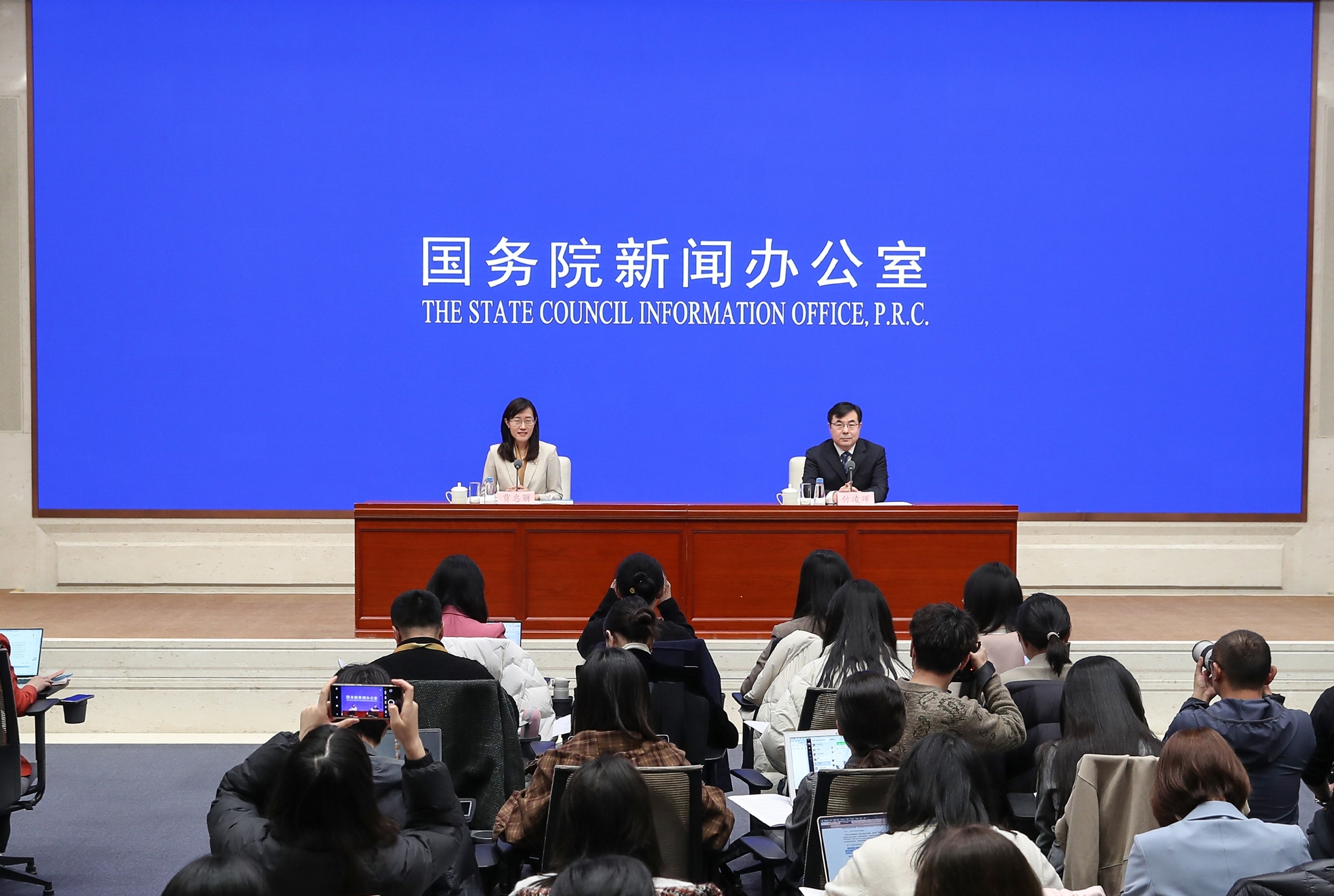
China.org.cn | March 27, 2026


Jia Huili:
Thank you, Mr. Fu. The floor is now open for questions. Please identify the news outlet you represent before asking your questions.
Yicai:
The year 2026 is the first year of the 15th Five-Year Plan period, and January-February is also a barometer for the whole year. How would you evaluate the performance of China's economic operation in these two months? What are the main highlights and positive changes? Thank you.
Fu Linghui:
Thank you for your questions. This year marks the first year of the 15th Five-Year Plan period, and China's economic performance in January and February has drawn widespread attention. Since the beginning of this year, the international environment has been volatile with rising external risks, especially the spillover risks of geopolitical conflicts. Even so, under the strong leadership of the CPC Central Committee, all regions and departments have earnestly implemented more proactive and effective macroeconomic policies, focusing on maximizing the integrated effect of existing and new policies. In the January-February period, production and supply grew rapidly, domestic demand expanded steadily, employment and prices remained generally stable, and new quality productive forces were fostered and strengthened. Put simply, the economy got off to a strong start in the January-February period. The characteristics were as follows:
First, production grew at a relatively rapid pace. In the industrial sector, the total value added of industrial enterprises above designated size increased 6.3% year on year in the first two months, 1.1 percentage points faster than in December. This growth was mainly driven by improved domestic demand, stronger export momentum and the continued effect of macroeconomic policies. Within the sector, equipment manufacturing made a particularly notable contribution to overall industrial growth. Its value added rose 9.3% year on year, accounting for 47.4% of total growth among industrial enterprises above designated size. In the service sector, growth accelerated due to the combined effects of the Spring Festival and consumption-promoting policies. In the first two months, the Index of Services Production grew 5.2% year on year, 0.2 percentage point faster than in December. The development of artificial intelligence also notably boosted demand for information services. In the first two months, the production index of information transmission, software and IT services increased 10.1% year on year, continuing the rapid growth the sector has sustained in recent years. Meanwhile, boosted by the Spring Festival, the production index for transportation, accommodation and catering services rebounded notably in January-February from December.
Second, domestic demand expanded. In terms of consumption, the extended Spring Festival holiday provided a strong boost to start the year, while consumer goods trade-in programs continued to take effect. Cultural tourism, leisure and entertainment activities remained lively, service spending grew rapidly, and overall market sales posted a clear rebound. In the first two months, total retail sales of consumer goods increased 2.8% year on year, 1.9 percentage points faster than in December — a figure that primarily covers goods transactions. Retail sales of services increased 5.6%, significantly outpacing those of goods. In terms of investment, with 2026 marking the first year of the 15th Five-Year Plan period, efforts were made across the board to seize opportunities and accelerate the launch and construction of major projects, driving a rebound in investment. In the first two months, investment in fixed assets increased 1.8% year on year, while that of the previous year was down 3.8%, thus reversing the downward trend. Specifically, investment in infrastructure grew 11.4% year on year, well above the full-year growth rate of 2025.
Third, foreign trade maintained strong growth. In the first two months, foreign trade grew rapidly on the combined strength of improving global demand, the rise of emerging industries worldwide, and the growing competitiveness of China's advantageous products. In the first two months, the total value of imports and exports of goods increased 18.3% year on year, accelerating sharply compared with overall growth in 2025. Looking at major trading partners, imports and exports with ASEAN, the EU and Belt and Road partner countries all grew at around 20%. The rapid growth of imports and exports reflects the strong resilience and vitality of China's foreign trade.
Fourth, employment and prices remained generally stable. In terms of employment, affected by Spring Festival dynamics, the national urban surveyed unemployment rate rose slightly in January and February compared with last December. However, the average rate for the first two months held steady at 5.3%, unchanged from the same period last year, indicating that the stable employment situation in China has not changed. Among key groups, rural migrant workers returned to their jobs after the Spring Festival holiday in a steady manner, keeping employment stable. In terms of prices, the CPI recovered moderately in the first two months, buoyed by recovering market demand and the boost from the Spring Festival. In January-February, China's CPI rose 0.8% year on year, the same as last December, but higher than in the fourth quarter and the whole of 2025. Excluding food and energy, categories known for their outsized influence on price swings, core CPI rose 1.3% year on year in January-February, also picking up from December. These trends indicate a positive momentum in price.
Fifth, new growth drivers developed at an accelerated pace. The sound economic performance in the first two months was inseparable from the cultivation of new quality productive forces and the growth and strengthening of new growth drivers. The deep integration of sci-tech and industrial innovation, the accelerated expansion of the "AI plus" initiative, and the sound development of the digital economy all contributed to improvements across the industrial chain. In the first two months, the value added of computer, communication and other electronic equipment manufacturing increased 14.2% year on year. The rapid growth of the electronics industry also drove growth in upstream raw material sectors, especially the chemical industry. In the first two months, the value added of chemical raw materials and chemical products manufacturing increased 7.6% year on year, sustaining relatively fast growth. At the same time, the development of AI and the rising demand for computing power significantly boosted upstream energy industries. In the first two months, the value added of electricity and heat production and supply industries increased 5.1% year on year, 4 percentage points faster than last December. New growth drivers played an even stronger enabling role along the industrial chain. It should also be noted that, as the green transition advances, the manufacturing of new energy equipment has accelerated significantly, with many such products maintaining rapid growth. All these factors have injected new momentum into economic growth.
Overall, China's economy got off to a strong start in the January-February period and continued to move toward new growth drivers and improved performance. At the same time, we are aware that the external environment remains complex, with rising risks from geopolitical conflicts and increasing uncertainty in their spillover effects. Domestically, the mismatch between strong supply and relatively weak demand persists, and some enterprises are facing operational difficulties. Looking ahead, we will fully implement the decisions and arrangements made at the Central Conference on Economic Work and the annual sessions of the National People's Congress and the Chinese People's Political Consultative Conference. We will carry out more proactive and effective macroeconomic policies, continue to expand domestic demand and optimize supply, and develop new quality productive forces based on local conditions. We will also further advance the construction of a national unified market, thereby promoting sustained and sound economic growth and better ensuring and improving people's well-being. Thank you.