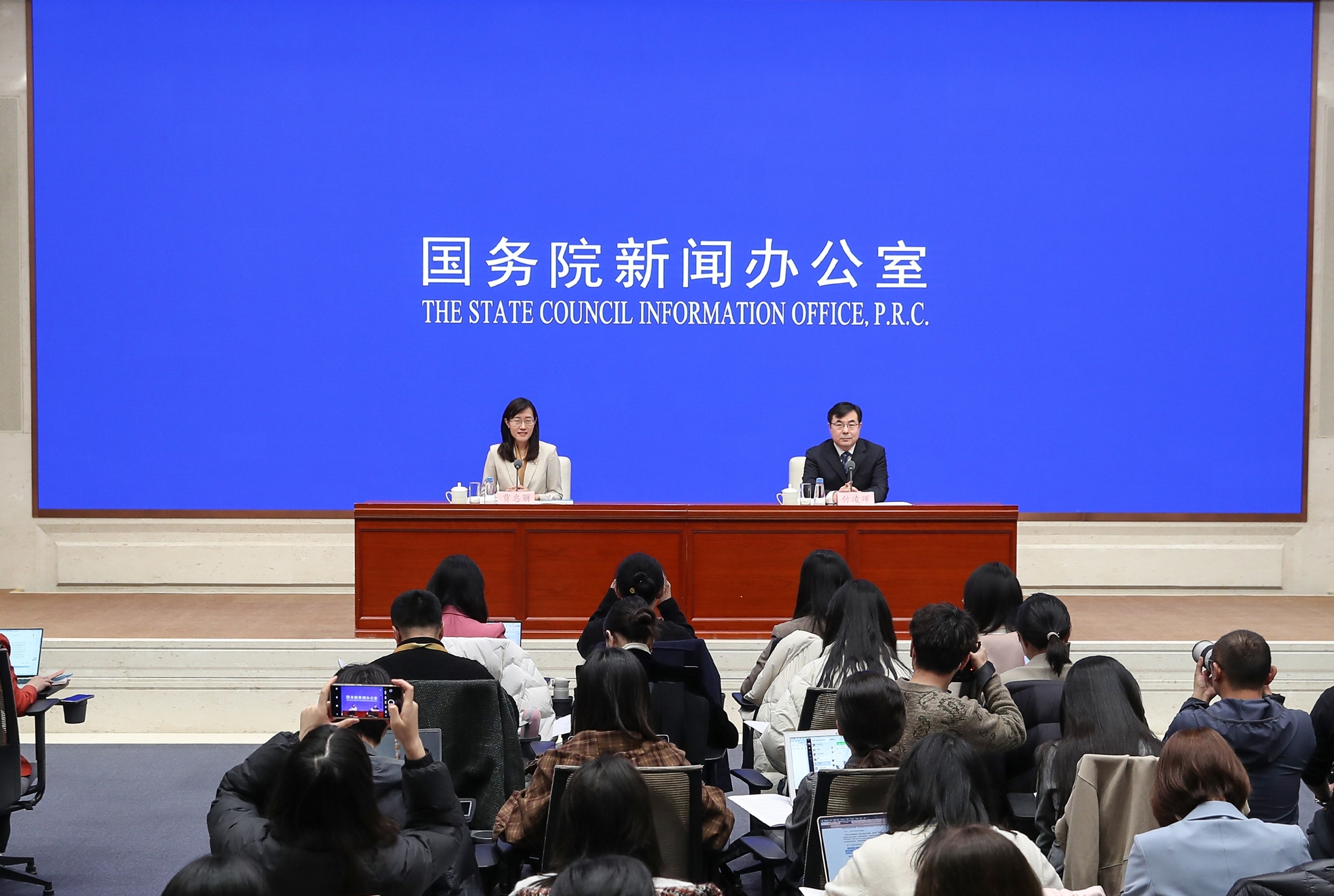
China.org.cn | March 27, 2026


Speaker:
Mr. Fu Linghui, spokesperson and chief economist of the National Bureau of Statistics (NBS) and director general of the Department of Comprehensive Statistics of the NBS
Chairperson:
Ms. Jia Huili, deputy director general of the Press Bureau of the State Council Information Office (SCIO) and spokesperson of the SCIO
Date:
March 16, 2026
Jia Huili:
Ladies and gentlemen, good morning. Welcome to this press conference held by the State Council Information Office (SCIO). This is a regular briefing on China's economic data. Today, we are joined by Mr. Fu Linghui, spokesperson and chief economist of the National Bureau of Statistics (NBS) and director general of its Department of Comprehensive Statistics. Mr. Fu will brief you on China's economic performance in the first two months of 2026 and then take your questions.
Now, I would like to give the floor to Mr. Fu for his introduction.
Fu Linghui:
Thank you, Ms. Jia. Good morning, everyone. I will start by briefing you on the main economic indicators for the first two months of 2026 and then take your questions.
In January-February, the national economy got off to a robust and promising start.
In the first two months, under the strong leadership of the Central Committee of the Communist Party of China (CPC) with Comrade Xi Jinping at its core, all regions and departments conscientiously implemented the decisions and arrangements made by the CPC Central Committee and the State Council, adhered to the general principle of pursuing progress while ensuring stability, implemented more proactive and effective macro policies, and stepped up counter- and cross-cyclical adjustments. All regions and departments further boosted domestic demand, improved supply and optimized the allocation of new resources while making the best use of existing ones. As a result, production and supply accelerated, market demand maintained a steady growth, employment and prices were generally stable, and new quality productive forces developed and thrived. The national economy got off to a robust and promising start.
First, industrial production accelerated and equipment manufacturing and high-tech manufacturing showed good growth momentum.
In the first two months, the total value added of industrial enterprises above designated size grew by 6.3% year on year, 1.1 percentage points faster than that in December. In terms of sectors, the value added of mining went up by 6.1% year on year, manufacturing up by 6.6%, and the production and supply of electricity, thermal power, gas and water up by 4.7%. The value added of equipment manufacturing increased by 9.3% year on year, and that of high-tech manufacturing rose by 13.1%, which were 3 percentage points and 6.8 percentage points faster than that of industrial enterprises above designated size, respectively. In terms of ownership, the value added of state-holding enterprises increased by 4.2% year on year; that of share-holding enterprises was up by 6.9%; that of enterprises funded by foreign investors or investors from Hong Kong, Macao and Taiwan was up by 4%; and that of private enterprises was up by 7.4%. In terms of products, the output of 3D printing devices, lithium-ion batteries and industrial robots grew by 54.1%, 42.6% and 31.1% year on year, respectively. In February, the total value added of industrial enterprises above designated size went up by 0.83% month on month. In February, the Manufacturing Purchasing Managers' Index stood at 49%, and the Production and Operation Expectation Index was 53.2%, 0.6 percentage point higher than that of the previous month.
Second, the service sector grew rapidly and modern services developed quickly.
In the first two months, the Index of Services Production grew by 5.2% year on year, 0.2 percentage point faster than that in December. Specifically, the production index of information transmission, software and information technology services, leasing and business services, finance, transportation, storage and postal services, and hotels and catering services grew by 10.1%, 8.2%, 7%, 6.3% and 5.4%, respectively. In February, the Business Activity Index for Services was 49.7%, 0.2 percentage point higher than that of the previous month, and the Business Activity Expectation Index for Services was 55.8%. Specifically, the Business Activity Index for hotels, catering, and culture, sports and entertainment stayed within the high expansion range of 60% and above.
Third, growth of market sales picked up and service retails grew quickly.
In the first two months, the total retail sales of consumer goods reached 8,607.9 billion yuan ($1,249.6 billion), up by 2.8% year on year, 1.9 percentage points faster than that in December. Analyzed by different areas, retail sales of consumer goods in urban areas reached 7,444.9 billion yuan, up by 2.7%; and that in rural areas reached 1,163 billion yuan, up by 3.2%. Grouped by consumption patterns, retail sales of goods were 7,581.5 billion yuan, up by 2.5%; and the income of catering was 1,026.4 billion yuan, up by 4.8%. Sales of basic living goods and certain upgraded goods grew quickly. The retail sales of clothes, shoes, hats and textiles, of grain, oil and food, of communication equipment, and of gold, silver and jewelry by enterprises above designated size increased by 10.4%, 10.2%, 17.8% and 13% year on year, respectively. In February, total retail sales of consumer goods increased by 0.81% month on month. In the first two months, retail sales of services went up by 5.6% year on year, 0.1 percentage point faster than that of last year. Specifically, that of communication information services, tourism consultation and rental services, and cultural, sports and leisure services grew quickly. In the first two months, the online retail sales of goods and services reached 3,254.6 billion yuan, up by 9.2% year on year. Specifically, the online retail sales of goods were 2,081.2 billion yuan, up by 10.3%, accounting for 24.2% of the total retail sales of consumer goods. The online retail sales of services totaled 1,173.4 billion yuan, up by 7.3%.
Fourth, fixed-asset investment shifted from decline to growth and infrastructure investment grew relatively rapidly.
In the first two months, the national investment in fixed assets (excluding rural households) reached 5.2721 trillion yuan, up by 1.8% year on year. It dropped by 3.8% in 2025. Investment in fixed assets was up by 5.2% with the investment in real estate development deducted. Specifically, investment in infrastructure grew by 11.4% year on year, that in manufacturing grew by 3.1%, and that in real estate development declined by 11.1%. The floor space of new commercial buildings sold was 92.93 million square meters, down by 13.5% year on year; and the total sales of new commercial buildings were 818.6 billion yuan, down by 20.2%. By industry, investment in the primary industry went up by 17.4% year on year, that in the secondary industry was up by 5.4%, and that in the tertiary industry was down by 0.4%. Private investment decreased by 2.6% year on year, with the decline narrowing by 3.8 percentage points compared with the whole of last year. Excluding real estate development investment, private investment grew by 1.0%. Investment in high-tech industries increased by 5.1% year on year, among which investment in the manufacture of aircraft, spacecraft and related equipment, R&D and design services sector, and information services sector increased by 20.2%, 20.6% and 16.5%, respectively. In February, fixed-asset investment (excluding rural households) increased by 0.39% month on month.
Fifth, imports and exports of goods grew quickly and the trade structure continued to be optimized.
From January to February, the total imports and exports of goods was 7.7321 trillion yuan, an increase of 18.3% year on year, accelerating by 13.4 percentage points compared with December. The total value of exports was 4.6178 trillion yuan, up by 19.2%; and the total value of imports was 3.1143 trillion yuan, up by 17.1%. General trade imports and exports increased by 13.5% year on year. Imports and exports with Belt and Road partner countries grew by 20.0%. Imports and exports by private enterprises increased by 22.8%. Exports of mechanical and electrical products increased by 24.3%.
Sixth, employment was generally stable and the surveyed urban unemployment rate was unchanged year on year.
In the first two months, the average surveyed urban unemployment rate nationwide was 5.3%, unchanged from the same period last year. In February, the national surveyed urban unemployment rate was 5.3%, 0.1 percentage point higher than that of the previous month. The surveyed unemployment rate of population with local household registration was 5.4%; and that of population with non-local household registration was 5.0%, among which, the rate of the population with non-local agricultural household registration was 5.2%. The surveyed urban unemployment rate in 31 major cities was 5.1%. Employees of enterprises worked an average of 48.1 hours per week.
Seventh, the growth of consumer prices increased and the decline of producer prices for industrial products narrowed.
From January to February, the national Consumer Price Index (CPI) increased by 0.8% year on year, rising by 0.2% in January and 1.3% in February. Grouped by commodity categories, in the first two months, prices for food, tobacco, alcohol, and catering services were up by 0.6% year on year; clothing up by 1.9%; housing down by 0.1%; articles and services for daily use up by 2.7%; transportation and communication down by 2.1%; education, culture and recreation up by 1.0%; medical services and health care up by 1.8%; and other articles and services up by 14.3%. Within the category of food, tobacco, alcohol and catering services, prices for pork went down by 11.2%, grain down by 0.2%, fresh fruits up by 4.5%, and fresh vegetables up by 8.8%. The core CPI, excluding the prices of food and energy, went up by 1.3% year on year. From a month-on-month perspective, the national CPI rose by 0.2% in January, and by 1.0% in February.
From January to February, the national Producer Price Index (PPI) for industrial products fell by 1.2% year on year. On a monthly basis, January decreased by 1.4% year on year and rose by 0.4% month on month, and February decreased by 0.9% year on year and rose by 0.4% month on month. From January to February, the purchasing prices for industrial producers nationwide fell by 1.1% year on year.
Overall, from January to February, major economic indicators rebounded significantly and the national economy got off to a good start. However, it should also be noted that the impact of changes in the external environment has deepened, geopolitical risks continue to increase, and there remain old problems and new challenges in domestic economic development and transformation, with some enterprises experiencing difficulties in operation. In the next stage, we must adhere to Xi Jinping Thought on Socialism with Chinese Characteristics for a New Era as our guide, thoroughly implement the guiding principles of the 20th CPC National Congress and the plenary sessions of the 20th CPC Central Committee, and earnestly carry out the decisions and arrangements of the Central Conference on Economic Work and the national "two sessions." We will fully, accurately and comprehensively apply the new development philosophy, accelerate the building of a new development pattern, and focus on promoting high-quality development. We will uphold the general principle of pursuing progress while ensuring stability, implement a more proactive and effective macro policy, and develop new quality productive forces based on local conditions. We will focus on stabilizing employment, enterprises, markets and expectations, and promote effective qualitative improvement and reasonable quantitative growth of the economy. Thank you.