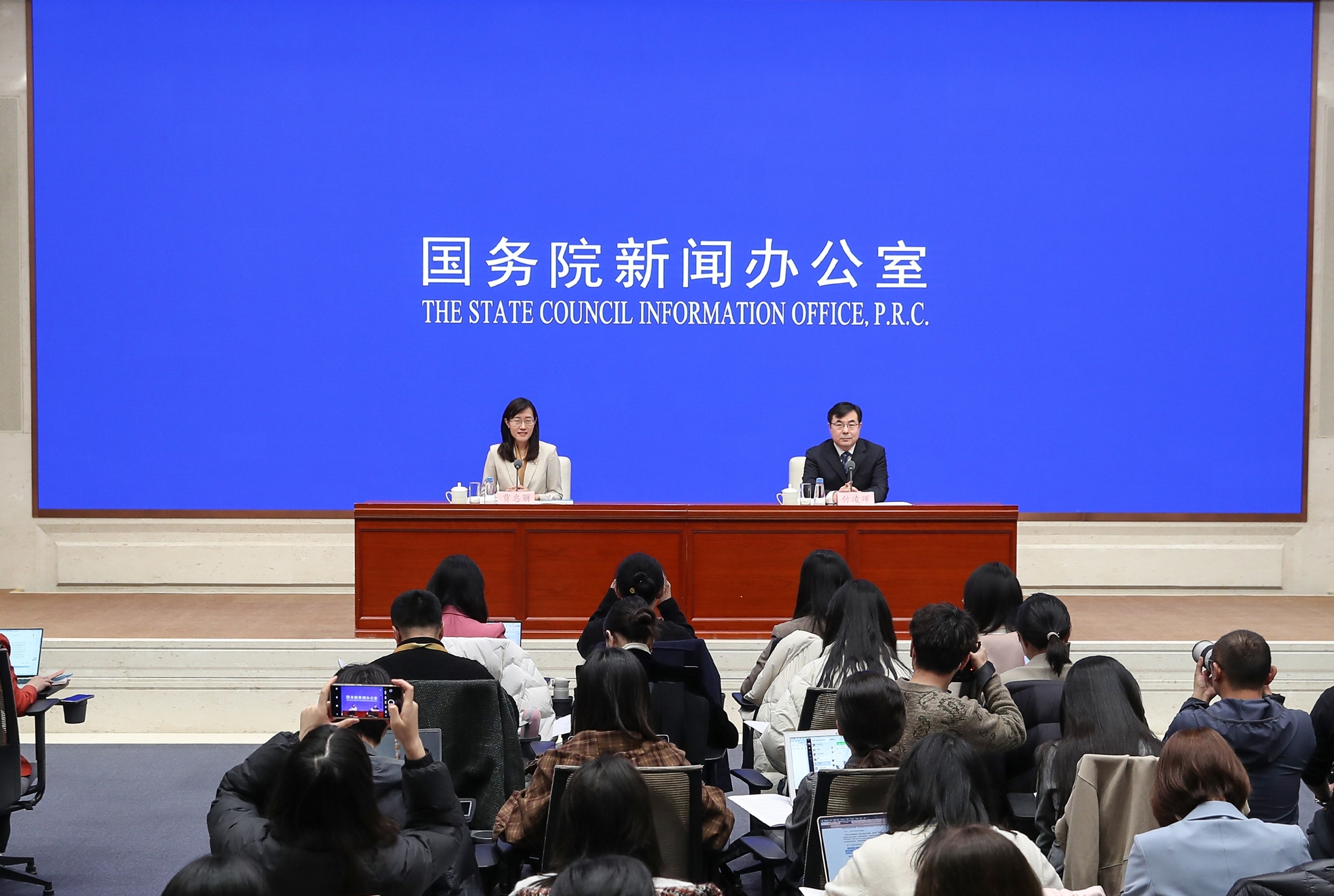
China.org.cn | March 27, 2026


Jia Huili:
The last question, please.
Economic Daily:
In the context of global economic uncertainty still being relatively high, how do you evaluate the performance of import and export data for the first two months of the year? Thank you.
Fu Linghui:
Thank you for your question. Regarding the performance of foreign trade at the beginning of the year, the China Customs has already released the relevant data. The data exceeded expectations, indicating that the development of foreign trade this year is very impressive. Last year, with the complex changes in the international situation, China's foreign trade pressed forward against pressure and achieved steady progress. This year marks the beginning of the 15th Five-Year Plan period. Based on the relatively strong growth in foreign trade last year, the growth achieved at the beginning of the year reflects the strong vitality and resilience of China's foreign trade. According to the released data, in the first two months, China's imports and exports of goods grew rapidly, and the trade structure continued to be optimized. Improvement in both quantity and quality was evident, highlighting the development vigor. The main features are as follows.
First, imports and exports have accelerated significantly. Affected by factors such as the marginal rebound in global trade demand, positive development in artificial intelligence applications, and the Spring Festival holiday, from January to February, the total value of goods imports and exports increased by 18.3% year-on-year, with the growth rate significantly higher than that of the whole year last year. Both exports and imports saw a rebound in growth from January to February with goods exports growing by 19.2%, 13.1 percentage points higher than that of the whole year last year. Goods imports grew by 17.1%, increasing by 16.6 percentage points. It should be noted that the rebound in goods import growth outpaced that of exports, which on one hand reflects that improved domestic demand is driving imports, and at the same time, it also suggests that new opportunities are provided for trade development of countries around the world.
Second, the strategy of foreign trade diversification has continued to yield positive results. On the basis of mutual benefit and win-win cooperation, China has expanded trade exchanges with countries around the world, promoted by high-quality Belt and Road cooperation. It is this unilateral and voluntary opening up in an orderly manner, as well as the advanced construction of pilot free trade zones, that has continued the support and growth of foreign trade. In the first two months, China's total imports and exports with ASEAN and the EU increased by 20.3% and 19.9% respectively, and imports and exports with countries and regions participating in the Belt and Road Initiative grew by 20%. China's circle of friends in foreign trade is steadily expanding.
Third, new growth drivers have been gaining strength. With China's industrial upgrading, the competitiveness of export products has increased, the proportion of industrial manufactured goods in total exports has risen, and exports of mechanical and electrical products as well as high-tech products have grown rapidly, driving the growth of foreign trade. From January to February, exports of mechanical and electrical products increased by 24.3%, and exports of high-tech products increased by 24.2%. Exports of products with higher technical content such as integrated circuits and ships have maintained a good growth momentum. At the same time, the positive development of digital trade and green trade is also conducive to forming new growth drivers.
Fourth, development vitality has continued to be unleashed. The energy of China's foreign trade is reflected in the rapid growth of new business forms and models. Within these proactive efforts to explore overseas markets and open up new spaces, new opportunities have been created for foreign trade. In the first two months, imports and exports of private enterprises increased by 22.8% year-on-year, outpacing the total growth rate. Imports and exports of foreign-invested enterprises grew by 15.3%, maintaining rapid growth. Several factors are crucial for viewing foreign trade development. First is global demand. China’s products, in terms of both quality and standards, are highly adaptable to the needs of the foreign markets. Second is that China has high-quality supply. This is reflected not only in the quality of the competitiveness of products, but also in the ability to ensure stable procurement. Against the backdrop of an international landscape fraught with instability and changes, China can consistently and steadily provide high-quality products to various countries. Third, China's foreign trade development has always been built on the basis of mutual benefit and win-win results. It not only provides the world with high-quality products but also actively expands the imports. By hosting the China International Import Expo, China offers its development opportunities to the global community.
Overall, China's imports and exports of goods have maintained sound growth since the beginning of this year, with a solid foundation and strong vitality driving the development of foreign trade. However, we should also recognize that the external environment remains complex, with many unstable and uncertain factors. The stabilization of foreign trade continues to face pressure. In the next stage, we will adhere to win-win cooperation, steadily expand institutional opening-up, actively advance autonomous opening-up, promote the stable scale and optimized structure of foreign trade, cultivate and strengthen new drivers of foreign trade development, advance high-quality BRI cooperation, further expand imports, and promote the balanced development of foreign trade. Thank you.
Jia Huili:
Today's press conference has now concluded. Thank you to our speakers and to our friends from the media. See you next time.
Translated and edited by Yang Chuanli, You Jiaxin, Zhu Bochen, Wang Ziteng, Liu Caiyi, Lin Liyao, Liao Jiaxin, Xu Xiaoxuan, Xu Kailin, Zhang Tingting, Jay Ian Birbeck, David Ball, Tudor Bentley Finneran, Wang Wei, Fan Junmei, Zhou Jing, Zhang Junmian, Huang Shan, Li Huiru, Yuan Fang. In case of any discrepancy between the English and Chinese texts, the Chinese version is deemed to prevail.