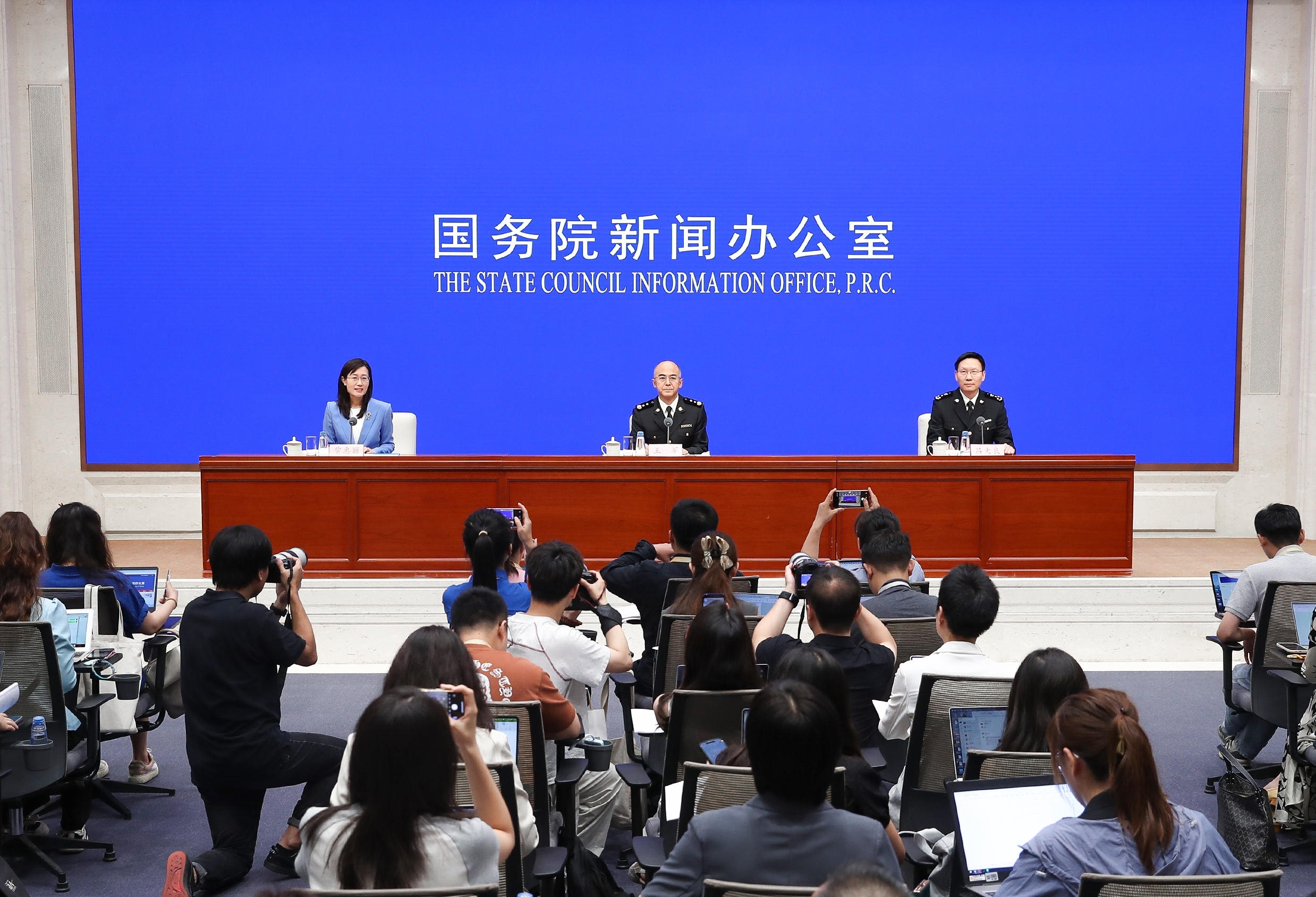
China.org.cn | September 3, 2026


Economic Daily:
Private enterprises have maintained their position as China's largest foreign trade contributors for years running. Just now, the spokesperson also mentioned that exports by private businesses have continued to grow steadily. Could you please elaborate on the performance of China's private enterprises in imports and exports since the beginning of this year? Thank you.
Wang Jun:
Thank you. I'd like to invite Mr. Lyu Daliang to answer your question.
Lyu Daliang:
Thank you for your question. In the first half of the year, imports and exports by private enterprises reached 14.53 trillion yuan, an increase of 17%, with exports up 12.7% and imports up 26.2%, maintaining solid growth momentum.
Many of you following the World Cup may have noticed a strong presence of Chinese products at the venues, many of which come from our private enterprises. If enterprises are like athletes on the field, I would like to use a few keywords to describe the performance of China's private enterprises.
First, their position as the key player is solid. In the first half of the year, private enterprises maintained their position as China's largest foreign trade contributors, with the number of active trading firms surpassing 660,000 and their overall scale steadily expanding. Private enterprises accounted for 57% of the country's total trade value, contributing nearly 60% of the China's foreign trade growth.
Second, technological capabilities have been constantly improving. The core competitiveness of China's private enterprises lies in independent innovation. In response to global trends towards green and digital development, the share of high-tech and innovative products in private-sector exports has continued to rise. In the first half of the year, high-tech exports by private enterprises increased by 35.9%, with high-end equipment, new materials, and electronic information products rising by 29.8%, 44.5%, and 43.1%, respectively. Exports of the "new trio", namely, electric vehicles, lithium-ion batteries, and photovoltaic products increased by 45.8%, with private enterprises emerging as an important supplier for global green transition.
Third, they have delivered strong performances. Private enterprises have continued to strengthen their foothold in traditional markets, expand into new markets and tap into potential markets, building a broad and resilient global trade network. In the first half of the year, private enterprises achieved growth in imports and exports with more than 180 countries and regions. Among them, trade with emerging markets such as ASEAN, Latin America and Africa increased by 17%, 12.1% and 25.2%, respectively, and trade with traditional markets such as the EU also registered good performance.
Fourth, they have responded in an agile manner. The market, much like a sports arena, is subject to rapid changes and fleeting opportunities. Private enterprises take the initiative to recognize and adapt to changes, leveraging their keen perception and flexible production capacity to translate market trends into tangible orders. Taking Yiwu as an example, private enterprises have given full play to their pioneering spirit, seized the opportunities presented by market procurement policies and quickly responded to the diverse and ever-changing global demands, turning small commodities into vast markets and a major industry. In the first half of the year, Yiwu's exports via market procurement reached 347.25 billion yuan, increasing by 16.4%.
In athletic competition, what ultimately matters is strength; in international markets, what matters most is sustained competitiveness. Chinese private enterprises have demonstrated excellent qualities and robust capabilities. We believe that in the arena of international trade, Chinese private enterprises will continue to shine with "Chinese brilliance." Thank you.