China.org.cn | March 27, 2026


Red Star News:
The 15th Five-Year Plan period is very critical for promoting carbon peak work. Compared with the 14th Five-Year Plan period, what new arrangements does the draft outline of the 15th Five-Year Plan make for the comprehensive green transformation of economic and social development, and how will they be implemented? Thank you.
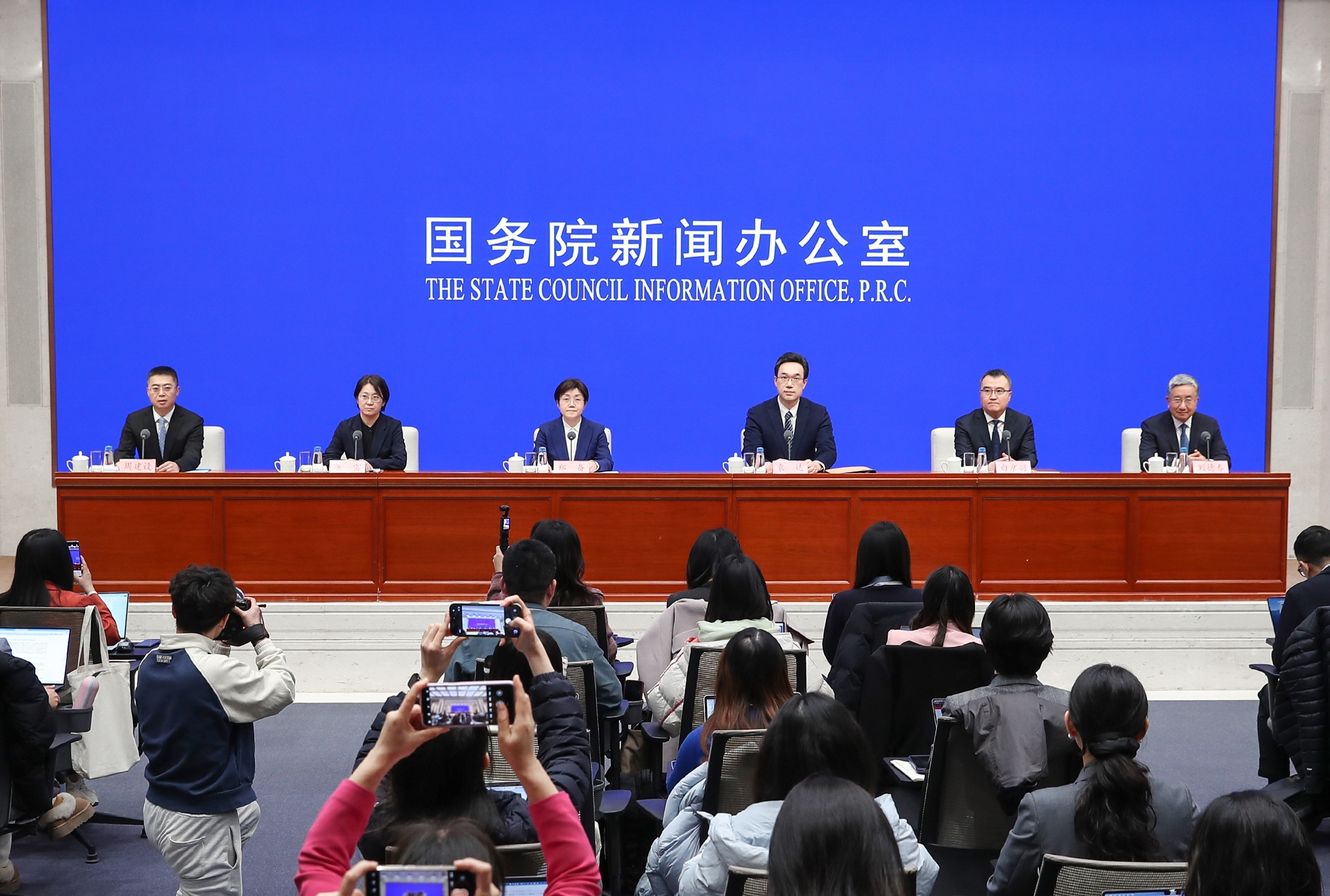
Zheng Bei:
During the 14th Five-Year Plan period, we have indeed achieved historic accomplishments in green development. The draft outline of the 15th Five-Year Plan has also made arrangements in this area. I would like to invite Mr. Yuan to answer this question.
Yuan Da:
Thank you for your question. The 15th Five-Year Plan period is a key period for accelerating the comprehensive green transformation of economic and social development, and also a decisive period for achieving the carbon peak goal. Compared with the 14th Five-Year Plan, the draft outline of the 15th Five-Year Plan highlights the "low-carbon" requirement more prominently in implementing the concept of green development. First, it explicitly proposes taking carbon peaking and carbon neutrality as the driving force to promote carbon reduction, pollution reduction, greening and growth in a coordinated manner. Second, it fully implements the dual control system of total carbon emissions and emission intensity. It should be noted that energy activities are the main source of carbon emissions, and shifting from dual control of energy consumption to dual control of carbon emissions does not mean relaxing energy-saving efforts. Energy saving is still the most direct, economical and effective way to reduce carbon.
In this regard, the draft outline emphasizes building "one mechanism" and carrying out "three tasks."
The "one mechanism" refers to an incentive and constraint mechanism covering all types of entities. We will promote the introduction of the Comprehensive Evaluation and Assessment Measures for Carbon Peaking and Carbon Neutrality, scientifically and reasonably allocate the dual control targets for carbon emissions, strengthen responsibilities for achieving carbon emission targets, and carry out local carbon assessments in an orderly manner. At the same time, we will adhere to the combination of policy guidance and market incentives, establish and improve the policy and legal system, and steadily implement industry carbon control, enterprise carbon management, project carbon evaluation and product carbon footprints.
The "three tasks" will be carried out in depth around three aspects: energy, industry, and production and lifestyle.
First, we will accelerate the move toward new and green energy. During the 14th Five-Year Plan period, China's installed capacity of renewable energy accounted for about 60% of total capacity, with its contribution to global newly installed renewable energy continuing to exceed 50%. During the 15th Five-Year Plan period, we will make greater efforts to develop non-fossil energy, accelerate the construction of a new type of power system, speed up the process whereby new electricity demand is covered by newly generated clean energy, and promote the peaking of coal and oil consumption.
Second, we will accelerate industrial carbon reduction and advance green development. On one hand, we will pursue "additive" strategies: vigorously developing green and low-carbon technologies and industries, facilitating the orderly transfer of eligible energy-intensive industries to regions with high concentrations of renewable energy resources, establishing about 100 national zero-carbon parks, and planning more than 10,000 kilometers of zero-carbon transportation corridors. On the other hand, we will pursue "subtractive" strategies: implementing major projects for energy-saving and carbon-reducing transformation in key industries, accelerating the phasing out of outdated and inefficient production capacity, effectively controlling high energy consumption and high emissions projects, promoting low-carbon substitution of transportation power, and improving energy efficiency in emerging fields such as computing power facilities and 5G base stations.
Third, we will accelerate resource conservation and efficiency enhancements in production and daily life. We will prioritize conservation, strengthen whole-process management and full-chain saving of water, land, minerals and other resources, vigorously develop the circular economy, and support the growth and expansion of the remanufacturing industry. We will carry out nationwide green and low-carbon actions to jointly practice a lifestyle and consumption pattern that is simple, moderate, green, low-carbon, civilized and healthy.