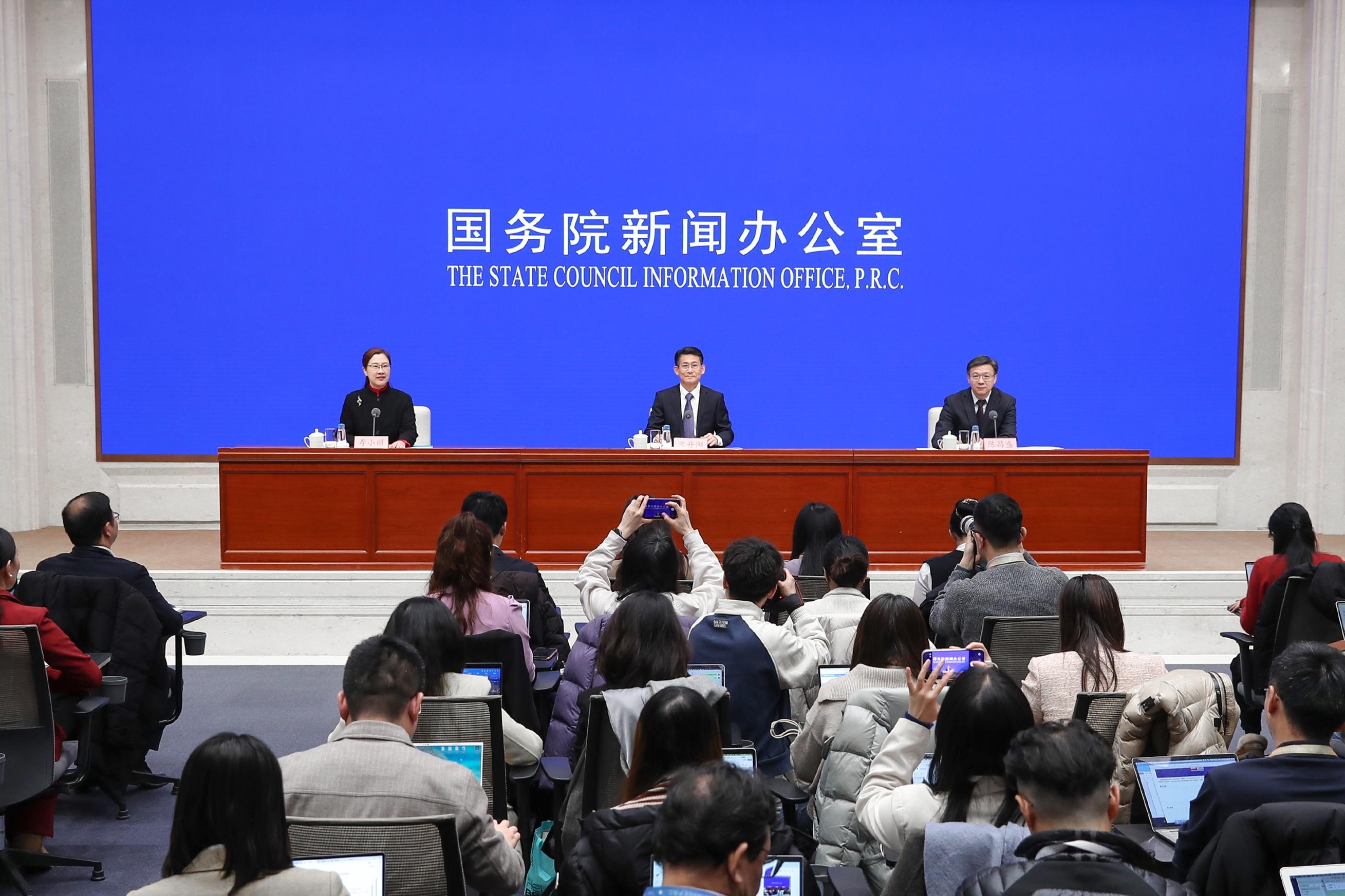
China.org.cn | March 20, 2026


Beijing Youth Daily:
This year's government work report proposes promoting quality and full employment. We have also noticed that many young people feel considerable pressure in the job market. Overall, how do you assess the employment situation this year? What measures will be taken to ease employment-related anxiety, particularly among young people? Thank you.
Shen Danyang:
Thank you for your question. I'd like to invite Mr. Chen to answer it.
Chen Changsheng:
Thank you for your question. This is a very important issue. Employment is the foundation of every family's livelihood. When everyone has a job, households can thrive and society as a whole can prosper. This year's government work report once again places employment in a prominent position, prioritizing employment stabilization as the top task among the "four priorities for stability," and puts forward a series of policy measures. These measures mainly focus on targeting overall scale, structural alignment and key demographic groups.
First, in terms of overall scale, the focus is on expanding employment capacity. This year, around 20 million people are expected to enter the job market. After deducting positions vacated through retirements and other reasons, approximately 12 million new urban jobs will still need to be created. Based on the relationship between economic growth and job creation in recent years, particularly over the past two years, achieving this level of employment will require economic growth of around 4.5% to 5%. This was an important consideration in setting this year's economic growth target. Stable economic growth is the foundation for stabilizing employment. At the same time, we will implement initiatives to stabilize jobs, expand employment capacity, and improve job quality. Targeted support will be provided to labor-intensive industries and sectors that generate large numbers of jobs. Temporary policies will continue, including job retention subsidies for enterprises that avoid or minimize layoffs, as well as job stabilization and expansion loans for small- and medium-sized enterprises (SMEs).
Second, structurally, the focus is on improving job matching. As many of you know, structural issues have become more prominent in the current employment landscape. Broadly speaking, there are two main types of mismatches. One type is a skills mismatch. Many industries are developing rapidly, but the skills of some workers do not match the needs of those industries. For example, market data show strong demand for positions related to artificial intelligence, yet the supply of talent remains limited, with a demand-to-supply ratio of about 3.5 to 1. The ratio stands at about 5.1 to 1 for new energy technology engineers and 5.2 to 1 for technical professionals in the robotics industry, pointing to significant talent shortages. Addressing the skills mismatch requires a stronger focus on education and training. In the short term, the priority is to deepen cooperation between industries and enterprises, carry out targeted skills training and build a number of public training bases. This year, government-subsidized vocational training is expected to reach over 10 million participants. At the same time, we will optimize the discipline and program structure of universities to better align academic programs with practical needs. We will also implement initiatives to accelerate the development of urgently needed disciplines and majors, thereby helping address the skills mismatch. Another challenge is the mismatch in employment expectations. Many manufacturing industries, as well as services sectors such as household services and elderly care, face significant labor shortages. However, factors such as salary levels, career development prospects, and social recognition of certain occupations have limited the supply of workers. For instance, estimates from various sources suggest that the domestic service sector faces a shortage of more than 20 million workers. This year, several new measures will be introduced. The domestic service industry has long been dominated by an intermediary-based system. Going forward, efforts will be made to actively shift toward an employee-based model, allowing domestic service workers to become formal employees. This will enhance job stability and establish clear responsibility mechanisms. Policy support will also be strengthened, including expanded tax incentives and training subsidies.
Third, in terms of key groups, particular emphasis will be placed on young people. College graduates, migrant workers, and people facing employment difficulties are all key groups in employment work, with young people being the top priority. As everyone knows, employment for young people is of critical importance to families. This year, the number of college graduates is expected to reach a new record high of 12.7 million, and a series of measures will be taken to support their employment. For example, we will expand policy-supported positions, make better use of staffing resources in government agencies and public institutions, and maintain stable recruitment levels in these sectors. We will also encourage state-owned enterprises to gradually raise their campus hiring share. At the same time, support policies for employment in private enterprises will be strengthened, including tax incentives, training subsidies and loan interest subsidies. The one-off job expansion subsidy policy will also be extended. In addition, we will actively develop transitional positions, such as research assistant and teaching assistant posts, to accommodate the trend of some young people taking more time before entering full employment. We will also step up support for entrepreneurship. The rise of artificial intelligence has lowered the barriers to starting a business and created opportunities for would-be entrepreneurs. Therefore, we will strengthen support for entrepreneurship, including one-off start-up subsidies, higher ceilings on entrepreneurship guaranteed loans with greater government interest subsidies, and free or low-cost access to business incubation spaces. Employment affects every household. It takes the combined efforts of government, society and families to help young people find opportunities to apply their talents and realize their potential. Thank you.