China.org.cn | March 20, 2026


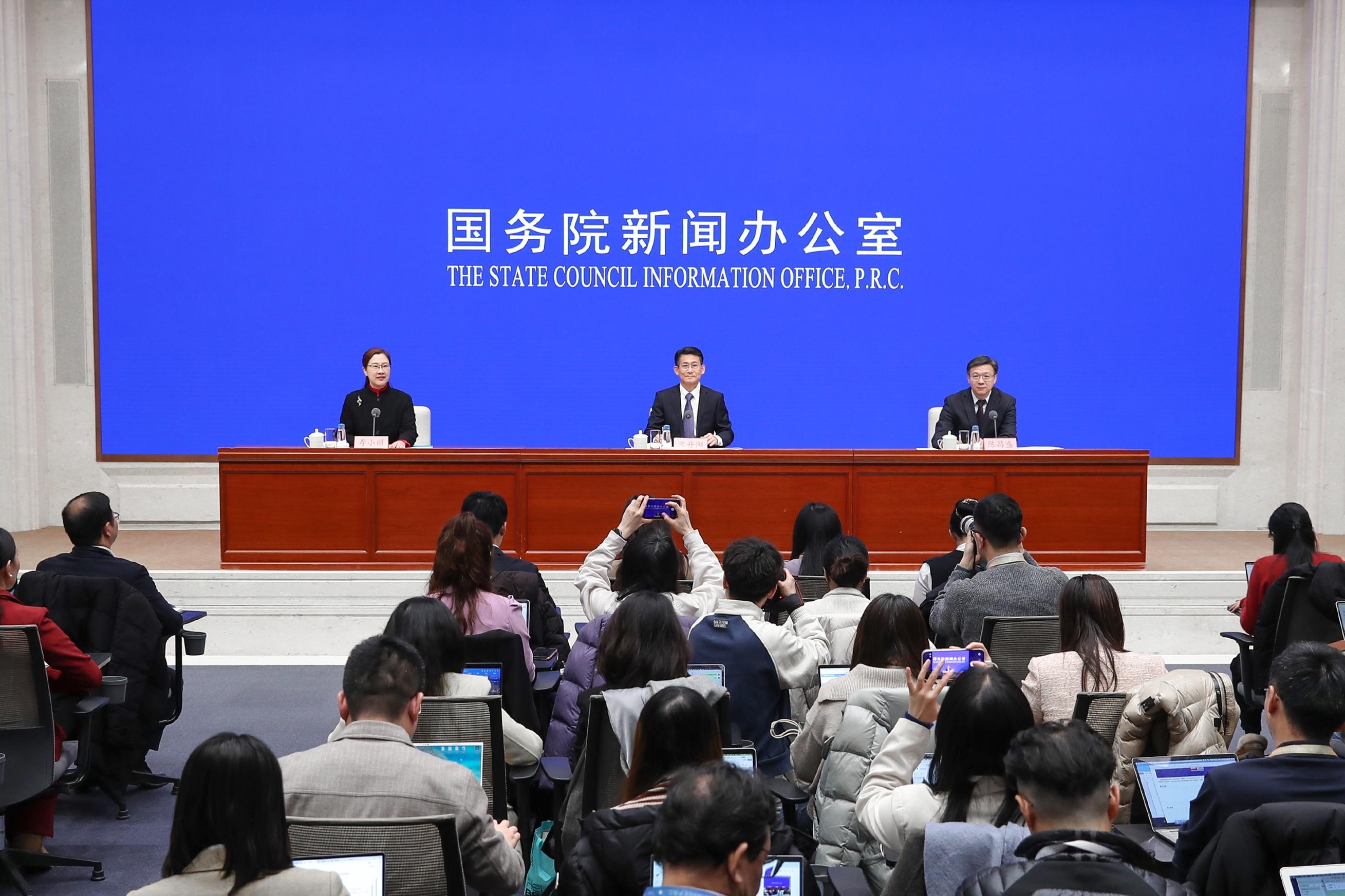
Speakers:
Mr. Shen Danyang, head of the government work report drafting team and director of the State Council Research Office
Mr. Chen Changsheng, member of the government work report drafting team and deputy director of the State Council Research Office
Chairperson:
Ms. Shou Xiaoli, director general of the Press Bureau of the State Council Information Office (SCIO) and spokesperson of the SCIO
Date:
March 5, 2026
Shou Xiaoli:
Ladies and gentlemen, good morning. Welcome to this briefing held by the State Council Information Office (SCIO). Today we have invited Mr. Shen Danyang, head of the government work report drafting team and director of the State Council Research Office, and Mr. Chen Changsheng, member of the government work report drafting team and deputy director of the State Council Research Office, to introduce the Report on the Work of the Government and answer your questions.
Now, I'll give the floor to Mr. Shen for his introduction.
Shen Danyang:
Good morning, everyone. I am very pleased to meet with you again to introduce the drafting of the Report on the Work of the Government. First of all, thank you for your interest in and coverage of the report and the government's work, as well as for your support for the work of the Research Office of the State Council.
The Central Committee of the Communist Party of China (CPC) and the State Council attached great importance to the drafting of the Report on the Work of the Government. General Secretary Xi Jinping presided over meetings of the Political Bureau of the CPC Central Committee and its standing committee to review the report, and made important instructions on multiple occasions, providing the basic principles for the drafting. Premier Li Qiang personally led the drafting of the report, convening executive meetings and plenary meetings of the State Council to study and discuss the report, requiring the comprehensive implementation of the decisions and deployments of the CPC Central Committee, and carefully refining the measures needed to put them into effect. Other leading officials of the State Council also provided instructions on the drafting and revisions of the report. The report fully implements Xi Jinping Thought on Socialism with Chinese Characteristics for a New Era, and the guiding principles of the 20th CPC National Congress and the sessions of the 20th CPC Central Committee, closely focusing on refining and implementing the deployments of the Central Economic Work Conference. It is divided into four parts, totaling about 19,000 Chinese characters. This year's report focuses on promoting high-quality development, with an emphasis on ensuring a strong start, enhancing innovation, improving people's livelihoods and ensuring practical implementation.
First, ensuring a good start to the 15th Five-Year Plan period (2026-2030). This year marks the first year for fully implementing the guiding principles of the fourth plenary session of the 20th CPC Central Committee and the launch of the 15th Five-Year Plan. It is also a crucial year for the government to bridge past and future efforts. As such, the report emphasizes coherence in structure, content and tasks. In reviewing past work, the report summarizes the previous year's work and outlines the achievements of the 14th Five-Year Plan period (2021-2025). In introducing the goals and tasks of the 15th Five-Year Plan period, it provides the public with a clearly understanding of the expected level of development in the next five years and the key measures that will be implemented. Many aspects of the 15th Five-Year Plan have already been integrated into this year's key tasks.
Second, emphasizing reform and innovation. The report thoroughly implements the reform deployments of the third plenary session of the 20th CPC Central Committee, proposing multiple reforms in key areas. These include the formulation of regulations for a unified national market, zero-based budgeting reform, and a categorized approach to promoting university reforms. The report proposes many innovative measures to accelerate the development and expansion of new drivers of growth and to accelerate high-level self-reliance and strength in science and technology. These include creating new forms of intelligent economy, enhancing the quality and capacity of the service sector, promoting advances in original innovation and breakthroughs in core technologies. The terms "reform" and "innovation" appear 75 times throughout the document, reflecting their high priority.
Third, prioritizing people's well-being. This has been a distinctive feature of the report in recent years. This year's report gives even greater prominence to safeguarding and improving public wellbeing. Proposed measures are more closely aligned with public concerns, such as emphasizing increased financial support for livelihoods, the formulation and implementation of plans for increasing incomes of urban and rural residents, and raising the proportion of government investment in public welfare projects. These efforts reflect a people-centered development philosophy and the government's commitment to delivering practical benefits, so that the public can have a stronger, tangible sense of gain.
Fourth, highlighting practicality and feasibility. The main tasks and policies outlined in the report have been proposed after thorough consideration, and aim to be proactive, practical, operable and feasible. The measures include establishing special fiscal-financial collaborative funds of 100 billion yuan to stimulate domestic demand, raising standards for public welfare subsidies, and integrating regular assistance into the coordinated implementation of the rural revitalization strategy. The report underscores the importance of making sure that officials have a correct understanding of what it means to perform well and act accordingly, insisting that achievements must be measured by their benefit to the people and through practical efforts.
In the drafting process, great importance was attached to seeking and incorporating suggestions from all sides. Premier Li Qiang personally presided over three symposiums. The drafting team held multiple thematic symposiums and conducted field research in various localities. The draft report was printed and distributed to all regions and departments to solicit feedback. The State Council website, together with many other websites, collected suggestions from netizens. The drafting team carefully analyzed and studied the feedback and adopted suggestions whenever possible. For example, concerns raised by netizens, such as addressing rat race competition, protecting platform workers' rights and interests, and ensuring primary-level medication access, all received positive responses in the report. The draft report, like last year's, strives to be concise and easy to understand, with a plain and down-to-earth writing style.
This morning, after Premier Li Qiang delivered the report to the fourth session of the 14th National People's Congress (NPC), preliminary feedback shows that the response from all quarters has been enthusiastic and highly positive. My colleagues who worked on drafting the report and I are deeply encouraged and inspired by this.
My colleague Mr. Chen and I are now happy to take questions from the media on the drafting process and related topics. Thank you.
Shou Xiaoli:
Thank you, Mr. Shen, for your opening remarks. We will now move to the Q&A session. Please identify the media outlet you represent before raising your questions. Please raise your hand to ask a question.