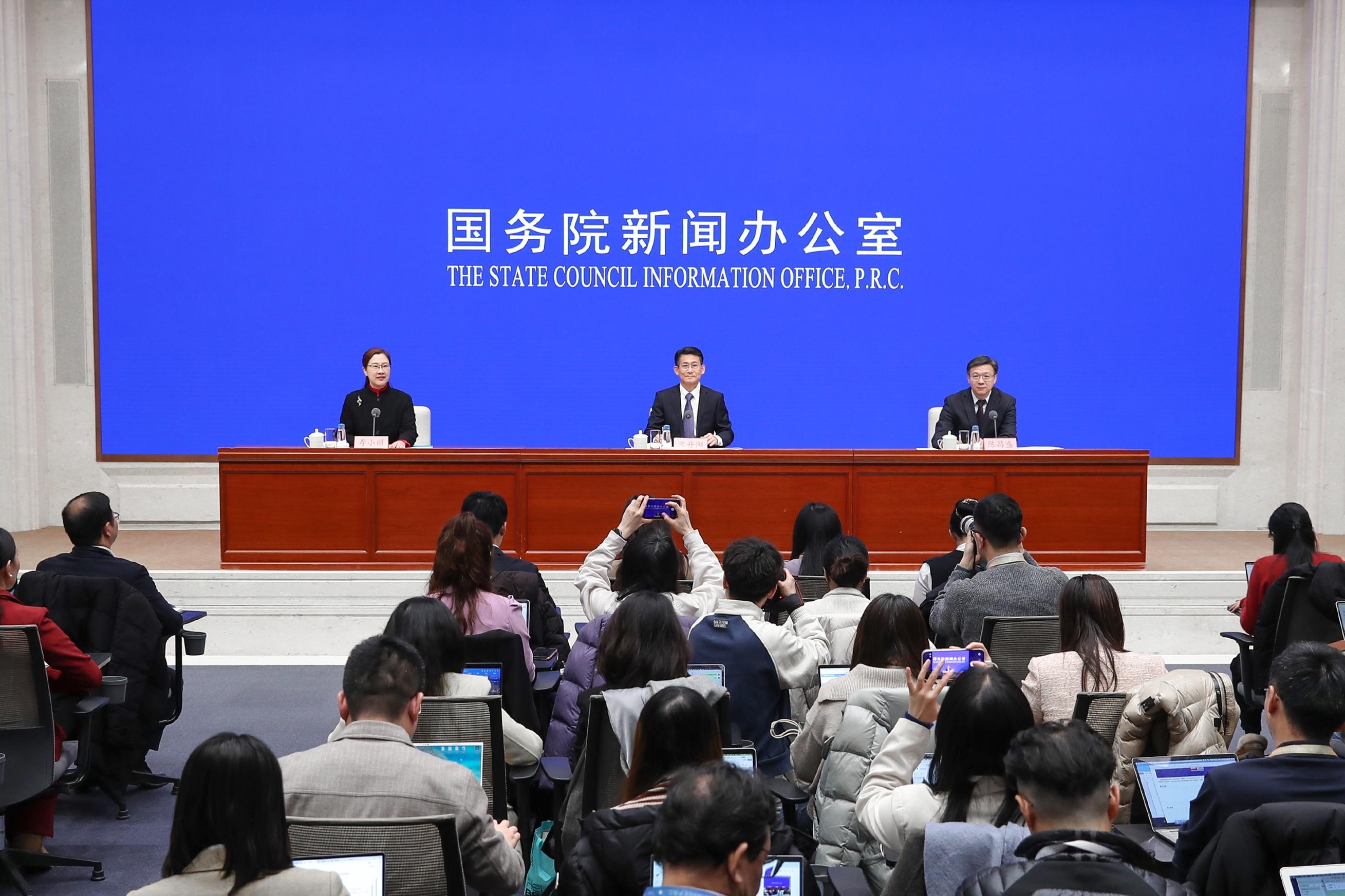
China.org.cn | March 20, 2026


Zhinews of Shenzhen Satellite TV:
Currently, the AI Plus Initiative is accelerating its integration with production and everyday life. The Government Work Report has made arrangements for the AI Plus Initiative for three consecutive years. What considerations are behind this? This year's Report proposes to advance and expand the AI Plus Initiative. What new measures will be taken? Thank you.
Shen Danyang:
I'd like to invite Mr. Chen Changsheng to answer these questions.
Chen Changsheng:
Thank you for your questions. This is a very hot topic. It is fair to say that today's artificial intelligence is evolving by the day. Many companies talk about weekly iterations, updating on a weekly basis, and applications are rapidly expanding. All of us here, and countless internet users, have experienced this themselves — from kung fu robots to today's AI-driven shopping. During the Spring Festival, I also used AI to generate a New Year greeting video and sent it to my parents. I guess many people did the same. Over the Spring Festival holiday, the nationwide Token (word unit) call volume grew exponentially, with a wide range of applications. It can be said that AI technology is now moving from the "digital screen" to the "real world," shifting from "being able to chat" to "being able to get things done." It should be said that AI is accelerating the reshaping of business models, production organization, and the ways we produce and live. Premier Li Qiang has outlined plans in the Government Work Report for three consecutive years. This year, for the first time, he proposed creating new forms of smart economy. This is a brand-new concept, which is essentially about seizing the opportunities brought by AI development, expanding the breadth and depth of AI empowerment across all sectors, opening up new space for economic growth as quickly as possible, cultivating new models, and strengthening new drivers of growth. Specifically, this year's Report contains a dedicated section explaining this issue, and it also lays out plans for emerging industries. It can be understood from the following three aspects.
First, we will expand large-scale applications and strive to speed up the advance of the AI Plus Initiative. For example, in terms of hardware and smart terminals, it is necessary to continue implementing support policies for trade-in programs, so that AI smartphones, AI laptops, AI cockpits, intelligent connected vehicles and other such products can further enter every household. From the software perspective, we should accelerate the development of intelligent agents. Some see this year as the beginning of a new era for intelligent agents, so we should work to scale up the industry and cultivate new business forms empowered by intelligent technologies. In addition, from an industry perspective, it is crucial to accelerate vertical applications by building a batch of pilot application bases, so that AI can be deeply and rapidly integrated with vertical fields such as industry, agriculture, education, healthcare, and technology. In terms of the approach to advancement, we need to address our long-standing tendency to value hardware over software, and treat the two equally. We should also avoid the old approach of "project-based + privatized" deployment. Instead, we should support the development of the public cloud and provide enterprises with universal tools for "cloud adoption, data utilization, and AI empowerment," so that the "flywheel" of artificial intelligence applications can spin faster.
Second, we will deepen open-source development. Since last year, tremendous changes brought by open-source models such as DeepSeek have already become evident. Therefore, we should speed up the building of open-source communities, accelerate the development of open-source datasets and toolkits, and cultivate a batch of high-quality open-source projects in AI, large models and embodied intelligence. In addition, we should reduce the cost of applying large models for SMEs, and encourage local authorities to provide support in terms of computing power, models and token usage. Additionally, we should foster an open-source culture, make good use of the national AI industry investment funds, and support AI startups. This will help lower costs and accelerate the development of AI innovation and entrepreneurship.
Third, we will consolidate the foundation for AI development. First, foundational infrastructure should be reinforced. There is a saying online nowadays that the ultimate future of AI is energy. We must leverage the strength of our national power grid system and further develop new infrastructure projects on hyper-scale intelligent computing clusters and coordinated development of computing capacity and electricity supply. This is from the perspective of hardware. From a technological standpoint, we will further support the enhancement of large model capabilities and computing power, adopt multiple approaches to develop embodied intelligence, world models and other related technologies. This requires greater openness in technological development and comprehensive exploration across various dimensions. We should accelerate the cultivation of the "model-chip-cloud-application" ecosystem to enhance our forward-looking competitive capabilities, expedite the development of AI innovation hubs to create a strong force to attract AI technologies, talent and other key elements.
In summary, AI is opening up infinite possibilities for us, and yet it may also bring us challenges in the process. Therefore, the next step is to accelerate the improvement of AI governance, enhance international dialogue and cooperation, and steer AI toward a beneficial, safe and fair direction. We also anticipate that AI will unleash greater momentum for the emergence of new growth drivers. Thank you.