China.org.cn | September 17, 2025


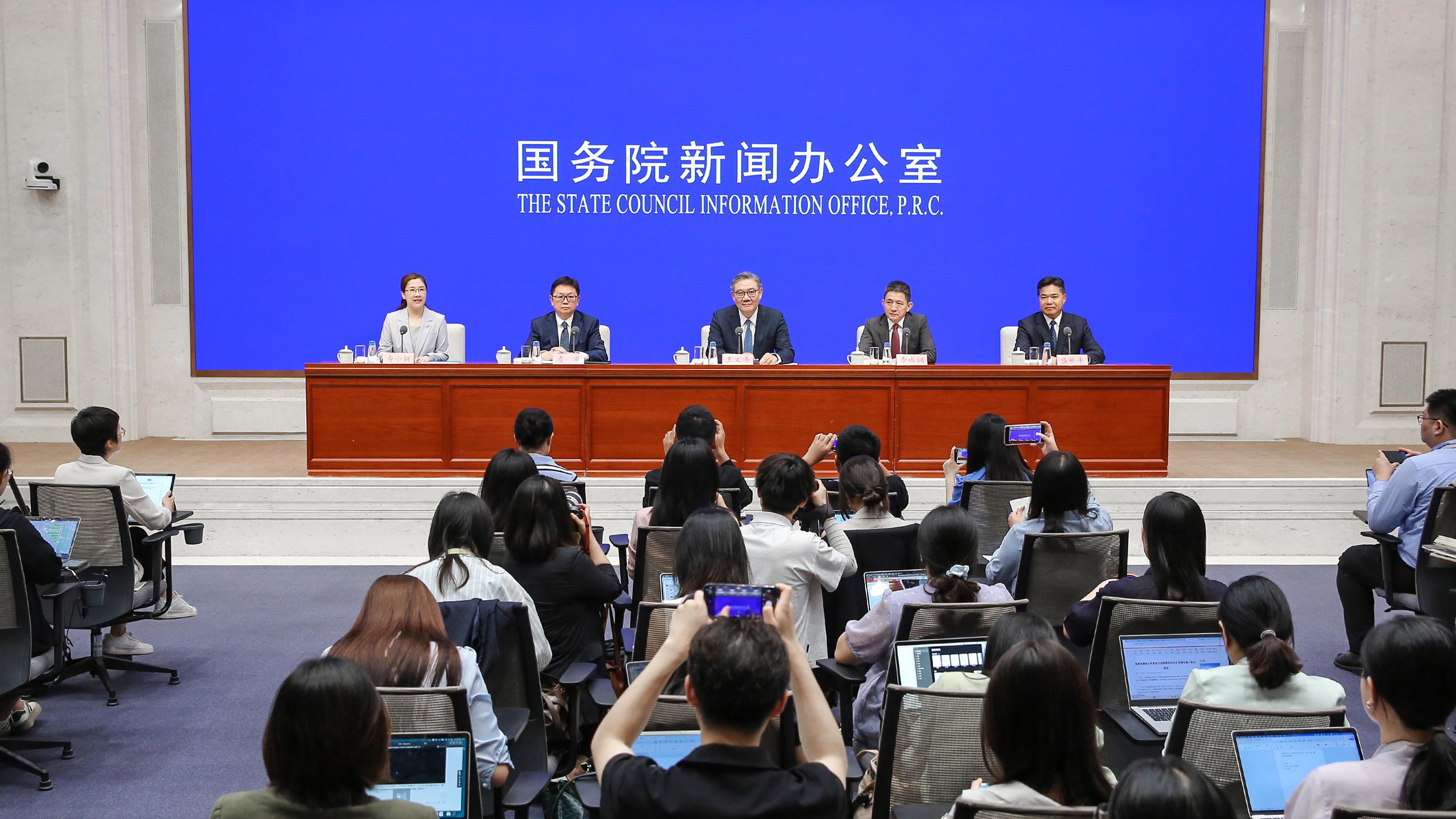

Yicai:
We have observed that during the 14th Five-Year Plan period, whether in cities or rural areas, online or offline, shopping has become more convenient and faster. The entire urban and rural commercial circulation system has undergone significant changes. What measures has the MOC taken to promote the development of a modern circulation system during this period? What results have been achieved? Thank you.
Wang Wentao:
I would like to invite Mr. Sheng to answer these questions.
Sheng Qiuping:
Thank you for your questions. The circulation system serves as the "arteries and veins" of the economy, connecting production and consumption, domestic and foreign trade, and online and offline commerce. The system is especially important for a super-large economy like China. General Secretary Xi Jinping emphasized that developing a modern circulation system is a strategic task in building a new development paradigm. During the 14th Five-Year Plan period, we prioritized the modern supply chain as our spearhead and the high-quality development of the wholesale and retail industry as our main task. Through these efforts, we promoted the construction of a modern commercial circulation system and achieved positive results.
Over the past five years, we have witnessed both sector growth and declining costs. On the one hand, circulation entities in the wholesale and retail industries have achieved robust growth in terms of both scale and strength. In 2024, the value added of the wholesale and retail industries reached 13.8 trillion yuan, second only to manufacturing. The figure represents an increase of 40% compared to the end of the 13th Five-Year Plan period and accounts for a record high of more than 10% of GDP. The sector has also created 135 million new jobs. In the first half of this year, the value added of the wholesale and retail industries increased 5.9% year on year, maintaining rapid growth momentum. On the other hand, social logistics costs have declined. The ratio of social logistics costs to GDP dropped from 14.7% five years ago to 14.1%, while comprehensive logistics costs for key enterprises decreased 10%. As a result, the commercial circulation sector has become an important pillar for China's economic and social development, providing strong support for building a new development paradigm.
Specifically, we have made progress in four areas:
First, circulation facilities have become more convenient and people-friendly. In rural areas, we have strengthened county-level commercial systems by renovating and upgrading market and store facilities. As a result, 155,000 commercial outlets have been renovated in counties, townships and villages. In more than 95% of administrative villages, farmers can enjoy direct express delivery services. In cities, we have built 35 national demonstration pedestrian streets and commercial districts, as well as 5,510 15-minute community life circles, serving over 125 million residents. The convenience and happiness found in Chinese cities have increasingly amazed overseas tourists.
Second, the circulation network has become more complete and comprehensive. On the one hand, we have conducted pilot projects to build modern commercial circulation systems in 40 cities, strengthening the "arteries" of the economy by expanding the "capillaries." On the other hand, we have strengthened weak links by vigorously developing cold chain logistics. Currently, total cold storage volume has reached 253 million cubic meters nationwide, an increase of 42.9% compared to the end of the 13th Five-Year Plan period. The number of refrigerated trucks has reached 495,000, an increase of 80% during the same period. This expansion has further facilitated commodity circulation from farm to fork.
Third, circulation entities have become more diverse and robust. A framework has taken shape in which small enterprises flourish in large numbers while large enterprises serve as pillars of the economy. One aspect is greater numbers. The wholesale and retail industries include more than 10 million legal entities and nearly 45 million individually-owned businesses, accounting for more than 45% of all businesses. Another aspect is greater vitality. Traditional business forms such as shopping malls and department stores are rapidly transforming. Meanwhile, new business forms and models like membership supermarkets and buyer's stores continue to emerge. This has made commercial distribution one of the most innovative sectors of the Chinese economy. A third aspect is growing strength. Seventeen Chinese circulation companies made the Fortune Global 500 list in 2024, with average revenue exceeding $90 billion.
Fourth, the operation of the circulation system has become more intelligent and efficient. We are focusing on three main areas of transformation. The first is digitalization. We're applying big data, artificial intelligence, the Internet of Things and other technologies to upgrade the entire system of commercial circulation through intelligent digitalization, improving how well we match supply with demand. The second focus is standardization. Standard pallet sharing rates have risen from 32.4% to 37.8%, helping companies improve cargo turnover efficiency and reduce logistics costs. The third area is green transformation. We've established 32 pilot cities for renewable resource recovery systems and 10 pilot cities for secondhand goods circulation initiatives, with green, low-carbon lifestyles gaining widespread acceptance.
Looking ahead to the 15th Five-Year Plan period, we will continue our strategic efforts with sustained momentum, building on each phase of progress. We aim to accelerate the development of a larger, higher-quality modern commercial circulation system, advance high-quality development in the wholesale and retail industries, further reduce logistics costs throughout the economy, and make greater contributions to ensuring smooth national economic flow and establishing a new development pattern. Thank you.

