China.org.cn | September 17, 2025


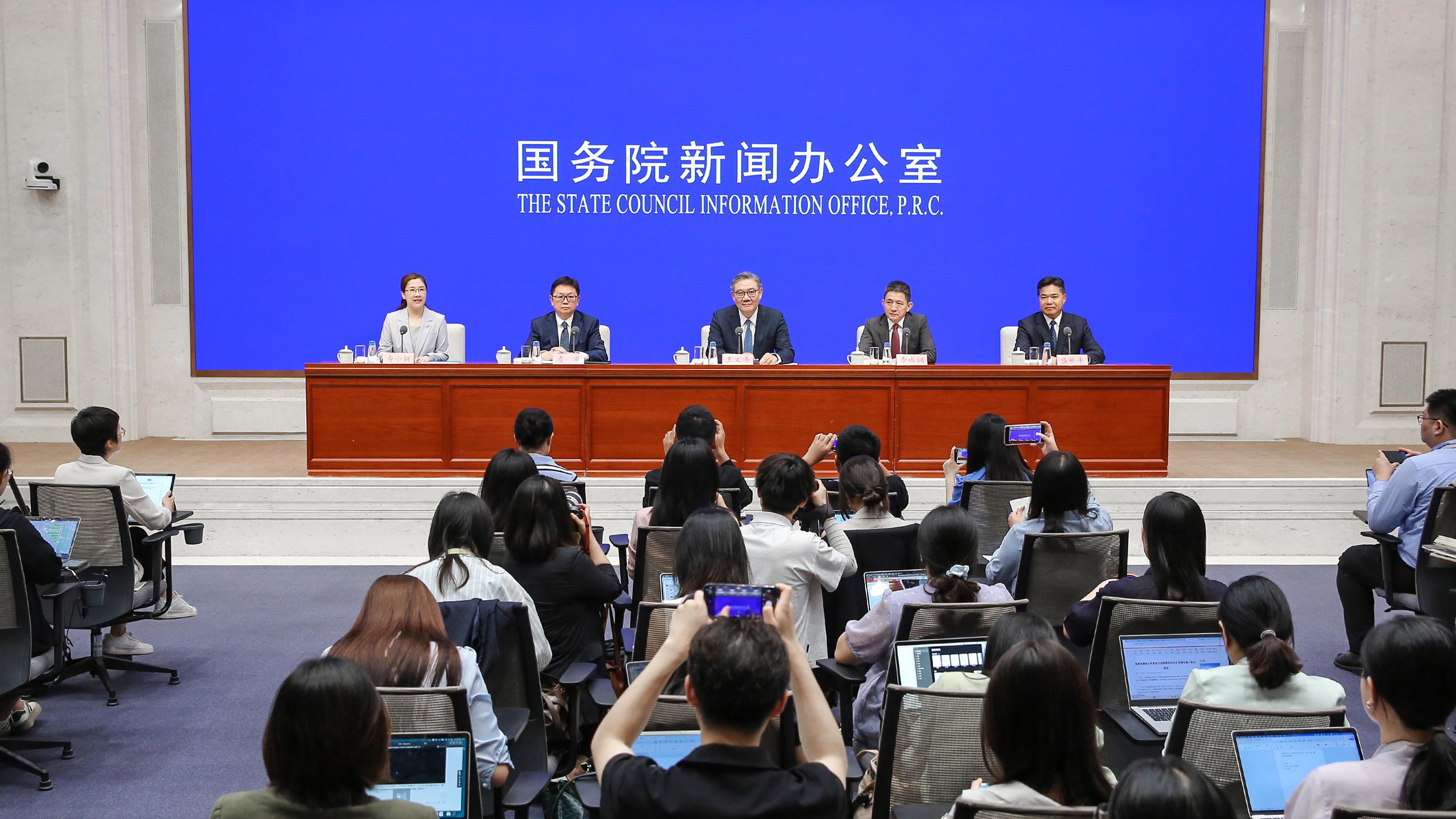

Reuters:
Minister, what can the commerce ministry do to address vulnerabilities that have emerged towards the end of this Five-Year Plan owing to China's relative reliance on exports as policymakers consider priorities for 2026 to 2030? What more can the ministry do to stimulate domestic consumption for example?
Wang Wentao:
I'll take these questions. Thank you for your questions. Let's first review the 14th Five-Year Plan period before looking ahead to the 15th. When examining the 14th Five-Year Plan period in a broader context, we can see that China's per capita GDP falls within the range of $10,000 to $20,000. During this stage, consumer demand diversified at a faster pace and consumption patterns underwent faster transformation. This range characterizes the entire 14th Five-Year Plan period, and will persist into the 15th, at least in its early phase. In that stage, consumption will undergo some new changes and also show some new highlights, which is in line with the stage of development and underlying patterns. Over the past five years, MOFCOM has conscientiously implemented the decisions and arrangements of the CPC Central Committee, proactively adapted to new situation, and taken multipronged measures to boost consumption. We have boosted the consumer market, achieving steady expansion in scale, continuous optimization in structure, and progressive release of potential while strengthening domestic circulation. By reviewing the 14th Five-Year Plan period, we can better plan for the 15th. Four changes and highlights have emerged during the 14th Five-Year Plan period:
The first is "market expansion." Our super large market has become even larger. China's position as the world's second-largest consumer market has been consolidated. Our total retail sales of consumer goods increased from 39.1 trillion yuan in 2020 to 48.3 trillion yuan in 2024, representing an average annual growth of 5.5%. We have made a comparison with the United States. In nominal terms, China's total retail sales of consumer goods are about 80% of America's, but when measured by actual purchasing power using World Bank data and methodology, China's retail sales have already surpassed the U.S., and are 1.6 times the size. Looking at this year's performance, with the first half of the year having already passed, retail sales for the entire year will definitely exceed 50 trillion yuan. Several sectors have maintained their leading positions. Speaking of the "large size," our online retail sales, for example, have ranked first globally for 12 consecutive years, and our automobile sales are also number one in the world. Our air conditioners, washing machines and other home appliances are the bestselling in the world. What I want to say is that with a population of 1.4 billion, any product's potential market becomes enormous when scaled across the population.
The second is "quality upgrade." Quality products and services have entered ordinary households. People have gone from just "getting by" to "living a good life." In terms of goods consumption, we have introduced a series of support policies, such as the trade-in program for consumer goods. This is not just a policy to stimulate consumption, more importantly, it promotes a switch to smart and green products, enhancing everyone's quality of life. Since launching last September, the retail sales of home appliances by companies above designated size have maintained double-digit growth. New energy vehicle ownership in 2024 increased by 5.4 times compared to 2020, and in the first half of this year, the penetration rate of new energy vehicles has exceeded 50%, reaching 50.2%. As of the middle of this year, the trade-in program has generated 2.9 trillion yuan in sales, with about 400 million subsidies granted. I saw online comments calling this the most popular and beneficial consumer policy. In terms of service consumption, China entered a stage of rapid growth during the 14th Five-Year Plan period. From 2020 to 2024, residents' spending on services grew at an average annual rate of 9.6%. As I have mentioned in a previous press conference, our service consumption has outpaced goods consumption, a trend you may have noticed in your own spending. In fact, for many households, spending on services, such as domestic services, fitness, travel, beauty, education and health care, has greatly exceeded your household expenditure on goods. The main contradiction in this stage of service consumption lies primarily in the supply side, which more precisely is a shortage of high-quality services. Together with relevant departments, we have implemented targeted measures, including opening up further and lifting restrictions, to address the shortage. In terms of opening up further, we have expanded pilot programs in fields such as health care to attract more high-quality services. In terms of lifting restrictions, we have introduced a series of "1+N" policies to support the high-quality development of service consumption, carried out a campaign to upgrade service quality and expand consumer benefits, and reduced some restrictive measures in sectors like health care, eldercare and domestic services to increase and diversify supply. As noted in the Reuters reporter's questions, the measures implemented during the 14th Five-Year Plan period will continue through the 15th Five-Year Plan period.
The third is "innovations." New trends of spending are flourishing. We have implemented an initiative to innovate and upgrade the retail industry, helping traditional forms of business find new life. For example, some malls now incorporate museums or aquariums, merging shopping, exhibitions and family entertainment under one roof. Others are offering cross-sector "one-stop" services combining commerce, tourism and culture, while continuously introducing new concepts. We have supported the innovative development of time-honored brands. For instance, the now popular Hanfu, including horse-faced skirts, as well as other new Chinese-style clothing have become trendy. "China-chic" products including high-quality cultural and creative products and local specialty products are selling well at home and abroad. These products excel in both quality and creativity, winning over young consumers. We have also promoted the integrated innovation in new consumption models and vigorously developed digital consumption and quality e-commerce, while cultivating new growth drivers such as the "debut economy," "AI + consumption" and "IP + consumption." We see various types of robots in shopping malls or other service spaces, and as I just mentioned, some smart home appliances have entered households. Our trade-in program has greatly boosted smart home appliance consumption. There are also new trends and fashions like the "guzi economy" and blind boxes of trendy toys. Media reports often talk about the global craze for Labubu.
The fourth is "openness." Domestic and international markets are reinforcing each other. On the one hand, more high-quality goods and services have entered China. We have cultivated international consumption center cities, and established demonstration zones to promote innovation in import trade. In particular, we have held the China International Import Expo (CIIE) and the China International Consumer Products Expo (CICPE). From 2021 to 2024, China imported consumer goods totaling 7.4 trillion yuan, making a substantial contribution to global development as a major consumer market. On the other hand, China has expanded its list of countries covered by unilateral visa-free exemptions, attracting more international visitors to travel here and shop, and experiencing the appeal of shopping in China. We have launched the "Shopping in China" campaign and notably optimized our departure tax refund policy. In 2024, inbound tourists spent a total of $94.2 billion — a striking 77.8% increase. This surge in travel has effectively boosted consumption.
Looking ahead to the 15th Five-Year Plan period (2026-30), the fundamentals of China's long-term economic growth remain unchanged, along with the strong potential, resilience and vitality of its consumer market. As for your question about new stimulus policies in the upcoming plan, we will build on the experiences and practices during the 14th Five-Year Plan period. Policies that have proven effective in the Chinese market and have been well-received by the public will be institutionalized and made long-term. At the same time, during the 15th Five-Year Plan period, we still face a complex and challenging global landscape. Given the uncertainties in the international environment, we will introduce targeted policies in response to evolving circumstances. As mentioned previously, we have a well-stocked policy toolbox and we are fully prepared. More importantly, we will adopt timely and situation-specific measures to further drive the growth of commodity consumption, unlock the potential of service consumption, boost the impact of new forms of consumption, and comprehensively expand domestic demand, thereby strengthening domestic circulation. Thank you.

