China.org.cn | September 17, 2025


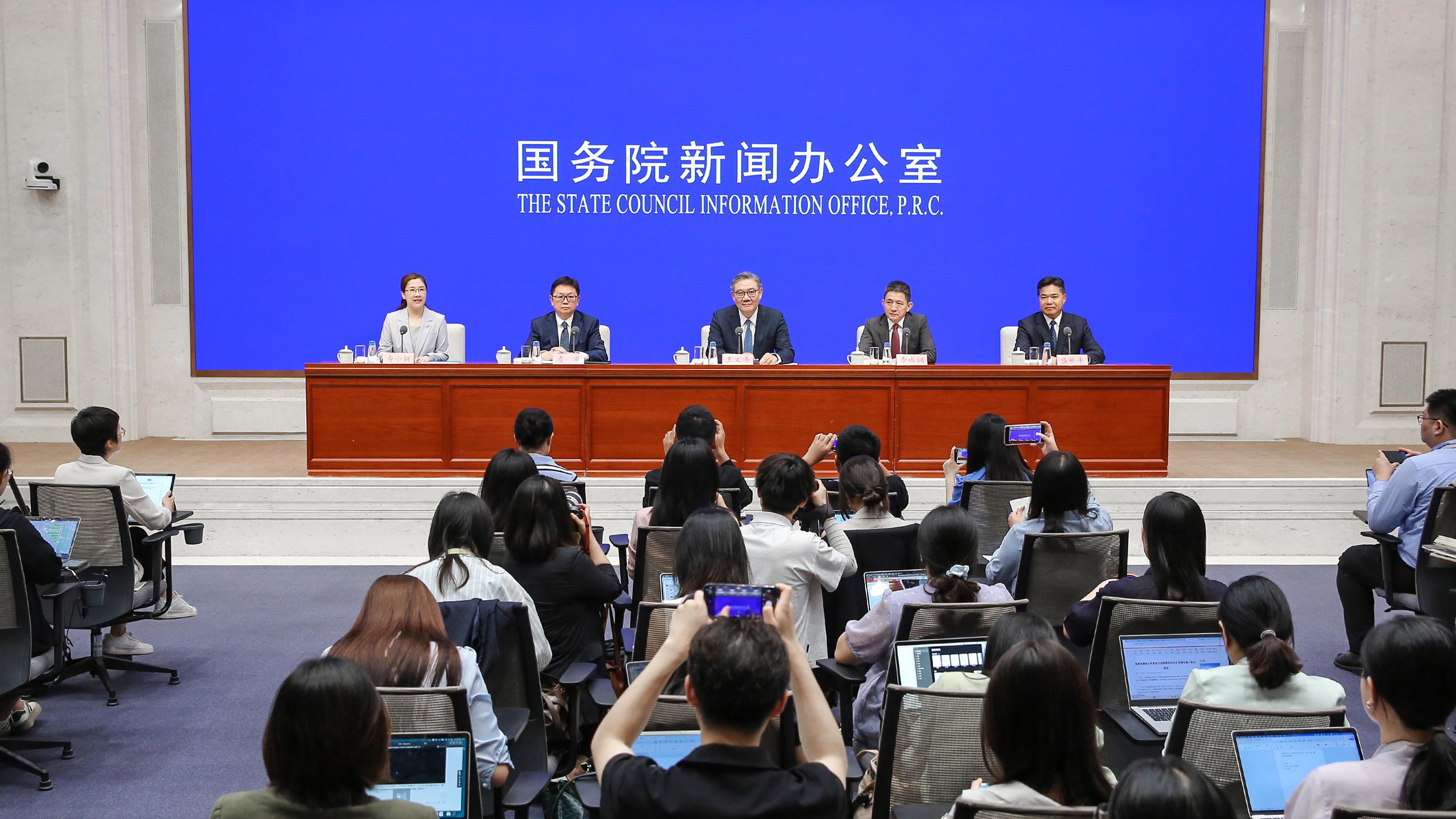

CCTV:
My question is about foreign trade. In recent years, China's foreign trade has performed impressively. Despite a complex and volatile external environment and mounting pressure, China's foreign trade has shown strong resilience and new growth momentum. How does MOFCOM evaluate the development and future prospects of China's foreign trade? Thank you.
Wang Wentao:
I'll answer this one. First, thanks for your question. Your question actually answers itself in the latter part of what you said. We do have strong resilience and momentum. Of course, I'll add some supplementary points about these factors.
As you just mentioned, we have faced considerable pressure during the 14th Five-Year Plan period. Foreign trade has undoubtedly encountered major challenges and intense pressure. These are conditions we can at least describe as "high winds and choppy waters." However, under the strong leadership of the CPC Central Committee and the State Council, we have decisively introduced policies to stabilize foreign trade on multiple occasions. With concerted efforts from all parties, foreign trade has bucked the trend and grown even in these "high winds and choppy waters," and progress has been made in building China into a trader of strength. This can be summarized in three keywords.
The first keyword is "large." China's status as a major trading nation has been strengthened. In what way is it large? The scale of China's trade in goods surpassed two key milestones of $5 trillion and $6 trillion. In 2024, it hit $6.16 trillion, up 32.4% from 2020 at the end of the 13th Five-Year Plan period. China has ranked first globally for eight consecutive years. In terms of trade in services, the scale exceeded $1 trillion for the first time, ranking second worldwide. Behind this large scale in foreign trade lies the advantages of scale and a comprehensive industrial ecosystem. So in a sense, being large means being strong. We can look at this from three angles. First, trade cooperation has benefited the world. We are a major trading partner for more than 150 countries and regions. We have not only provided high-quality products and services to the world, but also ensured the resilience and stability of global industrial and supply chains. At the same time, we have supported the multilateral trading system through concrete actions and promoted trade liberalization and facilitation. Second, the opportunities of China's large market have been shared globally. Looking at imports, the Chinese mainland and Hong Kong together imported about 13.3% of the world's total goods in 2024, according to WTO data. What was the U.S. share? It was 13.6%. In other words, imports by the Chinese mainland and Hong Kong together were only 0.3 percentage point behind the U.S. Therefore, we are the second-largest import market in the world, nearly on par with the U.S. At the same time, we are a major export destination for nearly 80 countries and regions. Where do these countries send their exports? Their main export destination is China. Of course, we've long run a services trade deficit. Although China's trade in services exceeded $1 trillion last year, we've maintained a long-term deficit, with the U.S. being the largest source of that deficit. China is the largest source of the U.S. goods trade deficit, while the U.S. is China's biggest deficit generator in services. This reflects our complementary advantages. However, we have proactively expanded imports and successfully held the China International Import Expo for seven consecutive years, with this year marking the eighth. We have also established 43 import trade promotion and innovation demonstration zones and unilaterally granted zero-tariff treatment to relevant countries. This is completely unprecedented. Earlier in my opening remarks, I mentioned that China has expanded zero-tariff treatment for the least developed countries to all 53 African countries with which we have diplomatic ties through mutually signed agreements. China's large market has already become a shared global market, and it will surely continue to be a source of growth and vitality for the world economy. Our opening-up policy not only attracts foreign investment but also expands imports. Third, trading entities have become more diversified and expanded. In 2024, the number of enterprises engaged in actual imports and exports reached nearly 700,000. This includes many globally recognized companies, along with specialized and sophisticated "little giant" enterprises that produce novel and unique products. Private enterprises' share of exports rose from 56% at the end of the 13th Five-Year Plan period to 64.8% last year, registering rapid growth.
The second keyword is "strong." China's transformation into a trader of strength has been accelerated. The 20th CPC National Congress proposed accelerating efforts to build a trader of strength supported by three major pillars: trade in goods, trade in services and digital trade. These three major pillars have been continuously strengthened. The first pillar, trade in goods, has been upgraded. In particular, the share of high-value-added and technologically advanced products has been growing. High-tech products accounted for 18.2% of goods exports in 2024, with high-tech items now comprising a large portion of our exports. The potential of new forms of foreign trade has continued to be unleashed, with cross-border e-commerce imports and exports reaching 2.7 trillion yuan in 2024, up 67% from 2020. The second pillar, trade in services, has achieved innovative upgrades. We rolled out negative list management for trade in cross-border services for the first time, with the trade value of knowledge-intensive services up 38% in 2024 compared with 2020. The third pillar, digital trade, has made innovative progress. We have improved policies to support digital trade and built a number of high-standard national digital service export bases. China's trade in digitally deliverable services was up nearly 40% in 2024 versus 2020. We have continued to host national-level exhibitions. For example, the China International Import Expo primarily serves imports, while the Canton Fair focuses on exports. The China International Fair for Trade in Services handles the services trade. The Global Digital Trade Expo covers digital trade. These important exhibition platforms play a key role in supporting the "three major pillars" of building China into a trader of strength and better serving high-quality trade development.
The third keyword is "resilience." China's foreign trade has become significantly more resilient and shock-resistant. You never know how difficult something is until you've lived through it. In recent years, the external environment has been complex and volatile, but China's foreign trade has weathered the storms and forged ahead resolutely. We have actively optimized our international market presence, diversifying our trade partners. ASEAN has remained our largest trading partner for five consecutive years, with trade volume up 9.6% year on year in the first half of this year. In 2024, trade with Belt and Road partner countries accounted for over 50% of China's total trade. Our exports to the U.S. accounted for 14.7% of total exports in 2024, down from 17.4% in 2020. In the first half of this year, exports to the U.S. fell 9.9%, while our overall exports grew by 7.2%, showing divergent trends. During the "two sessions", I mentioned here that "when one door closes, a window opens." We have achieved trade diversification. We have also effectively managed trade frictions by leveraging WTO rules to defend our legitimate rights and interests, thereby maintaining trade security. In particular, we found that foreign trade enterprises have demonstrated remarkable resilience. They have actively adapted to changes, proactively pursued transformation, and accelerated product upgrading by increasing the application of new technologies in their products. Meanwhile, they have worked to open up new markets and channels and created many innovative business models. Our foreign trade production and supply chains have become more complete, flexible and efficient, with a stronger ability to cope with risks and challenges. As a result, we have greater confidence.
Looking ahead to the 15th Five-Year Plan period, we will make greater efforts to promote high-quality trade development, strengthen innovation momentum, and expand both exports and imports. We will also promote international cooperation, enhance trade resilience, and strive to build an international trade landscape characterized by openness, cooperation, mutual benefits and win-win outcomes. Thank you.

