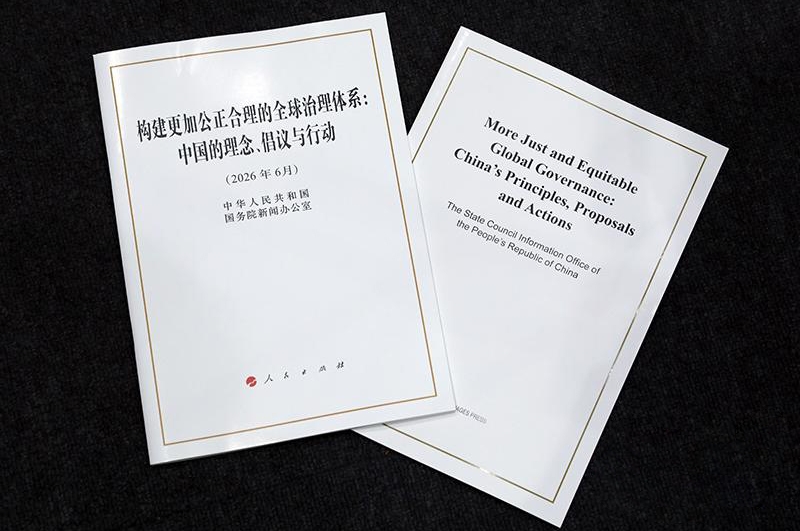
Xinhua | June 17, 2026


II. The Global Governance Initiative Responds to Challenges of Our Times
The Global Governance Initiative upholds the purposes and principles of the UN Charter and embraces a global governance vision characterized by extensive consultation, joint contribution, and shared benefits. It is built on five core concepts: sovereign equality, the international rule of law, multilateralism, a people-centered approach, and real actions. By addressing the crux and root causes of crises and challenges, the initiative provides sound guidance for building a more just and equitable global governance system.
1. Sovereign Equality
Sovereign equality is enshrined in the UN Charter as the first among all principles and the supreme norm regulating state-to-state relations. Countries, whether large or small, strong or weak, developed or developing, are equal members of the international community. Every nation's sovereignty and dignity must be respected, and all countries are equally entitled to participate in, deliberate on, and benefit from global governance.
Equality is the premise of state-to-state relations. Countries should, in the spirit of mutual respect, conduct consultations on an equal footing and manage their differences appropriately. Major countries should lead by example in honoring equality, good faith, and cooperation, rather than leveraging their position of strength to engage in hegemonic, high-handed and abusive acts. If allowed to deviate from the principle of sovereign equality, international relations would degenerate into a game among powers, and international law would become groundless, leaving the world in perpetual chaos.
Sovereign equality is an essential requirement for solidarity against challenges. The future of all nations is bound by shared interests, common challenges, and collective responsibilities. Global governance cannot be dominated by a select few developed nations. Only when all countries participate equally can all sides build the political trust essential for solidarity and collaboration; only in this way can the resulting rules and decisions receive extensive recognition and rest on solid legal ground. This is the necessary approach to reaching broad consensus and creating powerful synergy.
Equality and inclusiveness are the inexorable progress in the evolution of the global governance system. Coexistence in diversity is a fundamental characteristic of human society, and multipolarity is vital to the evolving international landscape. A global governance system that is more representative, inclusive, and beneficial to all is an irreversible trend, and equal rights, equal opportunities, and equal rules are the shared aspirations of all peoples. Hegemony and power politics that run counter to the tide of history are destined to fail.
2. The International Rule of Law
The international rule of law is the fundamental safeguard for global governance. Only a global governance system that is grounded in the rule of law can provide all countries with a fair and just environment for development, achieve a balance between rights and obligations, and make international order more just and equitable.
Rigorously enforcing the international rule of law is rooted in upholding the purposes and principles of the UN Charter. Confrontation and injustice in today's world do not arise because the UN Charter is outdated, but because it is not effectively implemented. Its purposes and principles, such as maintaining international peace and security, promoting international cooperation, settling international disputes by peaceful means, and refraining from the threat or use of force in international relations, have established the fundamental norms governing international relations and underpinned post-war stability in the international order, and thus must be honored without the slightest compromise.
Rigorously enforcing the international rule of law hinges on safeguarding its justice and integrity. Only when international law is applied equally and universally, rather than selectively, can we truly distinguish right from wrong and advance peace and development. All nations are stakeholders in the international rule of law – without it, anyone at the dining table today could appear on the menu tomorrow. Major countries are the key forces in advancing international rule of law. They should lead by example in following rules and upholding the rule of law, rather than putting their own interests above international law or, even worse, imposing their own rules upon others.
Rigorously enforcing the international rule of law calls for improving rulemaking in emerging sectors. Human society is constantly evolving, and global governance rules must keep pace. New domains such as the deep seas, polar regions, outer space, and cyberspace, some of which are the common property of humanity and some represent the frontiers of future development, require urgent attention in order to establish rules and close gaps in their governance. All parties should uphold the principles of peace, sovereignty, inclusiveness, and joint governance, and put law in place for the development and utilization of new domains, so that they expand the space for cooperation rather than become arenas of rivalry. The governance of artificial intelligence should guard the red line of security and ethics, and be pursued in the spirit of openness, shared outcomes, and equal rights, to ensure AI for good and truly benefit humanity.
3. Multilateralism
Multilateralism emerged for the cause of peace and development, and multilateral mechanisms are vital for addressing global issues. No country can achieve development outside the global governance system, nor can it secure a future without participating in international cooperation. It is not a matter of whether we choose it or not, multilateralism is the only viable path forward.
Countries should stick to the principles of extensive consultation, joint contribution, and shared benefits. The essence of multilateralism lies in extensive consultation on international affairs and collective decision-making among all countries for the future of the world. Countries should pool wisdom through extensive consultation, gather strength through joint contribution, and promote universal interests through shared benefits. They should unequivocally oppose all forms of unilateralism, hegemony, dominance by a few countries, and bloc politics in the understanding that the deliberate erection of barriers will only push the world into the abyss of antagonism and confrontation.
Countries should be steadfast in safeguarding the central role of the United Nations. The United Nations is the primary platform for practicing multilateralism and advancing global governance. Its leading position must be upheld and remain rock solid; its role can only be reinforced, not weakened. All countries should reaffirm the founding purpose of the United Nations, work to restore its authority and vitality under new circumstances, and enable it to play a central role in coordinating global actions to address common challenges.
Countries should be firm in promoting multilateral dialogue, consultation, and cooperation. In light of the complexity of global challenges, no country can remain insulated from their impacts or resolve all issues alone. Countries should build consensus through dialogue, resolve disputes through consultation, and pursue win-win results through cooperation, striving to expand their common interests. Global and regional multilateral mechanisms should play a constructive role in this, pooling the resources and strengths of national governments, international organizations, and non-governmental organizations to increase the synergy and efficiency of global governance.
4. A People-Centered Approach
People's wellbeing is a core concern of global governance. The people of every country across the world are the essential participants and direct beneficiaries of global governance. Only by serving public interests, boosting public confidence, and meeting public expectations can the global governance system win extensive support and function effectively.
Pursuing common development heightens the sense of gain among all peoples. Development concerns people's life and dignity; it is a matter of hope or disappointment. World prosperity and stability cannot be built upon ever widening gaps between rich and poor. Countries must restore development to the center of the international agenda, mobilizing global resources to implement the UN 2030 Agenda for Sustainable Development without delay. The North-South divide must be bridged as soon as possible, and help should be provided to developing countries to boost their capacity for independent development, so that all nations have greater and fairer access to the fruits of development.
Addressing common challenges heightens the sense of security among all peoples. In today's world, all countries share a common stake in security, and all must therefore embrace a vision of common, comprehensive, cooperative and sustainable security while addressing the threats to this stake – whether traditional or non-traditional. In responding to risks and challenges such as climate change, public health, and cyberspace security, it is important for the people to truly feel that countries are taking action and that unity can overcome all difficulties.
Promoting mutual understanding and friendship heightens the sense of fulfillment among all peoples. Civilizations become colorful through exchanges and are enriched through mutual learning. Countries should let cultural exchanges prevail over estrangement, mutual learning over clashes, and inclusiveness over superiority. Cultural and personnel exchanges should be strengthened to break down ideological barriers between nations and social groups. A shared conviction for safeguarding common interests will allow all civilizations to thrive and succeed together.
5. Real Actions
Global governance finds its source of vitality in practice, hinges on action, and is verified by its effectiveness. A vision is realized only through concrete action. It falls on the international community to turn this vision into reality – setting common goals, embracing a problem-oriented approach, and acting in concert.
Coordinating overall progress and individual breakthroughs. A coordinated approach should be adopted to advance global governance agendas, address governance deficits, and prevent fragmentation in the governance system. Targeted efforts should also be made for the most pressing issues in individual countries, particularly developing countries, to achieve tangible progress in poverty reduction and in improving people's wellbeing and closing the digital divide.
Addressing both symptoms and root causes. Given present conditions, feasible plans should be made to resolve the immediate challenges facing the world. The effectiveness in responding to major public crises and providing international public goods should be increased. With future development in mind, fundamental solutions should be explored to tackle chronic and persistent issues and bring change to the global governance system – which is lagging in reform – to align it with the evolving political and economic landscapes.
Synergizing North-South cooperation and South-South cooperation. The Global North and Global South should leverage their complementary strengths and move towards the same direction. Developed countries should diligently fulfill their international obligations and deliver on their commitments regarding development assistance and climate financing; they should not evade their international responsibilities under any pretext. Developing countries should unite to build their strength, improve South-South cooperation mechanisms, increase their capacity for collaborative development and their collective voice, and inject sustained momentum for improving global governance.