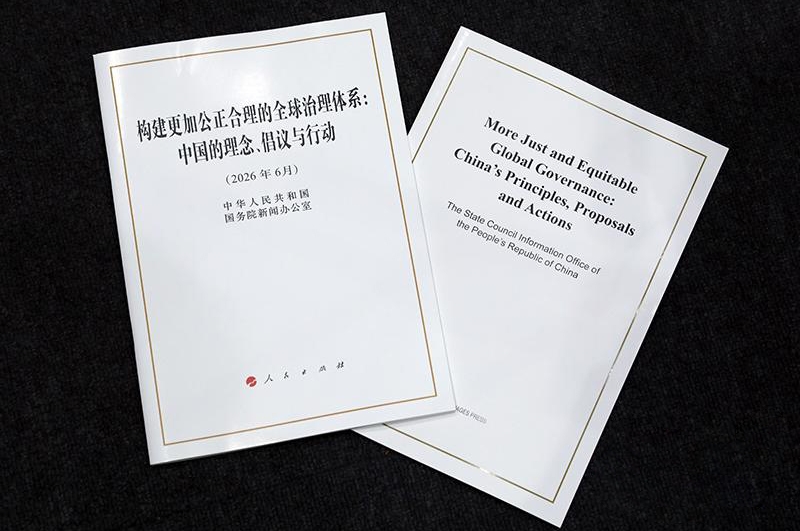
Xinhua | June 17, 2026


I. The World Today Faces Severe and Complex Challenges
Our world has entered an era marked by profound change on a scale unseen in a century. The pursuit of peace and development remains a daunting challenge. The international system established after World War II has been severely disrupted by multiple crises, placing global governance at a critical crossroads. Progress is imperative; failure to advance risks falling behind. Now, more than ever, the world needs to revitalize multilateralism, uphold the rule of law, and ensure more efficient governance.
1. Growing Challenges Call for More Effective Governance
Currently, the international landscape is undergoing profound changes on an unprecedented scale, with turmoil and upheaval more intense and pronounced. Political and economic disputes worldwide are escalating, revealing deep-seated conflicts, while "black swan" and "grey rhino" events keep emerging continually. The ship of human civilization has entered dangerous waters with hidden reefs and violent storms.
Geopolitical tensions are intensifying, with armed conflicts erupting in multiple regions. The Ukraine crisis has entered its fifth year, hostilities in the Middle East are spilling over and spreading, and multiple hotspot issues remain unresolved. The Global Peace Index continues to decline: in 2025, the number of armed conflicts reached a new high after World War II, with more than 50 countries directly embroiled in conflict or war. Global military spending has surged, militarism has resurfaced, and nuclear proliferation and "nuclear sharing" continue to pose a grave threat, leaving international security in a precarious state.
Global economic fragmentation is exacerbating, significantly hindering development. Economic globalization is facing strong headwinds, as some countries erect fences and barriers, pursue decoupling, sever industrial supply chains, and impose unilateral tariffs, disrupting the global economic order. Overall progress in the implementation of the UN 2030 Agenda for Sustainable Development has lagged far behind, with nearly 80 percent of assessable targets progressing slowly or even regressing. More than 830 million people worldwide still live in extreme poverty while 2.3 billion suffer from food insecurity, and the North-South divide and wealth gap continue to widen.
New challenges are arising in quick succession, with multiple crises intertwining and accumulating. The transition to a climate-resilient future is fraught with difficulties, the digital divide is deepening, and the misuse of artificial intelligence poses new security risks. Challenges to food and energy security are also intensifying, and non-traditional security threats such as terrorism, cyberattacks, transnational crime, and biosecurity risks are on the rise. The issues that human society must collectively address are becoming increasingly complex and diverse.
The universe has only one Earth, which is the shared home of all humanity. Countries are not riding separately in some 190 small boats, but aboard a single giant ship of shared future. Only by working together and supporting one another can we navigate through the storms of global challenges and sail towards a brighter future.
2. The Law of the Jungle Seriously Undermines the International Rule of Law
Built upon the ruins of the two world wars, the UN serves as a shelter for peace and development, and its Charter laid the institutional cornerstone for global governance. History can only move forward, not backward; we must draw lessons from the bloodshed and fires of war of the past and prevent a return to the law of the jungle at all costs.
Unilateralism and hegemonism cause only grave harm, openly trampling upon international law and the basic norms governing international relations. By bullying the small and weak and brazenly wielding force against sovereign states, certain countries have shown they prioritize their national interests above all else, applying double standards and challenging international justice for their own selfish gain. These nations gang up to form exclusive groups and blocs, inciting division and confrontation and carving spheres of influence today – in the 21st century – as they did in centuries gone by. By so doing they have become the major source of global turbulence.
De-globalization and protectionism are on the rise, while economic and trade issues are being politicized, instrumentalized, and weaponized. Some countries have instigated trade wars and tech wars, imposed unilateral sanctions illegally, and abused long-arm jurisdiction. They have single-mindedly sought to build "small yards with high walls" or "parallel systems", and have overstretched the concept of national security to suppress and contain the economic and technological progress of other countries. These retrogressive actions violate the principles of the market economy, trample on the rules of free trade, and severely disrupt the international economic order.
Humanity now faces several crucial questions. Fairness and justice, or the law of the jungle? Openness and mutual benefit, or isolation and confrontation? The rule of law, or power politics? At this historical crossroads, we must be responsible and make the right choice.
3. It Is Imperative to Shore Up the Governance System
The UN is the most comprehensive, representative and authoritative international organization, and the UN-centered international system plays an irreplaceable and vital role in global governance. Over time, however, the current global governance system has become increasingly incompatible and misaligned with the realities of today and the evolving international landscape, and its shortcomings and deficiencies are growing ever more pronounced.
The UN's authority is challenged. Disregarding the purposes and principles of the UN Charter, a certain major power has withdrawn from international organizations and agreements, defunded key bodies, blocked Security Council resolutions, and paralyzed the World Trade Organization's (WTO) dispute settlement mechanism. These actions have seriously disrupted the international order and caused further damage to multilateral mechanisms, eroding the foundation of trust in multilateral cooperation.
The effectiveness of multilateral institutions is in urgent need of improvement. As some countries refuse to fulfill their responsibilities and obligations, multilateral agendas are often left discussed but undecided, or decided but not implemented. Efforts must therefore focus on improving the operational efficiency, emergency response capabilities, and transparency of multilateral institutions such as the UN. At the same time, the existence of governance gaps in emerging fields – including artificial intelligence, cyberspace, and outer space – also demands attention.
The UN's representation is critically inadequate. To maintain their hegemony and protect their own interests, some countries have long obstructed the reform process of the UN and its agencies, causing significant delays in reforms such as the IMF quota and World Bank shareholding. Developing countries remain underrepresented and their voices insufficiently heard.
The current governance system is certainly not perfect, but it needs neither to be dismantled and rebuilt in full, nor replaced entirely by a new system. Instead, as an international community, we must focus on reforming and improving the existing system to make it more compatible and aligned with the world's realities, addressing governance shortcomings from a developmental perspective, and responding to the call of the times with a vision for progress.
4. More Global South Voices Need to Be Heard
The Global South is a vital force in seeking peace, pursuing development, and promoting cooperation, and its collective rise represents human progress. To stabilize and improve the world, the international community needs to be more responsive to the concerns of the Global South in international affairs and fully leverage its role.
The Global South has grown remarkably strong. After World War II, national independence and liberation movements swept across Asia, Africa, and Latin America, dismantling the global colonial system. The number of UN member states has increased from 51 at its founding in 1945 to 193 today. Based on purchasing power parity, the Global South now makes up over 60 percent of the world economy and contributes 80 percent to global economic growth, with multiple hubs of development across various regions. The monopolization of international affairs by a small number of countries is no longer sustainable, and long-standing historical injustices must be redressed.
This rise has brought a new dynamic to global governance. BRICS has undergone a historic expansion, and the Shanghai Cooperation Organization (SCO) has become the largest regional intergovernmental organization in terms of territory and population. Together, they are playing a positive role in the development and reform of the global governance system. The G20 has become the premier platform for global economic governance, with emerging economies now accounting for more than half of its membership. Championing fairness and justice, the G77 and China have deepened South-South cooperation. Meanwhile, Global South countries have hosted a series of multilateral summits, contributing their share to global governance and leaving their imprint.
The times call for a model of global governance that is more inclusive, equitable, and sustainable. The process of securing greater respect for the Global South countries' rights to development, voice, and decision-making in international affairs will mark a historic journey towards a more dynamic, effective, and hopeful global governance system.