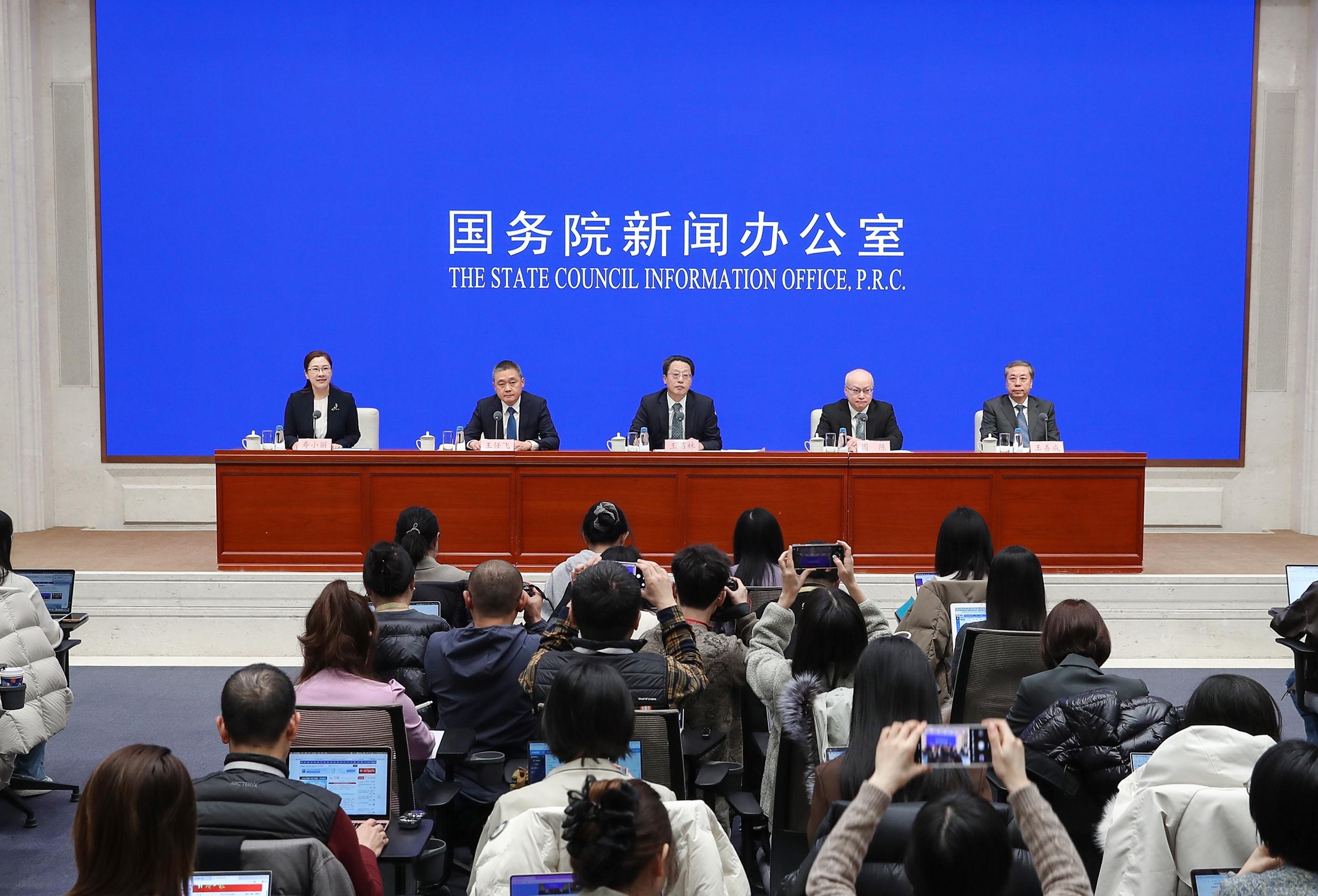
China.org.cn | March 17, 2026


Top News:
The Central Economic Work Conference stressed the need to continuously pursue both policy support and reform and innovation. What considerations do you have this year for enhancing the synergy between reforms and policy supports? Thank you.
Wang Changlin:
This is an important issue regarding reform and innovation, and also a vital principle we have to understand. Mr. Wang Renfei will answer your question.
Wang Renfei:
Thanks for your question. Adhering to both policy support and reform and innovation is an important experience in macroeconomic governance in the new era. At present, China's economic development is facing a complex interplay of cyclical, structural, and institutional problems. Solving these problems requires a comprehensive approach, combining strong policy support with proactive reforms. Macroeconomic policies focus on counter-cyclical adjustments to stabilize the overall economy, while reform measures aim to streamline systems and mechanisms to enhance internal driving forces. The effectiveness of macroeconomic policies needs to be supported and released by reform measures, while breakthroughs in reform need to be buffered and underpinned by macroeconomic policies. Advancing in tandem and complementing each other, the two can generate complementary, additive, and multiplicative effects, producing a combined amplification effect to better achieve a combination of short- and long-term solutions, and address both symptoms and root causes. The main considerations are specifically as follows:
First, we will enhance the coordination between reform and fiscal and financial policies. This year, we will continue to implement a more proactive fiscal policy and a moderately loose monetary policy. On the one hand, we will make more use of reform methods to smooth the policy transmission mechanism, improve the efficiency of policy implementation, give full play to the integrated effect of existing and incremental policies, and enhance the comprehensive effectiveness of counter-cyclical and cross-cyclical adjustments. On the other hand, efforts will be made to combine fiscal and financial policies. As many have noted, at a State Council executive meeting on Jan. 9, arrangements were made to implement a package of policies to promote domestic demand by leveraging coordinated fiscal and financial measures. This is to use reform and innovation to strengthen the coordination between fiscal and financial policies, thereby creating multiplier effects.
Second, we will enhance the coordination between reform and consumption and investment policies. In terms of consumption, we will relax market access restrictions and optimize supervision to further eliminate the unreasonable restrictions in the consumption field. We will establish and improve management measures that adapt to new consumption forms, models and scenarios, and accelerate the cultivation of new growth drivers in consumption. In terms of investment, we will closely integrate investment in both physical assets and human capital, and enhance market-driven momentum for effective investment. We will leverage the role of new policy-based financial instruments, implement measures to further promote the development of private investment, improve the long-term mechanism for private enterprises to participate in the construction of major projects such as nuclear power, and at the same time, give full play to the role of government investment to better stimulate social investment.
Third, we will enhance the coordination between reform and industrial policies. It should be mentioned that after the previous stage of curbing the "rat race" competition, the market ecology and competitive order of related industries have steadily improved. However, sustained efforts are still needed. On the one hand, we will further promote the upgrading of related industries through industrial policies, standards guidance, and quality supervision. On the other hand, as I just mentioned, it is necessary to implement the arrangement of further advancing the building of a unified national market. We will regulate the economic promotion activities of local governments, local investment attraction activities, and fiscal subsidy policies to create a healthy market ecosystem. This will enable the market mechanism of "survival of the fittest" to truly meet their potential. It will also invigorate all business entities, enabling sustained improvements in industrial performance and market expectations.
Fourth, we will enhance the coordination between reform and innovation policies. The development of new quality productive forces requires the supply of corresponding new production relations and institutions. The key focus in this regard is to coordinate and promote reforms in market access, factors of production, and application scenarios. We will refine the market access system to ensure greater accessibility for new forms of business and new sectors. We will deepen the reform to promote market-based allocation for factors of production and actively explore ways of allocating new factors of production, such as aerospace, marine resources, underground space, and spectrum. In particular, we will fully leverage the role of application scenarios as both the scarce resource and new policy tools. Following the State Council's launch of relevant measures for cultivating and opening application scenarios at the end of last year, application scenarios have recently become a buzzword in society. We understand that an application scenario is a systematic pilot-scale testing, which includes both "hard verification" of technological products and supporting infrastructure, and "soft verification" of business models, market space, and supporting systems. It can be summarized as a common systematic verification in "two hard and two soft" dimensions. In the next step, we will support qualified regions to conduct pilot programs, while guiding governments and central and state-owned enterprises to take the lead in opening application scenarios and developing a number of high-value and comprehensive landmark application scenario projects. These are tailored to local conditions, thereby boosting industrial innovation and development. Thank you.
Shou Xiaoli:
Let's continue with the questions. There are two more reporters raising their hands. We will have our last two questions.