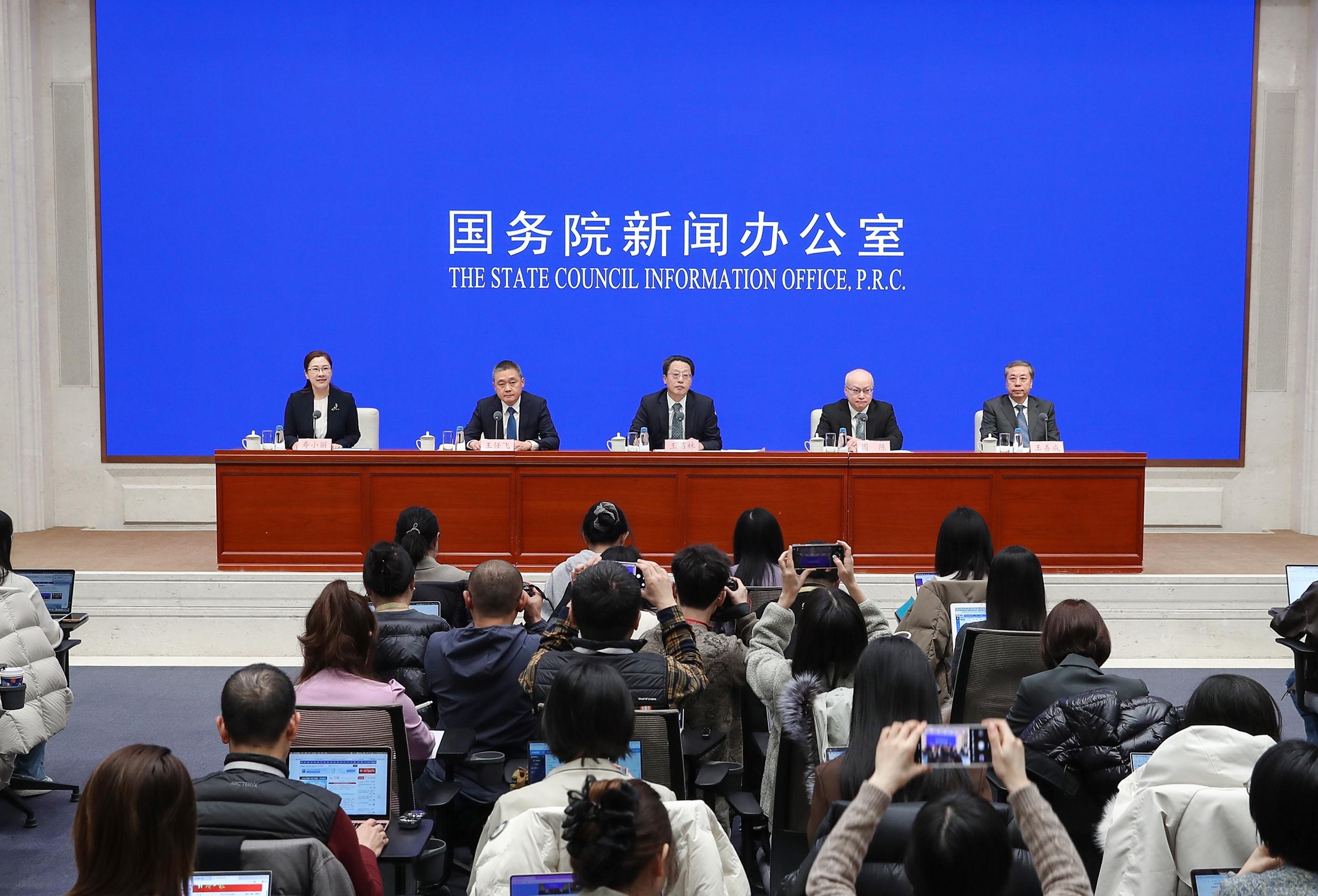
China.org.cn | March 17, 2026


CCTV:
The year 2026 marks the beginning of the 15th Five-Year Plan period, and high expectations are being placed on China's economy. What are the main aspects of this core potential? And how can we fully tap into China's economic potential? Thank you.
Wang Changlin:
These questions concern China's economic potential. I'll invite Mr. Zhou from the Department of National Economy to answer them.
Zhou Chen:
Thank you for your questions. Yesterday, the National Bureau of Statistics released statistical data on China's 2025 economic and social development. These hard-won achievements fully demonstrate the key features of China’s economy: a solid foundation, multiple advantages, strong resilience and vast potential. The market itself is a scarce resource, and China’s ultra-large market represents enormous potential and powerful momentum. Looking ahead to 2026, China's economic structure will continue to improve, development momentum will increasingly be driven by innovation, and the overall development trend will remain positive. As new quality productive forces develop steadily, we believe that consumption and investment, technology and industry, as well as urban-rural and regional development, will all unleash substantial development potential. Specifically, the analysis can be approached from three perspectives: points, lines and areas.
First, looking at points, new technologies, products and application scenarios are gaining momentum. Emerging growth drivers such as new energy, new materials, aerospace, quantum technology, bio-manufacturing and embodied AI are poised for rapid growth. The installed capacity of new-type energy storage has exceeded 100 million kilowatts. What does this scale represent? It accounts for more than 40% of the global total. The "AI Plus" initiative, launched last year, is empowering and enhancing efficiency across China’s vast array of application scenarios. AI is rapidly moving from the digital world to the physical world, transitioning from "talking" to "doing." This will drive explosive growth in high-end manufacturing, emerging consumption and new business formats and models. Looking at the 2025 data, high-tech manufacturing value added now accounts for more than 17% of total industrial output from enterprises above designated size. Looking ahead, we are currently planning and advancing a series of landmark high-tech industrial projects for the 15th Five-Year Plan period.
Second, looking at lines, innovation chains, industrial chains and talent chains are integrating at a faster pace. As we all know, China has a complete industrial system, an ultra-large market of more than 1.4 billion people, and the world's largest and most comprehensive talent pool. The number of graduates in science, technology, engineering and mathematics exceeds 5 million annually, providing full-chain, full-scenario advantages for taking innovation "from the lab to the market." What people experience most directly is probably the digital economy, such as digital consumption, digital trade, and especially the recently popular micro-dramas. These are vivid examples of how innovation, industry and talent converge to achieve cluster-based growth. In 2025, the value added of China’s digital economy is expected to reach 49 trillion yuan, accounting for 35% of GDP, and will create even greater market space in the future.
Third, looking at areas, the innovation-leading role of growth poles continues to strengthen. China is now home to 24 of the world's top 100 innovation clusters, the most of any country for three consecutive years. Among them, the Shenzhen-Hong Kong-Guangzhou cluster has jumped to the top spot globally. Among the top 15 innovation clusters, China accounts for five, or one-third. The Central Economic Work Conference has made arrangements to build three international sci-tech innovation centers in Beijing (Beijing-Tianjin-Hebei region), Shanghai (Yangtze River Delta region), and the Guangdong-Hong Kong-Macao Greater Bay Area. The recently established national venture capital guidance fund has set up three dedicated regional funds. These funds progressively amplify their impact through investments in sub-funds and direct projects, accelerating the development of global sci-tech innovation hubs and major incubators of emerging industries.
The Chinese economy is like a vast ocean. We will continue to combine policy support with reform and innovation to fully unleash the enormous potential within this ocean. By transforming development potential into new momentum and converting technological advancement into new economic growth, we will ensure the 15th Five-Year Plan gets off to a good start.