China.org.cn | September 17, 2025


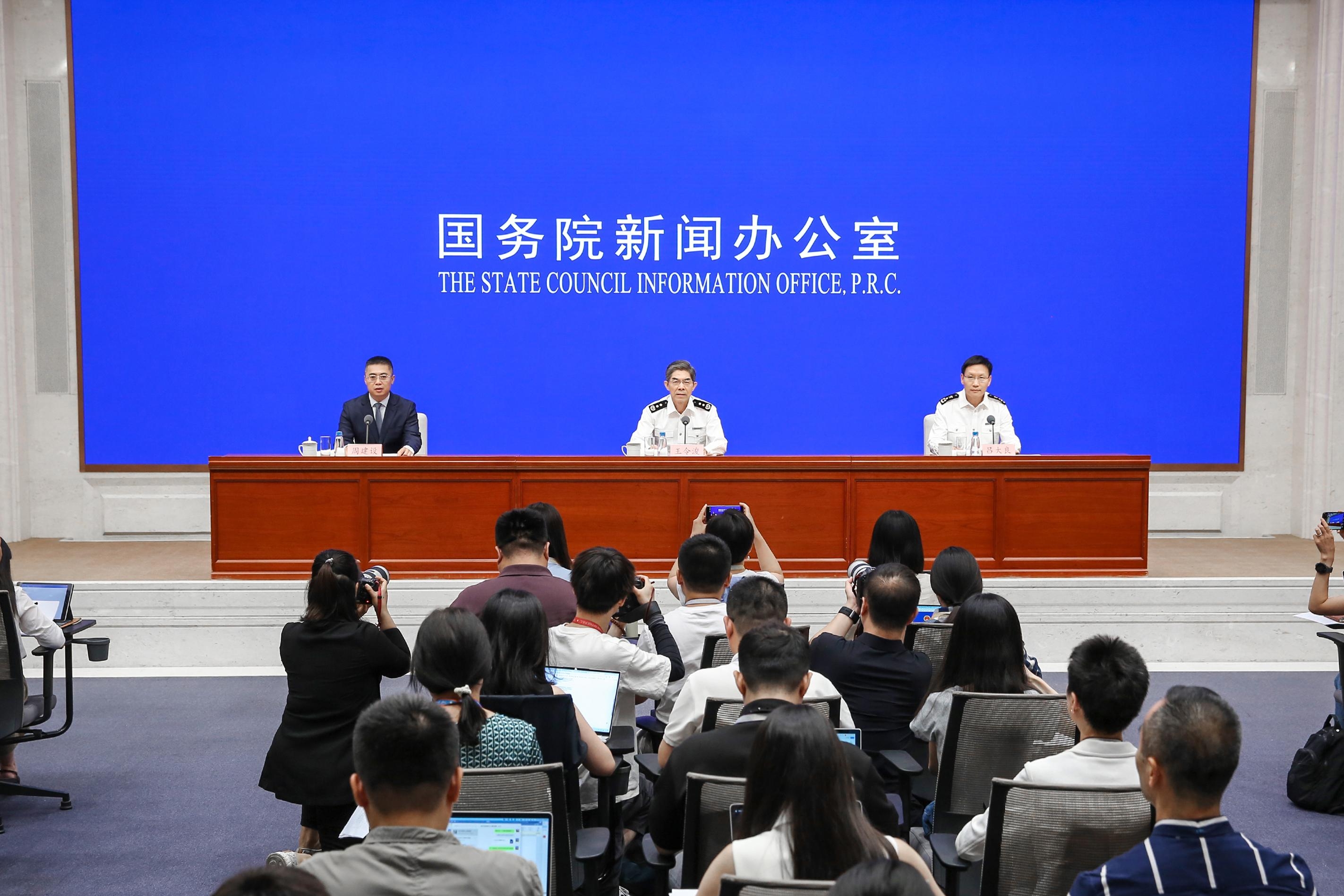

Speakers:
Mr. Wang Lingjun, vice minister of the General Administration of Customs of China (GACC)
Mr. Lyu Daliang, spokesperson of the GACC and director general of the Department of Statistics and Analysis of the GACC
Chairperson:
Mr. Zhou Jianshe, deputy director general of the Press Bureau of the State Council Information Office (SCIO) and spokesperson of the SCIO
Date:
July 14, 2025
Zhou Jianshe:
Ladies and gentlemen, good morning. Welcome to this press conference held by the State Council Information Office (SCIO). This is a regular briefing on China's economic data. Today, we have invited Mr. Wang Lingjun, vice minister of the General Administration of Customs of China (GACC), to brief you on China's import and export data for the first half of 2025 and to take your questions. Also attending today's press conference is Mr. Lyu Daliang, spokesperson of the GACC and director general of the Department of Statistics and Analysis of the GACC.
Now, I'll give the floor to Mr. Wang for his introduction.
Wang Lingjun:
Thank you. Good morning. I will start by briefing you on the import and export performance in the first half of this year, and then my colleague and I will answer your questions.
Since the beginning of this year, under the strong leadership of the Central Committee of the Communist Party of China (CPC) with Comrade Xi Jinping at its core, China has adhered to the general principle of pursuing progress while ensuring stability, unwaveringly managed its own affairs well, unwaveringly expanded high-standard opening up, focused on stabilizing employment, enterprises, markets and expectations, effectively responded to external shocks, and ensured overall stable performance and steady growth of the economy. Our foreign trade has withstood pressure, maintained momentum, and demonstrated vitality in a complex environment. According to statistics from the GACC, China's foreign trade volume in goods in the first half of 2025 jumped 2.9% year on year to 21.79 trillion yuan. Exports grew 7.2% year on year to 13 trillion yuan, while imports fell by 2.7% to 8.79 trillion yuan. Specifically, there were five main features:
First, the scale of foreign trade has grown steadily. In the first half of the year, China's total imports and exports reached 20 trillion yuan, marking a record high for the same period. According to quarterly trends, imports and exports in the second quarter increased by 4.5% year on year, accelerating by 3.2 percentage points compared to the first quarter, and continuing a streak of seven consecutive quarters of growth.
Second, our circle of foreign trade partners has become more diverse. In the first half of the year, China's trade with Belt and Road (BRI) partner countries reached 11.29 trillion yuan, up 4.7% year on year, and accounting for 51.8% of total foreign trade, 0.9 percentage point higher than the same period last year. Notably, trade with member states of the Association of Southeast Asian Nations (ASEAN) rose 9.6% year on year to 3.67 trillion yuan. During the same period, imports and exports to the European Union, South Korea, Japan and other countries all registered growth.
Thirdly, export momentum has shifted toward higher quality and greater innovation. In the first half of the year, China's exports of mechanical and electrical products reached 7.8 trillion yuan, up 9.5% year on year, and accounting for 60% of total exports, 1.2 percentage points higher than the same period last year. Specifically, high-end equipment closely related to new quality productive forces grew by more than 20%, and the "new trio" (namely, electric vehicles, lithium-ion batteries and photovoltaic products) representing green and low-carbon development grew by 12.7%.
Fourth, the expansion of domestic demand has helped stabilize imports. With the continuous efforts to implement major national strategies and enhance security capacity in key areas, and increase support for a new round of large-scale equipment upgrades and consumer goods trade-in programs, imports turned to positive growth in the second quarter. In the first half of the year, imports of machinery and equipment in petrochemical, textile and other industries grew at double-digit rates. Imports of key components such as electronic parts grew rapidly, while import volumes of major raw materials such as crude oil and metal ores saw notable growth.
Fifth, the vitality of foreign trade business entities continued to grow. In the first half of the year, China had 628,000 foreign trade enterprises with actual import and export activity, surpassing 600,000 for the first time in the same period, an increase of 43,000 compared to the same period last year. Among these, 547,000 were private enterprises, whose imports and exports grew by 7.3%, accounting for nearly 60% of the total trade value.
Overall, China's foreign trade forged ahead despite headwinds in the first half of the year. The country maintained steady growth in foreign trade volume and achieved improvements in trade quality, which was truly a hard-won result. The achievement was fundamentally due to the centralized and unified leadership of the CPC Central Committee. It was also made possible by the concerted efforts of local governments and departments, as well as the adaptability and innovation of foreign trade enterprises and professionals nationwide. However, it is also important to recognize that rising global unilateralism and protectionism, along with increasing complexity, severity and uncertainty in the external environment, present significant challenges. Maintaining stable growth in China's foreign trade in the second half of the year will still require considerable effort.
The GACC will fully implement the decisions and plans of the CPC Central Committee and faithfully fulfill its responsibilities to guard the country's borders and promote development. We will deepen the development and cooperation of the Smart Customs project, vigorously advance special initiatives to facilitate cross-border trade, and actively leverage our role as a hub connecting domestic and international circulation. Through more effective regulation, enhanced security, greater convenience and stricter crackdowns on smuggling, we will work to stabilize trade volume and improve the quality of foreign trade, contributing to high-standard opening up and high-quality development. Thank you.
Zhou Jianshe:
Thank you, Mr. Wang, for your introduction. The floor is now open for questions. Please state your news organization before asking your question.

