- SCIO briefing on agriculture and rural development
Speakers:
Mr. Han Changfu, minister of agricultureMr. Han Jun, director of the Office of the Central Rural Work Leading Group
Mr. Ye Zhenqin, vice minister of agriculture
Mr. Wu Hongyao, deputy director of the Office of the Central Rural Work Leading Group
Chairperson:
Hu Kaihong, spokesperson of the State Council Information OfficeDate:
Sept. 29, 2017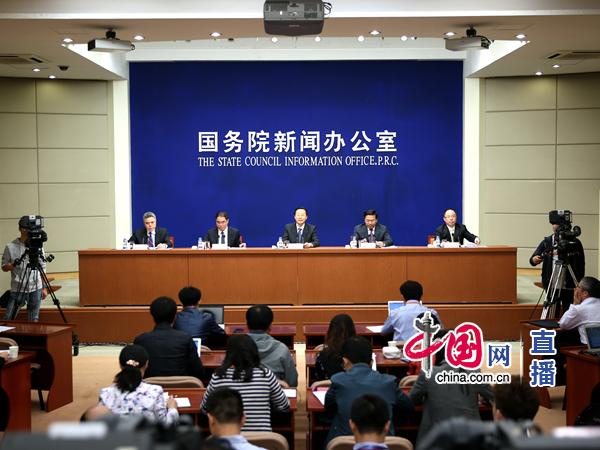
A press conference about China's agriculture and rural development is held on Sept. 29. [Photo/China.org.cn]
Hu Kaihong:Ladies and gentlemen, good morning. Welcome to this press conference. The Central Committee of the Communist Party of China (CPC) has always attached great importance to the issues concerning agriculture, rural areas and farmers, and much headway has been made in this regard.
Today, we are delighted to invite Mr. Han Changfu, the minister of agriculture, and Mr. Han Jun, the director of the Office of the Central Rural Work Leading Group, to this press conference. They will introduce the progress on agriculture and rural development since the 18th CPC National Congress, and answer some of your questions.
Also present at this press conference are: Mr. Ye Zhenqin, the vice minister of agriculture, and Mr. Wu Hongyao, the deputy director of the Office of the Central Rural Work Leading Group.
Now, let's welcome Mr. Han Changfu to make his briefing.
Han Changfu:
Ladies and gentlemen, friends from the press, good morning. Thank you for your concern and support for the work concerning agriculture, rural areas and farmers over the years. Autumn is a season of harvest, and it's a pleasure to exchange ideas with you on agriculture at this time.
Since the 18th CPC National Congress, the Party and the state have made great achievements under the strong leadership of the CPC Central Committee with Comrade Xi Jinping at its core and under the guidance of Xi's major addresses and his new vision, thinking, and strategies for the governance of China, and the same is true for the development of agriculture and rural areas.
The agricultural departments at all levels have studied Xi's speeches on agriculture, rural areas and farmers, focusing on agricultural supply-side structural reform and also on guaranteed supply, income and ecology to promote the modernization of agriculture. We have witnessed bumper harvests over the past five years, famers have gained increasing incomes and rural areas have maintained harmony and stability. All these factors have contributed to the stable economic and social development as a "ballast stone."
Since the 18th CPC National Congress, agriculture and the rural economy have made achievements in six areas, including progresses in grain production capacity, agricultural supply-side structural reform, agricultural modernization, rural reform, green agricultural development and the income of farmers.
Han Changfu:
First, the capacity for grain production has reached a new level, with annual output above 600 million tons for four consecutive years. General Secretary Xi Jinping has pointed out that we must ensure a sufficient food supply for 1.3 billion people. Based on that, we have always prioritized food safety and maintaining an adequate supply of important farm products, mobilizing local governments to focus on agricultural development and promoting farmers' enthusiasm for their industry.
Since 2013, China's food production has reached 600 million tons for four consecutive years. This year's food production is expected to remain at this level. Although accounting for only 10 percent of arable land worldwide, China produces food for 20 percent of the global population, which is a major contribution to the world's food security.
China has enjoyed good harvests for each of the last five years. In addition to bumper crops, the supply of other important farm products has also been adequate. The production of meat, eggs, vegetables, fruits and fish ranked first in the world. Urban and rural residents have both benefited from the rapid development of agriculture.
Second, supply-side structural reform in the rural sector has entered a new phase with marked results. President Xi Jinping has stressed promoting supply-side structural reform in the agricultural sector is the main thrust of the country's agricultural policy reform and development in the current stage as well as the future period.
We adhere to an orientation meeting market needs, deepen reform so as to create powerful impetus and further develop structural adjustment in agriculture. Now, the production structure has become smoother and unhindered. According to market needs, we have reduced the corn planting area by nearly 50 million mu (about 3.33 million hectares), and increased the soybean area by more than 16 million mu (about 1.67 million hectares) in the past two years. As much as 56 percent of livestock farming is now large-scale. Notable progress has also been made in the fisheries industry by reducing quantity and improving quality.
The industrial structure has been further improved, particularly in processing of agricultural products, farm-based recreation and agricultural tourism, and rural e-commerce. Development has been pursued in rural areas where the primary, secondary and tertiary industries have further been integrated. In 2016, the ratio between the processing of agricultural products and total agricultural output reached 2.2:1, e-commerce turnover of agricultural products reached 220 billion yuan, and farm-based recreation and agricultural tourism earned 570 billion yuan. Meanwhile, the production and supply of agricultural products featuring "green, ecological, high quality and safety" have increased significantly.
The regional structure is more reasonable. The concentrated area for grain, edible oil, cotton and sugar products continues to increase. Pig farming has been transferred to major grain-producing areas with a better environment. The output from major farming areas devoted to pigs and cows accounted for 80 percent and 60 percent respectively of the national total.
Third, modern agricultural construction has taken new steps, with the level of technology and equipment improved greatly.
Agricultural mechanization has been clearly enhanced. The level of comprehensive mechanization has reached more than 65 percent for the cultivation and harvest of all main crops. The cultivation and harvest of wheat is fully mechanized, while corn and rice have been more than 75 percent mechanized. These developments indicate that agriculture in China has pivoted from the centuries-old approach based on animal and human labor to mechanical engineering.
The level of technicalization has also been noticeably enhanced. Advances in agricultural science and technology contributed to 56 percent of agricultural production. Thus, China's agricultural development has gone from relying mainly on an increase of resources to a new phase of relying on technological progress.
Premium seed varieties have also increased. Improved breeds account for 96 percent of main crops, while the breeds and localization ratios of livestock are improving every year.
The production scale has also increased. There are more than 2.9 million new types of agribusiness in operation, such as family farms, farmers' cooperatives and leading industrial corporations. The proportion of suitably scaled-up operations of land reached 40 percent.
The installation of equipment and facilities has substantially increased. A total of 500 million mu of high-standard farmland was built to ensure stable yields regardless of drought or excessive rain, with more than 52 percent of farmland effectively irrigated. The facilities-equipped farmland covered 55 million mu. This indicates that the agriculture industry will no longer fully depend on the mercy of the natural environment.
Han Changfu:
Fourth, rural reform has been pushed forward with a new top-level design. Since the 18th CPC National Congress, General Secretary Xi Jinping has chaired 38 group meetings among members of the CPC Central Committee to deliberate on deepening reform, of which rural reform has been singled out for consideration 18 times. During these meetings, they scrutinized 24 plans in regard to rural reforms and issued several circulars, including the separation of the "three rural rights", namely, land ownership rights, contract rights and management right. Other reforms covered the collective property right system, the development of appropriate scaled operations of land, and the agricultural land reclamation reform. All in all, the fundamental framework of rural reform has been established.
The reform of the "three rural rights", in particular, has become an institutional design reflecting immense political wisdom and a visionary view to meet the expectations of farmers in preserving their contract rights and contract management rights of land under transfer. It represents a new round of significant systematic innovation following the establishment of the household contract responsibility system in rural China.
Rural collective property rights system reform is crucial to improve the rural production relationship. It clarified the ownership of property rights, activated collective assets, and increased property income for farmers.
The registration of land rights has become essential to rural reform. The country has so far completed the registration of 1.05-billion-mu (1 mu=0.067 hectare) of rural land.
Fifth, greener agricultural development and initial success in solving prominent resource and environmental problems. Xi Jinping, general secretary of the CPC Central Committee, pointed out that it is a profound revolution in development philosophy to pursue green agriculture. We have pushed for green production models and actively prevented and controlled agricultural pollution from nonpoint sources. This has been pursued mainly through five campaigns: curbing pollution from animal manure, replacing chemical fertilizers with organic ones in the production of fruits, vegetables and tea, treating crop straws in northwest China, protecting aquatic life (especially those inhabiting the Yangtze River), and recycling agricultural films. As a result, agriculture is now less resource-intensive, the coefficient on the effective utilization of water for farmland irrigation has risen above 0.55, 2.83 million hectares of marginal farmland have been turned into forests or grasslands, the crop rotation and fallow land trials have been expanded to 800,000 hectares, and the strain on resources and the environment from agricultural development has decreased. In addition, the worsening trend of agricultural pollution from nonpoint sources has moderated, the administration of pesticides has remained unchanged, the use of chemical fertilizers has seen almost zero growth, green technologies for preventing and controlling pests and diseases have been employed in over 33 million hectares of land growing grain crops, vegetables, fruits and tea, and the utilization rates of animal manure and crop straws and the recycling rate for agricultural films have all risen above 60 percent. (In short,) agriculture is turning green and rural areas are becoming beautiful.
Sixth, rural incomes have increased further, remarkably improving the living standard of farmers. In 2016, their per capita disposable income exceeded 12,000 yuan, with a four-year average annual growth of 8 percent, or a growth of near 1,000 yuan a year. In the first half of this year, the income growth continued to maintain a good momentum, with a growth rate of 7.4 percent, so that the income level is expected to reach 13,000 yuan by the end of this year.
The urban-rural income gap is continuing to narrow since the growth of rural income has surpassed that in urban areas for several years in a row. The ratio of urban income to rural income was 2.72 last year, a drop of 0.16 from 2012. In 2016, the Engel coefficients (i.e., the proportion of food expenditure in total consumption spending) per rural household fell to 32.2 percent compared to 37.5 percent in 2012. Incomes increased even faster in poverty-stricken areas, with an annual growth of over 10 percent. The figure is higher than national average rural income growth. As a result, we have further reduced the number of rural residents living in poverty by over 13 million a year during the period under review.
Looking back, we have made remarkable achievements; looking forward, we are firm in our confidence. We will be closely uniting around the CPC Central Committee with Comrade Xi Jinping at its core, and work diligently and blaze new trails to promote agricultural supply-side structural reform and consolidate the favorable development of agriculture and rural areas, so as to greet the 19th CPC National Congress with remarkable achievements.
Thank you.
Hu Kaihong:
Thank you, Minister Han Changfu. Now let's invite Mr. Han Jun, director of the Office of the Central Rural Work Leading Group to give us an introduction.
Han Jun:
Ladies and gentlemen, good morning. Since the 18th CPC National Congress, under the strong leadership of the CPC Central Committee with Comrade Xi Jinping at its core, we have followed a new development philosophy, taking agriculture, rural areas, and farmers as the top priority of CPC's work and promoted innovation in the practice, theories and institutions of work in this regard. We have held an annual Central Rural Work Conference for five consecutive years; issued the annual No.1 Central Document focusing on agriculture, rural areas, and farmers; formulated policies to comprehensively deepen rural reform, accelerate agricultural modernization, build a new socialist countryside, advance supply-side structural reform in agriculture, foster new growth engines to power agricultural and rural development; underscored the importance of agriculture and boosted its development. Thanks to the concerted efforts of the CPC and the entire country, difficulties and challenges in the development of agriculture and rural areas have been overcome and historic achievements made.
Just now, Mr. Han Changfu described the progress on agriculture and rural area development from six perspectives. The achievements should be attributed to the Party's leadership. Preliminary statistics show that, after the 18th CPC National Congress, General Secretary Xi Jinping took 23 inspection tours to rural area across the nation to gauge public opinion and seek solutions that would promote further rural development. In a series of instructions and speeches, he proposed new ideas and strategies for the work related to agriculture and the rural areas.
After the 18th CPC National Congress, we have accumulated important experiences in three specific aspects.
Han Jun:
Firstly, we continue to adhere to overall planning and top-level design in rural reform. Focusing on properly handling the relationship between farmers and the land, we have implemented measures for separating land ownership rights, contract rights and management rights for rural land. We have also made overall arrangements to carry out trial reforms with regard to rural land requisition, the marketization of rural collective land designated for commercial construction and the system covering rural residential land.
Focusing on properly handling the relationship between government and market, we have been constantly deepening reforms of the purchase and storage systems, as well as the pricing mechanism for grain and other important agricultural products. We have gained notable progress through pilot reform programs for ensuring guaranteed base prices for cotton from Xinjiang Uygur Autonomous Region and soybeans from northeast China.
In addition, we have also improved the agricultural subsidy system, promoted the integration of agriculture-related funds, innovated the rural credit and insurance mechanism, deepened comprehensive reform of the rural supply and marketing cooperatives and promoted reforms in the handling of reclaimed land.
We have ensured an orderly, stable and rapid reform mode. The implementation of a series of rural reform measures has injected powerful endogenous impetus to agriculture and rural development.
Han Jun:
Secondly, we have been working on a balanced and coordinated development between urban and rural areas. Despite the tightening financial revenue and expenditure, we continue to give priority to agriculture, rural areas and farmers in our public expenditures, which ensured the stable growth of the investment in these three areas.
From 2013 to 2017, China's national general public budget expenditures for agriculture, forestry and water are expected to reach 8.28 trillion yuan. More newly-added budget expenditures for education, culture, health care and other social undertakings were allocated to rural areas. As such, the basic standards and level of rural public services have been improved. We promoted new socialist countryside construction and carried out projects to improve the water supply, roads, power grids and internet connectivity in the countryside. We have also reinforced the dangerous buildings in rural areas.
We worked to improve living conditions in rural areas, with waste and sewage treatment as the focus. Rural production and living conditions have undergone significant changes. With increased support to rural compulsory education, the conditions for schools have been further improved. New systems for rural cooperative medical care and assistance for treating major and serious diseases were put in place. We increased subsistence allowances, benefits and basic pension benefits for entitled groups. The culture and sports industries have become more prosperous. Take the new rural cooperative medical care system as an example: financial subsidies at all levels reached 450 yuan this year, a twofold increase since 2012.
By the end of this August, over 500 million urban and rural residents have been covered by endowment insurance, among which 488 million were rural residents; over 150 million people reaching the age of 60 have been able to draw a pension. The income of farmers has been growing faster than urban residents for five consecutive years. The income gap between urban and rural residents fell from 2.88:1 in 2012 to 2.72:1 last year.
We have also carried out targeted poverty alleviation. By the end of last year, 55.64 million poor people in rural areas had been enabled to shake off poverty steadily, and the incidence of poverty in the country dropped from 10.2 to 4.5 percent. In the process of promoting new type urbanization, we have promoted basic public services in urban areas to cover all permanent residents. From 2012 to 2016, 60 million people originally with a rural household registration were able to transfer to urban household registration.
We have been making full use of the unique advantages of the countryside to foster new industries like rural e-commerce, leisure agriculture and rural tourism, and promote integrated development of the primary, secondary and tertiary industries in rural areas. With coordinated planning of urban and rural areas, the agriculture sector and rural areas have demonstrated new appeal. More people are moving or returning to the countryside to start their own businesses.
Third, sticking to green, sustainable development, with the firm belief that green can turn to gold too, we have put greater emphasis on ecological progress and promoted clean production methods in rural areas.
We ensured that China's farmland remains at or above the red line. Presently, the area of land recognized as permanent basic cropland totals 1.55 billion mu (1 mu=0.067 hectare).
We protected the community of life, which consists of mountains, water, forests and farmland ecosystems. Pilot programs were launched to reform crop rotation and fallow land systems. More marginal farmland was turned into forests or grasslands, with 30.10 million mu of marginal farmland transformed from 2014 to 2016, and 12.30 million mu of farmland to be transformed this year.
We also protected natural forests in an all-round way, and tackled agricultural pollution from non-point sources and other prominent problems in the ecological field.
We have entered a new phase of reform on agriculture and the rural area. The future will be even brighter.
That's all I want to share with you. Thank you.
Hu Kaihong:
Thank you, Mr. Han. Now let's move to the question session. Please identify your media outlet before stating your question.
_ueditor_page_break_tag_CRI:
In recent years, people from all walks of life have been concerned about entrepreneurship and the development of new industries in rural areas. Would you please brief us on this and any related measures taken by the government?
Han Jun:
I think people have seen the vigorous development of the new industries of farm-based recreation and agricultural tourism in recent years. A new wave of migrant workers, trade owners and even some college students have started their businesses in rural areas. This trend has only just begun. We believe that, through appropriate guidance, the development of new industries and entrepreneurship can hopefully become deliverables in China's agricultural supply-side structural reform and highlights in the development of the country's rural reform.
What are the reasons behind these? After analysis, we believe there are three major points: first, urban and rural residents have such demands. In the past, the demand of people was to have enough food. Now, they not only demand enough food, but also demand good and safe food. They want to eat safely and enjoy the food. As their income levels and living standards have been improved, they have new demands for the development of agriculture and rural areas.
Second, the rural areas have advantages. Many villages have a very good environment, without PM2.5 pollution, great ecology, the water is clean and the mountain is green. The ecological advantage is more and more obvious. And, there are great folk cultural environments in the countryside. There are distinguishing architectures, unique folk customs, distinct regional cultures and ethnic cultures, and particular lifestyles. I can say the cultural charm in the rural areas is very outstanding. And the values of ecological and cultural advantages are clearly rising fast.
Third, there are conditions for development. The rural areas have new industries and businesses, and the business start-ups didn't come out of the blue. You can feel that at present that rural traffic and transportation is becoming ever more convenient and accessible. In addition, the internet and information technologies are increasingly popular in the countryside. The gap between rural and urban areas is clearly shrinking, while logistics distribution systems are quickly entering the rural areas. These have placed a very good foundation for the development of new industries and businesses in the rural areas.
The development of rural areas needs not only clean water and green mountains but also young talented people. Therefore, we encourage migrant workers, entrepreneurs and college graduates to launch start-ups in our countryside. The No.1 Central Document has set out an overall program with policies required to be implemented for dealing with a particular issue, shoring up land utility, financial applications and training programs.
In regard to land utility, there is a certain proportion of new construction land that should be contributed to emerging industries or to other trends concerning rural development.
Synergic efforts are being undertaken to support the various preferential policies, including, market access, fiscal and tax issues, financial services, land use, electricity consumption, entrepreneurial training and social security, all designed to inspire innovation and entrepreneurship in rural areas.
Migrants returning from the cities are encouraged to start their own businesses through innovation zones, incubators, start-up service platforms, streamlined and open-window administrative services to support new development modes in the countryside.
All in all, we believe, as long as the momentum emerging from village maiden entrepreneurship is maintained, China's rural economy, now known as the 2.0 Version of China's rural entrepreneurial endeavor, will flourish again with the inception of new start-ups and innovation among the returning migrant population. Thank you.
Han Changfu:
I'd like to give another figure. So far, the number of migrant workers returning home to start a business and permanent urban residence holders who are rural business owners has exceeded seven million. We welcome more people to follow suit.
CCTV:
We only have less than three years to go before 2020, but still many farmers are not well-off. Income increases for farmers has now become quite difficult after a streak of rapid growth in recent years. My question is what concrete measures will be taken next to ensure rapid income growth.
Han Changfu:
Affected by the international market, the price of farm produce saw only a slight increase in the past two years, which resulted in a sluggish increase in farmers' operating revenues. For migrant workers, their income increased, but at a slower rate. How to make the income growth sustainable for them? This is indeed a question for us. Anyhow we will never cease our efforts and continue to take it as our central task in our work related to agriculture, farmers and rural areas.
There are several key aspects to maintaining the good momentum: First, to keep up the growth of household business operating income. Specifically, we should prioritize a green and eco-friendly approach as well as safety in agricultural production, and nurture high quality farm products with brand recognition, so as to ensure they can be sold at a good price. And we should also be more efficient and energy-saving. Together with green development, water and energy saving should be widely applied in agricultural production, so as to reduce the cost of labor, transportation and resources. Meanwhile, we should facilitate the development of appropriately scaled-up agricultural operations.
Second, we should further expand the channels available for increasing rural incomes. This involves developing emerging industries, such as leisure agriculture, rural tourism, creative agriculture and e-commerce. In addition, we should also encourage migrant workers to start businesses in their hometowns and villages.
Third, reform of the rural collective property-rights system will be deepened to clearly identify such rights and to provide rural residents with a more adequate property rights system.
Fourth, in poor counties, various actions for promoting rural development will be carried out vigorously. We will take targeted measures to cultivate business operations with distinctive local features, for instance, growing vegetables, fruits, tea trees, edible mushroom and herbal medicines as well as raising silkworms. We are confident in achieving the growth of rural income at a higher rate than that of the GDP and urban income.
Reuters:
I have two questions. The first is about pig breeding. About 200,000 pig farms have been shut down since this year's new environmental rules were introduced. Could you inform us about the specific drop in numbers of pigs? How many pigs will there be at the end of the year? The second question is about ethanol. China plans the nationwide use of ethanol fuel by 2020. How much corn will be consumed to achieve the goal? Does China have enough corn? Or will it have to import corn or other raw materials for ethanol as many predict? Thank you.
Ye Zhenqin:
It is important to control pollution caused by pig breeding. The Ministry of Agriculture has implemented the policies of the central government and made efforts in the following four aspects order to achieve a balance between production and environmental protection.
The first is introducing bans. Pig breeding is banned in drinking water-protected areas, scenic spots as well as in educational and sci-tech parks.
The second aspect involves setting limits. Limits have been set on the number of pigs bred in areas containing an intensive water network, restricting the huge amount of pigs and low farming capacity in southern China.
The third aspect is relocation. Some pig farms have been relocated to areas with high capacity, such as northeast China, where there is vast land and enough corn to feed the animals.
Finally, there is treatment. Environmental pollution is being controlled through such ways as ecological breeding and waste recycling.
All those efforts aim to handle properly the relationship between agricultural production, stock supply and environmental protection. Up to now, areas with high capacity in northeast China have accommodated a substantial number of pigs transplanted from the water-extensive areas in the south. I think this is a growing trend. Meanwhile, we should avoid the "one-size-fits-all" approach and only impose bans on a scientific basis so as to protect farmers' interests.
Han Changfu:
Please allow me to offer you two figures. The first relates to the number of hogs. There was a slight drop in those in stock, but the general situation remains stable. The total number of hogs in stock and sold is around 1.2 billion a year.
The second figure concerns hogs raised on large-scale farms. About half of the hogs are raised on farms capable of feeding at least 500 animals and even more, making it easy to prevent epidemic diseases and treat the manure in a more efficient manner.
Han Jun:
You have talked about the impact of using corn to make fuel ethanol just now. Lately, 15 government departments of China jointly issued a plan to increase the production capacity of fuel ethanol by another 8 million tons. Currently, only 2.6 to 2.7 million tons of fuel ethanol are produced from grain. With this plan in place, the production capacity will reach 10 million tons. What does it mean? It means every three tons of grain can be processed into one ton of fuel ethanol, and if all the fuel ethanol is to be made from corn, the production capacity of 10 million tons of fuel ethanol will consume 30 million tons of corn, or 30 billion kilograms.
One of the major considerations behind this plan is that our corn has had good harvests for several years in a row, which has accumulated into the largest stock of corn in the world, but the corn in the granary must be channeled due to its short storage period. So now, multiple channels have been utilized to reduce the excess stockpiles of policy-supported grain. According to the calculation and measurement of relevant national authorities based on the current grain stock, increasing the production capacity of fuel ethanol now will not have a big impact on the food supply and demand in the short term.
The de-stocking of corn will help the market return to its basic balance of supply and demand gradually within three to five years. Also, we are not just using grain to produce fuel ethanol now. Actually, if you take a look at the plan by the 15 government departments, you will notice that we will adopt many other ways to develop fuel ethanol apart from corn, for example, raw materials like the crop straws.
Based on China's national conditions, one thing has been made very clear in the policies is that it is not permitted to appropriate agricultural land or grain to develop fuel ethanol. China is a country with a large population density, so our primary guideline is to make sure that everyone has food to eat. You asked if China will import corn from abroad to develop fuel ethanol. This is a question many people have asked before. Actually, I have already answered this question just now. The leading reason why we are developing fuel ethanol and expanding its production capacity now is to de-stock the corn. So I think, from our national conditions, it is not practical to import corn from abroad to develop the industry of fuel ethanol.
That's all I would like to say for now. Thank you.
People's Daily Online:
This year's No. 1 Central Document put forward the need to keep advancing agricultural supply-side structural reform. Please introduce in more detail the progress made so far. Thank you.
Wu Hongyao:
Agricultural supply-side structural reform involves using the reform approach to promote the adjustment of the agricultural structure, so that the supply of agricultural products better fit ongoing changes in demand, thus being better able to meet consumers' expectations. Over the past two years, various regions and departments have implemented fully the spirit of the No. 1 Central Documents, deeply promoted agricultural supply-side structural reform, and made positive progress mainly in the following aspects.
First, the structure of agricultural production has been constantly improving. Fostering high quality products and distinctively local products has become the direction of current agricultural development. In the past, we cared only about yield. Now, we rely on high-quality brands to develop the market and improve incomes at all levels.
Second, we are fostering an environment-friendly mode of agricultural development. Green ecology has become the consensus for agricultural development.
Third, we have speeded up reform of the rural industrial structure. In particular, the integration of the primary, secondary and tertiary industries, and promoting flourishing new industries and businesses in rural areas, all of which have injected fresh impetus into agricultural and overall rural development. These have all become the most prominent agricultural and rural development highlights. Overall, the ecological and cultural values of rural areas, and such functions as sightseeing and recreation, are becoming investment hot spots.
As for rural reform, we have mainly activated the following three points.
First is to activate the market. The reform of the agricultural products' purchase and storage system has achieved remarkable results. The reform of the guaranteed base price policy for cotton is better than expected. We have initially established the pricing mechanism for agricultural products, activated the mainstay market of industrial chains, guaranteed the basic income of farmers, and enhanced the overall efficiency and competitiveness of agriculture.
Second is to activate the key elements. We have implemented measures for separating land ownership rights, contract rights, and management rights for contracted rural land. We have taken steady steps to reform the rural collective property rights system. We have also made overall arrangements to carry out pilot reforms with regard to rural land requisition, the marketization of rural collective land designated for commercial construction and the system covering rural residential land. Through a series of reforms, we have made rural resources proactive and effective, and the potential of the rural economy is gradually being played out.
Third is to activate the principal parts. The principal production and service parts in new agriculture continue to develop in various forms and in moderate scale. At the same time, governments at all levels are paying great attention to supporting small-scale production. By strengthening cooperation and service, small producers are gradually being brought into the track of agricultural modernization. Thanks.
Economic Daily:
I'm concerned about the crop seed industry. A modern crop seed industry is a strong symbol of modern agriculture. In recent years, China has made a series of arrangements to grow the industry. Would you like to elaborate on the industry's development? Thank you.
Han Changfu:
China is a large agricultural country with a big population. It ranks first in the world in the output of many agricultural products, so it is necessary for the country to have its own crop seed industry.
In recent years, the industry has seen obvious changes as a result of unswerving sci-tech and institutional innovations. These changes can be summarized as follows:
First, the industry is now significantly more capable of innovation. In 2016, the number of intellectual property applications for new seed products doubled that of five years ago. Seed strains independently bred by China now account for 95 percent of those used for the country's staple crops. For the two staple crops of rice and wheat, the proportion is 100 percent. For vegetables, the proportion of foreign-bred strains has been reduced across the board to 13 percent from 20 percent five years ago.
Second, seed enterprises have grown much stronger. Research institutes and universities used to carry out seed breeding research, but now it is mostly enterprises. This change is the result of government incentives being given to enterprises. Meanwhile, we support and encourage enterprises to engage in mergers and restructuring and increase their spending on R&D. Currently, the top 50 seed enterprises spend 7.4 percent of their collective sales revenues on R&D.
Third, seed production and supply capacity have improved remarkably. In the past, seed breeding was quite scattered and farmers kept a portion of the seeds from their own crops for future use. We have set up seed breeding bases where conditions are favorable. There are currently three national bases in Gansu, Sichuan and Hainan respectively.
Fourth, legal oversight has been strengthened. Not long ago, China revised its Seed Law along with nine supporting rules and standardization documents to improve the legislation regulating the industry.
Going forward, we will focus on breeding green, high-quality and cost-effective seeds and increasing the competitiveness of seed enterprises in the international market. It will take time for China's seed industry to grow strong, but it won't be long. Thank you!
China News Service:
Rural land expropriation, collective operational construction land entering the market, and rural residential land pilot reforms have been underway for more than two years, so I would like to ask how the pilot reforms are progressing? How can you protect the rights and interests of farmers in carrying out these reforms? Thank you.
Han Jun:
Rural land expropriation, collective operational construction land entering the market, and rural residential land system reforms are the three key areas of the rural land system that we identified as the "Three Reforms." This reform task was proposed by the Third Plenary Session of the 18th Communist Party of China Central Committee, and is being led by the Ministry of Land and Resources, and also involving the participation of the Central Agricultural Office and the Ministry of Agriculture. The three reforms were planned to be completed by the end of this year, but have now been moved back to the end of 2018. Looking at the reforms occurring in the past two years, the most important thing is that we have recorded a number of institutional achievements with the aim of further improving the rural land system. Land expropriation reform can be said to have entered the actual operational phase. Collective operational land for construction entering the market is now covered by a relatively mature and efficient system of rules, so that the results of reform in this aspect are outstanding.
In regard to rural residential land system reform, people are very concerned about it, and it is a very sensitive issue. It also has achieved very profound progress, and the protection of farmers' residential land property rights and interests has scored remarkable results.
For example, the first deal of the collective operational construction land entering the market, and the first land officially entered into the market transactions occurred in Deqing County, Zhejiang. Last year, while conducting research in Deqing County, we found 49 cases involving nearly 400 mu of land that had entered the market, with the volume of transactions reaching 104 million yuan. Meanwhile collective economic organizations and farmers obtained income of 83.55 million yuan.
Deqing comrades told me they have 1,180 cases involving 10,000 mu of land in 12 townships and 150 administrative villages that can enter the market as collective operational construction land. If all this land were put on the market, can you guess how much money would be involved? About 2.6 billion yuan! Farmers and collective economic organizations would get more than 2 billion yuan in revenue. This reform brings tangible benefits to the farmers. More importantly, when this 10,000 mu enters the market, it provides land support for local rural new industries, as well as for many people to return home to start businesses.
Another example is the system for rural residential land, where reform efforts have paid off. Yujiang County, Jiangxi Province, for instance, has achieved a success in its institutional reform far beyond expectations.
Nearly 40 percent of villagers in the county possessed more than one house site under a single household, which violated the law that one household can only possess one site.
The county has 92,400 house sites among which 23,000 are deserted. How to reclaim these abandoned sites? Within two years, villagers submitted a total of 28,000 house sites covering 3,800 mu (or 253.33 hectares). The retrieved land can sustain housing supply to the entire village for the next 10 to 15 years. Most of the 28,000 house sites were illegally built, and 81 percent of the land was providing no returns.
The difficulty of the work is beyond our imagination. However, after learning from their experiences, we know that highly autonomous governance with an executive board comprising local farmers is the key to addressing the disputes like those about residential land in rural society.
The major challenges facing land requisition are unspecific scope, low compensation standard and irregular procedures. Our pilot reform is drawing lessons from those experiences so that they can work as a testimony for amendment of pertinent laws.
The No.1 Circular has made it clear that we'll learn from the spearheading reform of the system for rural residential land to keep the property rights of farmers from being infringed by external capital. In view of such a prerequisite, the government should implement farmers' collective rights for residential lands, ensuring their rights to use and live on them, seeking rental or other cooperative models to ensure reuse of abandoned lands in the form of collective economic organizations, all contributing to an increase in farmers' incomes.
Beijing and Wuhan, capital of Hubei Province, are leading the way in testing the effectiveness of the reform. The Central Agricultural Office is resolved to press ahead with the pilot programs under the concerted efforts of other authorities, such as, the Ministry of Land and Resources, to release maximized reform dividends in this regard. Thank you.
Hu Kaihong:
This press conference is about to end. We only have the time for two more questions.
CCTV:
Food safety has been a great concern to the public over the past years. In particular, the people want to be assured that domestic formula milk is safe for our kids to drink. My question is for Mr. Han Changfu. What measures have the government taken to ensure the safety of agricultural products and to promote the sound development of the domestic diary industry? What progress has been made? Thank you.
Han Changfu:
The people want safe food. That's natural. The agricultural department shoulders the responsibility of ensuring the safety of agricultural products. Many measures have been taken in this regard.
In the past five years, we conducted food sampling annually. More than 96 percent of the sampled products from the farming, husbandry and fishery sectors met the quality standard. In the first half of this year, the ratio went up to 97.6 percent.
But of course, there are problems to be solved. One is the small-scale producers, who pose a great threat to food safety, and the other is law enforcement, which needs to be further improved and intensified.
The production process and regulation of agricultural products are crucial to ensuring product safety. There were three notable changes in the regulation field.
Firstly, sound systems have been established. In recent years, we have revised over 6,000 items of pesticides and veterinary drugs residual limited standards, and over 5,000 agricultural industrial standards. Powerful enforcement and operations will be ensured under these standards.
Secondly, supervision of farm products safety has been strengthened since the 18th CPC National Congress. We have built up a team from all levels to oversee quality safety of agricultural products. The supervision is becoming even more effective.
Thirdly, responsibilities have been clarified. We have urged the local governments to perform their administrative responsibilities and operational entities to fulfill their primary responsibilities.
The dairy industry also produces milk powder. The quality of milk powder produced by China has improved a lot over the last five years compared with that produced eight years ago. Several China's mainland milk powder brands have been certificated by the EU, and some have entered the Hong Kong market. Specifically, improvements have been made in three aspects. First, dairy farming has been scaled up. Second, the milking process has been mechanized. Mechanization has been achieved in large-scale farms. Third, production, supervision, and product standards of the dairy industry are in place. The dairy industry is a relatively modern one with a long and complete industrial chain, so its regulatory framework is developing from strength to strength.
All in all, now we have undergone a great change and laid a sound foundation. We have the confidence to revitalize China's dairy industry, and let our children be able to enjoy high-quality and safe milk produced in China. Thank you.
China Business News:
I have two questions. First, I would like to ask Mr. Han Changfu: the "No. 1 Central Document" in 2013 proposed that China should complete the registration for rural land contract rights and management rights in five years. And just now you mentioned that the rights covering 78 percent of the land has been made clear. During the process, are there any experiences and what are the difficulties? How will we handle the remaining 22 percent? And my second question is to Mr. Han Jun: Anhui, Hubei and Sichuan yesterday launched a minimum purchase price plan for medium and late rice. According to the plan, the minimum purchase price of 50 kilograms of medium and late indica and japonica was reduced by 2 yuan and 5 yuan respectively. The minimum purchase price of wheat was the same as 2016, but 3 yuan lower for early indica. So, what are the considerations behind such adjustment? Will there be further reforms in the future?
Han Changfu:
I will answer the first question. In relation to registering and certifying the rights to the contracted use of land in rural areas, I have stressed that it is a basic work. What kind of basic work is it? It is a basic work on rural reform, on the stability of rural land contract relations, and on the policy of separating land ownership rights, contract rights, and management rights for contracted rural land.
Primarily, land is collective and the form of ownership cannot be changed. Meanwhile, land is contracted by households and the contracting right cannot be changed, either. If this basic work can be done well, it will be of great significance for us to further improve the reform of rural land contract relations. President Xi Jinping said that, the main line of rural reform is still to manage well the relationship between farmers and the land.
The central document put forward outlines that it will take us five years to complete the work of registering and certifying the rights to the contracted use of land in rural areas. Namely by 2018, we will basically complete the work. The schedule may be postponed for some remote areas, ethnic minority areas and larger areas. Currently, five provinces have basically completed the work, and the country has completed 78 percent of the work.
When talking about experience, I would say there's a lot available. However, I think the most important experience may be summed up by the following two points. First, there is the attention of the leaders. Now, Party committees and governments at all levels, down to county Party committees and governments, are attaching importance to this matter, and organizing and implementing in accordance with the central government's policies, and then giving support in providing the best working conditions, in particular, leadership in regard to in-depth grass-roots research, so that the leaders can understand the situation and be able to resolve problems and conflicts. This may be a very important experience.
A second element involves relying on the public. It is a good thing for farmers when the central government issues them with the registry certificates confirming their rights to contracted farmland. This soothes farmers' nerves and they become active. You issue a certificate to one farmer, give him confidence that a land is contracted to him for a long time, and then he would like to expand, and move on to other places and businesses. Even when a new entity occupies his land, the original holder will still rest assured that all is well. We have to rely on the public to solve problems, so that in everything you should start from the realities, and rely on the public of a county, a township and a village to carry out the land contract work efficiently. In such a big country, with so many farmers and so much land to be cultivated, there are no huge clashes of interests and social instability. I think these two points are very important.
Han Jun:
The question you asked concerns a major reform carried out over the past few years. Generally speaking, we want to offer different policies to different products and reform the pricing system step by step.
The price of domestic corn has remained high, so Chinese processing factories and animal feed producers are inclined to use foreign products. From 2013 to 2016, they purchased 100 billion kilograms of foreign sorghum, barley, distillers grains and cassava to replace domestic corns in production.
This resulted in a growing stockpile of policy-supported corns. In view of this situation, in 2016, the government decided to reform the pricing system to let the market determine the price. Corn farmers are now subsidized directly, so as to guarantee their basic earnings.
Things are different concerning wheat and rice, which are a staple food.
Regarding wheat, supply and demand has remained basically balanced, with a gap of 2 million tons last year and a surplus of 5 million or 6 million tons this year. Because of the sound balance, the stock-piled policy-supported wheat can be auctioned at a price basically the same as the price the government purchased it - therefore not requiring a government subsidy. Wheat has a special advantage. It can be stored for a long time.
Regarding rice, the government will take actions this year too. The rice supply is increasing faster than demand. What's worse, it can't be stocked for a long time like wheat, and its industrial chain is not as long as for corn. Therefore, the pressure on stockpiles is mounting. We need to find a solution to reduce the stock of policy-supported rice.
This year, the prices of early indica rice, middle-season and late indica rice and japonica rice have been revised down 0.06 yuan, 0.04 yuan and 0.1 yuan per kilogram respectively. This shows that, on the whole, the supply of rice exceeds demand. As required in this year's No. 1 Central Document, we will take constructive, steady steps to reform the pricing mechanism for grain and other important agricultural products. We will also continue and improve the minimum purchase price policy for rice and wheat, making reasonable adjustments to these prices, to enable parity between prices. The reform should reflect the market demand under the basic policy framework. Therefore, these measures should play a vital role in maintaining farmer's enthusiasm to grow grains, pushing forward grain production and increasing farmers' income. Thanks.
Hu Kaihong:
Today's press conference will end here. Thanks to the spokesperson. Thank you everyone.
agriculture and rural development - SCIO briefing on reform of SOEs
Speaker:
Xiao Yaqing, chairman of the State-owned Assets Supervision and Administration Commission of the State CouncilChairperson:
Hu Kaihong, spokesperson of the State Council Information OfficeDate:
Sept. 28, 2017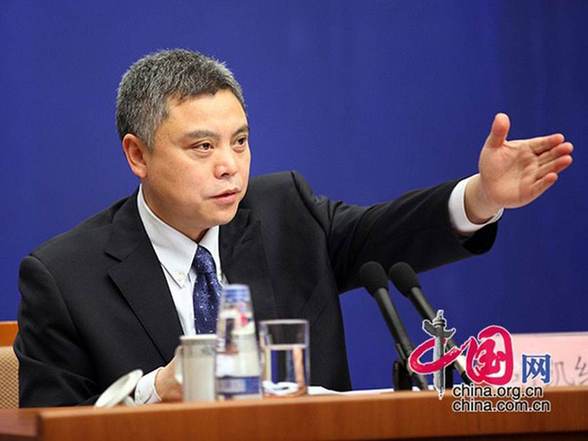
Hu Kaihong, spokesperson of the State Council Information Office. [Photo/China.org.cn]
Hu Kaihong:Ladies and gentlemen, good morning. Welcome to the press conference. As we know, many people are paying close attention to the reform of state-owned enterprises (SOEs), and are eager to know what has happened so far.
Today, we are delighted to invite Mr. Xiao Yaqing, the chairman of the State-owned Assets Supervision and Administration Commission (SASAC) of the State Council, to introduce the progress of reforms since the 18th National Congress of the Communist Party of China (CPC). He will also answer some of your questions.
Also present at the press conference are: Ms. Huang Danhua, SASAC vice chairwoman, and Mr. Peng Huagang, SASAC deputy secretary-general and spokesperson.
Now, let's welcome Mr. Xiao Yaqing to make his briefing.
Xiao Yaqing:
Thank you. Ladies and gentlemen, good morning. It's a great pleasure for me to be here with you.
Now, I would like to present a brief introduction to the reform of SOEs, especially centrally-administered SOEs, since the 18th CPC National Congress.
The CPC Central Committee attaches great importance to the reform and development of SOEs. Since the 18th CPC National Congress in 2012, the CPC Central Committee with Comrade Xi Jinping at its core has specified the direction and plans for the reform. The Committee pushed it forward with unprecedented determination and strength, as demonstrated by the series of major decisions it has made. General Secretary Xi Jinping has given a number of important speeches and instructions on the direction of the reform. Premier Li Keqiang has also clarified on multiple occasions the requirements for the reform and development of SOEs.
Subdivisions of the SASAC at every level and all SOEs, especially those centrally-administered SOEs, have worked in accordance with these plans and requirements. Remarkable results have been achieved in comprehensively advancing the reform and making breakthroughs in key areas.
Over the past five years, we have essentially completed top-level design of SOE reform and paid extra attention to implementing systematic, integrated and coordinated reforms. The Party Central Committee and the State Council have put in place a framework that consists of the Guidelines on Deepening Reform of SOEs as well as 22 supplementary documents, which have played an important role in guiding and leading practice at the grassroots level. Central and local SOEs have kept to a problem-oriented approach, adopted work plans and detailed implementation rules in view of their own circumstances, and intensified reform of SOEs.
In the five years, significant measures for SOE reform were implemented one by one. Breakthroughs occurred continually in regard to those key and difficult issues. Centrally-administered SOEs' classification reform was carried out comprehensively so that their functions were defined more precisely. There were 10 pilot reforms, all of which made significant progress and established many precedents and experiences that can be copied and replicated. More than 90 percent of the SOEs have undergone corporate system reform, along with about 92 percent of the branches and subsidiary companies under centrally-administered SOEs. Mixed ownership reform was carried forward in a stable way, and more than two-thirds of the central enterprises have introduced or are in the process of introducing capital from various social source in order to promote shareholding diversity. The regrouping and integration of SOEs is also been advanced in a significant way. The SOE structure is constantly being optimized through regrouping of the State-owned capital layout. The three key institutional reforms have achieved further progress. The supervisory function related to State-owned assets was further transformed, with continuously strengthened oversight. Party building was enhanced comprehensively, providing solid assurances for the development and reform of SOEs.
During the past five years, the SOEs have made big strides while gradually releasing the reform dividends. They have improved the market-oriented institution during the ongoing reforms, exemplified by the intensified operational controls of the centrally-administered ones, the quality, efficacy and vitality of which have continuously progressed.
By 2016, the aggregate assets of the centrally-administered SOEs grew to 50.5 trillion yuan, an 80 percent surge compared to the previous Five-Year Plan. Meanwhile, benefits over the five years reached 6.4 trillion, up 30.6 percent from their last quintuple effort, registering comparatively high growth.
The amount of taxes and fees paid was 10.3 trillion yuan in 2016, up 63.5 percent, and the good momentum was sustained in the first eight months of this year. The centrally-administered SOEs have secured historically high year-on-year growth represented by the 15.7 percent increase in revenues and 17.3 percent surge in gross profits.
The achievements made in the reform and development of SOEs has well proven the brilliance and correctness of the CPC Central Committee's policies on SOE reforms. These reforms and policies are completely in line with China's national conditions and market economy laws as well as the laws of corporate growth, and have won the sincere support and enthusiastic participation of SOE staff.
Meanwhile, we also know that the SOE reform has a long way to go. We have a lot of work to do to implement the requirements by the central government. Standing at a new higher starting point, we will double our effort in further deepening and implementing reforms and finding solutions to problems. We will push through the reform of SOEs to make them stronger, better and larger.
Now, my colleagues and I would like to take your questions.
Hu Kaihong:
Thank you, Mr. Xiao. Now, the floor is open for questions. Please identify yourself before asking your question.
_ueditor_page_break_tag_China Central Television (CCTV) News Program Center:
Since the 18th CPC National Congress, the CPC Central Committee and the central government have issued a series of documents to promote reforms of central SOEs - the priority of economic structural reform. What efforts have the State-owned Assets Supervision and Administration Commission of the State Council and central enterprises made to implement those documents? What effects have been delivered? Thank you.
Xiao Yaqing:
Since the 18th CPC National Congress, the CPC Central Committee with Comrade Xi Jinping at its core has made a series of strategic arrangements. In implementing "1+N" series of documents, both central and local SOEs have undertaken the following work.
First, making a strong push for implementation. In order to implement the "1+N" documents, ministries and commissions introduced a further 102 supportive documents, and local governments also produced a total of 926 supportive documents. Moreover, the central and local SOEs also worked out many implementation programs and detailed procedures according to their own needs.
Second, they launched various pilot programs. The pilot programs in 18 central SOEs are progressing well. China Central Television (CCTV) covered developments of the central SOEs pilot programs via several of its channels and People's Daily as well as other media also introduced their best practices.
Third, best practices are chosen to lead the way. In implementing the "1+N" documents, especially in various pilot programs, we undertake timely summarization and try to scale up the best practices that have emerged. At the same time, we are constantly learning lessons from dealing with new problems and challenges, so as to further promote reform.
Fourth, there is a strong focus on monitoring and assessment. During the reform, we are paying special attention to monitoring, reviewing and assessment of the results in order to ensure public satisfaction and drive the reform program forward.
As for the results of our efforts, firstly, great progress has been made in system and institutional reform. More than 68 percent of central SOEs have finished their process of mixed ownership reform, a total of 83 central SOEs have regulated the establishment of a board of directors and 92 percent of local SOEs have established a board of directors. Many central SOEs have reduced employees in their headquarters.
Secondly, the process of structural adjustment of the state-owned economy has been optimized and improved. Since the 18th CPC National Congress, 34 central SOEs have been merged, the number of central SOEs has been cut from 117 to 98 and a total of 136 provincial SOEs have started to merge. After the structural adjustment, the assets of SOEs are optimized and the development goals of SOEs are clear.
Thirdly, the system of assets supervision has been improved. We have accelerated the transition of our functions by focusing on capital management. Forty-three functions of the State-owned Assets Supervision and Administration Commission of the State Council have been cancelled and decentralized, while 563 functions of local State-owned Assets Supervision and Administration Commission of the State Council have been decentralized. There are ten pilot companies chosen from investment companies and operating companies of central SOEs with 18 functions being decentralized. Meanwhile, we have strengthened state-asset supervision to prevent the loss of state-owned assets.
Meanwhile, the leadership of CPC in SOEs has been strengthened through the reform.
To sum up, the reform facilitates the development of central SOEs. Without the reform and the leadership of the CPC, it will be difficult for central SOEs to achieve a great performance in 2017.
China Daily:
The central government has vowed to further boost supply-side structural reform to promote long-term, sustainable economic development. Since the reform involves a wide variety of issues, could you tell us what is the main focus for the central SOEs? Thank you.
Xiao Yaqing:
Implementing supply-side reform is a major strategic decision of the central authorities. Central SOEs have resolutely carried out the reforms and greatly benefitted from them.
The following are some of the main aspects.
First, taking the lead in reducing excessive production capacity. Central SOEs, especially those in the steel and coal sectors, achieved their goal ahead of schedule and, indeed, beyond expectations, in 2016 and continuing in the first eight months of this year.
Last year, the amount of overcapacity cut by the central SOEs in the steel industry accounted for 80 percent of the industry total. Meanwhile, in the coal industry, the central SOEs cut overcapacity by 200 million tons, or 73 percent of the industry total. In the first eight months this year, enterprises in the two sectors undertook further cuts in their overcapacity of 16.14 million tons and 55.10 million tons respectively.
Besides, small coal companies under the central SOEs, with a total production capacity of some 100 million tons, were either shut down or integrated.
The second area involves addressing the problem of "zombie enterprises". A total of 500 "zombie enterprises" of those in serious trouble achieved rectification, reducing annual losses of companies directly under the central SOEs by 88.5 billion yuan.
The third focus is reducing leverage and debt. A risk control system is taking shape and has achieved positive initial results. The system sets the debt alarm level for enterprises in different industries, monitors and controls operations of heavily indebted enterprises, and curbs issuance of bonds by such companies. At the end of August, the average debt to asset ratio fell by 0.2 percentage point to 66.5 percent.
Fourth, efforts were undertaken to further streamline the organizational structure. They focused on redundant and overlapping departments in central SOEs. Unprecedented efforts have been made in the past year and achieved remarkable results, with 6,395 departments shut down, and the posts of 6,395 general managers and an even larger number of deputy general managers abolished.
Fifth, there was also a significant focus on resolving long-lasting problems. Pilot programs have been launched to relieve enterprises of the burden of providing water, electricity, heating, gas, and property management services to employees, and to improve the service system covering retired employees.
The economic structure has noticeably improved as a result of supply-side structural reform. As was just mentioned, when carrying out reform, we obviously favor emerging industries of strategic importance and those that have a bearing on the national economy and people's livelihood.
On the whole, the reform has contributed to the development of central SOEs, especially in ensuring their development becomes more sustainable, market-oriented and in line with the expectations of the people. However, the reform needs to go deeper in a number of aspects, and we are undertaking studies and improvements in this regard. At any rate, we will continue the reform among central SOEs to help elevate the Chinese economy to the medium-to-high level.
NHK:
In June, the People's Daily reported that the building of Party organizations had been written into the regulations of more than 3,000 enterprises. Would you please briefly explain this?
Xiao Yaqing:
We appreciate our foreign friends' concern about Party building in SOEs.
Party building and the Party's leadership are a unique political advantage of SOEs, because all their progress has been made under the Party's leadership. For an enterprise with good management and strong competitive strength, the building of its team and top-level managers must be excellent as well. The leadership of the Party plays a very important role in the building of an enterprise's team and its top-level managers.
To give full play of the Party's leadership and its core political role, SOEs should stick to the political principle that all SOEs must be under the Party's leadership, and stick to the ultimate goal of establishing a modern enterprise system. The leadership of the Party should be emphasized during the improvement of SOEs' governance system.
Currently, 98 central SOEs have written Party building into their regulations. Notably, the responsibilities of two positions, the secretary of Party committee and the chairman of the board of directors, are borne by one person. This arrangement will strengthen the governance of enterprises.
In addition, Party building is strengthened during reforms. A series of measures have been taken to implement the responsibility system and simultaneously build Party organizations and working institutions. The heads and working staff of Party organizations are required to go to their duty posts at the same time. Party works are required to focus on enterprises' main business. As a result, the Party works and business operation of enterprises are integrated.
Another important point of Party building is to develop a team of enterprise leaders. We select personnel who possess management capabilities and are innovative, honest, just, and loyal to the Party. They are recruited into the management of SOEs, especially top-level management, so as to train and develop an excellent team of entrepreneurs.
On the other hand, to strengthen Party building within SOEs, we must unswervingly advance clean governance and anti-corruption work. Since the 18th CPC National Congress, we have worked hard in this regard, and achieved unprecedented results.
While deepening the reform of SOEs and increasing the value of State assets, we have strengthened anti-corruption work, which is the guarantee of success of all other works. After the 18th CPC National Congress, three rounds of nation-wide inspections were undertaken. Central SOEs removed a group of corrupt officials and closed loopholes to prevent the loss of State assets. More importantly, by strengthening the work of Party building, we have closed loopholes in the supervision and management system of State assets, thus ensuring the supervision system is sound and effective.
By upholding CPC leadership in SOEs, we should take improving enterprise efficiency and performance as the starting point and the ultimate goal of all Party building work, and treat the fruits of our reforms as a litmus test of the success of Party building. We can already see that enterprises able to undertake a better job in Party building possess a more vibrant staff and a better relationship between administrative personnel and common workers, so as to achieve stronger performance and greater competitiveness.
Japanese enterprises are famous for their unique business culture and personnel management. They have always placed great importance on team construction. Many of their ideas are worth learning.
In conclusion, Party building is an important foundation of SOE reform and development. It provides strong political support for raising the overall competitiveness of SOEs. Thank you.
Bloomberg:
SOE mergers have been used to build single, large, powerful national champions, and this is happening with automobile builders and others. Can you tell us what are the next sectors to become the focus of mergers, and would shipbuilding be one of those, with Beichuan (China Shipbuilding Industry Corporation) and Nanchuan (China State Shipbuilding Corporation) involved?
Xiao Yaqing:
Anything can happen. I would like to ask Ms. Huang Danhua to answer your question.
Huang Danhua:
Thanks, Mr. Xiao, and thanks to the Bloomberg reporter for your concerns about the restructuring of central SOEs.
The restructuring of central SOEs is pressing ahead as part of the CPC Central Committee and the central government's strategic layout to reinforce SOE reform, a big move for SOEs to increase their competence and competitiveness.
Since the 18th CPC National Congress, the State-owned Assets Supervision and Administration Commission of the State Council has coordinated efforts with the pertinent authorities to restructure 34 central SOEs, including China North Railway, China South Railway, Baosteel Group, Wuhan Iron and Steel Corporation and China COSCO Shipping Corporation Limited.
In keeping up with the needs of the times, we have jointly founded the Aero Engine Corporation of China and China Tower, and the number of central SOEs has now amounted to 98.
Yesterday (Sept. 27), the State Council released a statement about work in the next phase after hearing the report on what had been done so far in regard to the restructuring of central SOEs.
The Bloomberg reporter just asked what we will do next. Actually, the State Council has made that clear at yesterday's executive meeting. All we need to do is to continue to fulfill the decisions.
As for the integration effect the journalist just mentioned, I think it is comprised of many facets rather than merely integration. Thus, the integration effect is shown in the following aspects:
First, horizontal mergers strengthen the enterprises' scales. In 2017, a total of 48 central SOEs were included on the list of the Fortune 500 globally, significantly improving their leading role and influence in the industry.
Vertical partnership generates complementary advantages and improved upstream-downstream coordination of the industry chain. It explores ways to solve long-existing problems in the development of some industries and greatly enhances the overall strengths of enterprises.
Integration also optimizes the allocation of resources. It increases the level of resource sharing and cuts off redundant projects. It saves investment as well as land, and also protects the environment.
Second, as far as structure optimization is concerned, the restructuring and integration of central SOEs speeds up excess capacity cuts, improves the technological innovation of enterprises by integrating their complementary advantages, cuts managing and operational costs, and steadily increases their economic benefits.
Third, integration has had remarkable effects for individual enterprises. Their main business is more prominent. Their organization and structure are more streamlined, and their internal management is more efficient. More efforts are made in the coordination of enterprises and other reform work.
Therefore, we should view the effects of structural optimization and integration from multiple dimensions. Practices over the years show that the restructuring and integration of central SOEs is not aimed to change their numbers. It mainly aims to optimize resource allocation as well as the layout and structure of the state-owned sector of the economy. It also aims to enhance the overall functioning and efficiency of the state-owned sector of the economy.
Next, we will persist in deepening reforms to further boost the structural optimization, restructuring and integration of central SOEs. We will continue to improve the flow of state-owned capital. We will motivate the central SOEs to strengthen their main business, speed up their transformation and improvement as well as improve their quality and efficiency for better growth. Thank you.
Xiao Yaqing:
Thank you Ms. Huang for your answer. I would like to add that expanding these enterprises is a goal of the restructuring, but it's not the most important one. The problem is that dozens of enterprises are competing in the same industry, thus causing heavy friction between them. However, reducing the overall number is not the most important goal, either.
I think what really matters is developing enterprises that the domestic and international markets need. You mentioned CRRC, which is a large Chinese enterprise. But some world-famous companies, such as Siemens and Alstom, are undergoing restructuring as well. So the development of technology and markets constitutes the strongest driving force behind the restructuring of central SOEs, and we need to adjust the enterprises in line with this development.
In the meantime, restructuring should be combined with reform and opening up. We hope to cooperate with all kinds of companies at home and abroad when advancing the restructuring of central SOEs. Let's work together to accomplish this endeavor. Thank you.
CGTN:
What measures have the SASAC taken to prevent the loss of state assets? What have been the results? Thank you.
Xiao Yaqing:
I am also paying much attention to this issue. Let's invite Mr. Peng to answer this question.
Peng Huagang:
Thank you. We are fully aware that preventing the loss of state assets is an important part as well as a prerequisite of SOE reform - or the reform won't achieve expected result. We can summarize our efforts on this front in the following four aspects.
Firstly, improve the institutional system. In the past two years, we have formulated and improved a total of 27 rules and regulations in monitoring state assets which has laid a solid institutional foundation for our work.
Secondly, set up a closed-loop monitoring system to find problem and address them timely. In recent years, especially last year, the SASAC has set up three monitoring bodies during its functional transformation so that they can synergize with other bodies to facilitate the cycle of investigation, rectification and punishment.
Thirdly, strengthen the supervision in key sectors, in especial, SOEs mergers, equity transactions, and important investment. The supervision of overseas management has been highlighted in our supervision in recent years. We have taken many methods to strengthen the supervision of overseas management of SOEs systematically.
Fourthly, promote SOE's management and investment accountability. Last year, we established a mechanism to investigate and punish SOE management based on investment accountability. We have already investigated and punished relevant officials in the cases of huge losses of state-owned assets in China Railway Materials Company Ltd. and the Metallurgical Corporation of China Ltd according to the mechanism.
Strengthening the supervision of SOEs and preventing the loss of state-owned assets are our major responsibility. We will transform our function and improve our supervision to prevent the loss of state-owned assets. Thank you.
Reuters:
My question concerns the future of SASAC. As the modern enterprise system is fully employed by the central SOEs and mixed ownership is implemented within the corporate structure and completed by the central government companies, what is the future role of the SASAC in your estimation? Thank you.
Xiao Yaqing:
Thanks for your question, which inspires us to further consider the issue.
Speaking of the future, we are, on one hand, full of expectations, while, on the other hand, worry about its uncertainties. However, I agree with you that, with the furthering of the reform process, the central SOEs and other SOEs will definitely keep on changing with a new look, substantial achievements and progressive performance. The transformation is a pathway created by consecutive reforms, a pathway of improved systems and, more importantly, a definite trajectory of corporate progress.
We expect the SOEs, including the central SOEs, to keep on developing in such a way.
Will SASAC have nothing to do, when all SOEs have developed well? Of course, I hope we will have nothing to do. However, as far as I know, SASAC undertakes two important tasks assigned by the central government, which are supervision and administration. Since state-owned assets belong to the public, I think SASAC under the State Council, and SASAC organizations at all levels, are needed to preserve and increase SOE value, prevent losses, and enhance their functions so that SOEs and the related state-owned assets can achieve the optimum level and the most reasonable position in economic competition. In this way, SOEs can serve national development strategies and meet people's aspirations for a better life. The central SOEs should lead by example in this regard. SASAC and the SOEs should work together to fulfill all of their political, economic and social responsibilities.
Looking forward, the better the SOEs develop and the more enabling the market economy environment can become, the greater will be the need for SASAC to play an enhanced role. It should have a better grasp of the market economy, market rules and the laws governing enterprise development so as to enhance its supervision.
With regard to the missions and duties of SOEs and central SOEs, the SASAC also has great responsibilities.
There must be a sound legal and economic growth environment for the enterprises to fulfill their missions and duties -- so such supervision is essential. So far, both developed and emerging economies as well as SOEs and non-state economies are required to be regulated and supervised under the rule-of-law.
Therefore, the point is not to discuss the SASAC's future existence. The biggest pressure for us is how to improve it to let our supervision and regulation help boost the growth of enterprises, implement the national policies and achieve the goals of reforms set by the central government as soon as possible. Thank you.
People's Daily:
My question is about the mixed ownership reform. Last month, telecom carrier China Unicom released its mixed-ownership reform plan, which drew wide attention from the public. Meanwhile, many enterprises have advanced pilot reforms to introduce a mixed ownership structure in different levels and sectors. Could you please give me a briefing about the progress? Which areas will be the next focus? Do you have some specific timetables? And how will the experience of the mixed ownership reform be promoted?
Xiao Yaqing:
The mixed ownership reform is an entry point for reform and a focus of public attention. The pilot reforms are now underway to introduce a mixed ownership structure in various sectors. Now I will invite Mr. Peng to answer your question.
Peng Huagang:
There are three key points in regard to the process of mixed-ownership reform. Firstly, the number of SOEs involved in mixed-ownership reform is increasing. A total of 68.9 percent of central SOEs have initiated mixed-ownership reform, while 47 percent of local SOEs have been involved in that.
Secondly, the level of mixed-ownership reform is being upgraded. As we have seen, third-tier SOEs and those below the third tier were often chosen as pilot companies to undertake reform. In recent years, we have explored ways to facilitate mixed-ownership reform in both second- and third-tier SOEs, even in their headquarters.
Thirdly, the industries covered by mixed-ownership reform have been expanded. A total of 19 central SOEs from key industries have initiated mixed-ownership reform, covering electricity, oil, petrochemical, telecommunications, aviation, and military industries.
Mixed-ownership reform is an important breakthrough in the reform of SOEs. We will continue to promote the reform under the rule of "One Enterprise, One Policy."
Xiao Yaqing:
Apparently, you are eager to know the results of the reform. However, it takes time for the reform of an enterprise's ownership, especially the mixed-ownership reform, to yield results. The time needed can be a product lifecycle or an industry lifecycle. Meanwhile, we should be prepared that the reform won't necessarily succeed, so while looking forward to the results, we should also allow an enterprise time to pursue the reform through trial and error.
Wall Street Journal:
What do you see as the challenges to reforming SOEs, especially in the northeast, both in the medium and long term, and in Liaoning Province in particular? What do you think are the best examples of SOE reform? Can you expound on anything that you see as progress?
Xiao Yaqing:
Thank you for the questions. They cover a wide range of issues. I'll try my best to answer them.
SOEs are faced with many challenges. It's difficult to say which one is the toughest. Actually, all the reforms we just talked about are challenges for SOEs. In my opinion, the most crucial issue is whether the reforms can cope with economic development, and this can be gauged by the performance of SOEs.
I'm fully confident of the result, and I'm eager to see how SOEs will achieve it. There are many challenges and problems ahead. The problems may concern specific issues and general policies, such as government supervision and regulation, and company development strategies. All of the problems will be our targets in reform and will be addressed step by step.
You mentioned SOE reform in northeast China. That is an important topic. The CPC Central Committee has been paying much attention to the economic development of the region, especially its SOE reform. In recent years, the CPC Central Committee and the State Council have introduced many guidelines and supportive policies to rejuvenate the region's economy. I can see that it is now developing at a steady pace. According to my multiple field trips, I've noticed some positive changes in companies there -especially SOEs.
First, much progress has been made in relieving SOEs of their obligation to operate social programs, like the obligation to provide water, electricity, heating, gas and property management services to their employees' homes. Second, SOEs in northeast China are also proactively transforming themselves.
Third, as an old industrial base, northeast China is home to many heavy industries. But it is now shifting toward robotics, software design and modern logistics, among other new and strategic industries.
For example, the reform of pharmaceutical companies in Liaoning Province has achieved considerable results in terms of effective management and relieving their obligations in social programs. The restructuring of Dongbei Special Steel Group, which is a typical case, is so far quite successful considering its difficulties. Of course, there are more cases to demonstrate that northeast China is prospering and we can expect much more from the development of SOEs there. Thank you.
Economic Daily:
CCTV aired a documentary called Amazing China recently. The documentary contains scenes of central SOEs undertaking major projects, which was quite encouraging to watch. It was no less encouraging when we saw the innovative achievements of central SOEs at an ongoing exhibition. My question is to the SASAC: What are the areas where central SOEs have progressed most and what are the underlying reasons. Thank you.
Xiao Yaqing:
The exhibition you mentioned is a collective one staged by all the central SOEs to display their achievements in innovation. Thanks for your attention. Ms. Huang Danhua will answer your question.
Huang Danhua:
Thanks for your concern about the central SOEs' innovation efforts. As you mentioned just now, Amazing China is indeed very thrilling and encouraging. Many roads, bridges, harbors and networks that appear in the documentary were built by central SOEs with the application of major sci-tech innovations. Since the 18th CPC National Congress in 2012, the central SOEs have earnestly pursued innovation-driven development and seized the opportunities brought by the global technological revolution and industrial transformation. Their enhanced endeavors to make original, independent and collaborative innovations have delivered remarkable results. There are four aspects I'd like to mention here.
First, we have made multiple major scientific and technological breakthroughs at the world's most advanced levels. The manned spaceflight, submersible deep ocean exploration, high-speed railway, UHV transmission, mobile communication, domestically manufactured aircraft carrier launched this year and the homegrown large passenger aircraft which made its maiden flight this year. They are the world's top-notch technologies.
Second, we have many farsighted and groundbreaking scientific and technological innovations which have reinforced the industrial developments. They, as we know, include the Hong Kong-Zhuhai-Macao Bridge, the "No.1 Blue Whale" Deep Water Drilling Platform and the Beidou Navigation Satellite System, signaling our great achievements.
At the same time, the exploration of shale gas, the mining of combustible ice and the space-ground integrated information network, let alone the nuclear reactor and new carrier rockets, all have driven China towards the high-end of the industrial chain.
Third, there are lots of platforms which have supported entrepreneurship and the innovative aspiration of the entire Chinese society. The central SOEs have created 518 pertinent platforms involving a number of brilliant organizations, such as, Casicould, Avicui.com, Ouyeel and Shining Star Innovation, which have pooled social resources to ramp up innovation nationwide.
With its interconnection between big, medium and small enterprises, the new development model has created 6 million jobs and amassed innumerable resources, funds and knowledge for the innovative society where central SOEs have played a leading role.
Fourth, the central SOEs have formed a major force behind the nationwide drive of innovation. I'll reveal a group of data to show how the central SOEs are involved, in regard to funds and personnel for innovation. By 2016, the central SOEs have 808,000 people engaged in R&D. Besides, they have hired 226 academicians from the Chinese Academy of Sciences and Chinese Academy of Social Sciences. They have established 632 country-level R&D platforms and hold 486,000 valid patents.
The sci-tech progress awards and invention awards won by central SOEs accounted for one third of the national total, and the proportion was even higher in terms of special prizes and first placed prizes. Over the past five years, central SOEs invested 1.7 trillion yuan, or one-fourth of the national total, in sci-tech development, and won 424 national awards, accounting for one third of the national total. Generally speaking, great efforts have been made in deepening reform, intensifying innovation and cultivating talents.
In the next step, we will further implement the national strategy of innovation-driven development, and help central SOEs to make a greater contribution in making China an innovative country and strong sci-tech power in the world. Thank you.
Die Welt:
I read in your report that the number of central SOEs has decreased from over 170 to 98 in the past five years. Will the number continue to be fall in the next five years? Is there a target? Since the borrowings by SOEs account for about 60 percent of total corporate debt, is there a target of debt reduction for the next five years? What measures will be taken to meet the target?
Xiao Yaqing:
As to the number of central SOEs, Ms. Huang has already elaborated on this. Unprecedented efforts have been channeled into the restructuring of central SOEs in the past five years delivering obvious effects. As I have mentioned, we will not be taking the reduction in numbers or the size of any expansion as set goals. Instead, we will set the pace of restructuring on the basis of the needs of domestic and international markets, as well as the development trends of certain industries. Therefore, we will focus on enhancing enterprise core competitiveness and management level as well as raising the returns in regard to the preservation and increased value of State-owned assets. We will advance the restructuring process according to the laws governing scientific and market development and the demands of technology innovation.
Your second question is about corporate debt. At the end of 2016, the debt ratio of the central SOEs stood at at 66.7 percent. This was moderate compared with other countries. Over the past five years, the ratio has remained stable, rising slightly by 0.4 percentage point to 66.7 percent in 2016 from 66.3 percent in 2012.
To curb the rise of this ratio, a major approach is to intensify supply-side structural reform and structural adjustment.
Presently, the debt risk of the central SOEs is completely under control, as shown by the statistics I just mentioned. The enterprises are operating well. This means the risk has been reduced. So far this year, the central SOEs have maintained the positive growth momentum seen in the fourth quarter of last year, while a particularly rapid growth rate is appearing in the major sectors and among the large SOEs.
New York Times:
Regarding the merger of large SOEs, why does the government think that this is in line with the law of the market economy? Why not let the market decide? For example, let them take part in the market competition until one of them is shut down. Thank you.
Xiao Yaqing:
Thank you for your question.
Chinese enterprises have been competing in the market. After the 18th National Congress of the CPC, and especially after its third plenary session, the central government stressed that the market plays a decisive role in resource allocation and the government should play a better role in creating the best conditions. In the historical development of China's reform and opening up, a very important experience is that the process should never stop. We have been moving forward and have made remarkable achievements, especially since the 18th National Congress of the CPC. In the market economic context, central SOEs scored prominent achievements, including many innovations, enhancing the effects of mixed ownership reform and other reforms. All these show our success and progress in market-oriented reform.
The growth of an enterprise of any country must be in line with the country's laws and policies. Government regulation helps enterprises improve their competitiveness and develop themselves within the legal framework. The development of a market economy cannot be separated from the legal environment and market cultivation. In my view, the achievements made by Chinese enterprises and fresh and vivid experiences formed in market-oriented development have proven such development is feasible. Therefore, our development will become more international and market-oriented in the future. Thank you.
Hu Kaihong:
The last question.
Market News International:
My question is about mixed-ownership reform. You just mentioned that China is considering introducing the third round of pilot programs in the reform. What specific areas will it cover? Are there more rounds of pilot programs in the pipeline?
There have been some voices complaining that the reform is slow, indecisive and losing momentum. Are there any subtle changes in the government's attitude? Other overseas voices like the AmCham China complain about foreign companies' low access to major areas in China. How do you respond to that? Can foreign companies participate in China's mixed-ownership reform? Thank you.
Xiao Yaqing:
Your question covers many levels, just like the levels in the reform we are carrying out. I will try my best to give you an answer.
The reform to establish mixed-ownership systems is a key area in the reform of SOEs, and we have been firmly pushing it forward. However, the reform of mixed-ownership is only a part of the reform of SOEs, not the whole of it. It should be said that, the reform of mixed-ownership is not suitable for all SOEs.
Take the United States for example. Its enterprises not all feature mixed-ownership. They are not all privately-owned. Some are State-owned and undertake important social responsibilities.
In the reform to establish mixed-ownership systems, we hope that enterprises of different ownerships will learn from each other and play their respective roles so as to better develop SOEs. Many privately-run enterprises in China have excellent decision-making systems and decision-making procedures, as well as excellent management and experience.
Our SOEs have strong cohesiveness and pioneering spirit. Coupled with a sound foundation for development, they can overcome their own weak points by learning from each other's strong points and unite together. The mixed-ownership reform is open as well, just like other reforms.
President Xi Jinping delivered keynote speeches at this year's World Economic Forum in Davos, the Belt and Road Forum for International Cooperation and the 9th BRICS Summit. We have carefully studied these speeches and feel that China's gate for opening up and reform is always open -- this is also our demand for the central and local SOEs and the national assets supervision department. China's SOE reform is an open program that attracts all enterprise of various ownership forms to participate. If foreign enterprises are willing to join in, we also welcome them.
Of course, we hope America will be open to us, and open to our SOEs, as well. We hope the American government look at China's SOEs from a full, correct and objective perspective. The process of opening up must be a win-win, a multi-win situation. The process of reform must be exactly the same. All parties involved should see their interests enlarged and assured during the process of opening up and reform. Mixed ownership reform must continue, and the results and effects of the reform should just keep on emerging, which is something we are greatly anticipating.
Hu Kaihong:
Due to the time limit, today's press conference must end here. Thank you, Mr. Xiao, Ms. Huang and Mr. Peng. Thank you everyone.
SCIO briefing on reform of SOEs - SCIO briefing on China's economic performance in Aug.
Speaker:
Liu Aihua, spokesperson of the National Bureau of StatisticsChairperson:
Xi Yanchun, vice director-general of the Press Bureau, State Council Information OfficeDate:
Sept. 14, 2017
Xi Yanchun, vice director-general of the Press Bureau, State Council Information Office. [Photo by Liu Jian/China SCIO]
Xi Yanchun:Ladies and gentlemen, good morning. Welcome to this press conference. Today, we are delighted to invite Ms. Liu Aihua, spokesperson of the National Bureau of Statistics, to introduce and analyze China's economic performance in August. She will also answer some of your questions.Now, let's welcome Ms. Liu to deliver her briefing.

Liu Aihua, spokesperson of the National Bureau of Statistics. [Photo by Liu Jian/China SCIO]
Liu Aihua:Thank you. Ladies and gentlemen, good morning. As usual, before answering your questions, I will make a brief introduction.
In August, China's economic performance was stable with good momentum for growth.
The overall situation was sound. Structural adjustment continued to go deeper. New emergent driving forces continued to gain strength. Economic performance improved steadily in both quality and returns.
First, industrial production was stable, corporate profits continued to improve.
In August, the total added value of industrial enterprises above designated size increased by 6.0 percent year-on-year, down 0.4 percentage points from the previous month; and grew 0.46 percent faster than July, representing a gain of 0.05 percentage points.
An analysis by types of ownership shows State holding enterprises saw a gain of 7.8 percent; collective enterprises were down 2.1 percent; share-holding enterprises achieved a 5.8 percent increase; and those funded by foreign investors or investors from Hong Kong, Macao and Taiwan rose 7.9 percent.
The added value of the mining industry fell 3.4 percent year-on-year; manufacturing rose 6.9 percent, a gain of 0.2 percentage points from the previous month; and that of the production and supply of electricity, heat, gas and water rose 8.7 percent. The production and sales rate of industrial enterprises above designated size reached 98.5 percent. From January to August, the total added value of industrial enterprises above designated size increased by 6.7 percent year-on-year. In August, The Purchasing Manager's Index (PMI) stood at 51.7 percent, a gain of 0.3 percentage points from the previous month. This represented 13 consecutive months of improvement.
From January to July, industrial enterprises above designated size achieved a total profit of 4.2481 trillion yuan, an increase of 21.2 percent year-on-year. The main business income profit margin reached 6.09 percent, up 0.41 percentage points year-on-year.
Second, the service sector grew at a relatively fast pace, with the business activity index extremely active.
In August, the service sector production index increased by 8.3 percent year-on-year, the growth rate being unchanged from the previous month; however, it was 0.9 percentage point higher than the same period last year. Information transmission, software and information technology services, rental and business services maintained double-digit growth.
From January to August, the service sector production index increased by 8.3 percent year-on-year, 0.2 percentage point higher than the same period last year. From January to July, the operating income of service enterprises above designated size grew by 13.4 percent year-on-year, up by 0.2 percentage points from the first half of the year. The operating profit of service enterprises above designated size grew by 22.6 percent year-on-year, up by 6.6 percentage points from the first half of the year.
In August, the business activity index for services stood at 52.6 percent, showing a continued good performance. Specifically, the business activity index for sectors such as air transport, postal services, telecommunications, radio and television and satellite transmission, and the Internet and software information technology services stayed within the relatively good range of over 60.0 percent. From the market demand perspective, the new orders index of the service sector was 50.3 percent, 0.1 percentage points higher than the previous month, and maintaining an advance for the fourth consecutive month.
Third, the growth of fixed-asset investment slowed down with the investment structure becoming optimized.
In the period January-August, total fixed-asset investment (excluding rural households) was 39.42 trillion yuan, up 7.8 percent year-on-year. However, the growth rate was 0.5 percentage point lower than at the end of July. This included investment of State-owned capital of 14.38 trillion yuan and private investment of 23.91 trillion yuan, with year-on-year increases of 11.2 percent and 6.4 percent respectively. Private investment accounted for 60.7 percent of the total. Primary industry investment was 1.27 trillion yuan, up 12.2 percent from the same period last year; secondary industry investment was 14.82 trillion yuan, up 3.2 percent. This included investment in manufacturing of 12.17 trillion yuan, an increase of 4.5 percent. Investment in the tertiary industry was 23.32 trillion yuan, up 10.6 percent. Infrastructure investment totaled 8.47 trillion yuan, up 19.8 percent; hi-tech manufacturing investment increased by 19.5 percent, 11.7 percentage points higher than the growth rate of total investment. Investment in manufacturing industries with extensive energy consumption declined by 1.6 percent. A total of 39.62 trillion yuan of fixed-asset investment was available, up 2.8 percent and 1.3 percentage points from the end of July. The planned total investment in new projects was 33.01 trillion yuan, up 2.2 percent and 0.3 percentage point higher than at the end of July. Total fixed-asset investment (excluding rural households) increased by 0.57 percent month-on-month.
Fourth, investment in real estate grew in a stable way, and commodity housing for sale continued to decline.
In the period, January-August, the total investment in real estate was 6.95 trillion yuan, up 7.9 percent year-on-year. Investment in residential housing increased by 10.1 percent. Construction began on housing totaling 1.15 billion square meters, up 7.6 percent, with the area of residential housing up 11.6 percent. A total of 985.39-million square meters of commodity housing was sold, up 12.7 percent, with the area of residential housing up 10.3 percent. The sales of commodity housing reached 7.8 trillion yuan, up 17.2 percent, with the sale of residential housing up 14.2 percent. Property developers bought land totaling 142.29 million square meters, up 10.1 percent. By the end of August, the commodity housing for sale remained at 623.52 million square meters, 11.44 million square meters less than a month earlier. In the period from January to August, the capital available for property developers was 9.98 trillion yuan, up 9 percent.
Fifth, market sales continued to expand and online retailing showed good momentum.
In August, total retail sales of consumer goods reached 3.03 trillion yuan, up 10.1 percent year-on-year, 0.3 percentage point lower than the July figure, up 0.76 percent month-on-month, 0.05 percentage point higher than July. Sales of consumer goods in cities reached 2.62 trillion yuan, up 9.9 percent, while sales in rural areas reached 416.1 billion yuan, up 11.5 percent. The catering sector reported revenue of 336 billion yuan, up 10.7 percent; retailing 2.7 trillion yuan, up 10.1 percent, with retail sales of enterprises above designated size reaching 1.24 trillion yuan, up 7.5 percent. Sales of commodities regarding consumption upgrading saw fast growth, with the growth of sales of sports and entertaining commodities up 14.9 percent and that of communications equipment up 12.2 percent. In the period from January to August, total retail sales of consumer goods achieved stable growth of 10.4 percent.
In the period from January to August, online retail sales reached 4.25 trillion yuan, up 34.3 percent year-on-year, 0.6 percentage point higher than at the end of July. Online retail sales of tangible goods reached 3.21 trillion yuan, a year-on-year increase of 29.2 percent, accounting for 13.8 percent of total retail sales of consumer goods, which was 2.2 percentage points higher than the same period of last year; online retail sales of Intangible goods reached 1.04 trillion yuan, up 52.9 percent.
Six, mild rise in CPI; greater rise in PPI.
In August, the consumer price index (CPI) rose 1.8 percent year on year, 0.4 percentage point higher than in July. The breakdown is as follows: 0.4 percent for food, tobacco and alcohol, 1.3 percent for garments, 2.7 percent for housing, 1.3 percent for daily-use goods and services, 0.7 percent for transportation and communications, 2.5 percent for education, culture and entertainment, 5.9 percent for healthcare and 1.4 percent for other goods and services. Within the "food, tobacco and alcohol" category, the prices of grain and fresh vegetables rose by 1.6 percent and 9.7 percent respectively, and the price of pork dropped by 13.4 percent. The month-on-month rise for CPI was 0.4 percent. For January-August, CPI rose 1.5 percent year on year.
In August, the producer price index (PPI) rose 6.3 percent year on year, 0.8 percentage point higher than the growth in July, and rose 0.9 percent month on month. The rise for January to August was 6.4 percent year on year. In August, the producer purchasing price index jumped 7.7 percent year on year and 0.8 percent month on month. For January-August, the jump was 8.4 percent year on year.
Seven, rapid growth in imports and exports; higher proportion of general trade in imports and exports; higher proportion of mechanical and electrical products in exports.
In August, foreign trade increased 10.1 percent year on year to 2.41 trillion yuan, of which 1.35 trillion yuan was exports, up 6.9 percent, and 1.06 trillion yuan was imports, up 14.4 percent, resulting in a trade surplus of 286.5 billion yuan. For January to August, foreign trade increased 17.1 percent year on year to 17.83 trillion yuan, of which exports were 9.85 trillion yuan, up 13 percent, and imports were 7.98 trillion yuan, up 22.5 percent. In January to August, general trade expanded by 17.9 percent year on year, increasing its share in China's total foreign trade by 0.4 percentage point from last year to 56.7 percent. Exports of mechanical and electrical products expanded 13.4 percent, increasing its share in China's total exports by 0.3 percentage point from last year to 57.1 percent.
In August, industrial enterprises above the designated size (those with an annual revenue from their main business operations of 20 million yuan or more) delivered exports worth 1.09 trillion yuan, up 8.2 percent year on year. For January to August, the figure was 8.27 trillion yuan, up 10.3 percent over last year.
Eight, progress in the supply-side structural reform; extraordinary results in transformation and upgrading.
New progress has been made in cutting overcapacity, reducing excess inventory, deleveraging, lowering costs, and strengthening areas of weakness. By the end of July, overcapacity cutting in iron and steel industry had progressed smoothly with sales and production of substandard steel products banned; overcapacity cutting in coal resulted in a combined capacity of 128 million tons, or 85 percent of the annual target, eliminated. The area of commodity housing for sale at the end of August declined 12 percent year on year, 1 percentage point higher than a month earlier.
The debt-to-asset ratio and production cost of industrial enterprises continued to fall. At the end of July, the ratio was 55.8 percent for industrial enterprises above the designated size, down by 0.7 percentage point compared with the same period last year. The cost for each 100 yuan earned from main business operations was 85.72 yuan for January to July, 0.04 yuan less than the corresponding period last year. Investment in areas of weakness grew rapidly. In January to August, investment in environmental protection, public facility management, road transportation, water conservancy management and agriculture grew 28.2, 24.3, 24.1, 17.6 and 16.1 percent respectively.
New achievement was scored in adjusting the industrial structure and expanding new growth drivers. Technology-intensive and low-resource-consuming new industries and products that are in keeping with the trend of transformation and upgrading grew rapidly. In August, the high-tech industry and equipment manufacturing industry expanded 12.9 percent and 11.6 percent year on year in terms of value added. The expansions were 0.8 and 0.9 percentage point higher respectively than in July and 6.9 and 5.6 percentage points higher than those by industrial enterprises above the designated size.
In January to August, output of industrial robots, new-energy cars and SUVs increased by 63, 25.4 and 17.2 percent year on year respectively. Emerging services and producer services also recorded rapid growth. In January-July, enterprises above the designated size offering emerging services of strategic importance and producer services earned 16.8 and 14.5 percent more in business revenue compared with the same period last year.
On the whole, the national economy continued to make progress and move in a positive direction while remaining stable in August. Growth was steady with structure and quality improved. But we should also be aware that there are still concerns and challenges, because the international environment continues to suffer from numerous instabilities and uncertainties, and the Chinese economy is still clearing away barriers for restructuring. Going forward, we will rally even closer around the CPC Central Committee with Comrade Xi Jinping as the core, make progress while maintaining stable performance, and use new development concepts to steer the new normal in economic development.
We will continue to focus on the supply-side structural reform, moderately expand aggregate demand, make innovation a greater growth driver, better guide expectations, seek impetus and vitality through reform and pursue development and transformation through innovation. We will strive to upgrade the economy, making it more efficient, and boost the real economy, keeping risks at bay, so as to consolidate and stabilize the foundation for development.
That's all for my introduction. Now I'm ready to take your questions. Thank you.
Xi Yanchun:
Thank you Ms. Liu for your introduction. Now, the floor is open for questions. Please identify yourself before asking your question.
_ueditor_page_break_tag_China Central Television (CCTV):
You just mentioned that some of the economic indicators were still declining in August, which has drawn public concern. How do you see the overall economic performance of that month? Thank you.
Liu Aihua:
Thanks for your question. According to what I introduced just now, the Chinese economy has both maintained stability while taking a turn for the better, which can be seen in the following five aspects:
First, growth is stabilizing. According to the main growth indicators, the added value of industries above designated size from January to August increased by 6.7 percent, up 0.7 percentage points year-on-year. In August alone, the rise was 6.0 percent year-on-year, indicating maintenance of steady growth. From January to August, the service sector producer price index reached 8.3 percent, up 0.2 percentage points year-on-year; in August alone, the figure was also 8.3 percent, up 0.9 percentage points year-on-year. So, the growth was quite steady in regard to the production side. In terms of demand, total retail sales of consumer goods grew by 10.4 percent in the first eight months of this year, up 0.1 percentage point over last year. Investment growth also remained stable, with a year-on-year increase of 7.8 percent in fixed asset investment during the period. Investment in areas of perceived weakness also maintained rapid growth. Moreover, imports and exports maintained double-digit growth. Therefore, demand-side growth was also quite stable.
Second, employment has seen an upward turn. In August, the surveyed unemployment rate in urban areas remained stable, with the figure remaining below 5 percent in 31 major cities, a slight decline over the previous month. The weekly working time in industrialized enterprises increased by 0.07 hours compared to July. A total of 9.74 million jobs were created in urban areas from January to August, up 260,000 year-on-year. August saw a slight rise over July.
Third, increases in commodity prices have remained mild. In August, the consumer price index (CPI) rose by 1.8 percent year-on-year, and 0.4 percent month-on-month. This can be considered a moderate level compared to the same period in previous years and when set against other major world economies.
Fourth, the structure is continued to be optimized. In terms of industrial structure, high-tech industries have maintained relatively rapid growth, with their added value rising by 12.9 percent year-on-year in August, up 0.8 percentage points over the previous month; the added value of equipment manufacturing industries rose by 11.6 percent, up 0.9 percentage points. At the same time, manufacturing industries with high-energy consumption saw a slowdown, with growth of 2.9 percent in August, down 0.4 percentage points. In regard to the demand side, products that meet higher consumer demand grew fast. In August, sports and entertainment products as well as communications equipment registered double-digit growth, up 14.9 percent and 12.2 percent year-on-year respectively. The investment structure is also improving. On one hand, investment in high-tech manufacturing grew by 19.5 percent year-on-year; on the other hand, traditional sectors are also speeding up their transformation showed by the fact that investment in technological improvement for manufacturing grew by 11.4 percent from January to August. In addition, investment in infrastructure and in areas of perceived weakness also picked up. Since the beginning of this year, infrastructure investment has risen by 19.8 percent year-on-year; investment in environmental protection, public facilities, road transportation and other areas of perceived weakness enjoyed a growth of over 20 percent. Therefore, investment in industrial upgrading is quite obvious.
Fifth, quality has improved. From January to July, profits in industrialized enterprises above designated size increased by 21.2 percent, up 14.3 percentage points year-on-year. Operating profits of the service sector in the same period grew by 22.6 percent. Fiscal revenue continued a desirable growth rate. From January to August, general public budgets grew by 9.8 percent overall.
From the above five indicators, we can see that, from January to August, China's economic growth was within a proper range with deepened structural adjustment, improved quality and positive and steady growth momentum.
Phoenix TV:
We have noticed that the PPI rose to 6.3 percent in Augustafter three consecutive months of flat growth.What do you think of the rebound of PPI in the case of the overall decline of growth rates of several major indexes, involving the just-mentioned investment, consumption, imports and exports? Thank you.
Liu Aihua:
Thank you for your question. PPIhad a year-on-year growth rate of 6.3 percent in August, and the growth rate hasslightly expanded compared with last month. And itsmonth-on-month growth rate is also slightly expanding.Why? I think there are two main reasons.
First, the domestic supply-side structural reform has continued to advance. In terms of PPI's internal structure, PPI's rise is actually a structural boost. In August, the rise of PPI mainly came from the means of production, while the growth rate fromconsumer goods were relatively stable.
Second, changes in the prices of major international commodities had an impact on the rebound of PPI.Data from relevant international organizations show that in August there were a rise inprices ofmany upstream products. This was mainly caused by the recent sustained recovery of world economy and the steadily expanding of international markets which has a great demand for China's raw materials.
Here are some examples. The international energy price rose by 4.4 percent in August, the metaland mineralprice by 8.2 percent, and the raw material priceby 2.3 percent. The prices of major international commodities also rose invarying degrees. This impact of external factors cannot be ignored, either.In general, both domestic and international factors have contributed to the rebound of PPI in August.
Over the next period, the rise of PPI will have pushing-up factors and pulling-down factors. The pushing-up factors will include the just-mentioned sustained advancing of domestic supply-side structural reform and the continuedrising of major international commodities.
But there will be certain pulling-down factors, too.PPI's year-on-year growth turned from negative to positive for the first time in September last year. This base will appear as a comparatively large increase, which will also have a certain impact on PPI's year-on-year growth in September this year.
So from a whole point of view, the trend of PPI is yet to be seen. Thank you.
Economic Daily:
Since the second half of the year began, the statistics of production, consumption and investment have been falling. Now, there's a saying that the bonus brought about by the supply-side structural reform is shrinking. Can you please comment on this opinion. In addition, as our reform keeps on moving ahead, what will the next phase of the economic trend be like? Thank you.
Liu Aihua:
Thank you for your questions. Looking at the general picture, we can see certain numbers have indeed shown a slowdown in this month's statistics. However, if we observe the economy as a whole, there is a need to consider it from multiple angles and in multiple dimensions. The short-term ups-and-lows are often affected by some non-economic factors, such as climate and cardinal numbers, which do not necessarily reflect the overall trend. For example, in the recent two months, July and August, you know the high-temperature and often rainy weather can affect many indices. Because of this oppressive kind of weather, many industrial enterprises suspend their production and take advantage of the lull to undertake maintenance. So, the regular production and operation may be influenced, which will also affect the year-on-year growth of industrial production. Furthermore, we have mentioned that consumer prices have seen a larger increase on a month-on-month basis, and this is also due to the weather factor. For example, due to the weather, the cost of storing fresh vegetables will be higher. So, when we evaluate the economic situation, we should not only look at the year-on-year growth, but also the month-on-month and accumulated growth figures. When we look at it from various perspectives, in general the basic situation of economy in August did not change. Production and demand are stable, and the economic structure continues to be adjusted, and the quality and benefit are also on the rise. The stable and positively improving trend is not changed.
When there are no fundamental changes, the trend for the second half of the year will continue in a good direction. And there are three major factors to support that.
First, the base is stable. As supply-side structural reform continues, the enterprises' operations and benefits keep on improving, as the residents' income is improving in a stable way, and fiscal incomes are growing faster. The three major income sources are performing at their best rate in recent years, and this is very rare. The micro-foundations are positive, which has laid a stable base for the macroeconomic positive trend. For example, in regard to the consumers, in the past half year, incomes have actually grown 7.3 percent, or 0.8 percent faster on a year-on-year basis. This is a high speed when we look at recent years. When residents' incomes grow faster, this will promote upgraded consumption. In addition, as the supply-side has seen stable improvement of quality and level, so the consumption will have chance to stay in fast lane and continue to grow. From the perspective of investment, as enterprise profitability keeps on rising and the market demands keep on improving, this will strengthen the investment capabilities of enterprises and enlarge the investment space. And from the perspective of foreign demand, currently the world economy continues its revival and our export products have enhanced their competitiveness, so we have a relatively solid base for foreign needs to grow stably and positively. So, looking at the three demands, the base for the demand to stably enlarge is becoming better and more stable.
Second, there are clear signs of increased vigor. Thanks to the boost by public entrepreneurship and innovation, there are many more new entities appearing. In August, the number of newly-registered enterprises reached 17,000 a day, faster than the figures last year. Besides, new industries and new models are also fast developing. From January to August, in the online retail volume, the physical commodities' value of retail sales increased by 29.2 percent year-on-year, and non-physical commodities' value of retail sales grew even faster, increasing by 52.9 percent year-on-year. This dynamic new growth also created new impetus and vitality into overall economic growth, and will make the economic growth more stable and better.
Third, the prospects are very positive. As noted already, in August, the manufacturing industry's Purchasing Managers'Index was 51.7 percent, which has stayed above the critical point for 13 straight months. The non-manufacturing PMI activity was 53.4 percent, while the consumer confidence index also remains at a high level. Recently, the international community also have stronger confidence in China's economic development. So many international organizations have raised their projections of China's economic growth.
So, from these three aspects - first, more solid foundation; second, strengthened vigor; third, positive prospects - we can see that the short-term fundamental base for economic growth has not changed, and the stable and positive trend will continue.
Nikkei:
Industrial production has slowed down for two straight months. Besides the weather factor, is there any other reason in your view? Some local governments are currently strengthening their regulations on environmental protection, so how does that impact industrial production?
Liu Aihua:
First, industrial production may indeed have slowed down, but it still maintained steady growth. From January to August, the added value of industrial enterprises with annual revenue of at least 20 million yuan from their main business operations increased by 6.7 percent year-on-year, up 0.7 percentage point. Industrial production grew by 0.46 percent in August, up 0.05 percentage point from July.
Second, due to the hot and rainy days, industrial production in July and August did see a slowdown. However, this slowdown is also related to structural adjustment. The added value of industries with extensive energy consumption grew by 2.9 percent, 0.4 percentage point less than the previous month. Meanwhile, other industries that have speeded up their transformation and upgrading managed to raise their production. The added value of manufacturing industries rose by 6.9 percent, high-tech industries rose by 12.9 percent, and equipment manufacturing industries grew by 11.6 percent, respectively 0.2, 0.8 and 0.9 percentage point higher than the previous month.
The productive activities of industries with extensive energy consumption has slowed down, but, on the whole, we were able to speed up transformation and upgrading. Therefore, it shows we are following the new vision of development, which will not only boost short-term economic development but also give sustainable and fresh impetus to medium and long-term development. Thank you.
Reuters:
Recently, the exchange rate of RMB has been appreciating significantly. What is the impact on China's exports and macro economy? Thank you.
Liu Aihua:
Thank you for your question. I think the RMB appreciation reflects the fact that China's economic development was progressing steadily with some improvement, and it has boosted the confidence in China's economic fundamentals from home and abroad.
Based on this fact, I think China's economy can maintain the current trend and seek further development. There will be more and more factors to support the further development of the economy, which will grow at a medium and even high speed with higher quality. The exchange rate of RMB will also maintain a reasonable growth rate. Thank you.
CNR:
I have two questions. First, the investment in real estate development in the first eight months has witnessed a relatively stable increase, both the housing areas being newly developed and sold continued to grow year on year. Do you think the investment increase will last in the second half of this year? In addition, the "golden September and silver October" are usually the best months for the real estate industry, but some argue that September and October this year will witness a sluggish performance compared to previous years. What do you think of this? The second question is: we have also seen that PPI and CPI have been rising year-on-year. Does it mean that inflationary pressures still exist? How do you think the CPI will change in the H2? Thank you.
Liu Aihua:
Thanks for your questions. Let me address your first question about the real estate market first. The regulation on the real estate market since last year has manifested its effects in two aspects.
First, the housing prices in popular cities have kept rising too quickly. As seen from the housing prices of 70 large and medium cities in July, the year-on-year increases of new commercial housing prices in 15 first-tier cities and popular second-tier cities have all slowed down markedly, ranging from 0.8 percentage points to 4.9 percentage points; with month-on-month increases have narrowed down as well. Second, de-stocking has speeded up. By the end of August, the areas of commodity housing for sale had fallen by 12 percent year on year, and one percentage point higher than that of the end of last month.
As you said, real estate sales are still growing at a relatively fast rate. From January to August, the national commercial housing sales grew by 12.7 percent. During the same period, the investment in real estate development increased by 7.9 percent year on year at a relatively steady speed. In addition, from the supply side, the recent policies of some government departments including pilot rental housing will expand the supply of commercial housing and channel some of the demand. Therefore, the real estate market is expected to maintain a steady and healthy development overall under the exploration and efforts of all the regions and various government departments.
The second question is about the CPI. In August, the CPI rose 1.8 percent year on year and 0.4 percent from the previous month. In fact, the expansion of the CPI increase in August is mainly attributed to seasonal factors. The month-on-month increase of CPI was mainly due to rising food prices, which contributed a share of about 0.24 percentage points to the month-on-month increase of the CPI according to our measurements and calculations.
Non-food prices rose 0.2 percent month on month, an increase basically equivalent to that of last month. The rise in food prices was mainly due to the rise in the prices of eggs, fresh vegetables, pork and chicken. High temperatures were the main reason for the decline in egg production, which explained a month-on-month increase of egg prices by 16.2 percent. High temperatures and rainfall as well as strong convection weather increased the costs for storing and transporting fresh vegetables, and which led to a month-on-month increase of egg prices by 8.5 percent.
The price of chicken and pork rose by 3.0 percent and 1.3 percent respectively. The CPI rose by about 0.32 percentage point under the influence of the above four items. You are concerned about the trend of the CPI and whether its change will lead to inflation, I think the answer is no, because the CPI increased by only 1.5 percent from January to August, and the food supply is relatively adequate at present. This year, the summer crops and the early season rice yield are greater than last year, and the autumn crops are growing well so far.
Therefore, the overall supply of agricultural products is relatively adequate, and thus, food prices will not increase much. Moreover, the prices of industrial consumer goods showed a relatively low increase of 0.6 percent from January to August. Comparably, the prices of services increased by more by 2.9 percent, but under the continuous supply-side structural reform, the quality and level of services kept improving, so the prices were not supposed to show a large increase. Thus, overall, there will be no problem in fulfilling the objective of controlling price inflation for the whole year. Thank you.
Xi Yanchun:
The press conference ends up here. Thanks again for Ms. Liu Aihua, and thank you all.
SCIO briefing on China's economic performance in Aug. - SCIO briefing on BRICS economic and financial cooperation
Speakers:
Zhou Qiangwu, director general of the International Economics and Finance Institute of the Ministry of Finance;Ye Fujing, director general of the Institute for International Economic Research of the National Development and Reform Commission
Chairperson:
Hu Kaihong, spokesperson of the State Council Information Office
Date:
Aug. 31, 2017
Hu Kaihong, spokesperson of the State Council Information Office. [Photo/China SCIO]
Hu Kaihong:Ladies and gentlemen, good morning. Welcome to this press conference. The BRICS summit is going to open shortly in Xiamen. Yesterday, the Foreign Ministry held a press conference, in which Minister Wang Yi made a brief introduction of the forthcoming meeting. As we know, the event has attracted great public attention, so today, we are holding this press conference to introduce the economic and financial cooperation of the BRICS countries. Present here are: Mr. Zhou Qiangwu, director general of the International Economics and Finance Institute of the Ministry of Finance, and Mr. Ye Fujing, director general of the Institute for International Economic Research of the National Development and Reform Commission. They will make an introduction and then answer some of your questions.
Now, let's welcome Mr. Zhou to give his briefing.
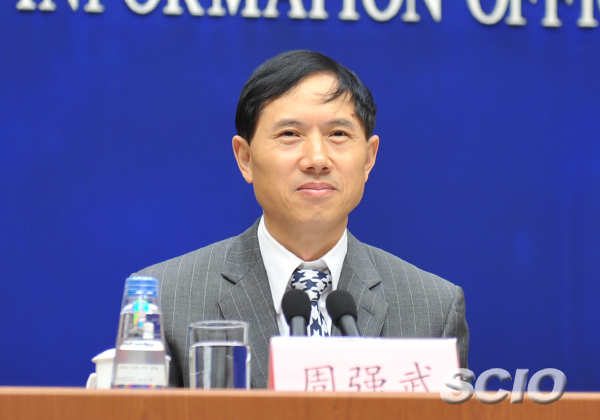
Zhou Qiangwu, director general of the International Economics and Finance Institute of the Ministry of Finance. [Photo/China SCIO]
Zhou Qiangwu:Thanks. Good morning!
The BRICS Xiamen summit is just around the corner. Iappreciatethe opportunity offered by the State Council Information Office to meet all of you here today. I'd like to start by sharing with you the achievements made by the BRICS cooperation in the economic sphere, especially in fiscaland financial areas, in the past decade, as well as the outlook for this year's Xiamen summit.
Since the BRICS cooperation mechanism was launched ten years ago, the five member countries have upheld the spirit of openness,inclusiveness, cooperation and win-win results, expanded the fields of cooperation and improved the mechanism of collaboration.
Step by step, the five countries have developed BRICS into a key platform for dialogue among major developing countries as well as global economic governance. The international influence and attraction of BRICS has also increased markedly. Now BRICS holds an overarching leaders' summit annually, coupled with more than 20 ministerial-level dialogues.
In China, over 40 departments are involved in the BRICS cooperation mechanism, in which fiscal and financial cooperation is a major part. BRICS countries have kept strengthening communication and coordination regarding fiscal and financial issues over the years, including the establishment of the New Development Bank more than two years ago. The bank has achieved tangible results in many fields, contributing to the socio-economic development of BRICS countries and the improvement of global governance.
I believe the upcoming Xiamen summit will producerich results in fiscal and financial areas.Now I'd like to introduce to you the expected results and possible highlights.
Since China took over the chairmanship of BRICS earlier this year, we have held two meetings of BRICS finance ministers and central bank governors and a meeting of their deputies, which I believe have laid a solid foundation for the upcoming Xiamen summit.
First, we must promote the economic growth of the BRICS countries and the world. BRICS countries will further strengthen communication and coordination at the macro level, including the use of all policy instruments of fiscal and monetary policy, and structural reform to promote their economic growth. The BRICS are also jointly urging developed countries to adopt responsible macro-economic policies to reduce negative spillover effects. At the same time, we are very clear in our joint opposition to trade protectionism
Second, is to deepen financial cooperation under the G20. At the G20 Hamburg Summit held in July, the BRICS countries also issued a joint statement, which made unique contribution to the success of the G20 summit.
Third, this summit will promote the development of the BRICS Development Bank, or, the New Development Bank. In this regard, if there is time, I will explain it to you further.
Fourth, facing the task of common development, we BRICS countries will work together to promote cooperation in the field of Public-Private Partnership (PPP) to lay a consolidated foundation for cooperation.
Fifth, we will work together on the convergence of accounting standards and the standardizing of audit supervision, with an aim to prepare for the interconnection of the BRICS bond market.
Sixth, we will improve tax cooperation, especially international tax cooperation, so as to improve the seamlessness and effectiveness of policy coordination.
Second, financial cooperation is a key part of cooperation among the BRICS countries. We will promote the improvement of the contingency reserve mechanism, keep fostering thelocal currency bond markets in the BRICS countries, propel the development of financial institutions and the network of financial services among the BRICS countries and intensify communication and collaboration on financial regulation, all of which dovetail nicely with the themes of G20.
We will also push cooperation on currencies, anti-money laundering and anti-terrorist funding. Fruits yielded from the practical cooperation in these areas will not only contribute toglobal economic governance, the economic development of the BRICS countries and the world, but will also elevate the cooperation among the BRICS countries to a new level, laying the foundations for the next ten year of BRICS. Thank you.
Hu Kaihong:
Now the floor is given to Ye.
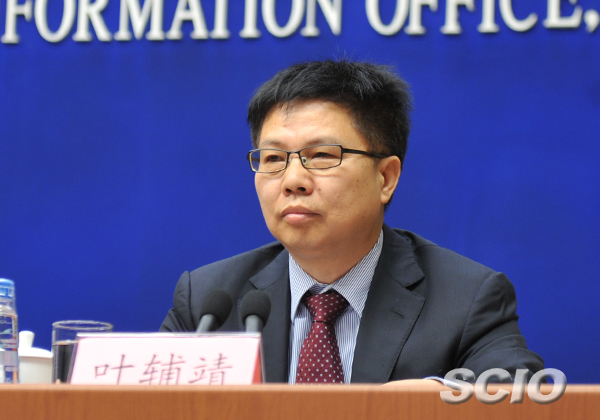
Ye Fujing, director general of the Institute for International Economic Research of the National Development and Reform Commission. [Photo/China SCIO]
Ye Fujing:Mr. Hu, friends from the press, good morning.
BRICS cooperation is one of the most important mechanisms of South-South cooperation. The ninth BRICS Summit is another major diplomatic activity held at home this year after the Belt and Road Forum for International Cooperation.
We know that the current world economic and political situation is undergoing profound changes. Although the global economy is showing signs of moving in the right direction, there are still many uncertainties and destabilizing factors. The supply-side constraints, in particular, have not been fundamentally resolved, thus we have to wait and see whether or not the economy can stride into a new round of growth. Moreover, anti-globalization and protectionism is still rampant.
The open world economy is facing new challenges and risks, and the global governance system needs to be further reformed and improved, therefore, there is still a long way to go to achieve the goal of inclusive and balanced development.
Under these circumstances, the ninth BRICS Summit, themed deepening the partnership and opening up a brighter future, aims to deepen the BRICS partnership to better promote the BRICS development, achieve win-win in emerging markets and developing countries, build an open world economic system, improve global governance and push for solutions to deficits in peace, development and governance.
BRICS cooperation has just stepped into the second "golden decade," having achieved spectacular success in the past ten years. We have been jointly building an open world by being at the forefront of international cooperation, outlining a vision of the future as a booster of global economic development, coping with global challenges by making significant contributions to the long-term stability of the international community, and safeguarding fairness and justice by continuing to lead the reform process of global economic governance.
The Strategy for BRICS Economic Partnerships outlines eight key fields, which have witnessed progress in different phases. For example, in the field of trade and investment, several cooperation agreements have been reached during the 7th Meeting of BRICS Trade Ministers, such as the BRICS service and trade cooperation roadmap, e-commerce cooperation agreement and program on investment facilitation.
In regard to industry, agriculture, technology and innovation, several action plans and consensuses have been reached during the ministerial level meetings in each field. And corresponding cooperation mechanisms have been established.
Considerable progress has been made in connectivity as well as other fields. While noting these achievements, we also see the challenges faced by the BRICS countries, both internal and external.
Internally, in the economic field, the BRICS countries generally face dual pressures of creating steady growth while undertaking structural adjustment, as well as the considerably biggerchallenge of energy transformation. In other sectors, some disputes and misunderstandings still exist. As we are developing countries, various kinds of implicit and explicit barriers also exist in our cooperation and remain to be eliminated.
Externally, the present deep-rooted problems of the world economy have yet to be settled fundamentally; there is no fundamental change in the balance of powers; and the driving force of world economic growth is still insufficient. Moreover, the stubborn determination of some developed countries to maintain their vested interests should not be underestimated, and some unstable factors, especially geopolitical conflicts, are frequent. Therefore, the BRICS countries face a complicated and severe international political and economic environment.
As the next step, we expect the BRICS countries to strengthen their cooperation in six areas and jointly address the challenges facing the organization itself within the context of global development.
Firstly, to strengthen innovative cooperation. We should establish a platform for technology exchange and an innovation alliance to promote joint innovation.
Secondly, to improve openness and cooperation. All parties concerned should work out and implement the roadmap for the economic, trade and investment cooperation before 2020 as soon as possible. On the basis of WTO regulations, we can adopt some reciprocal investment arrangements, including lowering trade barriers, like tariffs, to deliver a batch of pragmatic outcomes at the early stage, then further consider the possibility to establish a BRICS Free Trade Zone.
Thirdly, to further implement the strategy of economic partnership. We can deepen cooperation in eight key sectors, like production capacity cooperation and energy cooperation, and launch some landmark cooperation projects. Learning from the experiences of the G20 Hangzhou Summit, we can also strengthen evaluation and supervision over the implementation of the strategy.
Fourth, to promote the strategic docking mechanism. A brand new opening-up pattern, led by the Belt and Road Initiative, has been taking shape. Under the framework of the BRICS mechanism, we should dock the initiative with the development strategies of all member countries, so as to jointly prioritize sectors such as economy and trade, financial circulation, infrastructure connectivity and people-to-people exchanges.
Fifth, to grasp cooperation opportunities in emerging industries.
Sixth, to expand the range of sectors which benefit from BRICS cooperation.
We believe that the impact of the BRICS mechanism will be more far-reaching; its function positioning will be more accurate; its degree of openness will be much higher; its measures will be more practical; and its cooperation will be more beneficial.
Hu Kaihong:
Now, we move on to the question session. As always, please identify your media outlet before raising questions.
_ueditor_page_break_tag_CRI:
I have a question for Mr. Zhou. You just mentioned the BRICS New Development Bank. It was established two years ago, and has now become a highlight of the fiscal and financial cooperation among BRICS countries. How is it now? And, what cooperative agreements will be reached for the next step of cooperation at this summit?
Zhou Qiangwu:
The New Development Bank is "the baby" jointly owned by our five BRICS countries. For the past two years, there has beengreat progress in organizational structures, business development, financial and personnel policy making, some internal control policies as well as its general strategy.
At the same time, we have made phased progress in financing. We issued 3 billion yuan of green bonds on the Chinese capital market. The New Development Bank also started relevant procedures for inviting new members and has made solid progress in approving projects since last year. It approved seven projects last year, worth US$1.55 billion. All are sustainable development projects. Generally speaking, it is inspiring that thenew multilateral development bank has made such great achievements within only two years after operation.
This year, we will make new progress at the Xiamen summit to push forward the development of the New Development Bank. First, you may notice that the New Development Bank has established an African regional center, which opened on Aug. 17 in Johannesburg.
Second, we will provide a reserve project fund for the five BRICS countries to apply for loans, and this will boost the development and implementation of relevant projects.
Moreover, we will approve some new projects in 2017. The bank is expected to have a total loan value reaching US$2.5 billion in the whole year. Besides, the permanent office building of the New Development Bank headquarters will start construction in Shanghai soon. We believe that the bank will enjoy new opportunities for development at the BRICS Xiamen summit. Thank you.
TASS:
I have two questions. The first is for Mr. Zhou Qiangwu. In September, Russian President VladimirPutin will meet Chinese President Xi Jinping, and they are expected to discuss issues related to economic and trade cooperation. What do you think of the prospects for bilateral financial cooperation?
My second question is about use of the yuan and ruble, instead of U.S. dollars, in trade and investment between China and Russia. What do you think of its prospects? Will it develop in a good direction?
Zhou Qiangwu:
The two State leaders will hold a meeting at Xiamen, and discuss a wide range of issues. I believe financial cooperation will be on the list.
There are several financial cooperation mechanisms between China and Russia. One of them involves regular meetings of Chinese and Russian finance ministers. The latest meeting between them was held in Shanghai in June. It paved the way for the upcoming BRICS summit and the two State leaders' discussion on financial cooperation.
China and Russia both face challenges in the macroeconomic field. They have also developed a consensus on issues like pushing forward structural reforms and promoting cooperation under bilateral and multilateral frameworks. China has expressed its welcome and support to Russia issuing yuan-denominated sovereign bonds in the Chinese market.
I believe the two countries will further strengthen their macroeconomic cooperation. They will surely show stronger support for reform of the global governance system and even stronger opposition to protectionism. Under the Belt and Road Initiative, they will explore innovative methods on financing and connectivity development. Particular attention will be paid to the building of a financing mechanism under the Initiative. As a matter of fact, after the Belt and Road Forum in May, the two countries began exploring ways to build a long-term, stable and sustainable investment and financing system involvingdiversified participants and with controllable risk.
Regarding financial cooperation, the two sides will surely exchange views in depth and over a broad range of issues. It's certainthat China will support Russia in issuing yuan-denominated sovereign bonds in the Chinese market. In due course, they will sign a bilateral auditing regulation agreement to facilitate the issuance of the bonds. I believe financial cooperation will play a positive role in the development of bilateral ties.
Ye Fujing:
I want to add a few words concerning yuan settlements. I am glad that China-Russia political and trade relations have been boosted with the China-Russia Investment Cooperation Commission playing a positive role.
China and Russia are pushing forward settlements of reciprocal currencies. However, the choice of currency is made by the market and enterprises, so the government should rather foster the environment for facilitation.
Second, local currency settlement indeed helps circumvent currency risks and reduces the transaction costs of trade and investment, so it should be encouraged.
Third, the yuan's internationalization is an inevitable trend at the current stage, and it is also a helpful participation in and complement to the current international currency system.
Forth, China-Russia cooperation on currency is an important part of the current China-Russia economic ties and is also a focus put on China-Russia financial cooperation, which we should maintain and promote in the future.
China Review News Agency:
I wonder how are BRICS members going to enhance their cooperation to deal with trade protectionism from the United States?
Ye Fujing:
We are always opposed to trade protectionism, as it goes against the trend of economic globalization and the common interests of trading nations; it only meets the expectations of certain interest groups seeking to restrict competition through protection. Trade friction is nothing to worry about. Friction should be resolved through the WTO or by bilateral negotiations within the framework of international law, rather than through unilateral actions.
China adheres to trade openness based on a principle of modest and gradual progress, the process being in line with the national conditions and the development phase of each country. Due to differences in the development phase, China and the United States, indeed, have different industrial policies. However, it is not justifiable to embrace trade protectionism on the pretense of policy differences. We have always placed great emphasis on the protection of intellectual property rights, and are ready to safeguard and promote it on various fronts, including the BRICS mechanisms.
In addition, I'd like to talk about the trend of anti-globalization, of which trade protectionism is a key part. I think anti-globalization should neither be underestimated nor overestimated. Though the sentiments are still prevalent, its momentum has decreased. It has, for instance, receded through elections in France and the Netherlands. In the United States, those who have endorsed it have also regretted their action. Therefore, we should not overestimate its impact.
Anti-globalization is hardly constructive. People have realized that it cannot help improve their lives, but will only prove counter-productive in the future. Therefore, we can be optimistic about the trend of opposing trade protectionism and any moves towards anti-globalization.
Zhou Qiangwu:
The BRICS countries have always sought to promote globalization, which has benefited all of them. In the past two years, they have clearly voiced their support for globalization on various occasions. For example, at the G20 Summit in Hamburg, leaders from the BRICS countries issued a joint statement firmly supporting a rules-based, transparent, non-discriminatory, open and inclusive multilateral trading system, implementation and enforcement of existing WTO rules and commitments, and opposing protectionism. The BRICS countries have also made positive contribution in enlisting forces opposing protectionism as one of the outcomes of the G20 summit. We, the BRICS countries, speak with one voice in opposing protectionism, no matter whether this is under the framework of the G20, BRICS or the WTO.
Press Trust of India:
My question is about economic cooperation under the BRICS mechanism. Trade and economic cooperation is a core component of the BRICS cooperation. We are both new emerging market countries, but in recent years, we can see that many BRICS countries have trade deficits between them. For example, China and India are facing such problems.
You two are from think tanks. In your opinions, what progress has been made in resolving the issue of bilateral trade deficits? What measures can we take to promote the resolving of the deficit issue and push forward fairer trade? The problem I say isn't just within the framework of the BRICS countries; it goes even beyond the WTO framework to a larger scope. What are your opinions?
Moreover, we now are saying the BRICS cooperation has entered a new era for the next decade. How do you expect this issue to be resolved in the future?
Ye Fujing:
Thank you very much for your question. In order to answer it, I think, first we should go beyond specific issues, and look at how the BRICS countries deal with the challenges we are facing at a higher level and within a wider range. We should resolve the particular issues existing in the economic and trade cooperation under this overall framework.
We need to consider whether there is a very strong impetus to enhance cooperation. We should stand at this strategic level to look at the necessity of further strengthening the BRICS cooperation, and tackle the challenges together. We should know that it is very normal for countries, including the BRICS countries, to have various problems between them. It will be abnormal if there's no challenge. The key is not challenges, but how to respond to the challenges.
We should not only view it in terms of challenges, but also see if the favorable elements for dealing with challenges are increasing. In my opinion, over the past decade of BRICS cooperation, the good factors in our cooperation haven't reduced but increased significantly.
The challenges we are facing are not more severe than in the past, but much easier for us to deal with. This is a very basic judgment. In the past years, the achievements we have made were so profound in our hearts. China and India, as well as other countries under the BRICS framework, and all those developing and developed countries, all benefit from the cooperation and have received rewards. This is an irreversible and important foundation of our cooperation.
Another important factor exemplifying the efforts of China and India to promote globalization should be our resolve to uphold the core value of multilateralism around the world.
We see some challenges facing China or India. To be more specific, they include getting the financial sector more deeply involved in the real economy, immature measures currently available to prevent financial risk, and the need for broader opening of financial markets. However, these challenges can also be considered as emerging opportunities to foster bilateral cooperation between China and India, as well as multilateral cooperation among BRICS members and other developing countries.
Problems like trade deficits can become minor and unimportant details if we take a panoramic view of development, which can be blamed on insufficient or unexplored opportunities for cooperation, rather than cooperation itself being the cause of the troubles. We will solve those problems through development and cooperation enhanced with investment and trade in commodities and services. At the same time, other problems can also be resolved if we underscore the importance of mutual openness, mutual cooperation and friendly relations.
Zhou Qiangwu:
I'd like to say a bit more on the issue. First, the trade among five BRICS countries is immense. The trade between China and India hit more than US$70 billion last year and the volume between China and Russia and China and Brazil also reached enormous proportions. It is nothing unusual to witness some trade disputes among the BRICS countries because frictions arise even among full brothers.
Second, I cannot agree more with what Director Ye has said in regard to viewing trade frictions and trade deficits in the context of development. However, I would like to add one more point, that every time when we want to solve trade frictions, we'd better work them out through dialogues rather than abuse of the trade remedial measures available, which may cause the economic and trade relations to turn sour among BRICS members.
CGTN:
At the 7th Meeting of the BRICS Trade Ministers held in August, all parties reached an agreement to promote the development of e-commerce. I wonder if there will be any kind of agreement to be reached in the field of e-commerce at the forthcoming summit. What further action is to be taken in this regard?
Ye Fujing:
The 7th Meeting of the BRICS Trade Ministers in August approved a series of documents involving the BRICS' service trade cooperation roadmap, e-commerce cooperation initiative, and investment facilitation cooperation outline. We are looking forward to the forthcoming summit to discuss specific ways of implementation, and specific measures of cooperationat the next stage.
Zhou Qiangwu:
Here I would like to add one more point. At the just concluded Meeting of the BRICS Trade Ministers, the five member states completed eight major achievements through their concerted efforts. You might have noticed that these involved issues concerning the building of the BRICS countries' electronic port networks and investment facilitation as well as economic and technological cooperation. These eight achievements will be highlighted at the forthcoming BRICS summit.
I particularly value the building of the BRICS demonstration electronic port network you have mentioned. In this respect, China may already be at the forefront in some areas. We will work together with other BRICS members to make a positive contribution to this construction.
At the same time, I would like to stress two other points I just mentioned, namely, the BRICS countries' investment facilitation and economic and technological cooperation. In my opinion, they will become two wheels guiding BRICS economic and trade cooperation to advance further. Thank you.
TASS:
Just now, you mentioned that the wide use of yuan is welcomed. Do you mean investments made by Russian companies in China? Are Chinese investors who do businesses in Russia willing to use the ruble to make deals with Russian companies?
Ye Fujing:
Since the implementation of China's reform and opening up policy, China-Russia economic and trade ties has developed rapidly.
Monetary cooperation is a vital component. Many companies and investors in China and Russia are using each other's currencies, and the governments of both sides have show great support to them in this regard.
Therefore, we should not only internationalize China's official currency, but also promote the internationalization of Russian currency, which is beneficial for the bilateral cooperation.
Hu Kaihong:
We'll wind up today's briefing. Thanks for our two experts who have joined us and thanks to you all.
SCIO briefing on BRICS economic and financial cooperation - SCIO briefing on BRICS opportunities, challenges and prospects
Speakers:
Zhang Yansheng, chief research fellow of the China Center for International Economic ExchangesZhang Jianping, deputy director of Academic Steering Committee, Chinese Academy of International Trade and Economic Cooperation, Ministry of Commerce
Chairperson:
Xi Yanchun, vice director-general of the Press Bureau, State Council Information OfficeDate:
Aug. 28, 2017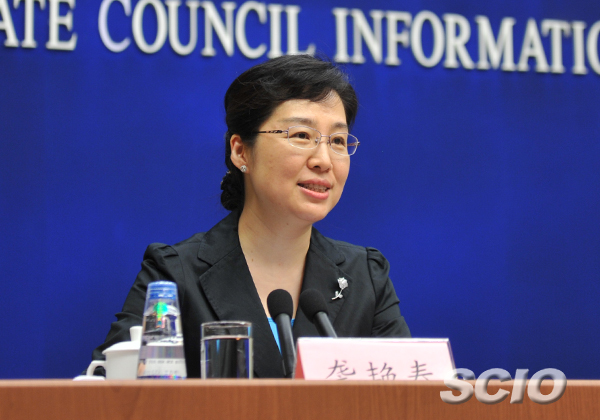
Xi Yanchun, vice director-general of the Press Bureau, State Council Information Office. [Photo/China SCIO]
Xi Yanchun:Ladies and gentlemen, good morning. Welcome to this press conference. As far as I know, you all share great interest in the prospects of BRICS cooperation. To help you gather more information on it, we invited Mr. Zhang Yansheng, the chief research fellow of the China Center for International Economic Exchanges, and Mr. Zhang Jianping, the deputy director of the Academic Steering Committee of the Chinese Academy of International Trade and Economic Cooperation of the Ministry of Commerce, to make an introduction and answer some of your questions.
Now, let's welcome Mr. Zhang Yansheng to give his briefing.
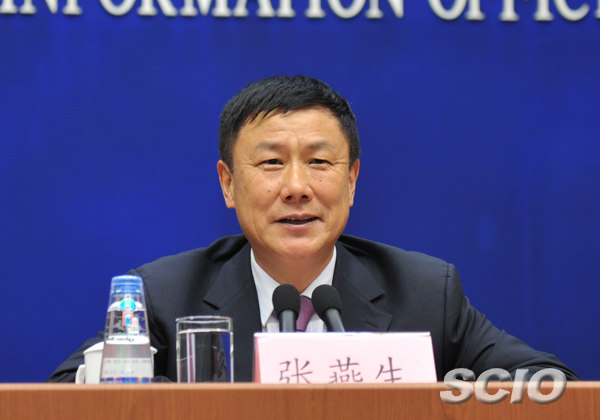
Zhang Yansheng, the chief research fellow of the China Center for International Economic Exchanges. [Photo/China SCIO]
Zhang Yansheng:Good morning. It's my pleasure to share my opinion with you today. Please allow me to first make a brief introduction of the upcoming BRICS summit in Xiamen.
First of all, the BRICS mechanism has been running for 10 years. In the spirit of openness, inclusiveness, cooperation and mutual benefit, we have made our partnerships closer, more comprehensive, and more solid. Through practical strategic cooperation, we have promoted peace and development in the world. In the pursuit of mutual benefits and win-win results, through open and transparent cooperation mechanisms, we have expanded our scope of cooperation, and shared our gains to the fullest extent.
Over the past 10 years, the proportion of the GDP of BRICS countries in the world total increased from 12 percent to 23 percent; the proportion of foreign trade increased from 11 percent to 16 percent; the proportion of investments made in foreign countries increased from 7 percent to 12 percent. In 2016, the proportion of foreign investments we attracted reached 16 percent, and our contribution to the world economic growth reached 50 percent.
This indicated that the BRICS mechanism has played a significant role not only in the economic and trade development of the five member countries, but also in the development of other emerging markets and developing countries, as well as in the economic development of the world as a whole.
The BRICS Xiamen summit will lead the BRICS mechanism into its second golden decade. Therefore, the summit in Xiamen will have two parts to its theme: the first part will center on deepening the BRICS partnership. It is what we have talked about before, the "BRICS plus," which means how the five BRICS countries can get more friends from all over the world, which will allow more and more emerging markets and developing countries to join together in the BRICS mechanism, and boost and enhance the BRICS causes, spirit and mechanisms.
The second part is inaugurating a brighter future. In fact the economic environment in our current world has two prospects: one is a bright one, which will push forward the world to be more open, safer and full of cooperative spirit. The BRICS mechanism and countries participating in the mechanism can benefit from this prospect. However, the world economy has another prospect, which has recently been frequently discussed by economists. It is the uncertainty of the world economy.
As a matter of fact, now there is an anti-globalization trend, accompanied by protectionism, populism, isolationism and unilateralism in trade, investment and finance. In 2017, the global economy has shown signs of improvement, but at the same time, there still exist uncertainties that may change the international environment and economic situation. Therefore we arrive at the theme of "deepening the BRICS partnership, inaugurating a brighter future."
In this case, we are very much looking forward to this year's BRICS summit in Xiamen to make joint efforts in deepening cooperation and injecting new energy towards achieving a new solution for improved global governance and making new contributions to world economic growth. Therefore, we believe that the Xiamen summit will focus on the following four aspects.
First is deepening cooperation among the BRICS member states and promoting common development. International cooperation will be pushed forward through a strengthened BRICS economic partnership.
Second, it will focus on strengthening global governance and jointly responding to challenges. BRICS member states are devoted to maintaining international peace and stability, improving the international financial and monetary system, and strengthening coordination and cooperation in regard to the multilateral mechanisms.
Third, it will focus on carrying out people-to-people exchanges and laying a solid foundation of public support. BRICS member states should carry out cultural exchanges and mutual learning, strengthen educational cooperation and promote development of various sports.
Fourth, it will focus on promoting the building of mechanisms and creating a broader partnership. We are looking forward to achieving a BRICS mechanism able to play a greater role in promoting international development and cooperation in the future. Thank you.
Xi Yanchun:
Thanks to Mr. Zhang Yansheng for that briefing. Now, we move on to the question session. As always, please identify your media outlet before raising questions. In addition, we have arranged a full range of simultaneous English interpretation for today's press conference. Now, please proceed with your questions.
China News Service (CNS):
Just now, you mentioned that China has been promoting the "BRICS Plus" initiative, hoping to widen our circle of friends, so as to turn BRICS into the most-influential platform for South-South cooperation. What sort of impact can we expect from such an initiative in terms of BRICS cooperation, as well as the global economy? Could you please elaborate on this?
Zhang Yansheng:
We often say that the BRICS mechanism is designed to establish the most extensive cooperation partnership. BRICS countries differ greatly in culture, religious beliefs, development level and national conditions. As the Chinese saying goes, gentlemen seek harmony but not uniformity, which means that we can cooperate with people who are totally different with us. Our aim is to promote world peace, development and cooperation. In this respect, we believe in openness and look forward to working with those countries and regions willing to join in a "BRICS Plus" system. Thank you.
Zhang Jianping, the deputy director of the Academic Steering Committee of the Chinese Academy of International Trade and Economic Cooperation of the Ministry of Commerce. [Photo/China SCIO]
Zhang Jianping:I'd like to say something more about this issue. The "BRICS plus" initiative is being promoted on behalf of developing countries and those transitional economies with their GDP per capita lagging far behind the developed world. Among the five BRICS countries for instance, the richest member like Russia has a GDP per capita of over US$20,000, while China barely reaches above US$8,000. Even though Brazil once hit a high of US$12,000, the figure has fallen to US$10,000 now. South Africa is lower, and India, the poorest, has a GDP per capita of around US$1,760.
Many developing countries have faced such economic conditions. Therefore, while developing economies, they face various imperative missions, such as shaking off poverty, promoting industrialization, improving infrastructure, and cooperating and participating in global value chains, based on which, they will be able to blaze a trail for their own advancement.
In view of that, the BRICS countries are expected to shape a system together while facing the critical challenge of development. However, the five member countries alone barely have enough power to achieve the desired goals. Exemplifying the model of the G20, the system, on one hand, consists of seven member countries from the developed world, and, on the other hand, comprises 10 more developing economies.
In such a perception, the "BRICS plus" initiative is open to all developing countries. However, at the same time, we consider the G20 a very important mechanism as well as a potential partner with its member countries being welcomed to "BRICS plus."
Going forward, BRICS countries and all the other developing countries will carry out "South-South cooperation." China knows very well the needs of other developing countries, including the need to improve infrastructure as well as the means to achieve it. China has a lot of advantages in infrastructure, industrialization as well as investment. We are willing to unite with other BRICS countries to form a global supply and value chain, so that all the developing countries will have more opportunities to develop themselves, improve their infrastructure and link their industrial chains. That way, we are bound for a better future.
Developing countries of the ''BRICS Plus" group will also talk (about our common development) along the way. Mr. Zhang said earlier that global governance today faces the challenges of anti-globalization, thus we have to figure out how BRICS members and other developing countries can be united to better safeguard and promote globalization and economic cooperation, as well as to find the momentum of development and economic and industrial cooperation so as to benefit each other.
Associated Press:
BRICS refers to five of the fast-growing emerging economies. However, now the situation is changing. Brazil, Russia and South Africa are facing some economic issues, while something is wrong with the relationship between China and India. My question focuses on these problems. Is the present concept of BRICS still workable? Can it still bring some achievements? Thanks.
Zhang Yansheng:
Just now, I mentioned the BRICS mechanism has been operating for 10 years. What does that mean? We can make comparisons between various mechanisms such as the G7, G8 and the Non-Aligned Movement. We know that these mechanisms have a history of several decades, or even a hundred years. So, for the BRICS mechanism, 10 years means it's still at an early stage of development. And at different stages, it needs to address different problems. Indeed, Russia, Brazil and South Africa are now faced with structural contradictions during their economic development. There is an important mechanism within BRICS that we need to explore so as to find a way for cooperative development for emerging economies and developing countries. The economies of Russia, Brazil and South Africa greatly depend on staple commodities and energy resources. Hence, BRICS cooperation aims to solve structural contradictions in economic development and achieve the diversity of economic structures. That's what we call "the Dutch disease" in economics -- focus on development of, say, natural gas actually causes a country's economic decline. We need to address this important issue and cure "the Dutch disease."
Besides, China and India are two major developing countries of a diversified economic structure. They need to rise from being a low-income country to a middle-income one, and then move further to become a high-income nation. There are traps everywhere. China and India need to overcome the low-income and middle-income traps. That's the second important issue the BRICS cooperation mechanism needs to address.
The third one is that, in addition to economic development, China and India are facing some problems and contradictions along their border. The BRICS mechanism needs to work out the way to maintain world peace while promoting economic development and cooperation. We should reach a consensus and establish an action plan within the BRICS mechanism to make clear what principles and measures we should take to deal with the various contradictions, conflicts and problems that emerge.
Zhang Jianping:
In fact, your question represents a typical view known as "fading of the BRICS" that has been around for a while. However, I would remind you that the acronym of "BRIC" was actually invented by economists from Goldman Sachs Group Inc. in the United States and therefore, as it is an institution based in the United States, you should not be suspicious of the BRICS concept.
People talk about Brazil, South Africa and Russia suffering from the "resource curse." However, as Secretary-general Zhang Yansheng just mentioned, the BRICS countries presently contribute 52 percent of global economic growth. Although developed countries account for a larger proportion of the total amount of the world economy, that is in the form of stocks. On an incremental basis, the contribution of the United States and Japan to current world economic growth is far below that of the BRICS countries. Over the last 10 years, the overall GDP of the five BRICS countries has accounted for 23 percent of the global economy, a ride of 11 percent over that period. If we look at the next 10 to 20 years, this proportion will steadily increase, and as part of a dynamic process, BRICS cooperation will become ever more valuable.
Looking at trade and investment, we just mentioned that the international trade of BRICS countries accounts for 16 percent of the global figure, rising from 11 percent a decade ago. The proportion of BRICS countries' GDP in the world economy has increased to 23 percent from 12 percent. In other words, almost double. You can see that the trade volume didn't keep up with the pace of GDP growth, which points to big demand of mutual trade and mutual investment among the BRICS countries as the next step.
In fact, from China's perspectives, our cooperation on production capacity with Latin American countries, such as Brazil, as well as with South Africa and Russia, is now moving forward rapidly. Even though there are contradictions between India and China, our entrepreneurs have also begun to invest in India. For example, Huawei, Xiaomi and Midea, companies well known internationally, have all invested in India.
As for mechanism cooperation, I will say that the BRICS will continue to press ahead in this regard. Some people have questioned there are the necessary cooperation mechanisms within the BRICS system, and I would say that the annual BRICS Summit itself is the most important mechanism. We also have the Meeting of the BRICS Trade Ministers, which was established in 2011, a mechanism established earlier than the G20 Trade Ministers Meeting, which was only set up last year. Thirdly, under the ministerial mechanism we have created different working groups handling different areas, such as e-commerce and intellectual property rights, playing a good role in promoting pragmatic cooperation in each field. Moreover, we have established the IPR protection mechanism, under which we hold talks and promote cooperation each year.
Next, we will improve the mechanisms in many areas, including e-commerce and service trade. China will host the China International Import Expo in 2018, which will be a very important mechanism for BRICS cooperation. India, Brazil and South Africa have high expectations of a growing share in the Chinese market. Therefore, with the improvement of mechanism, the economic and trade potential of BRICS countries will be continuously tapped and we will make greater contributions to the world economy in the future.
The gold of BRICS will glitter ever brighter, rather than fade over time. Thank you.
ITAR-TASS:
Will there be meetings between state leaders during the Xiamen summit in September? Will President Putin meet President Xi Jinping at the sideline of the event? If so, what issues will they discuss? What kinds of economic cooperation between the two countries will be promoted during the summit?
My second question is about the border dispute between China and India. Has it provided any negative influences on the Xiamen summit? Is there any worry over a possible split it could cause in the bloc? Will President Xi meet with India's top leader at the sideline of the summit? Thank you.
Zhang Yansheng:
Regarding your first question, relevant arrangements will be announced by the competent authorities. I'm sorry that I don't know the plan, but I'm sure you'll find the answer from the Foreign Ministry and other competent departments soon.
Regarding the second question, I'd like to talk about my understandings. As I have said when answering the questions of the Associated Press, the incident has provided a great opportunity for the BRICS countries to find out a way to handle problems concerning bilateral peace, development and cooperation. Possible solutions should be discussed and developed at high levels. I'm glad to see that all state leaders will meet at the summit. This will provide a good chance for them to discuss the disputes and problems between their countries, thus to find out possible solutions. Such talks are unavoidable for the BRICS countries if they want to make the mechanism more mature. Thank you.
Lianhe Zaobao:
Just now you said that the BRICS summit would allow leaders to communicate face to face. Will Indian Prime Minister Narendra Modi attend if the stand-off between the two countries on their border area lasts until September? Presently, there is no indication he won't come because of the stand-off. However, I just want to make sure.
Zhang Yansheng:
We are in the same position as you, namely, we haven't got any information to suggest he won't come. That means neither you nor I have any new information about this situation. Without new information, we cannot make any statements on a hypothetical issue, so, we will go ahead as planned.
Zhang Jianping:
Since everyone is very concerned about the issue of China and India, I would like to say a few words from the perspective of economic and trade cooperation. If we look at the volume of trade between China and India, there is still a lot of room for development. When Indian Prime Minister Modi visited China, his most important task was reducing India's trade deficit with China, which can be attributed in part to the underdeveloped infrastructure in India.
The next step for the development of India is very difficult. Whether it is infrastructure development or industrial development, India and China is complementary and have a lot of room for cooperation. Every time I ask you which country will become the new manufacturing center of the world, a lot of people would choose India. If it comes true, the BRICS cooperation will see an even brighter future, and the two countries will see further progress of trade cooperation.
As a matter of fact, there is a strategic economic dialogue between China and India every year. It is at the ministerial level and is advancing year by year. Therefore, we hope that bilateral and multilateral tracks will continue to promote pragmatic cooperation between China and India, and bring benefits to both sides. Thank you.
Xi Yanchun:
Please note that our guests for today's briefing are experts, not government officials. Your questions concerning the meetings of state leaders and the concrete agenda of the summit still need to be officially confirmed by the authorities. Therefore, we ask for your patience until the authorities announce their plan in due course. Now, let's continue with questions.
Press Trust of India:
What is the focus of this year's BRICS summit and what is the difference between this year's meeting and the previous years'? You mentioned this year marked the tenth anniversary of the BRICS summit, then what consensus is expected to be reached among the five economies and where is the BRICS heading for? Thanks.
Zhang Yansheng:
The theme of this year's summit is "BRICS: Stronger Partnership for a Brighter Future." As Professor Zhang said, documents on ten aspects were approved at a trade minister meeting in early August.
The first aspect was on the establishment of a BRICS Pilot E-port Network. We are now in an era of artificial intelligence, and a key issue is to set up an e-port network to make cross-border trade and exchange more convenient.
Second, the meeting endorsed the Guidelines on the BRICS Trade in Services Cooperation. Service trade, especially those which strengthen the manufacturing industry as well as enrich people's lives, can promote the BRICS countries' economic development.
Third, BRICS cooperation in the e-commerce sector was also endorsed at the meeting. E-commerce has played an important role in China's development in the past thirty years, thus BRICS nations are figuring out how to develop our cooperation more rapidly in this respect. During the G20 Hangzhou summit last year, Jack Ma (founder of Alibaba) came up with the idea of EWTP, an electronic world trade platform which we believe will help better develop e-commerce.
Fourth, the meeting also approved the Guidelines on Cooperation in Intellectual Property Rights. The protection of intellectual property rights is essential for the BRICS to foster an innovation-driven economy.
Fifth, the BRICS countries signed the Outline for BRICS Investment Facilitation to ensure the finance of small-and-micro or small-and-medium-size enterprises (SMEs).
Sixth, the Framework on Strengthening Economic and Technical Cooperation was signed at the meeting. The framework makes clear how the BRICS countries will achieve green, exclusive, sustainable and balanced development through economic and technical cooperation.
Seventh, a consensus was reached to support the multilateral trading system and oppose protectionism in fields of trade, investment and finance.
Eighth, as announced by Chinese President Xi Jinping in his speech at the Belt and Road Forum for International Cooperation on May 14 this year, China will host the China International Import Expo in 2018, and is expected to import goods worth US$8 trillion in the ensuing five years. As long as each BRICS member country takes the lead in exploring its internal demand, expanding consumption and increasing imports, it will provide a driving force for the development of BRICS countries as well as for the world economy as a whole.
These eight aspects mentioned above will be submitted to the summit in September for further implementation. The summit aims to promote economic development through partnerships so that the world will embrace a brighter future. That is critical to emerging markets and developing countries, like China and India, as it will benefit ordinary people, youngsters and small businesses.
Zhang Jianping:
Mr. Zhang, just now, mainly talked about some important fields and priority areas for cooperation in regard to the 2017 BRICS Summit. This time is different from past summits, at which leaders of BRICS nations focus their discussions in a certain field.
The theme of 2017 Summit is to build a stronger partnership for a brighter future, aimed at upholding world peace, promoting common development, improving global governance and deepening economic and trade cooperation so as to make the cooperation between the blocs most comprehensive and on a fuller scale.
As we all know, now the proportion of BRICS nation's investment in another member country is low. We will offer more convenient investment schemes and mechanisms, including intellectual property protection, e-commerce and the single-window service approach, to promote closer economic cooperation and make BRICS countries stronger.
It is common interest that makes us develop together. As we progress, we will have a bigger influence on the global system. The current institutions, pattern and model of global governance, mostly established in the past by the developed countries, cannot meet the needs of the times under new conditions, like the rapid progress of developing countries and the appearance of the trends towards de-globalization Mr. Zhang mentioned.
For BRICS nations, the crucial step is to deepen cooperation and explore new methods and patterns for global governance. The BRICS Plus initiative is also working toward the same target.
We BRICS nations will devote ourselves to building a global multi-polarization pattern, under which diversified civilizations can respect and reinforce each other, which, in my opinion, is the most significant future direction of global development.
The Beijing News:
Today, we've been talking about the deglobalization trend and trade protectionism starting to re-emerge, so I wonder if the BRICS summit would discuss this and come up with some measures to deal with the situation.
Zhang Yansheng:
As for the related issues of deglobalization, trade protectionism and populism, we have seen a strange phenomenon: the economies leading the deglobalization movement are not emerging markets. The United Kingdom is seeking to withdraw from Europe, known as Brexit, while the United States has conducted Section 301 investigations and holds a different view on trade protectionism. The two are both the leaders who had been pushing the globalization drive in history. Why do these two most developed countries with the soundest market economies and best legal and supervision capabilities allow their voters to elect leaders who have such a different view on globalization? Why?
Personally, I think these voters are not satisfied with the results of the globalization that started from 1990, so they choose to vote in this way. Why are they not satisfied? I think there are three problems. First, people are not satisfied with current income distribution. A very few people, about one percent of the population have been getting more of the benefits, while the vast majority have missed out, especially the middle class. Globalization promotes development, but the results have not been distributed well. Second, since 1990, we have seen the following phenomena: in the major powers of the world, the hi-tech manufacturing industry has slowed down, the application rate of innovations and inventions has decreased, and the proportion of the real economy has also shrunk; at the same time, the finance and real estate industries have prospered along with construction. So, in this way, we can see the major powers of the world have developed hollows in their economies. Therefore, not only political leaders but also business circles are not satisfied, because the real economy's proportion is going down. Third, we have seen an increase without development, that is, some countries see their GDP and GDP per capita increasing but the development of society and the overall structure are unbalanced.
You've just raised this question: How will the BRICS mechanism sum up the problems emerging from globalization since 1990, and resolve the problem of income distribution through cooperation? This is actually an issue of inclusive development, including how to encourage innovation and how to build strong growth dynamics. I think the BRICS mechanism can urge the countries to participate in global governance and improve it so as to build a better world economic system and a more consummate coordination mechanism for international macro policies. The BRICS mechanism can promote world peace, world development, world openness and world cooperation. If we make successful efforts in this aspect, it will be a contribution to world development and also to emerging markets and developing countries. Thank you.
Zhang Jianping:
As a matter of fact, anti-globalization sentiments are more prevalent in developed countries. For BRICS countries, we are very aware that globalization offers us real development opportunities, and that won't stop. President Xi had made that very clear at the World Economic Forum earlier this year, and I'd better not repeat it.
Take the climate change negotiations as an example. Over the past two decades or so, we BRICS nations have upheld the interests of developing countries in the negotiations despite our minor differences. We had talked with developed countries for a long time, which eventually landed us at the Paris Agreement. We believe all BRICS nations will continue to promote its implementation.
Another example is trade. A statement issued after a BRICS ministerial meeting earlier this year included a commitment to continue facilitating trade and investment and abnegation of trade protectionism. I believe we can still reach consensus on this issue this time. Some people say that India and Brazil have launched a slew of anti-dumping and anti-subsidy measures against China, which I think have to do with their attempt to protect their domestic market due to the weakness in their own industrial development and product competitiveness. But this is not the dominant practice in trade; we should look at the prevailing trend (of trade cooperation), which is evidenced by the 70 to 80 billion U.S. dollars of trade between China and India and between China and Brazil.
So, in short, trade friction remains a major conflict between developed and developing countries, because industrial manufacturing is being transported to the developing countries, resulting in an increased deficit for developed countries and an increasing surplus for developing countries.
Among the BRICS countries, we are promoting trade cooperation, economic cooperation, and industrial chain cooperation while resolving conflicts and frictions. With China accelerating investment into other BRICS countries, future trade frictions will gradually be reduced, and the global value chain cooperation will be strengthened. Thank you.
Xi Yanchun:
We'll wind up today's briefing for reasons of time. Thanks for our two experts who have joined us and thanks to you all.
SCIO briefing on BRICS opportunities, challenges and prospects - SCIO briefing on China's fiscal and monetary policies
Speakers:
Liu Wei, vice minister of the Ministry of FinanceWang Jianfan, director-general of Tax Policy Department, Ministry of Finance
Wang Kebing, vice director-general of Budget Department, Ministry of Finance
Chairperson:
Xi Yanchun, vice director-general of the Press Bureau, State Council Information OfficeDate:
July 28, 2017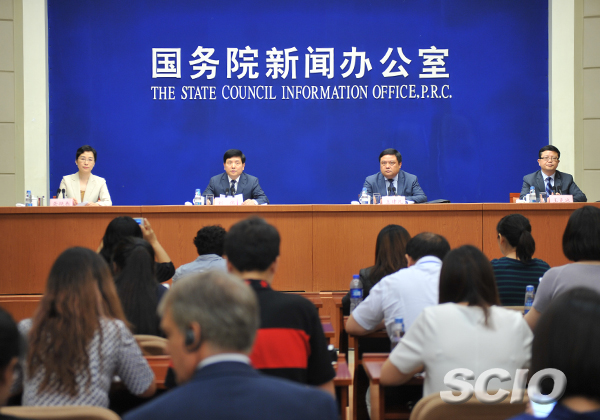
SCIO holds a press conference on China's fiscal and monetary policies in Beijing on July 28. [Photo/China SCIO]
Xi Yanchun:Ladies and gentlemen, good afternoon. Welcome to today’s press conference. We are delighted to invite Mr. Liu Wei, vice minister of finance, to introduce China’s fiscal and monetary policies and answer some of your questions. Also present are Mr. Wang Jianfan, director-general of the Tax Policy Department of the ministry, and Mr. Wang Kebing, vice director-general of the Budget Department of the ministry.
Now, let’s welcome Mr. Liu Wei to provide his briefing.
Liu Wei:
Ladies and gentlemen, good afternoon.
In the past six months, the Ministry of Finance has concentrated on supply-side structural reform, and launched a proactive fiscal policy, ensuring China’s economic performance would remain stable and would move in a positive direction.
First, Stepped-up efforts to cut taxes and fees.
We continued to ease the corporate tax burden. Measures taken included: implementing and improving the program to replace business tax with VAT in all sectors of society; simplifying the structure of VAT rates; halving corporate income tax for an increasing number of small and micro businesses; providing tax credit policies to more enterprises investing in business start-ups; widening the scope of tax deductions for R&D expenses of high-tech small and medium-sized enterprises.
We also made more efforts to cut fees. Measures taken included: overhauling and exercising standard-based management of administrative fees and government-managed funds; releasing the lists of administrative charges of central and provincial governments on the website of the Ministry of Finance; launching short-term policies to lower premiums for unemployment, reduce logistics and energy consumption costs of enterprises, and reduce business and service fees and charges.
These policies and measures are expected to save enterprises 1 trillion yuan in taxes and fees this year.
Second, Improving management of budget implementation.
Regarding central government’s transfer payments to local governments, by the end of June, we had carried out most of the appropriations to local governments, while the remaining funds are for special items, such as payments to those needing settlement by actual spending.
We deepened reforms to introduce a system for the treasury's centralized revenue collection and expenditure payments. Government funds, allocated and transferred in a timely way were also put to better use.
We speeded up the process of making budgetary funds available for fiscal expenditures. In the first half of this year, the growth rate of national fiscal expenditure was six percentage points higher than fiscal revenues. The proportion of budgetary expenditures implemented was 0.7 percentage points higher than the same period last year.
We improved performance-based budget management. Besides the general public budget, some government-managed funds and State capital operations were also placed under closer supervision.
Liu Wei:
Third, improved people's living standards.
Precise measures are being launched to alleviate or eliminate the prevailing impoverished conditions, with special attention being paid to the most affected areas. Funds for the agricultural sector have expanded from the pilot poverty-stricken counties to the entire impoverished area and local government attempts to alleviate poverty by asset incomes are being buttressed.We have unified policies whereby Chinese students receiving compulsory education are exempted from paying tuition and fees and paying for textbooks and a subsidy will be provided for the living expenses of students from families with financial difficulties, so that the exemptions can be deemed valid everywhere.
Funds for the needy group have been better integrated and the local governments are expected to better assist people with minimum incomes or those suffering severe poverty. Meanwhile, more efforts have gone into healthcare and great importance been placed on efforts to protect the air, water and soil from pollution through programs of ecological conservation.
The government has placed more importance on the most impoverished areas where the shortage of resources and energies leads to fiscal difficulties.
Fourth, tightened control of local government debt.
The fundraising programs by local governments have been further regulated. There are clear guidelines for the issuance of local government bonds. We have improved the system for local governments' special debt and a mechanism in response to risks and emergencies has been established. At the same time, a regular institution overseeing local governments' debts has also be established.
In the past few months, the joint efforts of macro-economic policies, such as fiscal policy, have ensured the sound and smooth development of the national economy and the execution of fiscal budgets has also performed well.
During the first half of this year, the National General Public Budget Revenue hit 9.4 trillion yuan, up 9.8 percent year on year--an increase of2.7 percentage points compared to the same period last year and 5.3 percentage points higher compared to the figure of last year's total. By slashing considerable amount of taxes and fees, revenue during the past six months surged above expectations, which demonstrates the sound and positive development of the national economy. The improved economic structure, the resurgence of the service industry, the positive balance sheet of enterprises and the growing imports and exports have laid a good foundation for increased revenue. At the same time, the growth also partly resulted from the rise of the producer price index (PPI) as well as the price hike of bulk commodities.
The structure of the revenue has changed positively. During the first half of this year, tax revenue growth constituting 92.9 percent of the entire increase, 13.3 percentage points higher compared to the figure of last year's total. The value-added taxes, including industrial and commercial VAT, enterprise and personal income taxes and taxes on imports, maintained double-digit growth. The secondary and tertiary sectors,accounting for 47.5 percent and 52.3 percent respectively, have contributed considerably to the growth of tax revenues.
Considering the tax growth of different sectors, the reduction of excessive capacities, supply-demand reform and the surging prices of products led to tax increases in the energy and raw material industries; the constant driving force of the improved industrial structure produced an increase of taxes from medium or high-end manufacturing industries and the shift of growth drivers and emergence of the new market demand brought about the rapid tax growth in cultural, sports, the internet and IT sectors. In regard to regional economies, the growth basically can be seen in balance, with 11.3 percent and 10.7 percent respectively in the middle and western areas and 9.3 percent in the east.
In the first half of this year, the National General Public Budget Expenditure hit 10 trillion, constituting 53.1 percent of the planned budget, and registering growth of 15.8 percent year-on-year. The growth rates of education, science and technology, social security and employment, healthcare and family planning and energy saving and environmental protection were respectively 17.2 percent, 22.7 percent, 24.6 percent, 18.2 percent and 39.8 percent.
The Ministry of Finance, in the following phase, will continue to comply with the strategic policy decisions made by the CPC Central Committee and the State Council, uphold the consistency and coherence of the policies, implement proactive and effective fiscal policies, fend off the risks of local government debts generally guided by the supply-side reform, curb the growth of hidden debts and ensure the sound and stable development of national economy.
I will conclude my report here and move onto the question-and-answer session with my colleagues. Thank you.
Xi Yanchun:
Thank Mr. Liu Wei for his introduction. Now, the floor is open to questions.
_ueditor_page_break_tag_Phoenix TV:
We have noticed that the recent National Conference on Financial Work demanded local government debts be strictly controlled. A lifelong accountability system and a system to retrospectively hold officials accountable for their erroneous acts were to be implemented. At a meeting of the Political Bureau of the CPC Central Committee, a warning was issued about local government debts and improvements were sought in a mechanism for local governments to secure financing so as to contain hidden debt-related risks of local governments. From this point of view, what is your opinion, and how will you implement the central government’s requirements?
Liu Wei:
The question you have raised is one that all sectors of society have been paying close attention to. At the meeting of the National Conference on Financial Work, President Xi Jinping laid down new and higher requirements. The CPC Central Committee and the State Council have placed emphasis on preventing and reducing risks of local government debts. In recent years, the Ministry of Finance has strengthened top-level planning, promoted institutional set-up and formed a “closed cycle” system for local government debt management and supervision. Let me introduce the work in detail.
First, setting ceilings on local government debts. It is known that ceilings on local government debts should be examined and approved by the National People's Congress. And the ceilings on government debts are determined through certain procedure for each province, and it is not allowed to break through.
Second, bringing local government debt under budgetary management. It means that new debts must be included in budget and under the examination and supervision of the National People’s Congress. Local governments cannot freely increase their debts at will.
Third, issuing new local government bonds. Local governments can issue bonds within the statutory limit in a legal and regulated way. The amount of bonds to be issued by local governments should be decided in accordance with their ability of debt repayment and their needs of financing.
Liu Wei:
Fourth, issue local government bonds in swaps with government debt. The previously mentioned newly-issued bond in the budget under central government guidance is the increment, which would be controlled in the new increased quota. But what should we do with the stock of local government debts already existing? Those debts were gradually replaced by issuing local government bonds, which will lower the entire cost of debt.
Fifth, improve local government's special debt management abilities. We are promoting special and particular bond management methods, strengthening the management of special debts related to local government's funded income and local assets (e.g. land assets).
Sixth, establish a risk pre-warning and emergency response mechanism. The Ministry of Finance has established approaches for achieving risk pre-warning and emergency response, asking local governments to evaluate the risks based on the total amount of debts and the debt structure. This involves very precise system design.
Seventh, we built a system of regular supervision of local government debt. Besides audit supervision, the Financial Supervision Commissioner's Office of the Ministry of Finance also exercises routine supervision on the debt of local governments according to law, which is also their major task. Somecity or county-level governments under theearly warning, and financing platforms with non-standard operation have also been placed under surveillance. We have taken a series of measures to strengthen daily supervision of local government debt.
Eighth, we will resolutely stop such action as financing guarantee in violation of the relevant law and regulations. Media friends may notice that, in regard to those illegal behaviors, local governments are not only required to take corrective steps, but also are held fully accountable for their actions.
With the gradual implementation of the measures, it can be said we have achieved remarkable success in controlling risks of local government debt, and we are fully capable of defending the bottom line, namely no outbreak of systemic risk. By the end of last year, local governments' outstanding debt stood at 15.32 trillion yuan, within the quota of 17.19 trillion yuan approved by the National People's Congress. If assessing the level of local government by measure of the debt ratio, it was 80.5 percent in 2016, which stayed below the international standard.
Adding in the outstanding central government debt of 12.01 trillion yuan included in budget management, the outstanding government debt nationwide stands at 27.33 trillion yuan. Calculated in accordance with GDP preliminary accounting of 74.41 trillion yuan released by the National Bureau of Statistics, the government debt ratio stood at 36.7 percent. This figure is lower than the European Union's warning line - 60 percent - and it is also lower than the level of major market-economy countries and emerging markets. In regard to government debt risk, we think it is generally controllable, which is our rational and confident answer.
As approved by the fifth session of the 12th National People's Congress this year, the debt limit for local governments in 2017 is 18.82 trillion yuan. At the end of June, with the issue of more bonds, the current debt balance of local governments is 15.86 trillion yuan, still under the limit of 18.82 trillion yuan. China's National Financial Work Conference and the meeting of the Political Bureau of the Central Committee of Communist Party of China have made special arrangements and specified requirements on controlling local debt levels and prevent risk, and the Ministry of Finance will carry out the implementation in a clear and resolute way. We will further implement the new concepts of development, and adhere to supply-side structural reform as the main effort, resolve accumulated local debtrisk in an active and prudent way, and regulate the debt financing of all local governments.
CCTV:
As for supply-side structural reform, the Central Economic Working Conference at the end of last year noted that the reform would be deepened this year. My question is, what measures has the Ministry of Finance taken to support the reform?
Liu Wei:
It's a good question. Supply-side structural reform involving a wide range of aspects is a key reform that will have profound influence; hence, all sides should coordinate and implement measures in a comprehensive way in order to accomplish reform tasks assigned by the Central Government. The Ministry of Finance and its subordinate departments have been following the spirit of the Central Economic Working Conference, deployment set in the Report on Government Work, and the new vision of development, so as to promote supply-side structural reform in the three following aspects:
First, carry out five tasks ofcutting overcapacity, reduce the excess urban real estate inventory,cutting costs,deleveraging and strengthening areas of weakness. We have appropriated specific incentive and subsidy funds of industrial enterprise restructuring in a timely way and supported personnel placement in the process of cutting overcapacity in the steel and coal sectors. We adjusted and completed subsidy policies on corn and soybean and cut policy-type inventories of cereal, cotton and oil. We improved the ratio of monetized compensation for personnel resettlement during shanty town renovation to cut real estate inventory. We implemented and completed policies related to enterprise merger, restructuring, and the assignment and writing-off of debts. We have carried out measures to lower taxes and administrative fees to relieve the burden on enterprises. We have also stepped up poverty alleviation in poor regions, promoted the pilot program of agriculture funds integration in all poverty-stricken counties, and supported local governments to explore ways of poverty alleviation through assets income.
Second, we have been pushing for supply-side structural reform in agriculture. Specifically, we have carried out green-oriented reform of agricultural subsidies, introduced a disaster insurance scheme on a pilot basis for farmers whose operations are suitably scaled-up in 200 major grain-producing counties from 13 major grain-producing provinces or provincial-level regions. Moreover, we will also work with related departments of the State Council to provide some preferential policies and subsidies for producing and processing high-quality grain and oil, as well as for brand promotion, in order to meet upgraded consumer demand.
Third, we have been pushing for the transformation and upgrading of the real economy through innovation. Specifically, we will continue to increase assistance for basic research, deepen the implementation of "Made in China 2025," support smart manufacturing and green manufacturing, strengthen industrial foundations, and carry out trials of the insurance compensation mechanism for newly-developed major technological equipment.
Under support of fiscal policy and other macro policies, supply-side structural reform is gradually producing a telling effect: the relationship between market supply and demand is improving, business performance and expectations have become stronger, and the economic structure continues to be upgraded. Next, under the direction of the CPC Central Committee and the State Council, we will continue to focus on supply-side structural reform, gradually implementing the priority tasks of "cutting overcapacity, reducing excess inventory, deleveraging, lowering costs and strengthening areas of weakness," so as to ensure supply-side structural reform in agriculture, rejuvenate the real economy, and promote healthy and continuous economic growth.
Thanks.
Reuters:
The financial deleveraging carried out recently is likely to increase the financing costs of some businesses. In this context, will any fiscal policies be introduced to cushion the impact? In addition, how serious is the problem of hidden debt at local levels?
Liu Wei:
The first question you raised involves both fiscal and monetary policies. As to fiscal policies, we will intensify our efforts to reduce taxes and fees so as to ease the burden on businesses. Besides, budgetary spending will also play its role in this effort.
I think the relationship between deleveraging and financing cost increases you mentioned is not mathematical. As to what policies will be introduced, we will try to reduce the burdens on businesses by slashing taxes and fees. In addition, we will give more support to small and micro- businesses in key sectors and policy-backed financing guarantee institutions in the endeavor to promote more business start-ups and innovation. Meanwhile, we will cooperate with other departments to improve the risk compensatory mechanism so as to lower the costs of financial institutions.
As to the second question, I have talked a lot about government debt, and I would like to invite Mr. Wang to give further information.
Wang Kebing:
Vice Minister Liu has elaborated on the management of local government debt from the perspectives of the measures undertaken by the Ministry of Finance, the achievements it has made and work in planning.I would like to add the following two points:
First, the CPC Central Committee and the State Council require that the increase of local government debt should be strictly controlled. The Ministry of Finance will adhere to the guidelines set by the CPC Central Committee and the State Council. We will stick to the approach of "close the back door, open the front door," improving mechanisms for local governments to secure financing in an appropriate way. In this regard, the following steps should be taken:
Impose appropriate ceilings on government debt in accordance with the law. Local governments should coordinate the use of funds allocated to major public projects. More should be spent on strengthening areas of weakness.
Steadily promote the management and reform of special bonds, an important measure to "open the front door."We have issued two documents, namely,Local Government Land Reserve Special Bond Management Approach andLocal Government Toll Road Special Bond Management Approach. Analysis shows funds raised for these two areas account for much oflocal government debt. The measures, based on local realities, deliver Chinese "municipal bonds" to ensure local reasonable financing requirement. The work concerns constructing an important mechanism to ensure local reasonable financing requirement. So, we must do it well.
Accelerate the market-oriented transition of financing platform companies. We will delineate the boundaries of government and enterprise in accordance with the law, separate government's financing function from financing platform companies, and support the latter in their transition tobecoming independent and self-financed State-owned enterprises. Local governments undertake responsibility in regard to the financing range. The enterprises serve local economic development in accordance with laws and regulations. However,governments cannot take the responsibility of paying debt they have incurred.
Take resolute and legal measures to ensure that local governments raise funds in a regulated manner. Local governments can only issue bonds within the ceiling set; beyond that, there's no other way to borrow money.
Step up work in regard to investigating and dealing with illegal bond issuance and hold those responsible to account. The hidden debtmentioned by Reutersis, in fact, the debt raised by local governments in breach of laws and regulations. We must strengthen oversight over this kind of debt.Provincial governments should establish strict accountability mechanisms. The Ministry of Finance and other government departments will form a synergy to exercise joint oversight and supervision.
Second, six ministries and commissionsjointly issued a Notice on Regulating Local Governments Debt Financing in May this year. The Ministry of Finance then issued a Notice on Resolutely Stopping Illegal Financing in the Name of Government. These two notices clarified the time limits for local governments to undertake overhaul of their procedures. As far as we know, local governments are stepping up their actions. They are required to submit reports to us within the time limits set. I think great progress will be made in this aspect. Thanks.
China News Service:
In the opening speech, Mr. Liu said that, this year, enterprises may save 1 trillion yuan in taxes and fees. Does it mean that the policies on cutting taxes and fees have taken full effect? What specific policies have the Ministry of Finance taken in the recent years?
Wang Jianfan:
In recent years, the Ministry of Finance has worked with other departments to launch a series of policies and measures to cut taxes and fees. These measures have been conducive to implementing the innovation-driven development strategy, promoting supply-side structural reform, encouraging widespread entrepreneurship and innovation, reducing costs for enterprises in the real economy, improving the overall business environment, and so on.
Generally speaking, we have worked on two aspects: First, stepping up efforts to cut taxes and fees; second, overhauling and exercising standard-based management of administrative fees and government-managed funds.
Regarding tax cuts, we have implemented trials in replacing business tax with VAT in all sectors. Measures taken include: cutting the number of tax brackets from four to three by cancelling the bracket of 13 percent on July 1; providing tax credit policies to more small- and micro-businesses; widening the scope of tax deductions for enterprise R&D expenses; widening tax credit policies concerning the accelerated depreciation of fixed assets; introducing policies on equity-based incentives for innovation and on deferred payment of individual income tax for R&D personnel who have become shareholders through their technology and innovation; widening the scope of tax deductions for R&D expenses of high-tech small and medium-sized enterprises; providing tax credit policies covering more enterprises investing in business start-ups.
Other measures taken included: exempting the vehicle purchase tax for new-energy cars; reducing the vehicle purchase tax for cars with small engine displacement; introducing policies on personal income tax deduction for buyers of commercial health insurance; introducing policies on deferred payment of individual income tax to encourage development of annuity plans in enterprises and public institutions.
These are just some of the measures we have taken, and I won't take more of your time on giving examples.
In terms of administrative fees, there has been downsizing in fields in which the government provides public services in general or common administration such as administrative licensing, inspection and detection, registration and retrieval, and supervision and management. In terms of government-managed funds, environmental resources and electric power bonds, certain counteracting policies and regulation or those considered unadaptable to reform and development have been removed. With continuous efforts, administrative fees set by the central government have been reduced by over 70 percent from 185 items to 51, among which fees for enterprises have fallen by nearly 70 percent from 106 items to 33, and those for government-managed funds have dropped 30 percent from 30 items to 21. The items of administrative fees by local governments have also dropped dramatically.
Thank you.
Nihon Keizai Shimbun:
China's fiscal deficit reached 917.8 billion yuan in the first six months of this year, an increase of 15.1 billion yuan over the same period of last year. What do you think is the main reason for the substantial increase in the base number? And, what do you expect will be the scale of the deficit in the second half of this year? Thank you.
Wang Kebing:
First, the deficit scale was approved by the National People's Congress at the beginning of the year, and the financial department itself has no options in determining it. Moreover, the deficit is calculated according to annual revenues and expenditures. As there is an imbalance between the monthly and quarterly revenues and expenditures, the deficit scale cannot be measured on a monthly or quarterly basis.
Second, even if calculated on an annual basis, the deficit is not simply the result of subtraction between revenues and expenditures, because, in addition to the general public budget revenue collected every year, the annual available revenues also include the central budget stabilization fund transfers according to law, the government-managed fund and the State-owned capital management budget fund allocated according to law, and any surplus fundsnot used up in the previous annual budget and carried forward to the next year.
In terms of spending, apart from general public budget expenditure, we also have expenditure to replenish the central budget stabilization fund. For example, the Budget Law stipulates that a surplus in the general public budget will be totally used to replenish the central budget stabilization fund. Moreover, the expenditure also includes surplus funds carried forward to the next year. Therefore, the fiscal deficit is the overall income from which overall expenditure is deducted.
China Daily:
Just now you mentioned something about disclosure of government-managed funds and the catalogue of administrative charge items. Can you tell us how you will implement this? And whether the catalogue will have space for future changes or adjustments? Thanks.
Wang Jianfan:
The Ministry of Finance published "a network" of government-managed funds and administrative charge items on its official website on June 29. When we say "a network," we mean it will either include central government-managed funds and administrative charge items, or those in various provinces, cities, and regions. It covers all charge items in various departments of the central government as well as provincial, regional and municipal governments. In fact, before the network was announced, according to the arrangement and deployment of the State Council, the Ministry of Finance and the various finance departments at provincial level had already been publishing lists of the government-managed funds and the administrative charge items from 2014. However, there were no requirements for formatting then, while there were differences in project arrangements. Besides, some places might also have problems with delayed updating and not properly maintaining the catalogues. When the network was published, we received positive feedback from all walks of society. The network is quite significant in reinforcing and expanding the reform achievements in terms of delegating power, streamlining administration and optimizing government services, speeding up the establishment of a modern fiscal system, and working hard to build fiscal transparency.
As the next step, the Ministry of Finance will continue to manage the Network with routinized and dynamic characteristics to clarify the subjects of duty, to strengthen the supervision and accountability mechanism so as to carry out the policies of slashing fees approved by the State Council and further improve economic development environment.
Firstly, we will take the Network as the carrier, in order to improve the mechanism system of charges. Through the Network, we will strengthen guidance and supervision of the central government on local governments' charge items. We are building and seeking to improve the dynamic adjustment mechanism. And the Ministry of Finance will check with the local governments regularly to ensure the timeliness and accuracy of the Network.
Secondly, we will take the Network as the model to push local governments to further review and regulate fees and charges. By exposing the lists of charge items in different provinces (cities, districts), local governments will be able to spot gaps by comparison, and learn from each other to absorb advanced experience and methods, in a bid to improve their management. The Ministry of Finance will analyze the charge items of these districts in the Network, leading local governments to deepen reforms in the process ofreviewing and regulating all fees and charges.
Thirdly, we will step up the effort to clean up arbitrary charges and focus on the "service network." On the basis of the "service network," the Ministry of Finance and other related departments will strengthen supervision and inspection of arbitrary charges and fees which are not on the lists, do our work in accordance with the lists, and establish an operational and supervisory mechanism.
Xi Yanchun:
We will invite more macro-economic departments to attend the SCIO briefings and answer your questions. Please stay tuned for more press conference notices published on the SCIO APP.
That's all for today's press conference. Thank you.
SCIO briefing on China's fiscal and monetary policies - SCIO briefing on China's current economic performance
Speakers:
Yang Weimin, vice minister of the Office of Central Leading Group on Financial and Economic Affairs;Wang Zhijun, director of Division One on Economic Affairs, the Office of Central Leading Group on Financial and Economic Affairs;
Cong Liang, director-general of the Department of National Economy, the National Development and Reform Commission;
Xing Zhihong, spokesperson of the National Bureau of Statistics and director general of the Department of Comprehensive Statistics of the bureau
Chairperson:
Xi Yanchun, vice director-general of the Press Bureau, State Council Information OfficeDate:
July 27, 2017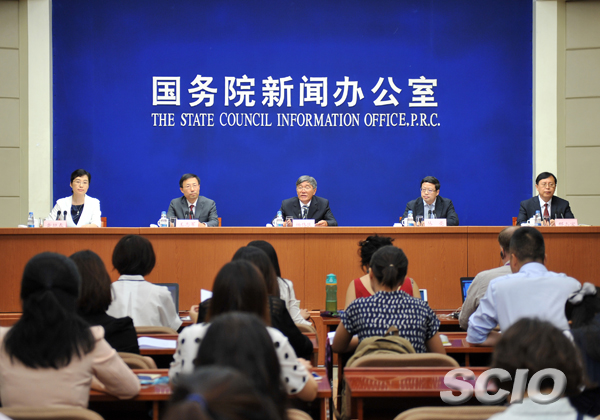
SCIO holds a briefing on China's current economic performance in Beijing on July 27, 2017. [Photo/China SCIO]
Xi Yanchun:Ladies and gentlemen, good afternoon. Welcome to this press conference. The State Council Information Office has held several press conferences this month to release latest economic data and provide relevant explanations. To help you gain a better understanding of the current situation, we are delighted to have with us: Mr. Yang Weimin, vice minister of the Office of Central Leading Group on Financial and Economic Affairs; Mr. Wang Zhijun, director of Division One on Economic Affairs, the Office of Central Leading Group on Financial and Economic Affairs; Mr. Cong Liang, director-general of the Department of National Economy, the National Development and Reform Commission, and Mr. Xing Zhihong, spokesperson of the National Bureau of Statistics and director general of the Department of Comprehensive Statistics of the bureau. They will introduce China's current economic performance and answer some of your questions.
Now, let's welcome Mr. Yang to give his briefing.
Yang Weimin:
Ladies and gentlemen, good afternoon. It's a pleasure to meet you. As you know, the Communist Party of China (CPC) Central Committee recently held a special meeting to review national economic performance in the first half of this year and arrange the relevant work for the remainder of the year. The press release has been distributed to you. Now, I'd like to brief you on how the Political Bureau of the CPC Central Committee viewed China's economic performance in the first half of this year and what will be carried out in the second half.
1. How to understand China's economic performance in the first half of this year.
Generally speaking, in the first half of this year, Chinese economy produced a stable performance and moved in a positive direction, with further structural adjustment.
What are the reasons behind this conclusion?
First, economic development was stable, with all major economic indicators standing in an appropriate range, and some even surpassing expectations. National GDP expanded by 6.9 percent, 0.2 percentage points higher than the same period of last year, reaching the highest level since the fourth quarter of 2015.
Second, the quality and efficiency of the economic performance were both enhanced. Fiscal revenue increased by 9.8 percent, and the profits of industrial enterprises above designated size increased by 22 percent.
Third, people's livelihood continued to improve. In both rural and urban areas, a total of 7.35 million new jobs were created, approximately 180,000 more than the same period of last year. Consumer prices remained stable, with the CPI growing by 1.4 percent year on year, and maintaining the same growth rate as the first quarter of this year. Personal per capita disposable income increased by 7.3 percent which was adjusted for inflation, higher than the economic growth rate. Remarkable achievements were made in poverty reduction. New progress was made in ecological conservation, environmental protection and other areas.
Why are we convinced that the structural adjustment has been deepened? Supporting evidence can be provided in three aspects:
First, consumption, investment and export growth had obviously become more balanced as we reviewed the recent structure of demand. The retail sales of consumer products grew by 10.4 percent, reinforcing the role of demand as a driving force to cement economic growth gauged by a contribution rate of 63.4 percent. Investment in fixed assets surged by 8.6 percent, with private sector investment increasing by 7.2 percent for a growth of 4.4 percentage points year-on-year. Exports and imports soared by 19.6 percent, with 15 percent growth in exports and 25.7 percent for imports. The international balance of payments was positive, the current account maintained surplus and the foreign currency reserves were above US$3 trillion.
Second,the industrial structure was much improved: the service industry continued to grow fast, supply-side structural reform in the agricultural sector kept advancing, industrial structure was improved and overcapacity problems continued to be alleviated. Moreover, the driving force of innovation started to take effect and various industries pressed ahead with upgrading and new technologies expanded rapidly. The growths of high-tech industries and equipment manufacturing, respectively standing at 13.1 percent and 11.5 percent, are higher than the increase of the entire industrial sector and the GDP. Besides, the industrial organizational structure saw further improvement as demonstrated by the rise of the concentration ratio of competitive industries and the further segmentation of small, medium and large enterprises. At the same time, controls were effectively strengthened over the real estate market.
Third, judging from the regional structure, the coordinated efforts of three major strategic programs, namely, the Belt and Road Initiative, the concerted development of Beijing, Tianjin and Hebei Province and the operation of Yangtze River Economic Belt are obviously paying off. China's eastern, middle and western region have all seen improvements, with good momentum being sustained in the east, development expanded in the middle and the west and signs of recovery have appeared in the northeastern region.
The good performance of the economy in the first half this year mostly resulted from the proposal of the economic new normal charted by the CPC Central Committee to create a unified view on the future course of national economy since the 18th CPC National Congress.
We need to uphold clear thinking while observing the future of the economy. President Xi has more than once stressed that we need dialectic views and farsighted visions to address the issue in particular. In doing so, we need to take into consideration both the current economic course and its future trajectory, both the indexes and expectations and both the achievements and problems.
Given the outlook of China's economy in middle and long term, positive changes can be seen. General development has maintained good momentum and it will keep improving in the long term, the structure of supply and demand has been essentially transformed, the combined expectations of enterprises and market confidence have been boosted and the driving force of the economy has been reinforced. Such progress has not only stimulated the national economy but also contributed to the recovery of the world's economy.
More to the point, the new development conception and supply-side reform have gained popularity, especially, among the local governments and enterprises, causing them to change for the good. Conceptions, referring to a fundamental change and a strengthened force, are attempting to reach a more advanced economic structure by spearheading a transformation in development modes, improving the economic structure and renewing the economic driving force. Therefore, I feel upbeat about China's economy and I am confident it will by no means fall into the middle-income trap as some have alleged.
Meanwhile, we are aware that China is at a crucial stage in its economic development where structural reform is still underway. Particularly, supply-side structural reform is deepening, with many challenges to be overcome. Despite stable performance with good momentum in the first half (H1) of this year, there are problems in China's economic development. Some of them are deep-seated, such as poor circulation of the real economy, the arduous task of managing financial risks, the lack of long-term mechanisms to ensure the sound and stable development of the real estate market as well as mounting pressure from increasing business costs.
Furthermore, the economic prospects for different regions, sectors and enterprises are increasingly divergent. Given the deep integration of the Chinese economy in the world economy, the latter, though improved in H1 this year, is transmitting its uncertainties to the former.
2. The work we will do in the second half of this year
The CPC Central Committee and the State Council stressed that to deliver sound and sustained economic growth in H2 of this year, we must make it our top priority to remain committed to the underlying principle of making progress while keeping economic performance stable. This serves as a major principle of China's governance and a reliable method for its economic development.
Ensuring stability requires making progress while maintaining stable overall performance. However, the stability we pursue is not equivalent to inactivity or stability achieved through strength and rigidity. Instead, we should endeavor to make progress while striking a balance, seizing opportunities and moderating our pace. New achievements should be made this year in managing financial risks and continuing supply-side structural reform.
We should stick to the guidelines set by the Central Economic Work Conference 2016 and the Report on the Work of the Government 2017, and seek progress in all areas of our work. To be specific, we will do the following: keep macro-level policy consistent and stable; pursue a proactive fiscal policy and a prudent monetary policy; focus on supply-side structural reform; expand aggregate demand as appropriate; do better in guiding expectations; and strengthen the role of innovation in driving forward development.
We should ensure that we achieve three essential goals, namely, maintaining stable and sound economic development, continuing supply-side structural reform and forestalling systemic financial risks.
Taking into account both the current situation and the long-term development needs, the CPC Central Committee and the Sate Council stressed that, while seeking progress in all areas, we should focus on the following six tasks: first, firmly continuing supply-side structural reform; second, actively yet gradually dissolve the accumulated debt risks of some local governments; third, suppress financial chaos; fourth, stabilize the real estate market; fifth, maintain the steady growth of foreign and private investment; sixth, word hard to improve people's livelihoods. That concludes my introduction. Now officials from National Development and Reform Commission, National Bureau of Statistics and the Central Leading Group on Financial and Economic Affairs as well as myself would like to take your questions. Thank you.
Xi Yanchun:
Thanks to Mr. Yang Weimin for his introduction. Now, the floor is open to questions.
_ueditor_page_break_tag_CCTV:
Since the second half of last year, the economy has shown signs of bottoming out. Production, prices and profit indicators are visibly picking up. One view is that these improvements still rely on real estate development and infrastructure investment. Mr. Cong, what is your opinion? Thank you.
Cong Liang:
Mr. Yang has just made a detailed evaluation on the whole economic situation. Since the 18th CPC National Congress, the CPC Central Committee and the State Council have established a judgment on the new normal of economic growth. They have steered the new normal with new concept of development, focused on improving quality and efficiency, and took supply side structural reform as the main line. Under the combined effect of these policies, some positive changes have taken place since the second half of last year. These positive changes were achieved on the basis of structural optimization. We didn't implement any powerful stimulation as was the case with Western countries. Instead, we are vigorously promoting mass entrepreneurship and innovation and revitalizing the real economy. We focus more on promoting development by speeding up structural adjustment and the conversion of old and new growth drivers, so as to achieve steady economic development.
Specifically, there are a few aspects to consider: First, the entire industrial structure has seen continuous optimization, with the service sector maintaining rapid development. From 2013 to 2016, the average annual growth of the added value for the service sector reached 8 percent, or 0.8 percentage point higher than the GDP growth rate. The service sector contributed 44.9 percent to the economic growth in 2012 and up to 58.2 percent in 2016. In the first half of this year, the service industry grew by 7.7 percent, contributing 59.1 percent to economic growth. From the point of view of proportion, service sector's added value accounted for 46.7 percent of the total in 2013 and 51.6 percent in 2016, a rise of 6.3 percentage points from 2012. In the first half of this year, its proportion increased to 54.1 percent. From an annual perspective, looking at each quarter, the contribution of the service sector might undergo a small change. However, viewed long-term, this change has been the most obvious in the last five years.
Second, the quality was improved on the basis of stability for the secondary sector. As the strategies of innovation-driven development were implemented, including the rapid advance of the "Made in China 2025" plan, as well as in-depth boost from the "Internet Plus" action plan and the construction of "Digital China," the transformation and upgrading of traditional industry was able to move ahead faster. The whole economy, especially the industrial economy, was able to maintain stable growth. Looking at the internal structure of industry, we can see that in the traditional industries - especially from the angle of cutting excessive industrial capacity - many invalid processes and products of low efficiency were reduced gradually, while the high-level and efficient parts of industry were able to play an increasingly important role. So. the supply and demand relationship of the whole market saw a relatively positive and substantial change. For example, the coal industry cut capacity totaling 290 million tons in 2016, and, since the beginning of this year, it has cut a further 111 million tons. This produced obvious easing in the excessive supply situation facing the coal market. Regarding the steel industry, in 2016, production capacity was cut by 65 million tons, while another 40 million plus tons has been eliminated so far this year. What's more, more than 100 million tons of substandard steel were prevented from being produced through bans based on safety and environmental protection standards. There was a great change in the supply and demand relationship in the entire steel industry. The industries with higher value added potential grew faster than traditional ones. Take, for instance, the equipment manufacturing industry. In 2016, its proportion was 32.9 percent, 4.7 percent more than what it was in 2012. The high-tech industry's proportion was 12.4 percent in 2016, three percent more than in 2012. So, there were relatively obvious changes in the entire supply and demand relationship, the transformation and upgrading of traditional industries, as well as the development of new industries. Especially, green development saw some achievements, and the utilization efficiency of energy resources was clearly raised. The energy consumption per unit of GDP dropped by 17.9 percent in 2016 compared with 2012, and the main pollutant emissions kept decreasing. During this period, the economic aggregate kept expanding.
While the structure was optimized, there were some changes in the demand structure, and consumption has become the main force. Currently, consumption's contribution to economic growth was 63.4 percent in the last half year. Consumption's fundamental role functioned efficiently. Regarding investments, those in ecological environmental protection, education, irrigation and innovation, including the investment in technology transformation aspects, all increased by double-digit figures. So. the whole economic structure, no matter if it is about industry structure or demand structure, has seen a lot of positive changes, which also have created their own trends. Viewed from a long-term prospective, this positive trend is very clear. Thanks.
Phoenix TV:
Recently, the "gray rhino" has been mentioned several times. The Chinese media first reported "gray rhino" threats and said these and "black swan"eventsshould be prevented. And the foreign mediaalso reported that China should pay attention to "gray rhino" threats. How do youevaluate this matter? Thank you.
Wang Zhijun:
Thank you. Firstly, I'd like to explain the meaning of the"gray rhino" threats and the "black swan"events respectively. The"black swan"event is a metaphor that describes an event that comes as a surprise. As for the "gray rhino,"it is known that the rhino has a big body, so the word meansthat a serious matter has not attracted enough attention, which leads to a serious event, even though it could have been expected in the early stage. The CPC Central Committee is effectively preventing and defusing risks in the financial sector. And the CPC is always defending the bottom line of no outbreak of systemic risk. Both "black swan" events and "gray rhino" threats may offend the bottom line of financial risk. However, as I mentioned, these two events differ in nature. So, we should have different ways to deal with and prevent risks.
Regarding "black swan" events, they are unexpected, and so we should keep calm and have a high sensitivity, especially in regard to the condition of an unstable economic base. We will become more aware of potential dangers and always keep potential risks in mind. We will strengthen the ways to trace, monitor and analyze various matters and improve the prediction and precaution system for identifying emerging issues as soon as possible. We will make full preparations and take preventive measures
In "gray rhino" threats, the matters have already appeared. So, we should have crisisawareness and adhere to a problem-oriented approach. Facing "gray rhino" threats, including a shadow banking system, property bubbles, inflated local debt levels and illegal fund raising, we should size up the situation, solve problems in order of importance and urgency, pay attention to the key factors, then take effective measures and properly solve problems. Thank you.
CRI:
Government data for the first half of this year showed that industrial profits grew 19.1 percent in June year on year, up 2.4 percentage points from the previous month's growth. Does the growth represent a turnaround in the real economy? And what will the economy be like in the second half of this year? What about the industrial profits?
Xing Zhihong:
With the deepened supply-side structural reform this year, the relationship between supply and demand has been improved, and we also saw a recovery in industrial product prices and industrial companies' operating conditions. According to the June data released this morning, we can see the following positive changes:
Firstly, profits maintained steady growth. The profits of industrial enterprises with annual revenue of 20 million yuan or more from their main business operations rose by 19.1 percent from the year before, up 2.4 and 5.1 percentage points from May and April respectively. Profits of large-scale industrial enterprises for the first half year increased by 22 percent from a year earlier, with growth level up 15.8 percentage points year on year.
Secondly, profits margin kept growing. The profits margin of industrial enterprises earning more than 20 million yuan from their main business operations increased 6.35 percent, up 0.29 percentage points from a year earlier.
Thirdly, the profits structure has been improved. Starting from the Q2,there's a new development in industrial profits growth. Industries upstream shared a smaller part in the newly-added profits, while industries in the middle and downstream shared more. Of the newly-added profits in June, the equipment manufacturing industry shared 40.7 percent of the total, up 11.3 percentage points from May; high-technology industries accounted for 19.3 percent, up 0.6 percentage points from May. As a typical upstream industry, the mining sector's portion of profits decreased by 13.4 percentage points from May, a fall for the second consecutive month.
Reasons for these positive changes in industrial enterprises' profits are as follow: firstly, we maintained a steady growth in market demand, and speeded up selling. In June, income from industrial enterprises' main business operations increased by 13.7 percent from a year earlier, up 0.6 percentage points than the May growth. This year, income from industrial enterprises' main business operations maintained double-digit growth, and the turnover of finished products was also speeded up. The turnover time of finished industrial products was 13.7 days in June, 0.8 days less than May. A number of the 34 industries in the second quarter of this year maintained price growth, showing market demand is increasing, which is also a major reason for the industrial enterprises to continue steady growth.
Secondly, the effect of taxes, fees and other costs cut was now felt. The government has been pushing forward supply-side reform since last year, and reducing costs is one of the major tasks. By cutting the taxes, fees and other costs relating to human resources, land, logistics, and systematic trade, industrial enterprises reduced their costs by 0.18 yuan per 100 yuan of income from their main business operations.
Thirdly, the upgrading and optimized supply strengthened the industrial enterprises' earning power. Under supply-side structural reform and innovation-driven development strategy, industrial enterprises proactively coped with the changes in market, and took effective measures to improve their equipment, crafts and technology. We can see that, in the first half of the year, not only the emerging industries maintained a good momentum, but also the traditional industries improved their operations through upgrading. Take the textile and garment industry as an example. This traditional industry rose by 12 percent in the first half of the year, up 9.6 percentage points from last year. Among the 41 sectors, 38 saw increased profits based on the improvements mentioned above.
Nikkei:
Market interest rates and mortgage rates both increased in the first half of this year. How will the increase impact the performance of the Chinese economy in the second half of this year?
Wang Zhijun:
China's prudent monetary policy and proactive fiscal policy, especially the supply-side structural reforms, have enabled the national economy to maintain stable and sound growth in the first half of this year. As Mr. Yang said just now, China will continue such policies in the second half of this year.
To cope with any possible impact from rate moves, we will maintain a prudent monetary policy, emphasize preemptive adjustment and fine tuning, and ensure moderate credit growth and stable liquidity so that interest rates remain at a reasonable level.
I believe China is able to sustain sound economic growth by using monetary policy instruments to offset the impact of interest rate moves.
Financial Times:
As has just been mentioned, it is very important to curb systematic risk. Could you please explain what kind of risk this refers to? In what circumstances would the highest probability appear? Which sector, for instance, will face such risk? What does systematic risk mean exactly? Thank you.
Yang Weimin:
Systematic risk refers to the risk that will affect the overall economy and the entire society. Definitely, it can be caused by small risks of different sectors and aspects rather than one sector alone. The subprime crisis, for example, didn't look like systematic risk, but it finally resulted in one, as it triggered a financial crisis in the United States and touched off the global financial crisis.
What we mean by guarding against systematic risk is to prevent those small risk points of different sectors, including interbank business, local governmental debt, and debt defaults of some State-owned enterprises (SOE) and a high leverage ratio. We have to identify, find and deal with those risks as soon as possible. By handle them in this way we can prevent small risks from becoming huge systematic risk in the end and doing more serious harm to Chinese economy. So, we balance the relationship between stable growth and risk prevention even at the cost of sacrificing something in other aspects now.
In the second half of this year, we will work on deleveraging, which is the source of risks. The direction of deleveraging is unchanged. Definitely, deleveraging will undergo a lengthy process with priorities, as the leverage ratio of different industries and sectors varies. It was stressed at the National Financial Work Conference that deleveraging of SOEs should have top priority. If SOE deleveraging is achieved, the leverage aspect of the entire enterprise sector will go down and leverage of the whole national economy will decline as well, which is how to prevent dangers at source. We will not maintain growth at the mercy of a rebounding leverage ratio. The economy of the first half year continues to be stable and is getting better. Meanwhile, the trend that the macro leverage ratio was rising too rapidly in previous years is now under control to some extent. That means both deleveraging and stable growth can be achieved. We are able to maintain a stable economy, and to curb the leverage ratio to some extent as well. Thank you.
CGTN:
My question is about employment. This year's economic statistics show the current employment situation is good, and there is no sign of any slowdown in the reduction of industrial overcapacity. At the same time, the number of graduates nationwide this year has hit an all-time high. How can we maintain this good momentum? Thank you.
Xing Zhihong:
There has been steady and sound development in the national economy since the beginning of this year. More positive changes have taken place in economic development, among them the sustained improved employment is a bright spot. I think the main reasons for this are as follows.
First, the effect of entrepreneurship and innovation initiatives. The implementation of entrepreneurship and innovation initiatives has further promoted market vitality and social creativity. New enterprises have emerged in large numbers, bringing about many new job openings. Statistics from relevant departments show the number of newly registered enterprises reached 291,000 in the first half of this year, an increase of 11.1 percent over the same period of last year. The average daily number of newly-registered enterprises reached 16,000. According to the National Bureau of Statistics, about 70 percent of the country's new jobs last year came from sectors regarded as new economic drivers.
Second, the economic effect. Presently, China's economic development has entered the period of the new normal. During the economic structural transition period, economic growth has steadily expanded instead of narrowing. In the first half of this year, GDP growth reached 2.35 trillion yuan, an increase of more than 200 billion yuan over the same period of last year. As long as our labor productivity is holds steady, the expansion of economic growth will mean a steady expansion of new employment in this regard.
Third, the effect of structural adjustment. The service industry began to exceed the secondary industry in terms of the proportion occupied in the national economy in 2013, and the proportion exceeded 50 percent in 2015.It can be said that China's economy has entered a service-leading development stage. Compared with the manufacturing sector, the service industry is a more powerful employer, because it has many labor-intensive sectors. The growing service industry is leading to a more flexible employment rate.According to our estimates, every one percentage point of GDP growth meant 1.7 million new non-agricultural jobs in the2012-2016 period, an increase of 300,000 over the 2009-2011 period. This is a tribute to economic structural adjustment.
Fourth, the effect of policies. The CPC Central Committee and the State Council have always adhered to the policy of giving priority to employment and have implemented other positive policies to cope with employment pressures.In supply-side structural reform, the scaling down of overcapacity in some industries has brought about such problems as the resettlement of laid-off workers. Meanwhile, the number of college graduates is unprecedentedly high in China this year. The central government has taken a series of positive measures aimed at these key groups. Let me give you an example. Last year, the central government allocated 100billion yuan in special funds for the resettlement of laid-off workers, and introduced an employment and entrepreneurship action plan for college graduates. All these approaches have provided a stable environment for the job market and further improved employment.
Thanks to these four reasons, China has maintained steady and sound employment development momentum. Thank you.
Bloomberg News:
The nation's economy has been stable overall, but there's great regional divergence. Gansu, Hainan and Tianjin, for instance, have decelerated in the first half by more than one percentage point from the first quarter. How can you explain that and what can policy-makers do to address these regional differences?
Cong Liang:
As regions differ in terms of their development stage and factor endowment, they naturally differ in economic growth.Just as you mentioned,the growth in Gansu and Hainan didslow down somewhat. However, for these two provinces, greatpriority should be given toenvironmental protection rather thaneconomic growth. Hainan is an island in the tropical rainforest zone. Its ecology can be found nowhere else in China, so its protection deserves greater attention than economic growth. Gansu's Qilian Mountain is regarded as China's "water tower."If the mountain were polluted, the entire Yellow River and Yangtze River networks would suffer. Therefore, for such regions, environmental protection is more important than economic growth. Thank you.
Yang Weimin:
I have something more to say on this issue. China has a large territory, with natural and geographical conditions differing greatly between regions. The natural environment in Qinghai and Tibet in the west is very different from Beijing, Shanghai, Jiangsu and Zhejiang in the east. That's why we create policies for functional zones to promote regional development. Under these policies, some regions can concentrate on industrialization and urbanization, while some perform the role of an agricultural zone. As major producers of agricultural products, these zones should not put too much effort into industrialization and urbanization. Likewise, the main responsibility for some regions is ecological conservation.
You mentioned Hainan just now. The province's main responsibility is protecting its ecological environment, thus serving as a "back garden" for the Chinese people. Therefore, it's reasonable for Hainan's economic growth rate to be a bit lower than some others. This was the necessary consequence of the central authorities' policies and new, green development methods. I think the result is positive.
Regarding Gansu, besides concerns on ecological conservation, the province is also handicapped by natural condition that is not as good as eastern provinces. The mining industry makes up a rather high proportion in Gansu's economic structure. As the official of National Bureau of Statistics has just said, profits in the mining sector have continued to drop; hence, in regions where the mining industry accounts for a large proportion of the economic structure, it's normal that the economic growth rate would be lower than others.
When analyzing economic development in different regions, we can't use a one-size-fits-all standard. What we care about most now is whether their development fits green ideas, and whether they have fulfilled their functions and promoted development as required. This is different from our previous appraisal of regional performance. We changed our way of thinking because great efforts have been undertaken to advocate ecological progress and green development after the 18th National Congress of the Communist Party of China (CPC). Thank you.
CNR:
As a vital part of regional economy, economic development of northeastern China has drawn a lot of attention in recent years. In particular, as Mr. Yang Weimin just mentioned, economic development there saw a recovery this year after touching bottom. Could you talk about China's economic development in the first half of this year from the perspective of regional development? What's more, will this recovery in the northeast be sustainable? Thanks.
Cong Liang:
As we have mentioned before, due to various factor endowments and geographic conditions among regions, their development differs from each other. However, this year, guided by the new development philosophy, the eastern, central, western and northeastern regions interacted and coordinated well. Economic development of eastern China maintained a good and powerful momentum. The economy of central and western China grew steadily, and the northeast underwent a recovery.
As the leading region of the country, eastern China contributes over 50 percent of the total national economy. In the first half of the year, the growth of industrial value added in the top five provinces - Jiangsu, Guangdong, Shandong, Henan and Zhejiang - all surpassed the national average, thus providing a steady base for China's economy. Especially, the transformation and upgrading carried out in eastern China played a vital role in leading the economy. In Zhejiang Province, the high technology and equipment manufacturing industries contributed over 50 percent of industrial growth. And in Jiangsu Province, 3D printing and industrial robots saw a growth rate of 70 percent. Some cities have achieved a lot during their transformation and upgrading. For example, in Shenzhen, its per capita GDP is over US$25,000, so it has avoided being caught in any "middle income trap." And its GDP growth, featuring high quality, great benefits and advanced technology, reached 8.8 percent in the first half of this year. Through these facts, we could see China's great economic development capability and potential.
Regarding the central and western regions, their development index is higher than the whole country, indicating they have gained obvious advantages as late comers. Over the last two years, with industry relocation and technology transfer from the eastern regions, the central and western regions saw their industry grow at a rather high rate.
Many provinces enhanced growth momentum by raising the quality and returns of development, and promoting industrial upgrading. For example, in Shanxi and Shaanxi provinces, after cutting excessive industrial capacity and treating zombie enterprises, the total corporate profit increased by 30 percent, much faster than the whole country. In Hunan province, which encouraged its equipment manufacturing industry to integrate with the software industry, the growth rate of the equipment manufacturing industry was double that of the industrial sector as a whole. In Anhui province, the growth rate of strategic emerging industries was over 20 percent, which is common in the central and western regions.
In the northeast region, the pressure of economic growth has been high in recent years. But from this year, the signs of stability are increasing. The growth rate of industry was 1 percent in the first half of the year. Last year, it decreased 3.1 percent. The drop in investment has slowed down. Meanwhile, some key industries are improving in terms of profitability. In previous years, the petroleum and petrochemical sector, including the mining industries, experienced great losses, but their profitability have markedly improved now.
Meanwhile, proactive efforts have been made to promote the three key initiatives: the Belt and Road Initiative, the coordinated development of Beijing, Tianjin and Hebei, and the development of the Yangtze River economic belt. Much headway has been made in promoting the Belt and Road Initiative. Steady progress has been made in the coordinated development of the Beijing-Tianjin-Hebei region, and in the projects to relieve Beijing of functions nonessential to its role as China's capital. The development of the Yangtze River economic belt is centred upon environmental protection, and the restoration of the whole ecological environment has achieved substantial results. Overall, the coordinated and integrated development between regions is clearly progressing well. New growth poles and growth belts are gradually forming. Deep-rooted problems in some regions are gradually being solved, and some have achieved obvious improvement. Thank you.
The Wall Street Journal:
I have a question regardingsupply-side structural reform. The expert just mentioned that the capacity of the coal industry has dropped sharply. We noticed that coal enterprises made a profit of about 100 billion yuan in the first half of the year thanks to the cuts in coal capacity and the rise in coal prices. However, rising coal prices will result inrising costsfor the coal-based power industry and the losses of coal-based power enterprises reached nearly 100 billion yuan in the first half of this year. Asadecision maker are you aware of this problem? The cuts in capacity in one industry may exert negative impacts on other related industries. If possible, will you be taking measures to avoid this phenomenonas supply-side reform continues in the future? Thank you.
Yang Weimin:
This is a good question. We areaware of the relationship between the upstream coal industry and the downstreampower industries, irrespective ofsupply-side structural reforms.As coal prices rise, the profits of the coal-based power industriesmay decrease. This continues to be a difficult problem to solve during China's long-term economic development process.
Currently, coal prices have rebounded very quickly due to complicated factors. Therefore, the practice of cutting capacity duringthe previous stage may need some fine-tuning for the next step. We will makebetter use of the measures enacted forremovingZombie enterprises as well utilizingmarket and legal approaches. We will also make less use of administrative orders in the future capacity-cutting process. Capacity cuts aim to correct distortions in the allocation of elements, and through reform, establish a more normal market order in theupstream-downstream relationship. But it needs some time. The conflicts will gradually ease in the future process of dissolving excess capacity and disposing Zombie enterprises. Thank you.
Xi Yanchun:
Thanks again for the release. In the next days, we will invite other economic departments to attend the SCIO briefings introducing China's economic situation. Please stay tuned for more interview notices published on the SCIO APP. Thank you. That's all for today's press conference.
SCIO briefing on China's current economic performance - SCIO briefing on national economic performance in H1
Speaker:
Xing Zhihong, spokesperson and director general of the Department of Comprehensive Statistics, National Bureau of StatisticsChairperson:
Xi Yanchun, vice director-general of the Press Bureau, State Council Information OfficeDate:
July 17, 2017
Xing Zhihong (R), spokesperson of the National Bureau of Statistics, speaks at a press conference held by the State Council Information Office in Beijing, capital of China, July 17, 2017. [Photo/China SCIO]
Xi Yanchun:Ladies and gentlemen, good morning. Welcome to this press conference. Today, we are delighted to invite Mr. Xing Zhihong to introduce China's economic performance in the first half of 2017. Mr. Xing is the spokesperson and director general of the Department of Comprehensive Statistics of the National Bureau of Statistics (NBS). He will also answer some of your questions.
Now, let's welcome Mr. Xing to give his briefing.
Xing Zhihong:
Good morning. It's a pleasure to meet you again. As usual, I will make a brief introduction before the Q&A session.
In the first half of this year, China's economic performance was sound and stable with more visible good momentum. Generally speaking, the growth was steady; employment levels rose; prices were stable; incomes kept growing; the economic structure further improved. National economic development became more stable, coordinated and sustainable
According to preliminary statistics, the H1 national GDP was 38.149 trillion yuan, rising 6.9 percent year on year at comparable prices. The Q1 GDP and Q2 GDP both rose 6.9 percent yearly. The added value of the primary, secondary and tertiary sectors was 2.2 trillion yuan, 15.3 trillion yuan, and 20.65 trillion yuan respectively, rising 3.5 percent, 6.4 percent and 7.7 percent on a yearly basis. The Q2 national GDP grew 1.7 percent as compared with Q1.
First, the agricultural sector posted a sound performance with a bumper harvest in summer.
In summer, the yield of grains was 140.52 million metric tons, increasing 0.9 percent, or by 1.31 million metric tons, from last year. In H1, the total amount of pork, beef, mutton and poultry was 38.92 million metric tons, growing 1.0 percent yearly, or 0.8 percentage points higher than Q1.
Specifically, the amount of pork was 24.93 million metric tons, growing 0.8 percent, with the growth rate up by 0.6 percentage points. The total number of live hogs was 403.5 million, up 0.4 percent, while that of hogs slaughtered was 321.83 million, up by 0.7 percent, both year-on-year.
Second, industrial production accelerated with rapidly growing corporate profits.
In H1, the added value of industrial enterprises above designated size registered a year-on-year increase of 6.9 percent in real terms. This was 0.1 percentage point higher than Q1, or 0.9 percentage point higher than the same period of last year.
Regarding different types of ownership, the added value grew 6.2 percent in state holding enterprises,1.9 percent in collective enterprises, 7.1 percent in share-holding enterprises, and 6.7 percent in enterprises funded by foreign investors or investors from Hong Kong, Macao and Taiwan.
Regarding different economic sectors, the added value fell 1.0 percent year-on-year in the mining industry, while growing 7.4 percent in the manufacturing industry and 8.1 percent in the production and supply of electricity, heat, gas and water. .
In particular, the manufacturing industry moved towards the medium-high end at a faster pace. The added value of the high-tech and equipment manufacturing industries grew by 13.1 percent and 11.5 percent respectively, 6.2 percentage points and 4.6 percentage points higher than the average of industrial enterprises above designated size, accounting for 12.2 percent and 32.2 percent of the total.
Regarding industrial enterprises above designated size, the sales-output ratio was 97.5 percent.Their added value in June grew 7.6 percent year-on-year, 1.1 percentage points higher than May, or up 0.81 percent month-on-month.
From January to May, the total profit of industrial enterprises above designated size was 2.9 trillion yuan, up 22.7 percent, 16.3 percentage points higher year-on-year. The profit rate from their primary activities was 6.05 percent, 0.45 percentage points higher than the same period of last year.
Third, the service sector grew at a relatively fast pace with a high prosperity index.
In H1, the Index of Services Production increased by 8.3 percent year-on-year, the same rate as Q1. Specifically, rapid growth was seen in the transport, storage and postal sector, the information transmission, software and information technology sector, as well as in the rental and business service sector. In June, the index grew 8.6 percent, 0.5 percentage points higher than May, or 0.6 percentage points higher than the same month last year.
In June, the Business Activity Index for services stood at 53.8 percent, 0.3 percentage point higher than the previous month and 1.6 percentage points higher than the same month last year.
Specifically, the index exceeded 59.0 percent in the producer service sector and logistics service sector, and exceeded 60 percent in the air transport sector, postal service sector, telecom, radio, TV, and satellite transmission sector, internet and software information technology service sector, monetary and financial service sector, insurance sector, among others. This indicated that the above mentioned sectors all saw robust development.
Regarding market demand and prospects, the New Order Index and Business Activities Expectation Index for the service sector were 50.7 percent and 60 percent respectively, 0.4 percentage point and 0.8 percentage point higher than last month respectively.
Fourth, the growth of investment holds steady with a slight slowdown, while the growth of investment in manufacturing and private investment rebounds.
In the first half of this year, fixed-asset investment (excluding rural households) reached 28,060.5 billion yuan, registering a year-on-year growth of 8.6 percent, down by 0.6 percentage points from the second quarter. Specifically, investment by State--holding investment reached 10,202.2 billion yuan, an increase of 12.0 percent; private investment totaled 17,023.9 billion yuan, up by 7.2 percent. The two figures in June were 0.4 and 4.4 percentage points higher compared with the first five months, and the same period last year respectively, accounting for 60.7 percent of total investment. Investment in the primary industry was 869.4 billion yuan, up 16.5 percent. The secondary industry received 10,580.7 billion yuan, up 4 percent, of which investment in manufacturing was 8,680.9 billion yuan, up 5.5 percent, 0.4 percentage points higher than that in the first five months, posting positive growth for the second consecutive month; it was 2.2 percentage points higher than the same period last year. The tertiary sector received 16,610.4 billion yuan, an increase of 11.3 percent. Specifically, investment in infrastructure reached 5,942.2 billion yuan, an increase of 21.1 percent, 0.2 percentage points higher in June than the first five months and the same period last year. The investment in high-tech industries grew rapidly and investment in hi-tech manufacturing and hi-tech services increased by 21.5 percent and 22.3 percent respectively, or 12.9 and 13.7 percentage points higher than the growth rate of the total investment. The fund in place for fixed-asset investment in the first half of this year was 28,627.5 billion yuan, up 1.4 percent year on year, shifting from negative growth to positive. The total planned investment in newly started projects was 23,725.8 billion yuan, a decrease of 1.2 percent year-on-year. This was 4.4 percentage points lower in June than in the first five months of the year. In June, fixed-asset investment (excluding rural households) increased by 0.73 percent month on month.
Fifth, the growth of investment in real estate development slowed down and the floor space of commercial buildings for sale continues to decrease.
In the first half of this year, total investment in real estate development was 5,061.0 billion yuan, 8.5-percent growth year on year, 0.6 percentage points lower in the second quarter than in the first. In particular, the investment in residential buildings went up by 10.2 percent. Total floor space of houses newly started in the first six months was 857.20 million square meters, up by 10.6 percent. The floor space of residential buildings newly started went up by 14.9 percent. The floor space of commercial buildings sold was 746.62 million square meters, up 16.1 percent, of which the floor space of residential buildings sold grew by 13.5 percent. The total sales of commercial buildings were 5,915.2 billion yuan, up 21.5 percent. Specifically, the sales of residential buildings rose 17.9 percent. The land space purchased by real estate development enterprises was 103.41 million square meters, up 8.8 percent year on year. By the end of June, the total floor space of commercial buildings for sale was 645.77 million square meters, 14.41 million square meters less than at the end of May. The fund in place for real estate development enterprises in the first half year reached 7,576.5 billion yuan, up by 11.2 percent year-on-year.
Sixth, the growth of market sales accelerates and online retailing shows strong momentum.
In the first half of the year, total retail sales of consumer goods reached 17,236.9 billion yuan, a year-on-year rise of 10.4 percent, 0.4 percentage points and 0.1 percentage point higher compared with that at the end of the first quarter and the same period last year respectively. Specifically, the retail sales of consumer goods by measure of units above designated size stood at 7,695.3 billion yuan, up by 8.7 percent. Analyzed by different areas, retail sales in urban areas reached 14,778.6 billion yuan, up 10.1 percent, while those in rural areas stood at 2,458.3 billion yuan, up by 12.3 percent. Grouped by consumption patterns, total income of the catering industry reached 1,854.6 billion yuan, up 11.2 percent; and the retail sales of goods totaled 15,382.2 billion yuan, up 10.3 percent. In particular, the retail sales of units above designated size reached 7,242.0 billion yuan, an increase of 8.8 percent. The sales of upgraded consumer goods witnessed fast growth. Specifically, the sales of cultural goods and office supplies grew by 11.8 percent, sports and recreational articles17.1 percent, furniture 13.4 percent and construction and decoration materials 13.9 percent. In June, total retail sales of consumer goods rose by 11.0 percent year on year, 0.3 percentage points higher than May, or 0.93 percent month-on-month.
In the first half of the year, online retail sales across China reached 3,107.3 billion yuan, year-on-year growth of 33.4 percent, or 1.3 percentage points higher in the second quarter compared to the first. In particular, online retail sales of physical goods were 2,374.7 billion yuan, an increase of 28.6 percent, accounting for 13.8 percent of total retail sales of consumer goods, or 2.2 percentage points higher than the same period last year.
Seventh, imports and exports grow rapidly with improved structure of foreign trade.
The total volume of imports and exports in the first half of 2017 was 13,141.2 billion yuan, an increase of 19.6 percent year-on-year. Specifically, the total value of exports was 7,209.7 billion yuan, up 15.0 percent; the total volume of imports was 5,931.5 billion yuan, an increase of 25.7 percent. The trade balance was 1,278.2 billion yuan in surplus. The import and export of general trade occupied a larger proportion, growing by 20.5 percent and accounting for 56.7 percent of the total volume, 0.4 percentage point higher than the same period last year. As for major exports, mechanical and electrical products grew by 14.6 percent, accounting for 57.2 percent of the total export volume. The import and export to some countries along the "Belt and Road" increased. In the first half year, trade with Russia, Pakistan, Poland and Kazakhstan increased by 33.1 percent, 14.5 percent, 24.6 percent and 46.8 percent respectively. In June, the total value of imports and exports was 2,404.3 billion yuan, a year-on-year increase of 19.8 percent. Of this total, the value of exports was 1,349.3 billion yuan, up by 17.3 percent; and that of imports was 1,055.0 billion yuan, up by 23.1 percent.
In the first half of this year, the export delivery value of the industrial enterprises above designated size reached 6,103.0 billion yuan, up 10.9 percent year on year, 0.6 percentage points higher than the first quarter. In June, the export delivery value of the industrial enterprises above designated size reached 1,172.3 billion yuan, up 11.7 percent.
Eighth, consumer prices rose moderately, while the increase of industrial prices slowed down.
In the first half of the year, national consumer prices rose 1.4 percent year-on-year, although the increase was flat after the first quarter. Among them, urban residents saw a consumer price rise of 1.5 percent, compared to 1 percent for rural residents. By category, food, tobacco and liquor prices fell 0.8 percent year-on-year, clothing prices rose 1.3 percent, housing 2.4 percent, daily necessities and services 0.8 percent, transport and communications 1.5 percent, education, culture and entertainment 2.5 percent, health care 5.4 percent, and other goods and services 3.3 percent. Among the food, tobacco and liquor prices, the price of grains went up 1.4 percent, pork fell 6.1 percent, while fresh vegetables fell 14.7 percent. In June, the national consumer price rose 1.5 percent year-on-year, the same rate as last month. The figure was down by 0.2 percent month-on-month.
In the first half of the year, the producer price for industrial products rose 6.6 percent year-on-year. There was a 0.8 percentage point reduction in the increase compared to the first quarter. In June, the producer price for industrial products rose 5.5 percent. The increase ratio had been flattening out. But compared with the previous month, the price actually dropped 0.2 percent. In the first half of the year, the purchasing price of industrial producers rose 8.7 percent yearly. In June, the price was up 7.3 percent year-on-year and down 0.4 percent month-on-month.
Ninth, the incomes of urban and rural residents grew rapidly, and the income gap between urban and rural areas continued to shrink.
In the first half of this year, the per-capita disposable income of the country's residents was 12,932 yuan, an increase of 8.8 percent year-on-year in nominal terms, with actual growth of 7.3 percent after deducting price factors. The growth rate accelerated by 0.3 percentage point as compared with the first quarter, and up 0.8 percentage point over the same period of last year. According to the place of permanent residence, the per capita disposable income of urban residents was 18,322 yuan, with actual growth of 6.5 percent after deducting prices factor; that of rural residents was 6,562 yuan for actual growth of 7.4 percent. The per capita income of urban residents was 2.79 times that of rural residents, 0.01 lower than that of the same period of last year. The median per capita disposable income of all residents was 11,238 yuan, an increase of 7 percent in nominal terms year-on-year. The per capita consumption expenditure of residents was 8,834 yuan, an increase of 7.6 percent in nominal terms for actual growth of 6.1 percent after deducting price factors. At the end of the second quarter, the total number of migrant workers from rural areas working in cities was 178.73 million, an increase of 3.64 million and 2.1 percent year-on-year. In the second quarter, the average monthly income of rural migrant workers was 3,405 yuan, an increase of 6.3 percent.
Tenth, the work of cutting overcapacity, reducing excess inventory, deleveraging, lowering costs, and strengthening areas identified as weak was further advanced, and the policy effect continued to manifest itself.
Overcapacity was addressed in a well-ordered way. In the first half of the year, the industrial capacity utilization rate reached 76.4 percent, an increase of 3.4 percentage points over the same period of last year. Real estate inventory continued to be reduced. At the end of June, the floor space of commercial building for sale dropped by 9.6 percent year-on-year, 3.2 percentage points higher than that at the end of March. The leverage of enterprises was brought down. The debt-to-asset ratio of industrial enterprises above designated size at the end of May stood at 56.1 percent, 0.7 percentage point lower year-on-year. The costs of enterprises continued to be reduced. In the first five months, the cost per 100 yuan of revenue from the principle business of industrial enterprises above designated size was 85.62 yuan, 0.04 yuan less year-on-year. Areas of weakness were identified and strengthened. In the first half of this year, the investment in ecological protection and pollution treatment, management of water conservancy, transport, storage and postal services, as well as education grew by 46.0 percent, 17.5 percent, 14.7 percent and 17.8 percent respectively, markedly higher than the growth rate of the investment in fixed asset in the same period.
Generally speaking, the national economy has maintained the momentum of steady and sound development in the first half of 2017, laying a solid foundation for achieving the annual target and better performance. However, we must be aware that there are still many unstable and uncertain factors abroad, and long-term structural contradictions remain prominent at home. At the next step, uniting even closer around the CPC Central Committee with Comrade Xi Jinping as the core, we will stick to the general principle of seeking progress while maintaining performance stable, focus on supply-side structural reform, give central importance to improving the quality and returns of development, expand aggregate demand as appropriate, guide social expectations, strengthen the role of innovation in driving development, accelerate the replacement of old growth drivers with new ones, and promote economic transformation and upgrading, so as to cement the foundation for steady and sound development, and better fulfill the goal of national economic development this year. Thank you!
Xi Yanchun:
Thanks to Mr. Xing Zhihong for his introduction. We see many foreign media reporters here today, and we have arranged on-site simultaneous interpretation. Now, the floor is open to questions. Please identify the media you represent before raising a question.
_ueditor_page_break_tag_CCTV:
According to your introduction just now, China's economy has still maintained strong growth in the second quarter. How has China managed to maintain this growth? What's your view of the national economy's performance over the past half year? Thanks!
Xing Zhihong:
Thank you for your questions. During the past half year, China's economy has had stable progress and a positive trend. There were many positive changes in the economic area, I can say that the good elements have further increased to sustain the economy's intermediate- and high-speed growth.
To summarize the characteristics of the economy's operation in the past half year, there are two points: one, stability has been reinforced; and the good trend has become more evident.
As I say, the stable situation has become more reinforced and it was reflected in the fact that the economy keeps operating in a reasonable range. First, economic growth was stable in the past half year, China's economy maintained intermediate and high speed growth and GDP grew by 6.9 percent year-on-year, which is in line with the first quarter. The economic growth rate has kept within a range of 6.7 percent and 6.9 percent in eight consecutive quarters.
Second, the employment situation maintained a positive trend. In the past half year, urban and township areas saw new employment of 7.35 million people, which was 180,000 more on a year-on-year basis, and this completed 66.8 percent of the annual goal. The urban and township unemployment rate generally went down. According to statistics from the National Bureau of Statistics of China, the survey shows that the national urban unemployment rate was kept under 5 percent in two consecutive months. In 31 big cities, the survey shows that their urban unemployment rate was kept under 5 percent in four consecutive months. There is more labor from rural areas. Just now I have mentioned that by the end of the second quarter, the number of migrant workers from rural areas working in urban areas has increased 3.64 million people, a 2.1 percent growth year-on-year.
Third, the price of commodities was generally stable. In the past half year, the national consumer price increased by 1.4 percent, which was basically in line with the first quarter; minus food and energy, the core CPI was basically stable, and the core CPI increased by 2.1 percent on a year-on-year basis.
Fourth, the international balance of payments continued to improve. The trade in goods continued its surplus. In the past half year, after balancing exports and imports of the trade in goods, we realized a 1.28 trillion yuan surplus. The RMB slightly appreciated, and foreign exchange reserves continued to rise. By the end of June, RMB's middle rate is 1 US dollar against 6.77 RMB yuan, which means an 1.84 percent appreciation for RMB compared with the rate at the end of March. China's forex reserves reached US$3.0568 trillion, a consecutive increase for 5 months.
So generally looking at the indexes of the four aspects in the macro-economy, we can see China's economy in the past half year shows stable growth, good employment, stable prices of commodities and an improved international balance of payment. The economic growth stability clearly was reinforced.
Regarding the positive trend becoming more evident, it is shown in three aspects: First, the structure was optimized by reform. The supply-side structural reform continues to have deep progress, which pushes forward the production and demand structure to be further optimized. From this year on, the distinction of the service industry dominating economic growth became clearer. In the past half year, the growth rate of the service industry was 1.3 percent faster than the secondary industry, while the service industry accounted for 54.1 percent of the whole economy, which was 14 percentage points higher than the secondary industry's percentage.
The manufacturing industry was progressing to the middle and high end. The high-tech manufacturing industry and equipment manufacturing industry grew 13.1 percent and 11.5 percent respectively on a year-on-year basis, which is 6.2 and 4.6 percentage points faster respectively than the overall industry above designated size. They accounted for over 12.2 percent and 32.2 percent of the whole industry above designated size respectively. Consumption has speeded up transformation and upgrading; high-tech industry investment has increased rapidly, while the consuming and needs structures are also adjusting and optimizing.
Second, the dynamics was strengthened in the transformation. The deep pushing forward of reforms to delegate power, streamline administrative procedures and optimize government services will optimize the environment of entrepreneurship and innovation. From this year on, many market entities surfaced and developed. From January to May, the number of newly registered enterprises increased by 14.7 percent on a year-on-year basis, and there are an average of 15,600 new enterprises registering on a daily basis.
The development of new entities and new technologies efficiently prompted the growth of new industries, new business formats and new patterns – resulting in new dynamics for economic development. In the past half year, the national online retail sales of physical products increased by 28.6 percent year-on-year, which was 18.2 percentage points faster than the nation's consumer goods retail sales. This took over 13.8 percent of total consumer goods retail volume, which was 2.2 percentage points higher year-on-year. Strategic new industries grew 10.8 percent year-on-year, which was 3.9 percent faster than the industry above designated size. The new force in the economy is constantly growing and strengthening.
Third, the quality is improving in transformation. While the economy keeps intermediate- and high-speed growth, quality has further improved. This year, enterprises' benefits clearly improved. From January to May, the enterprises above designated size saw their profits grow by 22.7 percent year-on-year. The main business revenue of the enterprises above designated size had profit margins of 6.05 percent, which is 0.45 percentage points higher year-on-year. The business profit of enterprises above designated size also maintained double-digit growth, and the consumer income's growth rate was faster than economic growth. In the past half year, personal per capita disposable income increased by 7.3 percent, 0.8 percentage points higher than the same period last year, and 0.4 percentage points higher than the economic growth rate in the same period of this year.
In fiscal terms, although tax reductions and fee cuts were large for enterprises, due to stable and positive economic growth, the tax base continues to expand. Therefore in the past half year, the public budget revenue increased by 9.8 percent year-on-year, and the growth rate was 2.7 percentage points higher year-on-year.
To summarize all of the above, in the past half year, China's economy was stable and positive, this trend became clearer and laid a solid foundation for China to complete its projected main economic targets.
Phoenix Satellite Television:
The data of the second quarter, including those in June, demonstrate a very good performance. However, we have also noted that, based on the analysis of different economists, there are different voices being heard. Some believe the economy is advancing in a new upward spiral having hit bottom; meanwhile, there is another view that pressures are lurking in the second half of this year. So, could you please tell us your view, especially, the impact of the retarded control over the real estate investment on the economy in the latter part of this year.
Xing Zhihong:
Your question generally seems to be about the economic tendency in the next stage. Amid deepened supply-side reform and implementation of the innovation-driven development strategy, so to speak, there will be more positive factors for the economy in the second half this year and the good momentum will be consolidated and expanded.
In my view, there are several points to be addressed here. First, the development of the real economy has sustained good momentum, consolidating the foundations of economic development.
The negative growth of the producer-price index (PPI), having lasting for 54 consecutive months, ended last September. Entrepreneurs saw their businesses and development prospects obviously improved, and industrial production has remained relatively stable since the deflationary impact ran out of steam. Industrial Enterprises Above Designated Size have generally sustained a growth of more than six percent since March last year, while, industry added value this year has achieved higher growth rate. Stabilized industrial productivity, improved efficiency and the promising forecasts will lure increasing investment to the sector. In the first half of this year, investment in the manufacturing industry grew by 5.5 percent, up 2.2 percentage point year-on-year. Investment for the purpose of technical upgrading increased by 11.8 percent, accounting for 45.6 percent of the total industrial investment, which would lay a solid bedrock for sustainable growth of the industry. The development of the tertiary industry also maintained a good momentum as the Service Industry Index has been able to retain a growth of eight percent since the beginning of this year. The interaction between the secondary and tertiary sectors has fostered growth of the producer service sector and the growth of IT-, commerce- and logistics-oriented service sectors have kept accelerating.
Second, the stabile growth of demand has expanded and the driving force of economic growth has been continuously enhanced. Domestic demand, a fundamental strategic target towards which we have made ceaseless efforts, has essentially fostered the internal stimulus of economic growth, a balanced structure between supply and domestic demand, mutual stimulation between updated consumption and efficient investment, andcoordinated development between urban and rural areas--all of which highlighted the role of domestic demand in economic growth. Since the beginning of this year, consumption has made stable progress, as the Final Consumption of Expenditure contributed 63.4 percent to overalleconomicgrowth, followed byproactive investments that hold key to the increase of GDP. At the same time, overseas demand, which rose by 15 percent in the first half this year, has interacted well with the domestic demand for the improvement of the economic driving force.
Third, small and micro businesses have been more dynamic in theireconomic growth. The prosperity index among 40,000 such enterprises in a survey conducted by the National Bureau of Statistics reached 96.5 percent in the second quarter, 3.4 percentage points higher than the first quarter and the highest in the past two years. The dynamic growth of small/micro businesses is no coincidence, and the large scale of such businesses formsan extensive force for economic development and construction. According to the survey, 75.4 percent of small/micro enterprises have facilities being used at or above the normal criterion, while, 72.7 percent of respondents disclosed that the amount of their orders has also stayed at or above the normal level, signaling consecutive growth for six straight quarters. The Purchase Management Index (PMI) indicated that small and micro businesses had maintained their momentum of expansion in two consecutive months up to June. The vitality of those businesseshas reflected the inclusiveness and extensiveness of the country's economic growth.
Fourth, the market forecast is turning positive and the confidence level in the national economy keeps rising. The PMI of the manufacturing sector reached 51.7 percent in June, up 0.5 percentage points up from a month before and maintaining an interval of expansion for 11 consecutive months. The PMI of the non-manufacturing sector in June reached 54.9 percent, rising 0.4 percentage points from a month earlier and keeping the prosperity indices above 54 percent for nine straight months. At the same time, the Consumer Confidence Index reached 113.3 percent in June, considered a comparatively high rate in the past few years. We have also noted that the International Monetary Fund (IMF) and the Organization of Economic Cooperation and Development (OECD) have increased their forecasts ofChina's economic growth.
Based on the statistics, the good momentum of the national economy will further be maintained and explored amid stable growth. Thank you.
Reuters:
Has the recently revised Chinese System of National Accounts (SNA) affected the growth rate in the second quarter and the first half of this year? What was the the contribution of gross capital formation (GCF) as well as imports and exports to economic growth?
Xing Zhihong:
Thank you for your attention to the statistical work. Recently, the State Council has officially approved NBS's proposal to implement the Chinese System of National Accounts 2016 (2016 Chinese SNA). Next, NBS will phase in the system, but the work has not yet been fully started, so it has no impact on the calculation of GDP and its growth rate. In addition, I would like to take this opportunity to inform you about the "2016 Chinese SNA."
SNA is an international standard system of national accounts which helps build up a comprehensive, scientific and systematic picture of economic performance. In the 1990s, China constructed its own national accounting system based on SNA. Over the years, Chinese SNA, in its various released versions, has formed the basis for a real and accurate picture of China's GDP, economic structure and growth rate. In 2009, the U.N. and other four international organizations published the latest version of SNA—"2008 SNA," which has been adopted by many countries.
To promote international comparability and compile national accounts in a more accurate and scientific way, NBS conducted an in-depth study on the"2008 SNA" and constructed the "2016 Chinese SNA" with China's realities taken into consideration. In "2016 Chinese SNA," there are new concepts, revised indexes, expanded accounting areas, more detailed standards and refined accounting methods.
However, to adapt the massive system for our use, we have to take progressive steps. We have adjusted some items. For example, we adjusted the method of accounting for R&D activities last year, and improved it at the local level earlier this year. But there are still many items to be adjusted. In brief, NBS will make continuous efforts to implement the approval of the State Council and make the national accounts more accurate.
As to the contribution of the three major demands of economic growth in the first half of this year, household final consumption expenditure (HFCE) contributed 63.4%; GCF 32.7%; and net exports of goods and services 3.9%. Thank you.
Nihon Keizai Shimbun (Nikkei):
I would like to know the possible impact of the current interest rate rise on both financial market and for mortgage loans in the second half year. Thanks.
Xing Zhihong:
This is related to the currency market. China's monetary policy, as made clear both at this year's Central Economic Work Conference and the Report on the Work of the Government (2017), is to maintain policy continuity and stability, and continue to implement a proactive fiscal policy and prudent monetary policy. China's monetary policy will remain stable and neutral; that is, it should provide necessary liquidity support for the economy to float within a reasonable range, and create a favorable financial environment for supply-side structural reform. At the same time, monetary policy should not be too loose, as this might lead to a leveraging effect, amplifying asset bubbles and thus bringing risks to the Chinese economy.
For your question concerning the current interest rate and money supply, I noticed a few days ago that a top officer from the People's Bank of China stated China's M2 figure had expanded 9.4 percent from a year earlier as of the end of June, slowing down a little. From the introduction of the People's Bank of China, this slower M2 expansion was mainly the result of financial deleveraging. This was especially evident in a slower pace of interbank lending, including off-balance sheet activities, where the total outstanding yuan-denominated loans at the end of June had risen 12.9 percent year-on-year,which is regarded as moderate growth. The central bank also diversified liquidity types through a variety of monetary policy tools. Such arrangements helped maintain market stability and provides important support for the real economy. The reform of China's financial system is speeding up. We will continue to improve and strengthen the transmission mechanism of monetary policy to stabilize market interest rate and ensure the stable and healthy development of the Chinese economy. Thank you.
China News Service:
The steady and sound development momentum of the national economy was more pronounced in the first half year. However, I would still like to ask why the CPI grew comparatively slowly and the PPI suffered a drop from a high level?
Xing Zhihong:
Thank you for your question. We often say that prices are a comprehensive reflection of supply and demand. In fact, the pattern of supply and demand has changed in a positive way this year, with the relationship between them markedly improved.
While analyzing changes in the CPI, we can see the figure has remained generally low for this year, as it has mainly affected by declining food prices, particularly pork, fresh vegetables and eggs, which declined continuously in the first half of this year. More specifically, pork and fresh vegetable prices declined for five straight months from February, and egg prices witnessed a consecutive eight-month decline, with only a slight new change recently.
We all know food consumption is relatively stable among residents, and its elasticity is relatively small, so any decline in food prices is mainly due to increased supply. Overall, so far this year, the situation of food supply in pork, fresh vegetables and eggs has been comparatively good, leading to significant price falls. However, we also noticed that prices in non-food sectors rose by 2.3 percent over the same period of last year, 1.1 percentage points higher than the same period of last year. Among them, the industrial consumer price rose by 1.9 percent compared to the same period of last year; however, last year's figure was 0.3 percent lower than previous year. Service-related project prices rose by 2.9 percent in the first half of this year, an increase of 0.9 percentage point year-on-year.These two statistics reflect a marked rise in market demand in the industrial consumer sector and in the service consumer sector. They are also consistent with the positive changes in our current industrial production and service development.
Moreover, in regard to the PPI, we can see the growth of the figure has gradually slowed down in recent months, mainly influenced by changes in raw material prices. Last year, a series of raw material prices – mainly involving coal, iron and steel, nonferrous metals and petroleum – rose fairly drastically to reach a high point in February this year before a downward adjustment took over. Take the oil exploration industry as an example. Prices rose by about 70 percent overall in the first quarter and rose only by about 25 percent in the second quarter, obviously, a huge fall. As for the steel industry, namely ferrous metal smelting and rolling processing, its price rose by more than 30 percent in the first quarter and about 21 percent in the second quarter. Such large price movements have great impact on the overall lmovement of the PPI. However, at the same time, we have also noticed that prices in most industrial sectors are still rising. Among the 40 surveyed sectors in the second quarter, prices in 34 saw year-on-year growth. At the same time, the trend of price changes in the equipment manufacturing, consumer goods manufacturing and other industries is in the opposite direction with year-on-year growth continuing to expand. The second quarter witnessed a higher increase of prices in 25 related sectors compared to the first quarter. This reflects an overall upward boom in our entire industrial field, which is a very positive change for the development of the industrial sector. Thank you.
NET(Japan):
Many cities have published house purchasing restrictions. Meanwhile, the growth of real estate investment slowed down in the first half of this year. What is the trend for the next half of the year? What will be its impact on the GDP?
Xing Zhihong:
Thank you for your question. Since last year, China has implemented a new round of property market regulations. There are two main tasks: one is to control property prices and to fend off risks in the first-tier and second-tier hot cities; the other one is to reduce the excess inventory of property in the third-tier and fourth-tier cities. The new round of work is different from before, owing to the new guidelines of giving guidance tailored to the local situation and implementing policies suited to the location. Under these circumstances, the growth of real estate investment slowed down, but not majorly.
The investment in houses increased by 10.2 percent from January to June; while the growth decreased by 0.2 percent in June comparing to that from January to May. All of the above was owing to the guidelines that I mentioned before. Commercial housing sales increased by 24.5 percent in non-key cities, maintaining a growth rate of 20 percent.
The growth of house sales slowed down mainly in the first-tier and second-tier cities, but the regulations are not only targeted at curbing purchases, loan and sales. For solving the contradiction between supply and demand and increasing the supply of land and residences, the range of changes in real estate investment is not as high as before. In general, the growth of real estate investment is expected to register a slower but stable performance. Thank you.
China National Radio:
You mentioned the composition of CPI just now. The data for a certain period of time, especially for the first half of this year, showed that the growth of food prices had been relatively stable with a slight decrease, while the prices in the service sector rose visibly. It indicated that the sub-indices of different CPI categories are moving toward different directions. What do you think of this change? Does it signify the upgrading of consumption is accelerating? What effects will the continuous price rise in the service sector have on the future trend of CPI? Will it impose certain pressure to the CPI target of this year? Thank you.
Xing Zhihong:
It is certain that the CPI target for this year will be achieved. As I introduced just now, prices in the service industry are increasing, and the main reason lies in the high consumption needs in this sector, which has lasted for a long time.
The price increase of the service sector has been maintained at a quite stable figure of over 2 percent. There are some long-term factors supporting the growth. In addition to the impact of consumption upgrading, rising labor costs also contribute to the higher price increases in the service sector than other industries.
However, looking at the overall price changes, the supply of industrial products still exceeds demand in general. The food sector maintains a relatively stable price increase under government regulation, and the overall price level of the service sector shows a stable trend, so the CPI will continue to rise moderately. In fact, the core CPI is relatively stable after deducting food and energy prices. Given these facts, the overall situation will remain stable. Thank you.
Xi Yanchun:
Thanks again for the explanation of Mr. Xing Zhihong, and thank you all. Our press conference today will end here.
SCIO briefing on national economic performance in H1 - SCIO briefing on half-year central SOE performance
Speaker:
Shen Ying, chief accountant of State-owned Assets Supervision and Administration Commission of the State CouncilChairperson:
Xi Yanchun, the vice director-general of the Press Bureau, State Council Information OfficeDate:
July 11, 2017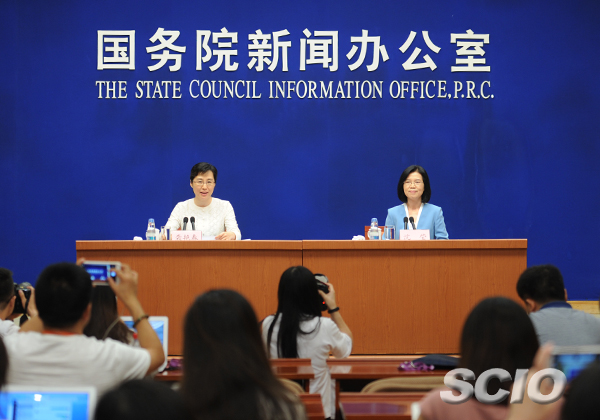
SCIO holds a press conference on half-year central SOE performance on July 11, 2017. [Photo/China SCIO] Xi Yanchun:
Ladies and gentlemen, good afternoon. Welcome to this press conference. The development of state-owned enterprises managed by the central government has drawn great public attention. Today, we are delighted to invite Ms. Shen Ying, chief accountant of the State-owned Assets Supervision and Administration Commission (SASAC) of the State Council, to introduce details of the performance of central SOEs in the first half of this year. She will also answer some of your questions.
Now, let's welcome Ms. Shen to give her briefing.
Shen Ying:
Good afternoon, everyone, and welcome to the press conference. First, please allow me to extend my appreciation to you for your attention and support of the central SOEs and their reforms. Before answering your questions, I'd like to make a brief introduction of their performance in the first half of this year.
During the first half of this year, the central SOEs achieved stable performance and were able to move in a positive direction. Their revenues and profits both hit record highs. Their operational quality improved in an all-round way. Their structure also continued to show an improvement. New growth drivers have developed at a quicker pace. More contributions were made to society. Generally speaking, their performance showed the following features.
First, they maintained stable prduction and operation with good growth momentum,and those involved in key sectors saw stable production and salesin particular.
Facing a complex and fast-changing market, the central SOEs took proactive actions and enhanced their production management. Compared with the first half of last year, the production and sales of refined products in the petroleum and petrochemical sectors grew 0.8 percent and 2.1 percent respectively; the production of electricity by central SOEs in the power sector grew 4.4 percent; those in the grid sector saw their sales grow 6.7 percent; the production of raw coal and the sales of merchandized coal grew 9.1 percent and 16.6 percent; the total turnover of central SOEs in the air and water transportation sectors grew 9.9 percent and 5.3 percent respectively.
Second, central SOEs saw accelerated growth in terms of scale and profits, with monthly profits hitting a new high.
Compared with the first half of last year, revenues grew 16.8 percent to 12.5 trillion yuan this time round. The central SOEs enjoyed double-digit revenue growth for five straight months. Their total profits and net profits were 721.8 billion yuan and 535.32 billion yuan, respectively 15.8 percent and 18.6 percent higher year-on-year. Double-digit growth was also been seen every month this year. In particular, profits in June reached 159.67 billion yuan, a record high.
Of the 102 central SOEs, 99 enterprises made profits, 48 enterprises saw profit growth higher than 10 percent, and 29 profit growth higher than 20 percent.
Third, central SOEs were able to streamline their structure, focus more on quality and efficiency, and improve their performance in an all-round way. Since the beginning of this year, the SASAC and central SOEs took 58 measures to improve performance.
A special action was taken to control costs and enhance profits, a decisive issue in operations. In the first half of this year, the growth of revenues outpaced growth in costs. When comparing the second quarter with the first, costs fell 2.4 percentage points. Comparing on a year-by-year basis, , costs for every 100-yuan of revenue dropped 0.1 yuan.
Great efforts were made in structural streamlining and reducing the number of enterprises with legal person status. By the end of June, the number of central SOEs with legal person status dropped 11 percent compared with last year. Of all the streamlined enterprises, 87 percent reduced their management levels to three, four or five levels at most.
Enterprises were urged to clear up receivables and cut inventories. In the first half of this year, the growth of receivables and inventories was 10.5 percentage points lower than revenue growth. Assets turnover was thus improved.
Fourth, deepening supply-side structural reform and constantly enhancing the impetus for further development. SASAC and central SOEs have been adhering to the main line of deepening supply-side structural reform, accelerating structural adjustment, transformation and upgrading, and continuously boosting core competitiveness and sustainable development capacity. Firstly, earnestly implement the task of cutting overcapacity. In the first half of this year, 5.95 million metric tons of steel overcapacity has been removed, which means the target for the whole year has been accomplished already. In the coal industry, 6.59 million metric tons of coal overcapacity has been cut, and 13 million metric tons of production capacity reorganized. Secondly, redouble efforts to deal with the so-called "zombie enterprises and enterprises facing operational difficulties." Specific policies and working programs for individual enterprises have been worked out to deal with those "zombie enterprises" [virtually existing in name only] and subsidiaries facing operational difficulties, aiming to achieve tangible results. Thirdly, address issues left over by history at a faster pace. Over 50 percent of the work has been completed by central SOEs to spin off and transfer their obligations of "supplying water, electricity, heat (gas) and managing realty." Pilot programs in independent industrial and mining areas burdened with social responsibilities have been carried out smoothly. Fourthly, strengthen investment in strategic new industries. The investment has gone mainly to strategic new industries, advanced manufacturing, modern service industry, infrastructure and areas related to people's livelihood. Among these, the portion of investment going to new energy, machinery manufacturing, scientific research and modern service industry has increased by 4.4 percentage points. More than 500 platforms for mass entrepreneurship and innovation have been set up, 200-plus incubators for mass entrepreneurship and innovation and scientific industrial parks have been established and over 200 funds are now operational. All these aspects have laid a good foundation for future development.
Fifth, steady growth has been achieved in regard to tax contributions, with fees cut and part of the profits surrendered to lower costs for the whole society. In the first half of this year, central SOEs cumulatively handed over 1.1 trillion yuan of taxes and fees, with a year-on-year increase of 5.3 percent, which is 2.1 percentage points higher than the previous year. This has made a positive contribution to fiscal revenue growth. The taxes and fees handed over by central SOEs in industries like petroleum and petrochemicals, coal, commerce and trade increased by over 10 percent year-on-year. Meanwhile, related central SOEs have actively fulfilled their social responsibilities, and strictly implemented relative national policies. As many as 74.71 billion yuan of fees have been reduced for the benefit of the whole society. Among them, telecommunications enterprises surrendered 11.78 billion yuan of profits by further "raising the speed and lowering fees," power enterprises contributed 17 billion yuan through the policy of cutting the price of electricity, petroleum and petrochemical enterprises provided 41 billion yuan by cutting the price of gas for non-residential purposes, and coal enterprises provided 4.93 billion yuan by applying a long-term contract price.
In the future, SASAC and central SOEs will closely unite around the CPC Central Committee with Comrade Xi Jinping as its core, and further implement the decisions and deployments of the CPC Central Committee and the State Council. With a strong understanding of the new development philosophy, we will focus on deepening supply-side structural reform and promote the work of maintaining stable growth, making structural adjustments, promoting reform, reinforcing Party building, improving management, and guarding against risks, etc. We will consolidate the hard-earned operational achievements and endeavor to maintain stable performance with good momentum for growth. We will definitely meet the goals set for the whole year to make greater contributions to the steady and healthy growth of the national economy, and present the 19th National Party Congress with outstanding achievements.
Thank you!
Xi Yanchun:
Thank you for your introduction, Ms. Shen Ying. Now, we move on to the question session. As always, please identify your media outlet before raising questions.
_ueditor_page_break_tag_CCTV:
We have noticed that the performance of SOEs has improved greatly in the last half of year, and the monthly profit even set a new historic record. Can you please explain what elements prompted the SOEs' big growth?
Shen Ying:
Thank you for your question. The SOEs have indeed maintained a stable and positive development trend. Their layout has been optimized through deep reform, their development dynamic has grown due to innovation, while the quality and benefits have improved through transformation and upgrading. Thus, the monthly benefit was able to reach an historic high. At the same time, we analyzed the benefits and profits structure, and felt that the growth of benefit was seeing clear improvement in terms of cooperation and stability, which was mainly reflected in the following areas. First, the main profit centers made a greater contribution. A SOE usually has various sources of profit, but the main profit is the core and represents stability. In the past half year, the main profit of the SOEs increased by 4.8 percent as a component in overall profitability. Second, we feel there has been a boost in synergy due to the improved dynamic from traditional industries as well as new areas of dynamism. The traditional petroleum and petrochemical, steel and coal industries have achieved a large rebound in terms of their benefits, which helped lay the foundations for benefit growth; meanwhile some equipment and advanced manufacturing industries, as well as elements of the modern service industry, all continued to achieve better growth. Third, the scale and benefit both saw significant growth. In the half year, the scale increase rate reached 16.8 percent, the year-on-year profit growth rate was 15.8 percent. We like to stress that the development quality of an enterprise doesn't just rely on expansion. If you expand in scale, but the benefit doesn't grow at the same time, it shows operational efficiency is limited. From current indicators, the matching rate is quite good in historical terms.
Meanwhile, the growth rates of profit, net profit, and profit solely accruing to the parent company have also basically kept pace. Profits grew by 15.8 percent, net profit 18.6 percent, while the profit accruing to the parent company grew 14.7 percent. The three figures indicate the foundations have been laid for enhanced growth for various subsidiary companies inside corporate groups.
There's another thing worth noting: the benefit growth should mostly be attributed to the release of potential production capacity. Through reform, readjustment, transformation and upgrading, certain dynamics and potentials were released, sustaining benefit growth, if you look at the sources of benefit increase for the past half year.
If you want to know why, we have concluded there are three reasons. First, China's macro-economic situation is becoming better, while maintaining stability. As you know, in the past half year, the macro-economic situation was very positive and stable; in particular, the PMI has now stayed above the threshold for 11 straight months. This indicates that the market situation is becoming better. The macro-indexes, including economic growth, employment, price of commodities, international balance of payments, etc., were all better than expected. China has adopted precise and efficient macro-control measures since the beginning of the year, including fiscal and monetary policies, that have greatly sustained the real economy. This is particularly true in regard to the reforms for streamlining administration, delegating more powers to lower-level governments and society, improving regulation and optimizing services. This created a good environment for business and cut the fees and pressures on them, creating good circumstances for the real economy's further development. Besides, the implementation of China's big strategies, including the integration of Beijing, Tianjin and Hebei Province, the Yangtze River Economic Zone, as well as the Belt and Road Initiative, provide great space for enterprise development. The macro-situation has laid a good foundation for SOEs to achieve rapid growth in revenues and profits.
Secondly, the better performance is also a result of central SOEs deepening the supply-side reform. These enterprises expanded economic benefits in the first half of this year after having well implemented the strategies charted by the Central Committee of CPC and the State Council, especially the supply-side reform, which have improved their structure, transformed and upgraded them, and fostered new growth drivers. We're increasingly aware that the supply-side reform is an essential therapy applied to unravel the structural conundrums of economic development while sustaining long-term growth.
We are determined to advance the supply-side reform of central SOEs and cut overcapacity in iron and steel as well as coal by addressing the problem of zombie enterprises first so as to balance supply and demand from a macro-economic viewpoint. All the above are designed to ensure stringent actions based on strong resolution. At the same time, we have encouraged the central SOEs to reorganize and different industries to cooperate to achieve synergy.
Thirdly, the achievements can also be attributed to the central SOEs' relentless efforts to improve themselves and expand economic benefits. Since last year, SASAC has led a program for the central SOEs involved to improve themselves and expand economic benefits, requiring them to pay high attention to stabilizing growth so as to support the national economy. The central SOEs have acted as required, exploring new markets, cutting costs, increasing economic benefits and pursuing industrial coordination in a bid to stabilize growth.
That is why they were able to secure a good performance in the first half this year.
Phoenix TV:
You mentioned just now the reorganization of central SOEs. What do you think is the biggest challenge in advancing the reform? Will the number of corporate reorganizations peak in the second half of this year?
Shen Ying:
SASAC has paid close attention to inter-enterprise reorganization and integration regard to the central SOEs since its establishment. Under current circumstances, reorganization and integration is not only an important initiative to adapt to and guide the economic "new normal", but also a normal operational move by enterprises in a market economy. In pursuing reorganization, we focus on whether we can achieve the desired results. In recent years, the central SOEs mainly adopted the following three approaches for their mergers and reorganization.
The first approach is reorganizing two equally-sized big enterprises in the same industry. Such merger and reorganization is intended to reduce overlapping investment and construction and lower operational costs. Cases in point are the merger of COSCO and China Shipping, Wusteel and Baosteel, and CNR and CSR.
The merger of COSCO and China Shipping to become China COSCO Shipping has produced obvious positive results. The new entity reported a profit of over 10 billion yuan in the first six months of this year, representing a significant rise from the before-merger figures. The merger of Baosteel and Wusteel into Baowu Steel has also been successful as the two are now synergizing their industrial strength and the supply of 180 types of products and services on their respective business portfolios. Such synergy will help avoid repetitive industrial investment, which is usually a common issue. In the first half of this year, Baowu Steel reported a profit of 8.7 billion yuan, wiping out losses from the same period of last year.
The second approach is incorporating one enterprise into another, as exemplified by the incorporation of Sinotrans & CSC Holdings into China Merchants Group. The two overlapped in part of their shipping business, and their deal has increased their shipping capacity, optimized their industrial layout and therefore brought greater benefits.
The third approach is reorganizing upstream and downstream enterprises to form an industrial chain to improve the industrial layout and jointly resist the risk of market fluctuations. One instance is the reorganization of two enterprises in supply of raw materials and processing respectively. Generally speaking, the positive effects of reorganization are gradually showing up, and are expected to be greater in the future.
As for the challenges emerging in the process, I take integration of corporate cultures as one of the biggest. Such cultural integration is an important guarantee for the alignment of corporate strategies.
Another big challenge is how to deal with the problems caused by the inevitable stripping of low-end businesses by the involved companies as they seek higher-end business. Such problems include the resettling of sidelined employees, disposal of assets and debt restructuring.
For example, Baowu Steel has to take care of the large number of sidelined employees in the process of stripping out some low-end productivity. Last year, Wuhan Iron and Steel carried out meticulous work to ensure the resettling of more than 30,000 employees as it cut overcapacity. Such work determines to a large extent the effects of the reorganization.
Therefore, reorganization of central SOEs in recent years is not simply a merger, but is more about the post-merger integration. Generally speaking, the process is smooth and achieves the desired results. Thank you!
CRI:
The Chinese economy is undergoing a shift in regard to its growth drivers. Can you introduce the measures the central SOEs have taken to develop new drivers of growth? And what achievements have they made so far? Thank you.
Shen Ying:
Thanks for your questions. The sustainable and healthy development of central SOEs depends on the cultivation of new growth drivers. We must change our developmental concepts and facilitate advancement through technological innovation. In recent years, SASAC has made some achievements in this regard, which can be summarized in the following aspects:
First, we've strengthened top-layer design and improved the innovation mechanism. In January, we issued the SASAC Work Measures to Facilitate Technological Innovation in Central SOEs, which includes a full set of policies and measures addressing key links in promoting innovation, such as creating a favorable environment and other means to stimulate initiative. In March, a leading group for technological innovation work in the central SOEs was established to coordinate relevant work, such as discussing innovation strategies, major policies, tasks and assignments.
Second, we have pushed forward the drive to strengthen the innovation capacity of the central SOEs. We have organized and supported those enterprises to comprehensively participate in major technological tasks, and encouraged them to increase investments in research and development. Up to now, there are 808,000 R&D personnel working in the central SOEs, involved in 3,063 R&D institutes and 635 national-level R&D platforms.
Third, we have promoted the integration of technology and capital. On May 16, a 150 billion-yuan fund was launched by the China Aerospace Science and Technology Corporation (CASC). Now, a preliminary framework for innovation funds has emerged, with more than 200 equity investment funds playing active roles.
Fourth, we have established high-level platforms for mass entrepreneurship and innovation. Up to now, a total of 518 such platforms have been set up by the central SOEs, including internet platforms, business incubators, and various other activities and funds to encourage innovation and entrepreneurship. The platforms substantially promote SOE restructuring and upgrading, promoting innovation both internally and society-wide.
Fifth, we have formulated mechanisms to stimulate innovation. In order to motivate the researchers to overcome difficulties and produce technological innovations, SASAC has explored and put into effect some measures regarding performance evaluation and salary distribution, such as the mid- to long-term incentives empowering state-owned technology enterprises to reward employees through equity share-outs and dividends.
Such incentives have produced remarkable outcomes. This year, the Chinese-made C919 airliner made a successful maiden flight. The first domestically-built aircraft carrier, jointly developed by the China Shipbuilding Industry Corporation (CSIC), was launched. The underground tunnel section of the Hong Kong-Zhuhai-Macao Bridge was completed. All these projects featured significant progress in technological innovation.
Meanwhile, a large number of advanced manufacturers and hi-tech sectors have significantly driven SOE profit growth. For example, the heavy equipment manufacturing sector in the half-year saw an investment increase of 12.9% year-on-year, with orders up 46%. Other sectors, such as medicine, military and electronic manufacturing, all have shown good momentum.
Wall Street Journal:
Hello Ms. Shen, you just mentioned that, since last year, SASAC has been attaching great importance to the role of the reform plan of making central SOEs "leaner and healthier for better performance." My question is, in the actual operation of the process, are there any contradictions and conflicts between the goals for steady growth and deleveraging?
Shen Ying:
Thank you for your question. The reform plan of making central SOEs "leaner and healthier" is an important measure in deepening supply-side structural reform. It is an effective way to improve the quality and efficiency of the central SOEs. At the beginning of the year, SASAC proposed 58 specific measures covering eight aspects in the 2017 plan of "leaner and healthier for better performance." The purpose was to tap potential and improve resource allocation efficiency. We have been earnestly implementing the program for cutting overcapacity, destocking and deleveraging, while in particular increasing productivity, focusing on risk control and improving quality and efficiency.
For example, concrete measures have been taken in "condensing the managerial tiers and cutting legal person units of enterprises." SASAC has carried out the campaign of "Reducing the Management Levels in Central SOEs" since May 2016, requiring a cut of central SOEs' subsidiary legal entities by about 20 percent and a reduction of management levels to within four tiers over a period of three years. Over the past year, SASAC, together with the central SOEs, vigorously promoted the implementation of [this program], and has made significant progress. As of the end of June 2017, 5,997 central SOEs' legal person units had been cut, producing labor cost savings totaling 26.8 billion yuan and management cost reductions of 10.2 billion yuan.
Another example is dealing with the historical problems of SOEs under the central government and transferring their obligations of "supplying water, electricity, heat (gas) and real estate property management." Currently, things are going smoothly with those SOEs in spinning off their social functions and solving problems left over from history. By the end of June 2017, over 50 percent of the work had been completed by those SOEs under the central government to spin off and transfer their obligations of "supplying water, electricity, heat (gas) and real estate property management" in their residential communities. Pilot programs for social management of SOE retirees have been carried out in five cities, namely Shanghai, Chongqing, Dalian, Jixi and Changsha. All are now on course to scale up by the end of the year based on the cities' practice and experiences. The transferring of SOEs' social responsibilities in regard to community management, fire control, healthcare and education is also going ahead smoothly. As we are now halfway towards the deadline, half of the work has been completed. I believe we are bound to complete our program to make SOEs under the central government leaner and healthier while improving their performance and efficiency.
SASAC attaches great importance to risk prevention of central SOEs as an important basis for stable growth. It has implemented control on both debt ratios and debt scale for some enterprises with high debt. The administrative efforts have been strengthened through the management of budget, personnel assessment, remuneration and investment.
21st Century Business Herald:
Central SOEs' profits have enjoyed rapid growth in the first half of 2017. As a matter of fact, their profits have registered stable growth for over eight consecutive months since last year. Does SASAC take this momentum as a sign that China's economy has achieved its L-shaped recovery? If so, will management policies for central SOEs be changed? In addition, out of the 102 central SOEs, a total of 99 gained profits, while the other three suffered losses. Did their losses become increasingly heavy? If so, can the losses be reduced via M&A, or will the three file for bankruptcy? Thank you.
Shen Ying:
Despite different opinions about China's general economic trend, we can be assured that the momentum of making progress while maintaining stability will be consolidated. The central SOEs, as stabilizers of the economy, can help strengthen the momentum by deepening reform and improving management. Opinions differ about China's growth trajectory: some say it is L-shaped, while others hold that it is U-shaped or V-shaped. Since the 18th CPC National Congress, the CPC Central Committee with Comrade Xi Jinping as the core has declared that China's economy is stepping into new normal, developing major economic policies including supply-side structural reform. It shows that we have found the measures that can achieve sound and sustained economic development. As long as we intensify our efforts to implement those measures and make steady progress to solve problems, we believe that the good momentum for growth will be consolidated.
As you have mentioned, we have a total of 99 SOEs under central government that made profits, while there were three who recorded minor loss. There is a mixture of being in an initial investment period, or of suffering temporary losses. At a time when Chinese economy is showing positive signals, SASAC will continue to focus on building world-class enterprises, and push forward supply-side structural reform, especially on structural adjustment, transformation and upgrading, in order to enhance core competitiveness. Meanwhile, according to the needs for marketization and globalization, the building of a modern enterprise system will be speeded up, especially in regard to corporate governance. Through the reform and optimization of the system, enterprises will be given fresh impetus and possess the ability for sustainable development, making more contributions for national economy to maintain a sustained, rapid and sound development.
Xi Yanchun:
As for China's general economic trend, there will be a series of press conferences in July by different departments from multiple aspects. Please look out for our further notices. Thanks for the introduction by Shen Ying, and thank you all. This is the end of the press conference. If there are any other questions, reporters could contact the Press Office of SASAC. Thanks.
SCIO briefing on half-year central SOE performance - SCIO briefing on production capacity cooperation under B&R Initiative
Speakers:
Ning Jizhe, vice chairman of National Development and Reform CommissionXin Guobin, vice minister of Industry and Information Technology
Chairperson:
Xi Yanchun, vice director-general of the Press Bureau, State Council Information OfficeDate:
May 12, 2017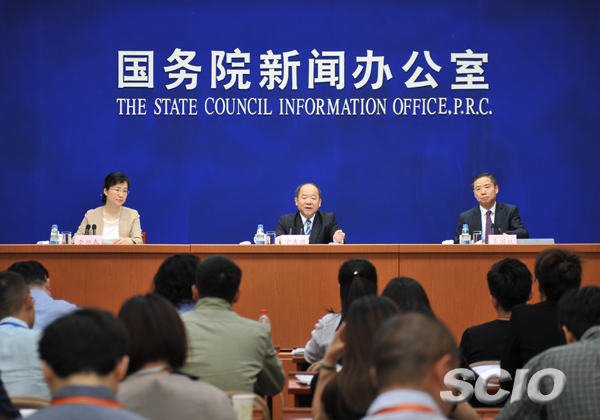
The State Council Information Office holds a press conference on production capacity cooperation under B&R Initiative on May 12, 2017. [Photo/China SCIO]
Chairperson Xi Yanchun:Ladies and gentlemen, good morning. Welcome to the press conference of the State Council Information Office. Today's conference will again be about the Belt and Road Initiative.
We are delighted to invite Mr. Ning Jizhe, vice chairman of National Development and Reform Commission, and Mr. Xin Guobin, vice minister of Industry and Information Technology, to introduce developments in production capacity cooperation between countries and regions along the Belt and Road. They will also answer some of your questions.
Now, let's welcome Mr. Ning to give his briefing.
Ning Jizhe:
Good morning, friends from the media. It’s a pleasure to meet you ahead of the Belt and Road Forum for International Cooperation. Today, we will talk about the production capacity cooperation between countries and regions along the Belt and Road.
As proposed by President Xi Jinping, the Belt and Road Initiative has opened a new chapter for coordinated development of China’s coastal and inland areas, and for the country’s opening up both eastward and westward. It has also charted a new course for different countries to achieve win-win cooperation and peaceful development, and to build a community of a shared future. The initiative has made significant achievements thanks to the enthusiastic response and active participation of all sides.
International production capacity cooperation is a major approach to jointly build the Belt and Road. With this approach, China can use its overall advantages in equipment development, technologies and funds, as well as its comparative advantages in a wide range of fields, to meet the demands for supply and growth of countries along the route, thus promoting common development of the real economy and infrastructure, and achieving complementarity, cooperation for mutual benefit and common development.
China adheres to the Initiative’s principle of extensive consultation, joint contribution and shared benefits to promote green, orderly, open and balanced development of all countries, with industrial enterprises being major players. Fruitful results in production capacity cooperation have been achieved in the following four aspects.
First, an extensive cooperation mechanism has been established. Regarding bilateral cooperation, China has signed production capacity cooperation deals with more than 30 countries along the Belt and Road, such as Kazakhstan and Malaysia. It has also increased cohesion in development plans and projects with other countries, and promoted enterprise cooperation. Regarding multilateral cooperation, China actively participates in and promotes regional and sub-regional cooperation. A series of important documents, including the Joint Statement between ASEAN and China on Production Capacity Cooperation and the Joint Statement on Production Capacity Cooperation among the Lancang/Mekong Countries, have been issued. Plans have also been developed to promote production capacity cooperation in important fields and projects with other countries and to speed up the building of a cooperative framework aiming at achieving win-win situation through open and inclusive approaches.
Second, a number of major projects have been launched. China’s first overseas contracts in regard to high-speed railways and nuclear power have been signed with countries along the Belt and Road. A deal on the Jakarta-Bandung high-speed railway has been secured, with construction starting soon. Construction of unit No.2 of Pakistan’s Karachi nuclear power plant has begun. In various countries, steady progress has been made regarding their programs in the steel, nonferrous metal, construction materials sectors, as well as other fields that all have a great need for Chinese equipment and technology.
From 2013 to 2016, direct investments made by Chinese enterprises in those countries have surpassed US$60 billion. By the end of 2016, Chinese enterprises had established 56 business cooperation zones in those countries, attracting over 1,000 companies. They have generated total output valued at over US$50 billion, total tax revenues of over US$1.1 billion and more than 180,000 new jobs for the host countries. In the first quarter this year, Chinese enterprises have signed nearly 1,000 project contracts in those countries valued at US$14.4 billion, 4.7 percent up year-on-year and accounting for nearly half of the total value of contracts signed in Q1.
While countries along the Belt and Road have become major destinations for Chinese investments and major markets for Chinese infrastructure, equipment, technologies, services and brands, Chinese enterprises have made concrete contributions to those countries by improving their infrastructure, upgrading their productivity, accelerating their industrial development, enhancing employment and improving people’s livelihood.
Third, the support system has been enhanced. To provide strong support to enterprises engaging in production capacity cooperation, we are giving full play to policy-based, development-oriented and commercial financial institutions. We have established cooperation funds and other financial platforms, and encouraged financial institutions to launch various programs to promote cooperation in this regard. By the end of 2016, the China Development Bank and the Export-Import Bank of China had issued loans totaling over US$110 billion in countries along the Belt and Road; the China Export & Credit Insurance Corporation had provided insurance worth US$320 billion for export and investment programs; nine Chinese banks have established 62 primary affiliates in 26 countries. So far, China has signed currency swap agreements worth over 900 billion yuan with 22 countries in a bid to integrate production capacity cooperation with the yuan’s internationalization.
Fourth, the investment environment has been gradually improved. China has continuously deepened reforms to streamline administration, delegate more powers, improve regulation, and provide better services. It has enhanced investment facilitation and standardized services for Chinese enterprises, urged them to carefully observe the laws of host countries, and guided them to fulfill their responsibilities to society and for the environment. By the end of 2016, China had signed bilateral investment agreements with 53 countries and double taxation avoidance agreements with 54 countries. Negotiations on ISO cooperation agreements, visa facilitation agreements and various other cooperation documents are underway. These efforts have promoted an orderly flow and sound allocation of capital, technologies, personnel and other production resources, cut down enterprise costs in fulfilling administrative procedures, and created a good environment for production capacity and investment cooperation.
At the upcoming forum, President Xi will deliver a keynote speech, and a series of achievements are expected to be made. The National Development and Reform Commission will spare no effort to promote capacity production cooperation, so as to bring more benefits to people living along the Belt and Road.
That's all I want to say at this time.
Xi Yanchun:
Let's thank Mr. NingJizhe for his briefing. Now the floor is open to Mr. Xin Guobin.
Xin Guobin:
Friends from the press, ladies and gentlemen, good morning! First I wish to thank you for your continuous support and concern for China’s development of industry and information technology. Please allow me to give you a briefing on how the MIIT has been working to promote the tasks relating to the Belt and Road Initiative.
First, we have strengthened policy coordination. We actively worked with countries along the Belt and Road concerning their development strategies on industry and communications, and coordinated policies with them. We promoted mutual recognition of industrial standards and explored cooperation potential.
With Russia we signed governmental cooperation documents on civil aviation. With Poland's Ministry of Energy we inked a cooperation deal on new-energy vehicles. With Cambodia, Iran, Bangladesh and Afghanistan we signed MoU on the cooperation in the fields of information and communication technologies. With the five nations in the East Africa Community (EAC), Ethiopia and the International Telecommunication Union (ITU) we signed cooperation deals on jointly building an information superhighway in East Africa. With Cuba's Ministry of Industry, we jointly compiled the long-term development plan of Cuba's industry.
At the same time, we have drafted the "Opinion on the Implementation of the Service from the Standardized work of the Industry and Communication Sectors for the'Belt and Road' Construction," a move to facilitate the mutual recognition of China's standards and those from other countries. In this way, China's advanced technological standards will be introduced to countries along the Belt and Road before serving their local economic development. So far, Ethiopia and Kenya have started implementing Chinese industrial standards on cement and construction ceramics, respectively.
Second, we continued to improve our service systems. We improved interdepartmental working mechanisms with the National Development and Reform Commission (NDRC) and the Ministry of Commerce, among others and established cooperation mechanisms with the National Development Bank (NDB), and the Export-Import Bank of China.
We strengthened contact and communication with key industrial associations and research institutes. We guided the industrial associations for petrochemical, steel, non-ferrous, construction material and communication to form an international alliance for capacity cooperation so as to provide information and consultations to the corporate sector. We promulgated code of conducts for enterprises eyeing the international markets, reduce irregular competition and actively fulfil social responsibilities in countries we invested in.
Third, we coordinated and guided mutually beneficial industrial cooperation. We actively built the docking platforms for the cooperation on international capacity and equipment manufacturing, invited countries along the Belt and Road to participate activities for industrial transfers and dockings and expos for international SMEs. We made most of the bilateral and multilateral mechanisms and organized industrial associations and enterprises to go abroad to facilitate their direct communication and dockings with local companies. In this way we deepened industrial cooperation with countries along the Belt and Road.
So far, in the sectors of raw materials, petrol refinery and agricultural chemicals, overseas projects under construction have a total contract value of US$60 billion. China's non-ferrous sector invested in Russia and Indonesia, among the total 15 countries along the Belt and Road. Enterprises in the construction material sector invested in a total of 33 projects overseas.
In the equipment sector, rail transit, engineering machinery, automobiles - which represent the higher technological level - rushed to invest in countries along the Belt and Road. In the electronic information sector, many PV enterprises invested in the solar power stations in the United States, Japan, Europe, South America and Southeast Asia, or contracted the engineering, procurement, and construction (ECP) package.
Fourth, we promoted the cooperation and construction of industrial parks. We promoted the constructions of China-Laos, and China-Mongolia cross-border cooperation zones, supervised the drafting of development plans of these industrial parks and supported the industrial development and the construction of communication facilities in the parks.
We advanced the constructions of the China-Belarus Industrial Park, the Morowali Tsingshan Industrial Park in Indonesia and the China-Tajikistan Industrial Park. We helped enterprises to know about opportunities for industrial cooperation. We built platforms for investment promotion, conducted investment promotion for the cooperation zones in other countries. We encouraged capable Chinese enterprises with rich experience in industrial park administration to join hands with financial institutions, industrial associations, and intermediate agencies to perfect accommodating facilities in these industrial parks, raise the software and hardware levels and enhance services when these parks are in operation.
Fifth, we accelerated the connectivity of information and communications. We ensured the connectivity of information along the Belt and Road, promoted the popularization of next-generation information and communications technological applications and serve the economic and social development of the countries along the Belt and Road.
We accelerated the construction of international communication accesses. We have established an overall framework of international communications access that mainly consists of comprehensive international gateway exchanges, regional international gateways, border area international communications gateways and international channel gateways. We raised the information and communication capacities in countries along the "Belt and Road."
We vigorously promoted the construction of cross-border cables and continuously improved our information interconnectivity with countries along the Belt and Road. We encouraged telecommunication enterprises to form multinational corporations to enhance their internationalized abilities. Some companies have started overseas operations in Pakistan, Thailand, Singapore, among other countries and regions.
As for our next move, the MIIT will continue with our classified guidance, raise services, perfect safeguarding systems, actively expand new room for industrial development, and promote the deepening of industrial cooperation with countries along the Belt and Road to ensure win-win development. Thank you all!
Xi Yanchun:
Let's thank Mr. Xin for his briefing. Now the floor is open for questions. As per our rule, please identify your agency before raising your questions.
_ueditor_page_break_tag_CCTV:
Director Ning, as China’s railway has become a name card of the country’s“going-out” strategy in recent years, would you please brief us on railway cooperation between China and the countries along the Belt and Road? Thank you.
Ning Jizhe:
Your question is about a very important issue of major concern to us and other countries. Railway cooperation can help improve railway construction capacities both in China and other countries, boost cooperation on railway equipment, technologies and standards. It is a key part of international cooperation on industrial capacities and a priority area for China’s“going-out” strategy as well as outbound investment.
China’s railway construction has developed rapidly during recent years and we have the most fully-fledged technical system in the world. We possess cutting-edge technologies, especially in high-speed railways, and have foster advantages in survey, design, engineering, manufacturing, operation, management and safety, making us very competitive on the global market.
China has been proactively pressing ahead with railway cooperation with countries along the Belt and Road. Such cooperation dovetails nicely with the needs of those countries, since connectivity among countries along the proposed routes is realized by the connection of traffic networks. Railway is a favored transport means. It is wanted by neighboring countries or needs renovating in those countries due to outdated conditions.
Recently, we have made solid progress on several landmark projects. The railway between China and Laos is under construction; a contract has been signed for the Jakarta-Bandung Railway, and hopefully overall construction will start soon; the China-Thailand Railway is preparing for construction; the business contract of the Serbian section of the Hungary-Serbia Railway has been signed, while the construction agreement of the Hungarian section has also been validated; the design for a high-speed railway from Moscow to Kazan has been completed; the China-Kyrgyzstan-Uzbekistan Railway is moving ahead now we have a joint working mechanism between the three parties; the feasibility study for upgrading the ML1 section of the Pakistan Railway is being studied; and Chinese companies have succeeded in their bids for involvement in the constructions of railways in the southern part and the east coast of Malaysia, etc. The smooth progress of railway construction has been pivotal for the promotion of international cooperation on production capacities, signaling an important chapter for the implementation of the Belt and Road Initiative, conducive to the B&R countries’ upgraded capacities for infrastructure construction and helpful to China’s“going-global” strategy by exporting indigenous facilities, technologies, standards, constructions and management, resulting in encouraging progress in other industries and boosting infrastructure construction of the relevant countries.
For the next step, China’s Development and Reform Commission will work with relevant departments, enterprises and institutions under the initiative to enhance pragmatic cooperation on railway with countries along the Belt and Road, advance China’s“going-out” strategy and international industrial cooperation and boost connectivity in pursuit of win-win benefits through joint development. Thanks for your question.
China National Radio:
Mr. Xin, how does China connect neighboring countries in regard to ICT (information and communication technology) infrastructure? Thank you.
Xin Guobin:
Thank you. Infrastructure connectivity is a priority area under the Belt and Road Initiative. Improved global connectivity can help popularize a new generation of ICT, improve regional information services and promote socio-economic development in countries along the Belt and Road. Since the Initiative was launched, we have undertaken work in the following areas:
First, we used various international cooperation mechanisms, bilateral and multilateral communications platforms, actively connected to the countries and regions along the Belt and Road. We successively signed Memoranda of Understanding (MoU) on Cooperation in ICT with telecommunications administrations of Cambodia, Iran, Bengal and Afghanistan; and, we signed the China-Africa Partnership Program in Trans Africa Information Superhighway with Ministries of Communication in five East African countries, Ethiopia and International Telecommunications Union (ITU) respectively. We will sign MoU on Strengthening ICT Cooperation Within the Framework of the Belt and Road Initiative with ITU.
Second, we optimized the layout of domestic ICT and established a framework of nine comprehensive international business agencies (in Beijing, Shanghai, Guangzhou, etc.), 10 regional international business agencies (such as the one in Kunming), 10 border services agencies (in places such as Shenzhen) and 58 information channels agencies (in Khorgas, for example) after adjustment. These agencies effectively ensure the quality of ICT and the safety of network information between China and countries along the Belt and Road.
Third, we effectively promoted the construction of a cross-border optical cable network and ensured effective information transmission. We established a cross-border land cable network with 12 neighboring countries, plus four submarine cable networks. And we are expanding the China- Kazakhstan cable network, and pushing ahead with the newly-established China-Afghanistan cable network and China-Pakistan cable network, and other cable networks along the Belt and Road region. We are positively promoting telecommunication enterprises to join in the construction of“China-ASEAN Information Harbor” and backbone state cable networks in African countries.
Forth, we encouraged the main telecommunication companies to engage in international telecommunications service business and provide high-quality telecommunication services. In 2016, the scale of foreign investment of China’s three main telecommunication enterprises was around five billion yuan. They engaged in overseas operations in Pakistan, Thailand, Singapore, and other countries and regions. Thank you.
Bloomberg:
Many projects around the world do not get funding because they are sub-parts, they don’t have good oversight, or they don’t have the prospects of returns that will pay off for the original course. What oversight do you have to prevent these kinds of projects from being dusted off and refunded during the Belt and Road Initiative in order to make it successful. And are there central reviews or general guidelines to prevent these parts of the projects from being refunded? Thank you.
Ning Jizhe:
Your question is very important. In the field of international investment, there are many examples of success. While investing in a project, investors have to make decisions and take risks by themselves, so they are all very concerned about the feasibility study of the invested project. Currently, most countries in the world are market economy-oriented ones who abide by the market rules and international practice and promote the construction of their projects under the protection of the law. This approach necessarily includes careful and serious evaluation and research of the project in the early phase to ensure the feasibility of the project. In the construction phase of the project, the supervision must be strengthened, during which a set of systems is available in the market economy conditions. In the operational phase of the project, market regulation still plays an important role. Therefore, thanks to the necessary guarantees in the whole process, the project can be constructed and operated smoothly so as to achieve corresponding economic and social benefits. This is an international practice as well as an important guideline which China must follow in promoting international capacity cooperation and in implementing the Belt and Road Initiative. Taking enterprises as the main body, we promote the market-oriented Belt and Road Initiative and international capacity cooperation in accordance with commercial principles and international practice.
It can be said that, currently in the process of promoting the key projects of the Belt and Road Initiative, the Chinese government and the governments of other countries concerned have attached great importance to this issue. The enterprises concerned also have carried out careful evaluation and deliberation for projects.
Some projects, particularly large railway projects, must go through repeated evaluations. In the course of operation and construction, we will continue to abide by this principle and conform to the international laws as well. As I mentioned just now, we have signed mutual investment agreements with the countries along the Belt and Road. Meanwhile, we must work together to comply with the international investment agreements so as to ensure that the Belt and Road Initiative and international capacity cooperative projects will achieve corresponding economic and social benefits, and bring benefits to local people and thus promote local economic development and social progress. Thank you.
People's Daily:
Mr. Xin, capacity cooperation is an important part of the Belt and Road Initiative. You just introduced the work the MIIT has done. My questions are: What achievements has the MIIT made in regard to international capacity cooperation and what is the latest situation? What can we expect from this summit? Thank you.
Xin Guobin:
Countries along the Belt and Road undoubtedly differ in resources, development stage and environment. However, they are economically complementary. So, there is a huge potential for cooperation. We have been sticking to the market-oriented principle, with companies being the main drivers, and promoted cooperation in the fields of capacity and equipment manufacturing by strengthening coordination to provide better services and support, as well as effectively linking China’s industrial and financial advantages with host country demands. Our goal is always to achieve win-win outcomes.
As for the capacity cooperation, we have organized relevant industrial associations and enterprises to cooperate with their counterparts in Saudi Arabia, the UAE, Malaysia and India, and instructed enterprises in the sectors of iron and steel, nonferrous metal and construction materials to open factories overseas. In 2016, the outbound investment of the manufacturing industry totaled US$31.06 billion, accounting for 18.3 percent of all such investment, up 6.2 percentage points from the year before. In addition, it’s worth mentioning that there were 197 mergers and acquisitions in the manufacturing sector. Here are some examples of our achievements. The program of Alliance Steel (M) Sdn Bhd, involving investment by Guangxi Beibu Gulf Port International Group Co., Ltd and Guangxi ShengLong Metallurgical Co. Ltd, started construction in Malaysia in 2014. HBIS Group Co.Ltd signed a contract with Industrial Development Corp of South Africa to set up a 5 million metric ton steel plant in that country. It also purchased Serbia’s Zeleara Smederevo steel mill. CRRC has conducted deep cooperation with Siemens, Voith Turbo and Deutsche Bahn in high-speed rail development and jointly explored the third-country market. These leading enterprises’ outbound moves have created jobs and generated tax revenue for the host countries and accelerated their industrial upgrading and industrialization process. Therefore, products made and services provided by China are welcome in more and more countries along the Belt and Road.
In future, we will continue to encourage Chinese enterprises to“go global,” following the overall arrangement and plan of the Belt and Road Initiative.
Reuters:
What is the total volume of investments in the“Belt and Road” projects so far? Would you please project how big the total investment will be in the next five years? Last year, China tightened scrutiny on capital outflows. Does this move have any impact on our outbound investment? Thank you.
Ning Jizhe:
As I mentioned just now, Chinese enterprises have invested more than US$60 billion in Belt and Road projects over the past four years – between 2013 and 2016. This is the figure that we can give to you. Some small investments may be not included.
Our outbound investment has been largely made by enterprises and driven by the market in line with business rules and international practices, rather than being planned. I should say it is not easy to predict the future, but we do have a projection for outbound investment for the next five years. China’s outbound investment will reach US$120 billion and even surpass US$130 billion each year over the next five years. Most of the investment will be put into Belt and Road projects. That will give a great impetus to the global recovery and liberalization of reciprocal investment and trade.
China’s management mechanism of outbound investment is based on market-oriented principles and international practices. Currently our outbound investment is subject to a registration mechanism. Also, we warn enterprises against potential risks and need to examine the veracity and compliance of their investment. Projects relating to the“Belt and Road” Initiative and industrial capacity cooperation will not be impacted by strengthened scrutiny but will proceed in a sound manner.
CRI:
As we know, Kazakhstan is one of the countries along the route that conducted capacity cooperation with China from an early stage. Can you tell us about its progress? Thank you.
Ning Jizhe:
It’s a good question. There is just one booklet about China-Kazakhstan capacity cooperation. Kazakhstan really took the lead in capacity cooperation with China. Over the past few years, the cooperation has achieved rapid progress and fruitful results as the two sides signed intergovernmental capacity cooperation agreements, established regular cooperation mechanisms, and have held intergovernmental dialogues 12 times. Being close neighbors, the two countries have frequent dialogues through video conferences, or sometimes through face-to-face talks.
We have formulated a list of key cooperation projects with a total investment of US$ 27 billion, established a China-Kazakhstan Capacity Cooperation Fund of US$ 2 billion, with great efforts from the Silk Road Fund, and also a China-Kazakhstan capacity cooperation specific loan of US$ 15 billion. Both sides also facilitated visa issuance based on inter-governmental agreements and carried out key projects for demonstration and expansion purposes. Until now, a batch of 34 projects have completed construction and been put into operation, such as a copper concentrator with an annual output of 25 million tons in Aktogay, an electrolytic aluminum plant with an annual production of 250,000 tons in Pavlodar, an asphalt plant with an annual output of 1 million tons along the Caspian Sea and a cement plant with a daily production of 3,000 tons in Mynaral.
Currently, a total of 43 projects are under construction in Kazakhstan, filling the gaps of electrolytic aluminum, copper beneficiation, high-end oil products, special cement and other sectors in the country, advancing its industrialization, offering job opportunities and promoting local development. With both countries faced with downward economic pressures in the past years, bilateral cooperation can help deal with the pressure and maintain sound development. At the same, it has propelled China’s export of competitive capacities, equipment, technologies and standards while helping to build up a good image of Chinese enterprises.
During our dialogues, we discussed how the government departments can serve enterprises better and how to create favorable investment environments, as there are also Kazakhstan enterprises investing in China. Through close communication and negotiation, both sides can enhance services for enterprises and strengthen supervision of markets. In the future, the two countries will seek more connections in bilateral economic, social and industrial development, step up guidance functions of planning, jointly compile capacity cooperation plans, and carry out key projects thus deepening bilateral capacity and investment cooperation.
You can consult the booklet for more detailed information. This is the Chinese edition and we also have an English version. Thank you.
China Industry News:
What opportunities does the Belt and Road Initiative offer for the export of Chinese equipment manufacturing products? What progress has been made in such exports? What difficulties do we encounter? What measures will MIIT take to drive export expansion? Thank you.
Xin Guobin:
Thank you for your question. Notable progress has been made in exporting Chinese equipment manufacturing products. High-speed rail-laying, electric power equipment, engineering machinery, electronic information manufacturing products and ships have become new business name cards for China’s equipment manufacturing. Our rail transport products have entered the global market, as evidenced by the completion of Jakarta-Bandung high speed railway and the construction of the China-Laos high speed railway. Our electric power technology is world-beating. The first overseas Hualong-1 Project is progressing steadily and the reactor has been used in the Hinkley Point C nuclear power station in England. Moreover, high-end products such as engineering machinery and ships are widely popular around the world.
Despite the progress, both the volume and level of major equipment exports need to be increased, and international investment and cooperation in this sector need to be expanded. Some constraints and problems lie behind the present situation. First of all, the global political and economic landscape keeps changing, greatly influencing Chinese companies’ international investment and cooperation. Besides, rising protectionism and growing trade barriers make it harder for China’s standards to gain international certification. Other constraints include the shortage of interdisciplinary professionals with global vision, lack of public information services and inadequate understanding of the investment destinations’ political and economic environments, laws and regulations as well as traditions and customs.
To increase exports of Chinese equipment manufacturing products, MIIT will take the following measures: help establish overseas service agencies, create a sound international environment based on bilateral and multilateral dialogue mechanisms, intensify efforts to nurture or attract interdisciplinary professionals with global vision and accelerate internationalization and mutual recognition of standards. Thank you.
Shenzhen Satellite TV:
I have a question for Mr. Ning. We all know that the construction of the Guangdong-Hong Kong-Macau Great Bay Area was addressed in the Government Work Report during the last NPC and CPPCC sessions, of which the new layout is important to the Belt and Road Initiative. My question is: How will the Guangdong-HongKong-Macau Great Bay Area, guided by the spirit of openness, make full use of their advantages to engender a new round of cooperation with the countries involved in the Initiative? Moreover, as Shenzhen has always spearheaded economic reform of China, how will the city continue to make its contribution to a new phase of openness led by the Initiative?
Ning Jizhe:
Hong Kong is playing an important role in the country’s far-sighted Belt and Road Initiative. During the past decade, when China started to unfold its Western Region Development Strategy, Hong Kong exerted great influence in the campaign and it is now expected to make an equal contribution to the Initiative by taking advantage of its comprehensive capabilities and forming a bridge between China and the world. It can encourage greater involvement by its competitive sectors, including, service, finance and shipping and making use of its role as a trade center, to support the Initiative as it gathers momentum.
The Guangdong-Hong Kong-Macau Great Bay Area, referred to in the Government Work Report this year, is related to the Initiative, in which it has an even more meaningful role. Some departments, both from the State Council and the NDRC, are in close contact with the HKSAR, to work out a draft plan.
At the same time, as a leading force of China’s reform and opening up and the earliest special economic zone in China, Shenzhen will undoubtedly have considerable responsibilities in any new round of upgraded openness. It is expected to extend its influence to both the Initiative and the construction of the Great Bay Area. Thank you.
Xi Yanchun:
That’s all for today’s press conference. Thanks for our two spokespeople and thank you all.
SCIO briefing on production capacity cooperation under B&R Initiative - SCIO briefing on trade and economic cooperation under B&R Initiative
Speakers:
Qian Keming, vice minister, Ministry of CommerceZhang Xingfu, head of the Department of Outward Investment and Economic Cooperation, Ministry of Commerce
Chairperson:
Xi Yanchun, vice director-general of the Press Bureau, State Council Information OfficeDate:
May 10, 2017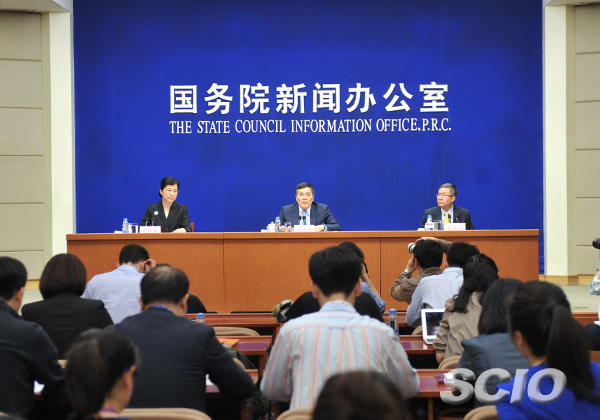
The State Council Information Office holds a press conference on trade and economic cooperation under B&R Initiative in Beijing, on May 10, 2017. [Photo/China SCIO]
Chairperson Xi Yanchun:Ladies and gentlemen, good afternoon. Welcome to the press conference of the State Council Information Office. Today's conference will be about the Belt and Road Initiative.
We are delighted to invite Mr. Qian Keming, vice minister of commerce, to introduce trade and economic cooperation under the Belt and Road Initiative and answer some of your questions. Also present is Mr. Zhang Xingfu, the head of the Department of Outward Investment and Economic Cooperation of the Ministry of Commerce.
Now, let's welcome Mr. Qian to give his briefing.
Qian Keming:
Good afternoon, friends from the media.
In 2013, President Xi Jinping proposed the Belt and Road Initiative to boost global development and cooperation. It demonstrated China's willingness to shoulder its responsibilities as a large and important country.
With the principles of extensive consultation, joint contribution and shared benefits, the Initiative features openness, inclusiveness and win-win cooperation. This fulfills the expectations of countries along the route, with the aim of creating a community of a shared future. So far, the Initiative has received positive responses from more than 100 countries and international organizations.
Unimpeded trade is a major issue under the Belt and Road Initiative. We have made notable achievements in the following five aspects.
Regarding trade, we have actively boosted mutual market openness and increased trade facilitation. Various expositions, including the China-ASEAN Expo, China-South Asia Expo, China-Eurasia Expo and China-Arab States Expo, have played their role in facilitating interaction between businesses along the Belt and Road and helped them enjoy the opportunities created by the Initiative. From 2014 to 2016, trade between China and countries along the routes of the Belt and Road enjoyed a growth rate faster than the global average, reaching 20 trillion yuan in total regarding investment and cooperation, we have continually improved services to encourage more Chinese businesses to invest in countries along the route. Between 2014 and 2016, the total direct investment made by Chinese businesses in those countries surpassed US$50 billion, and the contractual value of new construction projects reached US$304.9 billion. Besides, we have attracted businesses from countries along the Belt and Road to invest in China by offering them wider market access and a comfortable business environment.
Regarding major projects, we have worked with related parties to promote smooth progress in various projects. The China-Laos Railway, the second phase of Pakistan's Karakoram highway and the Karachi-Lahore motorway are under construction. The oil and gas pipelines joining China with Russia, Kazakhstan, Myanmar and other countries are either under construction or already in operation.
Regarding overseas business cooperation zones, Chinese businesses have invested more than US$18.5 billion in 20 countries to build 56 such zones. These have generated about US1.1 billion in tax revenue and created approximately 180,000 jobs for the host countries. The China-Belarus Industrial Park has become a landmark project in the Silk Road Economic Belt. Smooth progress has been made in the building of the Suez Economic and Trade Cooperation Zone in Egypt, the Thai-Chinese Rayong Industrial Zone and Cambodia's Sihanoukville Special Economic Zone, among others. Regarding free trade areas, we have signed free trade agreements with ASEAN collectively, along with Singapore, Pakistan and other international organizations and countries along the route. Agreement was reached last July on upgrading the China-ASEAN free trade zone. A free trade agreement is going to be signed with Georgia. Currently, we are working on negotiations over the Regional Comprehensive Economic Partnership (RCEP) and on negotiations over free trade zones with Israel, the Maldives, Sri Lanka, the Gulf Cooperation Council, among others.
Today, products made in China, projects undertaken by China and services offered by China have become increasingly popular in countries along the Belt and Road. More and more products, services, technologies and investments have flowed into China from those countries. Tangible achievements have been reached in trade and economic cooperation; new energy has been injected into those countries for economic development; new momentum has been provided for the development of an open world economy; innovative modes have been created for economic globalization.
Now, I'd like to answer your questions with my colleague.
Xi Yanchun:
Thank you, Mr. Qian. Now the question session begins. Please identify your media outlets before raising questions.
_ueditor_page_break_tag_China Central Television (CCTV):
We have noticed that the Ministry of Commerce is responsible for organizing a parallel session on promoting unimpeded trade during the Belt and Road Forum for International Cooperation. How is the preparatory work progressing? Also, could you please introduce the number and size of the free trade zones between China and countries along the proposed routes as well as the impetus they have given to the regional economy?
Qian Keming:
We all know that China will host the Belt and Road Forum for International Cooperation in Beijing on May 14-15. The forum will be the highest-level international conference to be held in China under the framework of the Belt and Road Initiative, and it has received wide support and positive response from the international community. The conference will consist of three parts — the opening ceremony, high-level meeting and the round-table summit. There will be six parallel themed sessions under the high-level meeting, among which the parallel session on promoting unimpeded trade is prepared and organized by the Ministry of Commerce.
The theme of the parallel session on promoting unimpeded trade is "smooth, efficient, mutual benefits, development and deepening economic and trade cooperation of the Belt and Road." If we can reach a consensus on many issues, we will make an announcement on this at that time.
Currently, all the preparations for the meeting are progressing smoothly. About 200 have confirmed their intention to attend the meeting, among whom about 120 are foreign guests from more than 50 countries. Presently, we are steadily moving ahead with preparations in cooperation with relevant departments and in accordance with the highest standards, most stringent requirements, and most practical measures to ensure the success of this meeting.
Up to now, we have already signed and implemented free trade agreements with 22 countries and regions, including 11 countries along the Belt and Road, namely. the China-ASEAN Free Trade Agreement, China-Pakistan Free Trade Agreement, and China-Singapore Free Trade Agreement. Just now. I mentioned that, during the summit we will sign a formal trade agreement with Georgia, and will start a free trade agreement feasibility study with Mongolia. There is a schedule according to which we will promote the building of free trade zones with 20 countries along the Belt and Road, involving the implementation of the regional comprehensive economic partnership agreement (RCEP), and the China-Gulf Cooperation Council (GCC), China-Maldives, China-Sri Lanka, and China-Israel free trade negotiations. We will carry out a joint free trade feasibility study with Nepal, Bangladesh and Moldova. And, we will start negotiations with Pakistan and Singapore on upgrading the free trade agreements already signed.
Moreover, under the Asia-Pacific Free Trade Agreement, we have concluded the fourth-round of tariff reduction negotiations with India, Sri Lanka, Bangladesh and Laos – four countries situated along the routes. Currently, the outcome of the negotiations is being implemented in an orderly manner.
Phoenix TV:
We've noticed that Chinese companies may face some risks when joining construction projects in countries along the Belt and Road. How will the Ministry of Commerce assess such risks? What specific measures are being taken to guide or help the enterprises? Besides, we've also noticed that a trend in favor of reversing globalization is rising around the world. In particular, we are facing difficulties in cooperation with our principal trade partners. How will the Belt and Road Initiative ensure expanding trade with China, especially in countering any trade barriers from some countries? Thank you.
Zhang Xingfu:
Foreign investment and cooperation are important to the Belt and Road Initiative. The Chinese government is encouraging qualified and capable enterprises to go international in their investment and cooperation activities. Generally speaking, the overall situation is good, according to ministry statistics. However, enterprises inevitably face some difficulties and problems when going international. We know the problems and risks involve political, economic, legal, social and security factors, as well as for business operational reasons. In recent years, we have been enhancing our guides and services for enterprises, by attaching equal importance to development and risk control, to ensure they go ahead in a steadier and better way. We have built a precaution system against risks involving foreign investment and cooperation so as to be able to issue timely risk warnings. We have signed investment agreements with countries related, provided guidance to enterprises on how to reduce and cope with overseas emergencies, and worked hard to safeguard the legal rights and interests of Chinese enterprises as well as foreign nationals. Meanwhile, the enterprises should carry on their business in accordance with the laws and regulations at home and abroad and create feasible international development strategies especially in avoiding blind investment without full investigation.
Qian Keming:
In general, the impact of the global financial crisis that hit the world in 2008 has lasted until now. In the midst of an economic downturn, trade protectionism is rising due to objective reasons, namely that economic globalization may bring about imbalances between the developed and developing countries in regard to their specific interests, within an individual country and among the developed countries themselves. In regard to structural imbalances, different countries take different measures, some turning to trade protectionism. China is committed to open development. In this context, we need a global public product to lead and promote and add fresh momentum to economic globalization, or to offer new political choices. It is in this context that the Belt and Road Initiative has been put forward at exactly the right time. The Initiative will add new impetus to China's future development, especially development of the middle and western regions of the country as well as the opening-up strategy. It will also inject new vitality to the world economy and the development of countries along the Belt and Road in particular and offer a new public product as well.
The Initiative plays a key role in boosting confidence in economic globalization and global economic growth, invigorating the world economy and providing new impetus for the globalization drive. Besides, it is known that the many countries along the Belt and Road, especially those in Central Asia, are landlocked. In a period of rapid development of globalization, they lag behind in economic development and participation in the globalization process. Thus, the previous round of globalization hardly brought any tangible benefits to the region, which is the deficiency we have analyzed in the process of developing our globalization approach, that is, lack of inclusiveness. Moreover, global development is imbalanced. The Belt and Road Initiative exactly covers that particular region and will offer them opportunities for economic integration and development.
Infrastructure construction is an important part in the Belt and Road Initiative. As you know, geographical factors play an important role in creating barrier-free trade and economic integration. The trade in landlocked countries is not smooth. Once the infrastructure is connected, the flow of capital, logistics and information, plus human interaction, will be enhanced. Trade and investment also will be boosted. So, the Belt and Road Initiative is of great significance in breaking down trade protectionism and promoting the development of the regions along the Belt and Road as well as further development of economic globalization.
Reuters:
The Belt and Road Initiative is President Xi Jinping's signature plan. Many think that the plan will continue for decades to come. So I'm wondering what guarantee the rest of the world have that once President Xi's term as president has ended, the overall plan won't be replaced or abandoned by the next leader. Secondly, there is a concern among foreign companies that all these infrastructure, these projects are for Chinese companies, not for other countries' companies. So will they be allowed to bid along with the Chinese companies for these projects? Thank you.
Qian Keming:
The Belt and Road Initiative was proposed by President Xi in 2013; however, it is not an individual proposal or one that somehow fails to be implemented. It has received worldwide responses and belongs to all. We call it an initiative of extensive consultation, joint contribution and shared benefits, because it is advanced by all participants rather than one country, namely, China alone. So your concern is unnecessary. The vitality of the initiative lies in the fact that it meets the expectations for future development of countries along the Belt and Road. It has awakened their desires and pursuit of development. This is why the Initiative is so dynamic, and its vitality has nothing to do with who proposes it or how long his tenure in office might be. It has received such a strong response as it accords with the hopes of the countries along the route.
Secondly, while promoting the Initiative, participants including enterprises and governments have all focused on scientific planning and prudent implementation to protect its sustainability. I believe that further promotion of the Initiative will have an ever-larger impact on the region's economic growth, as well as facilitating policy coordination, facilities connectivity, unimpeded trade, financial integration and strengthened people-to-people ties. It will definitely show even greater vitality.
Zhang Xingfu:
The Belt and Road Initiative is an open and inclusive framework. Chinese companies' investment in and cooperation with countries along the route must strictly conform to the requirements of the host country and abide by international conventions. In project bidding, Chinese companies compete and cooperate with their international counterparts on a level playing field. Investment and cooperative projects conducted by Chinese companies have driven the development of the local economy and society, and created many jobs and tax revenue for the host countries. According to our statistics, overseas Chinese companies achieved a sales volume of US$1.5 trillion in 2016, generating US$40 billion in taxes and creating over 1.5 million new jobs for host countries.
At the same time, many Chinese companies have cooperated with enterprises from a third country to contract for projects along the Belt and Road. For instance, the Hassyan Clean-Coal Power Project in Dubai involves joint investment from the Silk Road Fund, banks in the Middle East and multinational banks, and it is jointly contracted by Chinese companies and General Electric. The trade cooperation zone constructed by Chinese companies in Vietnam has not only attracted Chinese companies, but also enterprises from Japan, South Korea, Singapore, Australia, Malaysia and Vietnam. The Vinh Tan Coal-fired Power Plant (Phase I) Project in Vietnam also involves cooperative investment by China Southern Power Grid, China Power International Development and Vinacomin. These are all examples of our cooperation with other countries. Thanks.
Xi Yanchun:
We noticed that many foreign media have reported on the Belt and Road Initiative, but some of the reports may not be particularly comprehensive and accurate. We will have more press conferences like today to introduce to you the progress of the initiative. On the other hand, we hope that your reports will be more precise and objective. Please continue to ask questions.
People's Daily:
We've noticed that some of the countries along the Belt and Road are small in terms of economic size, and have limited import and export capabilities. How do you see the prospects of China's trade with these countries? What measures will be taken to boost trade with them? Thank you.
Qian Keming:
Thank you for your question. It is indeed a fact that some of the countries along the Belt and Road are relatively underdeveloped, with little trade cooperation among them. What lies behind it is the fact that these countries, small economically, have yet to deeply integrate themselves into economic globalization. This brings about not only problems and challenges, but also enormous potential and opportunities. There is great potential for investment and trade cooperation among them as they are highly complementary in terms of resources. We will introduce multiple measures in this respect, among which achieving infrastructure connectivity is the key. With overall infrastructure connected and standards aligned, trade will surely be boosted.
In addition, we are leveraging the role of joint commissions on commerce and trade and FTZ negotiations in bolstering bilateral trade. Other measures include holding expositions, such as the five or six large-scale national expositions I've already mentioned. I'm convinced that rapid economic growth, infrastructure connectivity and the alignment of standards and development plans will stimulate trade in this region.
Russia Today:
Mr. Qian, you just mentioned some major projects with Russia, Kazakhstan and Belarus. My question is what specific measures will China take or has already taken to achieve synergy between the Belt and Road Initiative and the Eurasian Economic Union?
Zhang Xingfu:
President Xi Jinping proposed jointly building the Silk Road Economic Belt during his visit to Kazakhstan in September, 2013. China and the 12 Eurasian countries are taking the lead in implementing the Belt and Road Initiative, with fruitful achievements. The work we've done and will continue to do can be summed up in six aspects.
First, we take immediate actions to realize extensive alignment of policies. The Ministry of Commerce has signed cooperation agreements on joint contributions with its Eurasian counterparts, advancing the development of the Belt and Road Initiative and Eurasian Economic Union as well as the alignment of economic and social development strategies.
Second, bilateral trade is growing steadily. The trade volume between China and 12 Eurasian countries increased by 20.9% year-on-year in the first quarter of 2017. China remains one of their major trading partners. The trade mix continues to improve, with e-commerce thriving and reciprocal market access being achieved for many agricultural products.
Third, breakthroughs are being made in FTZ development. China is about to sign a free trade agreement with Georgia, making the latter the first Eurasian country to sign an FTA with China. China and Moldova have concluded their feasibility study for FTZ negotiations and will officially start the process in due time. China and the Eurasian Economic Union have agreed to take establishing FTZs as our long-term goal, and have conducted the third round of negotiations on an economic and trade cooperation agreement.
Fourth, bilateral investment prospers. China has made all kinds of investments totaling US$83 billion in Eurasia, improving the well-being of local people.
Fifth, notable progress has been made in capital flows. The Asian Infrastructure Investment Bank (AIIB), the Silk Road Fund, China-Eurasian Economic Cooperation Fund and China-Kazakhstan Capacity Cooperation Fund have been established and currency swapsare being expanded, thus diversifying the platforms for China to invest in the region.
Sixth, the Shanghai Cooperation Organization (SCO) plays an increasingly important role. In recent years, China has taken the SCO as an essential platform to pursue connectivity, industrial-capacity cooperation, capacity building and investment and financing cooperation with countries along the Belt and Road. To advance trade facilitation, it has proposed establishing an SCO e-commence alliance and hosted SCO Countries Commodity Fair in Xi'an in 2015. The SCO prime ministers' meeting ratified a list of measures to further promote cooperative projects within the SCO from 2017 to 2021, and initiated SCO institutional arrangements on trade facilitation. SCO regional economic cooperation has entered a new stage featuring integrated development with the Belt and Road Initiative.
CBN:
I have two questions. Firstly, we know that the Belt and Road Initiative is a major move of China to pursue an all-dimensional opening-up under the new historical circumstances. How is the impact of it on the opening-up of the central and western areas? Moreover, we know that the Ministry of Commerce is in charge of the Department of Foreign Assistance. How to construct the Belt and Road in regard to providing foreign assistance? Will the system of foreign assistance be reformed and improved during this process? Thank you.
Qian Keming:
You are asking about the impact of the Belt and Road Initiative on the opening-up of the central and western areas. After it was announced, we intensified our efforts in opening-up in the central and western areas. You know that we established seven pilot free trade zones, of which five are establish in the central and western areas. At the same time, the two regions are situated along the route taken by China-Europe freight trains. This includes Chongqing, Chengdu, Wuhan, Zhengzhou, Xi'an and Lanzhou. These measures promote the opening-up of the central and western areas. Economic zones in border areas and cross-border economic cooperation areas are also being established to help regional advancement. In general, a new pattern of opening up from eastern areas to western areas has been formed.
Zhang Xingfu:
As for our foreign assistance, I mentioned that the Belt and Road Initiative is open and inclusive. Our foreign assistance is an important manifestation that China is a responsible major country. I believe reform of system of foreign assistance can keep pace with the times and the development of foreign assistance and the promotion of the Belt and Road Initiative complement each other. Thank you.
TV Asahi:
My question is about concrete statistics. According to the document, trade between China and countries along the Belt and Road route has totaled some 20 trillion yuan (US$2.90 trillion), with a growth rate above the average world level. So, what I want to figure out is the number of countries along the Belt and Road route. If there is an exact figure, would you please discuss it?
Qian Keming:
I don't know whether you have noted that Foreign Minister Wang Yi was asked a similar question a few days ago. The Belt and Road Initiative is open and inclusive so we only generally say that there are several directions without specifying which countries are included or excluded. Our overall principle is to extend a welcome to all those who voluntarily seek to join the initiative for joint efforts through consultation to bring benefits to all with no exclusions. The statistics are roughly calculated and I have more than once emphasized that the figures including outbound investment that has surpassed US$50 billion and contracted projects worth a total of US$300 billion are all general without showing exactly which countries are involved.
China Global Television Network:
As we know, building economic and trade cooperation zones is an important part of the Belt and Road Initiative. You've just mentioned that China has cooperated with over 20 countries along the routes to establish a total of 56 economic and trade cooperation zones. Can you tell us more about the construction progress and the highlights and challenges regarding these zones?
Zhang Xingfu:
Just as Minister Qian has mentioned, China has become involved in building 56 economic and trade cooperation zones in over 20 countries along the routes. Following the market operational mode, Chinese enterprises started from their own development needs and took into consideration the resources, market demand and development strategies of the respective countries to promote construction. According to our classification, there are mainly six types of cooperation zones, namely, processing and manufacturing, resource utilization, the agricultural product industry, trade and logistics, scientific and technological research and development, and comprehensive development.
The construction of cooperation zones is now playing a significant role in promoting economic growth, industrial upgrading, industrialization of those countries and enhancing bilateral trade and economic cooperation. I'll explain through some examples. The Suez Economic and Trade Cooperation Zone in Egypt has seen total investment of US$780 million, producing a GDP contribution exceeding US$600 million. During President Xi Jinping's visit in Egypt in 2016, he and Egyptian President Abdel Fattah al Sisi attended the unveiling ceremony of the second phase of the zone, testifying to its ability to develop with greater prosperity.
Then, there is Sihanoukville Special Economic Zone in Cambodia. It has become an important textile production base in the country, contributing over 50 percent to the economy of the Preah Sihanouk area, creating 17,000 job opportunities for local people and providing financial assistance of over US$10 million for Cambodia. In addition, China's Hodo Group, undertaking construction of the zone, has created training plan in Preah Sihanouk.
We have two cooperation parks in Hungary. One is the Borsod Economic and Trade Cooperation Zone, and the other one is a commerce, trade, logistics economic and trade cooperation zone. The former was constructed by Wanhua Chemical Group Co. Ltd following the mode adopted for Chinese economic and technological development zones. It has become a typical case in borrowing Chinese experiences.
Next, we will continue to promote the construction of economic and trade cooperation zones by stepping up planning and guidance, promoting strategy connectivity, enhancing the cooperative mechanism, and giving full play to the advantages of China, the host country and third-party enterprises to benefit more local people. At the same time, we hope that relevant countries can cooperate with the Chinese government to formulate favorable laws and policies for such construction, and create a good business environment.
Xi Yanchun:
The last question goes to a foreign reporter.
CNBC:
How do you see the development of the Belt and Road Initiative after the Belt and Road Forum for International Cooperation (BRF) is held? Will it be an integration of regional trade agreements? Is it going to be developed in this way? And, how often will the BRF be held?
Qian Keming:
Thanks for your question. To us, the Belt and Road Initiative is a great cooperative initiative. It includes five parts: policy coordination, facilities connectivity, unimpeded trade, financial integration and people-to-people bonding. So, it is different from free trade zones. Compared with the emphasis of free trade zones on trade and investment, the scope of the Belt and Road Initiative is wider. It not only involves the economy, but also cultural exchanges, and other aspects. The Belt and Road Initiative is not going to become a free trade zone in the future. Free trade zones are surely a significant part of the Belt and Road Initiative, but we cannot say that countries along the route of the Belt and Road will be built up into a great free trade zone.
As for your third question, the frequency of the BRF is up to the needs of development.
Xi Yanchun:
Thank you again, Vice Minister Qian. Thank you, Mr. Zhang, and all our friends from the press. Another two press conferences on the Belt and Road Initiative will be held tomorrow morning and afternoon. And more information about spokesman and the conferences will be released on the "SCIO" APP. That's all for today's press conference.
SCIO briefing on trade and economic cooperation under B&R Initiative - SCIO press briefing on Q1 economic performance
Speaker:
Mao Shengyong, spokesperson of the National Bureau of StatisticsChairperson:
Xi Yanchun, vice director-general of the Press Bureau, State Council Information OfficeDate:
April 17, 2017Xi Yanchun:
Ladies and gentlemen, good morning. Welcome to this press conference held by the State Council Information Office. Today, we are delighted to be able to invite Mr. Mao Shengyong, spokesperson of the National Bureau of Statistics, to brief us on China's economic performance in the first quarter. He will also answer your questions. Now, let's welcome Mr. Mao to give his briefing.
Mao Shengyong:
Ladies and gentlemen, friends from the media. Good morning.
Please allow me to brief you on China's economy. I'll answer your questions later.
China's economy did well in the first quarter.
So far this year, China's economy has maintained the good momentum in the latter half of last year, with steady progress. More and more positive changes have taken place, and major economic indices were better than we expected. We have made a good start, laying a solid foundation for completing the annual growth targets.
Preliminary statistics show that national GDP reached 18.07 trillion yuan in the first quarter, growing 6.9 percent calculated at constant prices. The added value achieved by the primary, secondary and tertiary sectors was 865.4 billion yuan, 7.00 trillion yuan and 10.20 trillion yuan respectively, representing growth of 3.0 percent, 6.4 percent and 7.7 percent year-on-year. From a month-on-month perspective, national GDP grew 1.3 percent overall.
1. Agricultural production was stable, with an improved mix of agricultural products.
According to a survey of 110,000 farmers nationwide, the rice planting area targeted this year decreased 0.3 percent, wheat decreased 0.8 percent and corn decreased 4.0 percent; soybean increased 8.1 percent, but cotton declined 0.7 percent. Currently, winter wheat is growing well, with 84.8 percent of the fields reaching either the Class I or Class II standard.
In the first quarter, the amount of pork, beef, mutton and poultry meat totaled 22.49 million tons, up 0.2 percent on an annual basis. The figure for pork was 14.68 million tons, up 0.2 percent. The number of hogs totaled 410.95 million, up 0.1 percent on an annual basis. Of them, 191.49 million hogs were slaughtered, up 0.2 percent.
2. Industrial production accelerated with fast growing corporate profits.
In the first quarter, the total added value of industrial enterprises above designated size registered a year-on-year increase of 6.8 percent in real terms. This was 1.0 percentage points higher than the same period of last year, or 0.8 percentage points higher than the whole of last year. An analysis by types of ownership showed that the state holding enterprises saw a gain of 6.2 percent; collective enterprises were up 0.5 percent; share-holding enterprises achieved a 6.9 percent increase; and enterprises funded by foreign investors or investors from Hong Kong, Macao and Taiwan rose 6.9 percent. The added value of the mining industry fell 2.4 percent year-on-year; manufacturing rose 7.4 percent and the production and supply of electricity, heat, gas and water saw a gain of 8.9 percent. The industrial structure continued to improve. The added value of the high-tech and equipment manufacturing industrial sector grew by 13.4 percent and 12.0 percent respectively, 6.6 percentage points and 5.2 percentage points higher than that of industrial enterprises above designated size, or respectively 2.6 percentage points and 2.5 percentage points higher than last year. The sales-output ratio of industrial enterprises above designated size was 97.2 percent. In March, the total added value of industrial enterprises above designated size increased by 7.6 percent year-on-year, 1.3 percentage points higher than the first two months, or up by 0.83 percent month-on-month.
In the first two months, total profits made by industrial enterprises above designated size stood at 1.02 trillion yuan, up 31.5 percent year-on-year, 23.0 percentage points higher than that of last year. The profit rate from their primary activities was 5.92 percent, 0.8 percentage point higher than the same period of last year.
3. Services sector grew at a relatively fast pace with high prosperity index.
In the first quarter, the index of services production increased by 8.3 percent year-on-year, 0.1 percentage point higher than the same period last year. Information transmission, software and information technology services, and transport, storage and postal services delivered a strong performance. The growth of wholesale and retail trade, and the accommodation and catering industry picked up speed. In March, their index of services production grew by 8.3 percent, 0.1 percentage point higher than that of the first two months, the same rate as the same period of 2016.
In March, the business activity index for services stood at 54.2 percent, 1.0 percentage point higher than the previous month and 1.1 percentage points higher than the same month last year, a continued high on the prosperity index. Specifically, the business activity index for sectors such as retail, air transport, postal services, internet and software information technology services, monetary and financial services, capital market services and insurance stayed within the relatively prosperous range of over 55.0 percent.
4. Investment in fixed assets witnessed steady growth and the available floor space of commercial buildings for sale continued to decrease.
In the first quarter, the total investment in fixed assets (excluding rural households) was 9.38 trillion yuan, up 9.2 percent year-on-year, 1.1 percentage points higher than that of last year, and 0.3 percentage point up on the first two months of this year. Of the total, investment by state holding enterprises reached 3.31 trillion yuan, an increase of 13.6 percent; private investment reached 5.73 trillion yuan, up 7.7 percent, 1.0 percentage point higher than in the first two months of the year, accounting for 61.1 percent of total investment. Investment in the primary industry reached 233.5 billion yuan, up 19.8 percent; that in the secondary industry was 3.51 trillion yuan, up 4.2 percent, of which the figure for manufacturing was 2.93 trillion yuan, up 5.8 percent; the investment in the tertiary industry was 5.63 trillion yuan, up 12.2 percent, of which, that in infrastructure was 1.90 trillion yuan, a gain of 23.5 percent. Investment in the high-tech industry grew by 22.6 percent, 13.4 percentage points higher than the growth rate of total investment. Funds in place for investment in fixed assets were 10.61 trillion yuan, down 2.9 percent year-on-year, and 5.1 percentage points lower than the first two months. The total planned investment in newly projects was 6.20 trillion yuan, a year-on-year decrease of 6.5 percent. Investment in fixed assets (excluding rural households) in March witnessed a month-on-month growth rate of 0.87 percent.
In the first quarter, total investment in real estate development was 1.93 trillion yuan, up 9.1 percent year-on-year, 2.2 percentage points higher than last year, and 0.2 percentage point higher than the first two months of this year. Of the total, the investment in residential buildings went up by 11.2 percent. Floor space of houses under construction was 315.6 million square meters, up 11.6 percent year-on-year. Specifically, the floor space of residential buildings newly started increased by 18.1 percent. The floor space of commercial buildings sold reached 290.35 million square meters, up 19.5 percent; that that of residential buildings went up by 16.9 percent. The sales of commercial buildings amounted 2.32 trillion yuan, up 25.1 percent. Of this total, the sales of residential buildings grew by 20.2 percent. The land space purchased by real estate developers was 37.82 million square meters, up 5.7 percent year-on-year. At the end of March, the floor space of commercial buildings for sale was 688.1 million square meters, down by 17.45 million square meters compared with the end of February. Funds in place of real estate development enterprises were 3.57 trillion yuan, up 11.5 percent year-on-year.
5. Market sales were stable with online retail sales maintaining a relatively fast growth.
In the first quarter, the total retail sales of consumer goods reached 8.58 trillion yuan, a year-on-year increase of 10.0 percent, which was 0.4 percentage point lower than that of the previous year. Of that total, retail sales of units above designated size reached 3.75 trillion yuan, up by 7.9 percent. Analyzed by areas, retail sales in urban areas reached 7.34 trillion yuan, up 9.7 percent, and those in rural areas amounted to 1.24 trillion yuan, up 11.9 percent. Grouped by consumption patterns, the total income of the catering industry was 919.6 billion yuan, up 10.8 percent; and retail sales of goods were 7.66 trillion yuan, up by 9.9 percent. In particular, the sales of retail units above designated size amounted to 3.52 trillion yuan, up 7.9 percent. Upgraded consumer goods showed robust growth. The retail sales of cultural goods and office supplies grew by 14.8 percent, communications equipment by 11.0 percent, sports and recreational articles by 17.3 percent, furniture by 12.6 percent, and building and decoration materials by 14.8 percent. In March, the total retail sales of consumer goods achieved growth of 10.9 percent year-on-year, 1.4 percentage points higher than the first two months of the year, or up 0.84 percent month-on-month.
In the first quarter, online retail sales hit 1.40 trillion yuan, up 32.1 percent year-on-year. Of the total, the retail sales of physical goods were 1.07 trillion yuan, an increase of 25.8 percent, accounting for 12.4 percent of the total retail sales of consumer goods, or 1.8 percentage points higher than the same period of last year.
6. Imports and exports grew rapidly and structures of trade have been improved.
Imports and exports reached 6.20 trillion yuan in the first quarter this year, registering a yearly growth of 21.8 percent, while, the figure last year slid 0.9 percent. Specifically speaking, exports reached 3.33 trillion yuan, up 14.8 percent year on year, while, imports grew by 31.3 percent to 2.87 trillion yuan. The trade surplus was 454.9 billion yuan.
The general trade of imports and exports increased by 23.2 percent, making up 56.2 percent of the imports and exports combined while registering an increase of 0.6 percentage points. The exports of mechatronics which grew by 15.1 percent in the first quarter this year remained the major force which composed of 58.1 percent of the exports in aggregation.
The imports and exports to some targeted countries involved in the Belt and Road Initiative generated growths. The figures of China's trade to Russia, Pakistan, Poland, Kazakhstan and India rose respectively by 37 percent, 18.7 percent, 19 percent, 69.3 percent and 27.7 percent. The imports and exports in March grew by 24.2 percent year on year to 2.31 trillion yuan, among which, the exports reached 1.24 trillion yuan, up 22.3 percent, while, imports increased by 26.3 percent to 1.07 trillion yuan.
In the last quarter, the delivery value for exports from domestic industries and firms above designated size reached 2.79 trillion yuan, up 10.3 percent year on year, among which the figure in March alone rose by 12.9 percent to 1.07 trillion yuan.
7. The Consumer Price Index (CPI) registered moderate growth while the Producer Price Index (PPI) experienced a decelerated growing rate.
In the first three months of this year, the growth of the CPI dropped 0.7 percentage points year on year to 1.4 percent, constituted by 1.5-percent increase from cities and 1.1 percent in rural regions. In view of industrial categories, prices of foods, cigarettes and alcohols dropped by 0.8 percent year on year, the wears rose by 1.2 percent, accommodations up 2.4 percent, the daily necessities and services grew by 0.6 percent, traffic and telecommunication surged by 2.0 percent, education, culture and entertainment increased by 2.5 percent, medical and healthcare services hiked by 5.1 percent and the other services climbed by 3.6 percent.
Amid the prices of foods, cigarettes and alcohols, those of crops rose by 1.3 percent, pork, up 0.9 percent and fresh vegetables fell by 18.8 percent. In March, the CPI grew by 0.9 percent year on year, a growth 0.1 percentage points higher than that in February, however, 0.3 percent lower than that in February.
The cost price of PPI in the first quarter this year rose by 7.4 percent year on year, while, the figure last year was down by 4.8 percent. In March, the cost price of PPI rose by 7.6 percent, 0.2 percentage points lower than the growth rate in February, while 0.3 percent higher than the growth generated a month ahead. In the first quarter this year, the purchasing price of PPI soared by 9.4 percent, and in March alone, the figure grew by 10.0 percent year on year as well as up 0.5 percent from that of a month ago.
8. Personal income has improved with economic growth while the wealth gap between urban and rural incomes keeps narrowing.
In the first quarter of this year, the per capita disposable income reached 7,184 yuan, with a nominal growth of 8.5 percent and an actual growth of 7.0 percent regarding the factoring of price factors. Growth has become 0.1 percentage points higher than that of GDP. Being dissected in view of urban and rural locations, the disposable income per capita of urban residents reached 9,986 yuan, registering an actual growth of 6.3 percent regarding price factors, at the same time, the rural individuals were distributed with 3,880 yuan, an actual growth of 7.2 percent.
The ratio between urban and rural per capita disposable incomes has reduced to 2.57, 0.02 points lower year on year. The median of the disposable income per capita reached 6,067 yuan, registering a yearly nominal growth of 6.7 percent. The per capita consumption expenditure reached 4,796 yuan, nominally up 7.7 percent year on year and 6.2 percent de facto. By February, the outflow of rural labor force to cities had totaled to 172.53 million, with a 2.7-percent increase of 4.54 million people comparing to the same period, last year. The per capita income of the migrant workers reached 3,483 yuan, up 6.4 percent.
9. The supply-side reform forges ahead and the economic structure continues to be improved.
Progress has been made in an endeavor to reduce overcapacities, real estate inventories and debts while cutting costs and strengthening vulnerable points.
In the first quarter this year, the utilization ratio of industries above designated size reached 75.8 percent, 2.0 percentage points higher than that in the fourth quarter last year, while, the output of raw coals fell by 3.0 percent year on year.
By March, the commercial housing to be purchased slid by 6.4 percent, 3.2 percentage points more than the decline in the end of last year. The costs and debt asset ratio among industries and firms dropped. By February, the ratio of asset liabilities among the industries and firms above designated size reached 56.2 percent, down 0.6 percentage points year on year. Between January and February, the cost of the enterprises above designated size reached 84.91 yuan per 100 yuan in revenue, with a reduction of 0.28 yuan, year on year.
The investment grew faster in the vulnerable sectors and the capitals used for environmental and ecological protection, management of public facilities, agriculture and irrigation respectively increased by 48.1 percent, 27.4 percent, 24.6 percent and 18.3 percent, 38.9, 18.2, 15.4 and 9.1 percentage points higher than the total investment growth.
The industrial structures continued to be improved. The tertiary industry made up 56.5 percent of the GDP, 17.8 percentage points higher than the secondary industry. The change of demand pattern is underway. The eventual consumption expenditures contributed 77.2 percent to GDP growth in the first quarter this year. With the accelerating expansion of new energies, the added value of the emerging industries grew by 10.3 percent year on year, 3.5 percentage points higher than the industries above designated size, in the past three months. The energy consumption has continued to be reduced as the energy consumption per unit of GDP declined by 3.8 percent in the first quarter, this year.
Generally speaking, the national economy maintained good momentum in the first three months, this year, as the growth rate rebounded, the structural reform sustained, the innovative industries accelerated and livelihoods have been much improved. With the numerous positive factors, the economic operation enjoyed a good start. But what we still need to be aware of is the complicated international environment and the acute national structural problems that remain to be solved, which challenged us to be more dedicated to sustain the good momentum.
With our ensuing plans, we'll make progress while avoiding big volatility of the national economy, prioritizing the implementation of innovative approaches, pressing ahead with supply-side reforms, stimulating more demand, effectively rationalizing social expectations and putting innovation as an incentive to fuel development. Let's roll our sleeves and work hard to press ahead with a smooth development of a stable and healthy national economy. Thank you!
Xi Yanchun:
Thanks for Mr. Mao's introduction. Now it's time for questions. The rules remain unchanged as the journalists are required to identify yourself with your media outlets before raising questions. Now the question session begins.
_ueditor_page_break_tag_CCTV:
From the data just released, the Chinese economy has made a good start in the first quarter, with several indicators showing positive signs -- industrial output and GDP both having surpassed market expectations. What are behind these increases? And what do you think of the overall performance of the Chinese economy in the first quarter? Thank you.
Mao Shengyong:
Thank you. You raised two questions, and I'll first answer the second one and then move on to the first.
The Chinese economy continued stable and sound momentum in the first quarter, the performance exceeding expectations and providing a rosy start to the year. This will lay a sound foundation for meeting the full-year target.
In terms of the four major macroeconomic indicators, the economic growth rate has picked up, prices are generally stable, employment has expanded and international payments have become more balanced.
First, the growth rate of the Chinese economy has picked up. The country's GDP increased 6.9 percent in the first quarter, an increase of 0.2 percentage points from the same period of last year and an increase of 0.1 percentage points from the fourth quarter of 2016. What's most noteworthy is that the value-added industrial output (of designated large enterprises with annual turnover of at least 20 million yuan) expanded 6.8 percent year-on-year in the first quarter, with a gain of one percentage point from the previous year. The value-added industrial output increased by 7.6 percent in March. This is growth after we remove price factors. If we factor in those prices -- which are on the rise currently -- industrial output would have reached double digit growth. Additionally, the service sector's value-added output also increased faster than the first quarter of last year.
Second, prices are generally stable. The CPI in the first quarter increased 1.4 percent year-on-year, while the core CPI (after excluding food and energy) increased 2 percent, showing a moderate increase. The PPI increased 7.4 percent in the first quarter overall, but 7.6 percent in March, registering expanded growth for five consecutive months since returning to positive growth last September. The PPI increased 7.8 percent in February, mainly due to a carry-on effect. The growth rate in March fell slightly compared to February. Judging from both CPI and PPI, we think prices overall are stable.
Third, employment has expanded. A total of 3.34 million new jobs were created in the first quarter, an increase of 160,000 compared to the same period of last year. At the end of March, the surveyed urban unemployment rates nationally and in 31 major cities fell compared from February; especially, the unemployment rate in the 31 major cities stayed below 5 percent. At the end of February, the number of migrant workers increased by 2.7 percent year-on-year. Additionally, market research discloses there were 1.13 vacant positions for every job seeker, slightly higher than the same period of last year. All this points to a sound employment environment.
Fourth, the international balance of payment has improved. Judging from the current account, the surplus of trade in goods topped 450 billion yuan in the first quarter. Taking into account of service trade, the current account is still in the black; judging from the capital account, the capital flow has also shown positive signs as the foreign exchange rate of the yuan and foreign reserves remain generally stable.
Based on the above four major indicators, the Chinese economy is in a stable and sound condition.
Now, turning back to your first question: What are the factors behind the sound performance of the economy? First, secondary industry, especially manufacturing, made a big contribution to the economic growth. As the supply-side structural reform continues to make gains, the supply-demand relationship has improved notably and businesses have increased their confidence. Enterprises have seen fast growth in their profits -- the profit of designated large enterprises with annual turnover of at least 20 million yuan increased 31.5 percent from January to February year-on-year, for example. As enterprises obtained higher profits, they expanded production, which contributed significantly to the overall economic growth. Secondary industry saw its added value rise 6.4 percent year-on-year, an increase of 0.5 percentage points from the same period last year. It contributed 36.1 percent to GDP growth, an increase of 1.1 percentage points year-on-year.
Second, consumption plays more of a basic role in driving economic growth. Firstly, people's income has grown by 7 percent in real terms in Q1, up 0.5 percentage points year-on-year. Income is a key requirement for consumption growth. Secondly, according to statistics, the consumption structure rapidly upgrades as service consumption takes up a larger share in the total mix. Service consumption is growing fast.
Moreover, the upgrading of the consumption structure is also manifested with the quick growth of quality products. Thirdly, mass innovation and entrepreneurship is breeding new consumption models and patterns and thus boosting emerging areas of consumption as well as new growth drivers. With all of the above factors combined, consumption has contributed 77.2 percent to economic growth, up by 2.2 percentage points over the same period last year.
Third, exports' contribution to economic growth has turned positive. The surplus of trade in goods was over 450 billion yuan in Q1, down by 35.5 percent year-on-year. This decline may trigger doubts about the so-called positive contribution of exports to economic growth. Actually, while doing the GDP calculations, we need to make several adjustments in those statistics by using the constant price, i.e. adjusting for import and export prices, to measure the growth rate.
And here, the 35.5 percent decline in the trade surplus is actually indicating the current price. The price index for export and import was 5.4 percent and 14.4 percent in Q1. After adjustment for inflation and taking trade in services into consideration, the surplus of trade in goods and services are actually growing compared to that of the previous year. Net export of trade in goods and services has contributed 4.2 percent to economic growth, compared to a negative 11.5 percent last year. So it is safe to say that exports contribution has turned from negative to positive.
All the above three drivers supported the rapid rebounding of economic growth in the first three months. Thank you.
Reuters:
To what extent had the capital formation contributed to economic growth in the first quarter? While consumption contributed 77.2 percent of economic growth, some economists still hold that the country's economy is still driven by infrastructure investment and the property market. How do you respond to this? Thank you.
Mao Shengyong:
What are the main factors driving economic growth? This is still the focus of public attention.
We may analyze it from the perspective of industrial structure. First, given the rapid industrial expansion, many people may think that industry might be the main driving force for economic growth. Then in this logic, can we say that traditional industry could also be a major driving force of economic growth if it profits well? Looking into the industrial structure, the tertiary sector actually contributed 61.7 percent to economic growth. Therefore, it should be the biggest driver for economic expansion.
Secondly, as we look into different fields of industry, the traditional sector is also growing but with a modest pace. For instance, the growth rate of the mining industry is still negative, but the drop is narrowing compared to the same period last year. Other traditional sectors are growing at a modest pace but quicker than that of the previous year. Advanced manufacturing sectors are better performers, which are exemplified by a 13.4 percent and 12 percent expansion in the high tech industry and equipment manufacturing industry respectively. Specifically speaking, therefore, advanced manufacturing sectors are growing faster while traditional sectors are keeping stable growth.
Thirdly, traditional sectors are also undergoing a major facelift. Pushed by the supply-side reforms in recent years, some traditional sectors like steel, non-ferrous metals and sheet glass have had its outdated facilities shut down and witnessed improved technology, quality, craftsmanship and competitiveness. From this perspective, different industries are developing toward medium and higher ends.
If we look at the picture from the demand side, consumption is still the largest contributor for growth. It contributed 77.2 percent to economic growth in Q1, up by 2.2 percentage points year-on-year. At the same time, capital's contribution is markedly declining to 18.6 percent. Therefore, capital is by no means the major factor driving economic rebound. The general picture is that consumption as well as the service sector constitutes a major part of economic growth. Thank you.
Financial Times:
Since October last year, the government has provided a very definite policy aimed to deflate housing-market bubbles. We could see the latest data: the 9.1 percent investment growth in the real estate market, much higher than that of the same period last year. Do you think this growth rate could be maintained? Will the tightening policy be tightened further?
Mao Shengyong:
Thank you for your question. We care about the real estate market very much. As for the control of the real estate market, firstly, the fundamental position for the real estate market is very clear. Houses are for living, not for speculating. This is a basic position. The real estate should keep its residential function. Second, in order to achieve this aim, we should establish robust long-term mechanisms for promoting the steady and sound development of the real estate sector. For tax, finance and land supply, we should establish a full set of institutional arrangements. Third, the real estate market is highly regionally demarcated. Some areas, especially the first-tier cities and some hot cities are under big pressure from rising housing prices. At present, there is still excess supply in the real estate market of third- and fourth-tier cities, we should adhere to align measures with local circumstances, implement policies based on city circumstances and local governments should give a better play to take primary responsibility in this respect.
After Sept. 30 last year, some areas have introduced a series of real estate policies, which were aimed to rein in surging housing prices. In March of this year, housing prices rebound turned up in some areas. In order to curb excessively rising housing prices, prevent real estate speculation and risks, we further take some adjustment measures. The new round of adjustment measures was rolled out after March 17, so the effect on the housing prices and other indices of real estate may appear in April and beyond.
Regarding your concern about the real estate market after taking adjustment measures.In the first quarter, the investment in the real estate market increased by 9.1 percent, 0.2 percentage points higher than that for January to February, 2.2 percentage points higher than that for the entire year of 2016. I think there are two reasons: one is that the transacted floor space had an excessive growth last year, and that housing prices increased a lot.
Because the investment in the real estate market is cyclical, so the investment from enterprises into properties lags. In the first quarter of this year, the transaction volume by floor space sales area of commercial properties increased by 19.5 percent year on year. Although it has fallen from the highs of last year, the growth is still fast. The enterprises still have a motivation to invest.
The other one is, seen from the paid-in investment of enterprises, the growth of the first quarter is not bad. But what is the trend of the real estate market investment in the next quarter? We could see from two aspects. On the one hand, sales by floor space have increased rapidly last year, with a high base number. The first quarter of this year has started to fall; the growth rate of the transaction by floor space is much likely to slow down, which may affect the motivation of enterprises investment to a certain extent.
On the other hand, some hot cities have increased land supply, which could help increase real estate investment. I think that the growth of real estate investment in the next quarter still needs observation. Thank you.
China News Service:
It's inspiring to see a 6.9 percent GDP growth rate in Q1. A latest report released by the World Bank has shown that China's growth is projected to continue easing steadily, to 6.5% in 2017 and 6.3% in 2018, as the government rebalances toward consumption and services. Mr. Mao, in your opinion, what are the future prospects of China's economic growth? Thank you.
Mao Shengyong:
Thank you for your question. Some international organizations and research institutes often make predictions for the economic growth of China and other major economies. Scholars and media in China have also shown their optimistic or pessimistic views. In my opinion, there are two characteristics of China's economy in the next stage and for the medium-and-long period.
Firstly, China's economy is becoming more stable, which means stable in growth rate, employment, commodity prices and incomes. Your concern is regarding the growth rate. China's economic growth rate was 6.9 percent in 2015, 6.7 percent in 2016 and 6.9 percent again in Q1 this year. The slight fluctuation shows the stability of economic growth.
The favorable growth rate brings promising employment. In the past few years, China added more than 13 million jobs in urban areas every year, with the unemployment rate staying under 5 percent and fast growth in the income of urban and rural residents. Fluctuation of economic growth is reasonable as long as the rise of commodity prices can be controlled, the employment can be guaranteed and the incomes can grow. This year's government work report sets the GDP growth target at 6.5% for 2017.
The recent years have seen dramatic changes in China's industrial structure. The tertiary industry now accounts for more than 50 percent of all the three industries, with 51.6 percent in 2016, which contributes much for the stability of China's economic growth. The service sector, with promising development and high growth, has become the anchor and stabilizer of economic growth. Meanwhile, the increasing contribution from consumption is a strong support for the country's economic stability.
Secondly, China's economic development sees a promising future. China is still a developing country, with GDP per capita of US$8,000. The potential of coordinated development of new urbanization, new industrialization, agricultural modernization and informatization is great. The fast development in the last 40 years has accumulated abundant capital, manpower capital, talent dividends and reform dividends which have been released by the supply-side structural reform and the reforms in key sectors. From the perspective of the medium-and-long-term, China's economic development is promising. Thank you.
Market News International:
The profits of industrial companies rose 31.5% in the first two months from a year earlier. In fact, we heard that some companies' cost of capital is increasing, including staff salaries and taxes. Since there is not much money left for companies after paying the tax. I believe the number just mentioned is gross profit, not net profit. If this is true, the next step in regard to a company's investment may be unknown. What are your views on this issue?
Mao Shengyong:
Firstly, it is true that the profits of industrial enterprises above the designated size basically increased 31.5% year-on-year. There are three main reasons for the growth: first, the price of major industrial products has been growing at a fast pace, with a PPI increase of 7.8% in February; second, industrial production has been expanding; third, the profit margins of companies are also growing. To be fair, the reason why we could reach the number of 31.5% is also because of the low base registered in the same period of last year. As regards the next step, the growth rate of enterprise profits may gradually return to a normal and reasonable level, but the enterprise profits could still maintain a relatively high growth.
Secondly, I'll answer the question about enterprise costs. We also received some feedback from enterprises through a variety of channels. In general, the State implemented a series of tax reductions to reduce enterprise costs. Last year, we reduced the overall tax burden by nearly 1 trillion yuan, particularly by replacing the business tax with a value-added tax that produced a reduction of 500 billion yuan. So, in this period, we have achieved great success in reducing costs. However, we still need to take note that enterprise costs are still relatively high, creating much pressure on their operations. The enterprises still carry a heavy burden, especially when overall domestic demand is not quite so strong. Hence, we need to push ahead with tax reduction and cutting systemic transaction costs, reducing the enterprise burden and creating a better market environment for their future development. Thanks.
China National Radio:
We have noticed that, in March, private investment reached 5.73 trillion yuan, up 7.7 percent, one percentage point higher than growth in the first two months of this year. Does the overall momentum of the private investment suggest a rebound now? Besides, private investment reflects the real economy. So, is the real economy getting better, too? Thank you.
Mao Shengyong:
Thanks for your questions. One is about the trend of the private investment and the other refers to the growth of the real economy.
Private investment in the first quarter of the year did indeed grow one percentage point, and was faster than the growth in the first two months of this year, reaching 7.7 percent. The manufacturing investment in the first quarter of the year grew 5.8 percent, which represented a 1.5 percentage-point gain compared to the first two months of the year. We pay close attention to private investment and investment in the manufacturing sector, because the latter mainly involves private enterprises and thus is a more accurate reflection of the market's growth momentum and dynamics. Since last September, both manufacturing investment and private investment have been rebounding.
Last year, private investment was at a low level with a rapid decrease. The State Council undertook studies, issued documents and dispatched supervisory groups to local governments to check the reasons for this. Since then, private investment has been given high attention by local governments. It has been on the rise from the last September to the present.
Viewed from the current circumstances, the rebound has a certain basis, and here are the reasons:
First, the supply-demand relationship has improved and the market has become more vigorous, creating a better atmosphere for the investment and growth of private enterprises.
Second, current policy support in various respects, including reforms for "streamlining administration and supervision and service efficiency", market access and accelerating PPP-based projects, have allowed more space for private enterprises, which will help the growth of the private investment. Thus, private investment can still maintain its rebound in the next phase.
As for the real economy you mentioned, revival of the real economy is one of this year's four key tasks in deepening supply-side structural reform. The real economy includes the manufacturing sector and the service sector. Given the current overall economic growth trend, the real economy has shown signs of rebound. Next, with more policy supports, more resources and funds will be pulled away from the virtual economy to benefit the real one. The real economy is well positioned to achieve better development. Thank you.
China Economic Information Service:
I have a question on Xiongan New Area. As you know, the new area has gained widespread attention since news about it was released on April 1. Will its construction stimulate investment to some extent? Thank you.
Mao Shengyong:
Thanks for your question. Xiongan New Area is currently a major concern all over China and around the world. The plan to create the new area is a major strategic choice made by the CPC Central Committee and the State Council to remove functions not related to the capital from Beijing and to integrate the development of Beijing, Tianjin and Hebei Province. It is crucial for the millennial development to come and will play a significant role in promoting economic and social development. First, it has shored up confidence in different aspects at present. Second, it will expand the space for regional development in terms of actual growth.
Next, as the plan of the new area has been introduced, Xiongan is under construction step by step according to this plan, generating strong demand for businesses, industries and talents. It will provide many startup platforms and opportunities for market entities.
Chairperson Xi Yanchun:
That's all for today's press conference. Thank you, Mr. Mao, and all our friends from the press.
SCIO press briefing on Q1 economic performance - SCIO briefing on 2017 government work report
Speaker:
Huang Shouhong, head of the State Council Research Office and leader of the report's drafting teamChairperson:
Hu Kaihong, spokesperson of the State Council Information OfficeDate:
March 5, 2017Hu Kaihong:
Ladies and gentlemen, good afternoon. Welcome to this policy briefing conference organized by the State Council Information Office. In the morning, the Fifth Session of the 12th National People's Congress opened, and Premier Li Keqiang delivered the government work report, attracting much public attention. Today, we are delighted to have with us Mr. Huang Shouhong, head of the State Council Research Office and leader of the report's drafting team, to brief you on the drafting of the report and answer your questions.
Huang Shouhong:
Friends from the press, good afternoon.
This year is of great significance to China. It will see the opening of the 19th Communist Party of China (CPC) National Congress; it is an important year for the country to implement the 13th Five-Year Plan (2016-2020), and to press ahead with supply-side structural reform. It is also the last year of this particular government's term in office. With the increased complexity and uncertainties of the international situation, Chinese people, like the international community, are paying close attention to the thinking and the actions, as well as the future outlook of the national leaders. During his delivery of the government work report this morning, Premier Li Keqiang reviewed government work in 2016, clarified the government plans for this year and responded to various public concerns.
The CPC Central Committee and the State Council attached much importance to the drafting of the work report. CPC General-Secretary Xi Jinping presided over meetings of the Standing Committee of the Political Bureau of the CPC Central Committee and meetings of the Political Bureau of the CPC Central Committee to discuss the report and provide some important instructions. Premier Li Keqiang personally chaired the work of drafting this report. During the initial stage, the Premier laid down specific requirements in terms of its guiding principles, structure, major contents and expressions. During the drafting process, he worked with the drafting team on revisions and contributed many important points to the report. He also chaired executive meetings and plenary sessions of the State Council to discuss the various drafts. Vice Premier Zhang Gaoli and other State Council leaders also provided specific instructions. The report has the following features:
First, the report fully displays new visions, new thoughts and new strategies of governing the country created by the CPC Central Committee with Comrade Xi Jinping as the core. The report fully implements the major spirit of the 18th CPC National Congress, its third, fourth, fifth and sixth plenary sessions as well as the Central Economic Work Conference. It further explores the thinking laid out in the important speeches of General Secretary Xi Jinping as well as his new visions, new thoughts and new strategies on how to govern the country. It is drafted in accordance with the overall plan to seek economic, political, cultural, social, and ecological progress while adhering to the Four-pronged Strategy. The drafting work was developed in accordance with the working principles and new development visions of making progress while maintaining national stability
Second, the report fully responds to various social concerns, reflects the common understandings reached by various parties and pools the combined wisdom of various entities. Premier Li Keqiang emphasized that all the government work is undertaken for the people and that drafting the government work report should, therefore, solicit ideas and opinions from the people. He personally made various research trips to meet grassroots communities, and chaired three workshops with: non-Communist parties, the All-China Federation of Industry and Commerce, and personages without party affiliation; experts, scholars and entrepreneurs; and people in science, education, culture, health and sports circles, as well as local communities. He listened to the opinions and suggestions expressed in such events while also drawing on many other sources. Many policy measures were adopted after the Premier listened to the opinions of the public.
_ueditor_page_break_tag_Huang Shouhong:
The State Council Research Office was in main charge of the drafting. Together with the State Administration of Foreign Experts Affairs, it held a meeting with 11 foreign experts to solicit their opinions. The experts came from different countries, including the United States, U.K., Germany, Canada, Australia and Japan. They made many useful suggestions from their global perspective.
In China, 731 million people have access to the internet, and 95 percent of them use cell phones to go online. These people play an active and important part in modern society. As the internet has become a major tool for governing the country, collecting public opinion online has become increasingly efficient.
This year, the State Council and 27 media websites launched an online campaign called "Share your thoughts with Premier Li" to collect opinions on the drafting of the work report. By March 3, around 316,400 messages were posted online. The previous year, the number totaled 183,400. More than 1,500 messages were extremely constructive and were passed on to us, as compared to 590 messages the previous year. Some of the reports we received were based on similar suggestions from a large number of people; there were also some suggestions from foreign internet users. Besides, nearly 2 million people shared their thoughts via other platforms, such as new media, microblogs and online forums.
The reports received reflected the opinions of different regions and departments. The central government's decisions and plans have to be carried out by individual local governments and many government departments. Therefore, only when the work report responds to their perceived needs, can they be really enthusiastic about undertaking what is required. We have studied the opinions from all circles, including those online ones. We have done our best to reflect these in the work report. In fact, most of them have been written into the report. In the next few days, we will make further improvements according to the opinions of NPC deputies and CPPCC members.
Third, the report strongly adheres to facts. On March 1, the State Council released a report on how the goals set in last year's government work report were fulfilled. There were more than 30 mandatory goals. Some were fulfilled as planned and some went beyond expectation. It ensured a good beginning for the implementation of the 13th Five-Year Plan (2016-2020).
According to estimates, China regained first place among the world's major economies in terms of the overall economic growth rate. However, I think, what is more important is the accelerated improvement and the upgrading of our economic structure, the marked enhancement of economic performance, the development of new engines of growth, and the stronger public sense of benefits, happiness and security.
Now, I'd like to invite you to read through the report. You will find specific measures for all major social concerns, including the treatment of smog, the relief of enterprises' financial burdens, increase of broadband speed, and the reduction of the rates for internet services.
Fourth, the report seeks to place people first. At the end of December, General Secretary Xi Jinping presided over the 14th meeting of the Central Leading Group on Finance and Economic Affairs. Six major issues concerning people's livelihood were discussed. They included the use of clean energy in winter heating, sorted treatment of waste, housing market reform, old-age care and food safety.
Premier Li Keqiang has repeatedly stressed that the wishes of the people should always determine our way of governance. We have done our utmost to respond to people's wishes in the government work report. In this year's report, it was stated explicitly that an important reason for maintaining stable growth is to ensure employment and improve people's lives. It was also stressed that we should solve prominent problems of public concern. There were specific measures to promote employment, cut the mobile rates for roaming and long-distance calls, increase government subsidies for basic health insurance for rural and nonworking urban residents, build a nationwide information network for basic health insurance so healthcare costs can be settled directly where incurred, and adjust and improve the natural disaster subsidy mechanism. All this shows the Chinese government continues to give top priority to the people in governance. It also shows that China's economic growth is oriented to people, ensuring they can enjoy their life.
_ueditor_page_break_tag_Huang Shouhong:
The aforementioned facts show the drafting of the government work report is a complex and systemic social undertaking. A rough calculation indicates millions of people contributed their opinions and suggestions for the drafting of the report, and some 9,000 people were directly involved in related discussions and revisions. The number includes more than 4,000 assorted heads of all localities and central government agencies, up to 3,000 NPC deputies and over 2,100 CPPCC members. For a report on government work, it is not commonly seen in other countries to extensively and intensively seek opinions from all sectors of society and draft targeted policies and measures.
It's worthy of note that Premier Li Keqiang's requirement to improve the textual style and keep the report concise resulted in a wordage count this time of 18,600 Chinese characters, 1,000 characters less than last year's report.
The tasks of seeking reform, development and stability impose extremely heavy pressure on us, not to mention the difficulties and challenges we face. In the government work report, Premier Li Keqiang said that just as we shouldn't underestimate the difficulties, we shouldn't let anything shake our confidence, either. We have confidence to achieve the yearly objectives of economic and social development and provide more social benefits that greatly surprise the world.
Hu Kaihong:
Let's thank Mr. Huang for his detailed yet succinct briefing. Now the floor is open to questions. Before you ask your questions, please identify which media you represent. Today we have many friends from international news agencies, and we have simultaneous interpretation for you.
Hong Kong Cable Television:
I noticed that the government work report delivered this year mentioned for the first time "Hong Kong independence," saying that the notion leads nowhere. What was the purpose of this mention?
Huang Shouhong:
The statement about "Hong Kong independence" in the report, I would say, is not aimless. What happened in the past two years, last year in particular, has revealed there are indeed remarks and actions advocating "Hong Kong independence." Since Hong Kong's return to the motherland in 1997, it has made achievements obvious to all. The region's prosperity and development would not be possible without the strong support of the motherland. This is a point I believe you know deeply from your own experience. Without the support of the mainland, what would Hong Kong be like? What would Hong Kong people's life be like? I think the answer is self-evident. Therefore, "Hong Kong independence" goes against the interests of all Chinese people, including Hong Kong compatriots. The premier's statement in the government report is a responsible one both for the country as a whole and for Hong Kong compatriots and Hong Kong's future. Thank you.
_ueditor_page_break_tag_CCTV:
Mr. Huang, China's economic performance this year is one of the key points of common interest. At the beginning of last year, many people, both at home and abroad, expressed pessimistic views about China's economic performance. However, figures published today show that performance has beaten their expectations. But, there are still talks of pessimism. Why is this? What is the real picture of our economy?
Huang Shouhong:
China's economic development has always been surprising in a good way these past years. As we all know, some international media have kept dampening expectations of the Chinese economy, predicting a hard landing from time to time. I once noticed a cover picture showing a skier speeding down a mountain trail comparing China's economic development to such a trajectory. However, facts have proven such reports wrong. Why? China's economy has its own resilience, potential and advantages; it also has a unique and effective internal mechanism for maintaining balance to resist risks. Likewise, China's economic growth was also surprising last year. The situation at the beginning of last year and the time when the annual session of the National People's Congress was held was quite different from how things are going now. Back then, people from various quarters were bearish about China's economy. We were indeed facing a tough time back then as major economic indicators had slipped in the preceding months. Premier Li Keqiang stressed when delivering the government work report last year the need to be prepared for handling a more difficult and complicated situation.
Through efforts on different sides, the Chinese economy started to improve gradually from the third quarter last year, and growth momentum has continued until today. As an ancient Chinese poem goes, "Where hills bend, streams wind and the pathway seems to end. Past dark willows and flowers in bloom lies another village". Every cloud has a silver lining. There are multiple reasons for the improvement. I will only stress one important point here: New growth drivers are picking up pace and strongly supporting the economy. There are two aspects important to the new growth drivers. The first is: new technologies, new industries, new business forms and new models. The Chinese economy has exhibited great vitality and grown rapidly during the transformation. I believe all of you here have already deeply felt this. For example, information industry and online shopping have witnessed a massive upsurge. Tmall.com sales exceeded 120 billion yuan during Taobao's annual Singles' Day shopping event this year.
Huang Shouhong:
For another example, someone said tourism is either a weather vane or barometer for the Chinese economy. Chinese people would like to live within their means. In the past, they saw tourism was a luxury item of consumption; now, it has become a necessity. If Chinese people don't have much money, and their families can't live a good life, who will be in the mood for touring? They will not go. So, when they go on a tour, they must have enough money as well as time and be in a good mood. Therefore, the life of ordinary Chinese people is a very important aspect in observing the economy,.
Second, traditional industries have revived in the process of transformation and upgrading, and now form a strong new momentum. Many traditional industries were forced by market demands to cut excessive industrial capacity and speed up their upgrading, which was beneficial to creating new momentum. So, when observing the development of the Chinese economy in the past year, as well as considering its development in the future, you have to look closely at new momentum being imparted for China's economic development. Today Premier Li also listed several statistics, including the number of newly-registered enterprises and other market entities of various kinds. The number of newly-registered enterprise grew 24.5 percent last year, which means an average of 15,000 new enterprises being registered every day. Adding individually-owned businesses, the number of various market entities saw an increase of 45,000 every day. Those new market entities will definitely become a new source of power for economic development. Of course, there will be elements of life and death for those new entities, but if consider that, currently, 70 percent of them are active, the incremental growth is still very big. Among them, there will be giant enterprises standing out in the future.
All in all, new momentum in the Chinese economy will come from either the new industries and new market entities, or the traditional industries that have been able to achieve transformation and upgrading. When you add the two together, these not only promoted great development for the past year, but also ensures better development for this year, as well as greater hopes for the future. Thank you.
The Nihon Keizai Shimbun:
The Chinese government releases detailed figures for the military budget annually during the two sessions period, so would you share the detailed budget numbers for 2017?
Huang Shouhong:
China is adamant in following a path of peaceful development, upholding the strategic guideline of positive defense; so every year, China will determine the scale of the national defense budget based on the defense construction demands and the level of economic development. The defense budget's proportion in China's GDP is much lower than the average international level. This year there will be some increase, but the extent will not be very high. As for the detailed figures, you may check the fiscal budget report, or check with relevant departments. Thanks.
_ueditor_page_break_tag_Phoenix TV:
We have noticed that this year's government work report uses very strong words in stressing environmental pollution and measures to tackle it, such as "working hard to tackle smog, pledging to make skies blue again….and sticking to the bottom line of environmental protection." In fact, previous government reports also used quite a lot of similar strong words in this regard, but people generally don't believe the results have been satisfactory. So, in terms of the public sense of security, what kind of measures do you think in this year's government work report can be put into place, so as to make people feel happier? Thank you.
Huang Shouhong:
From statistical analysis, nitrogen oxide and sulfur dioxide emissions have continuously been declining in recent years, which is a basic fact. Statistics released by the Beijing Municipality some time ago also show the number of blue-sky days has been increasing, while the number of smoggy days has fallen, and the ecological environment has taken a turn for the better, which is also the real situation.
The premier's government work report this time has greatly increased the wordage devoted to tackling smog, and provided a detailed introduction of many relevant measures. This is actually a message conveyed by the Chinese government that greater efforts will be made in dealing with smog. As you said just now, the government made similar remarks in the past, such as "we will do this and we will do that." But, I think the current situation is quite different.
First, there is consensus in society. That doesn't mean there was no consensus in the past in strengthening environmental protection and tackling pollution. The fact is that the consensus was not as strong as now. The situation was complicated. Some local officials thought there might be a contradiction between tackling environmental pollution and ensuring economic growth in a certain period. To tackle environmental pollution, we have to increase investment and shut down some enterprises, and this is a price we have to pay. In many cases, a bad thing can be turned into a good one. As soon as a crisis comes, and when the situation becomes serious, the society can quickly form a consensus. Now, after several rounds of severe smoggy days, a consensus has been reached and has become much stronger than before. Otherwise, it's hard for us to convince people and it's hard for us to persuade local governments in this regard.
Second, the government certainly has a determination to tackle the problem. Nothing can be done without such determination. We have both the determination and the means to control pollution. After continuous research and exploration, we know better now about the sources of smog. As we all know, smog is mainly caused by coal burning, industrial activity and motor vehicle emissions, as well as meteorological conditions and other factors. Now we have found the sources of pollution, we can take appropriate measures to deal with them. Our measures are also powerful. As mentioned in Premier Li Keqiang's government work report, a 24-hour online monitoring system will be implemented in regard to all major industrial pollution sources, and a deadline is set for polluting enterprises to meet the required standards. These enterprises will be resolutely shut down if they fail to attain the required standards in due time.
These are unprecedentedly powerful measures. We also have legal protection. The Environmental Protection Law is known as the strictest law in Chinese judicial history. It clarified the behaviors that violate the law and can be treated as criminal acts. The government has created a proper accountability system, and Premier Li Keqiang has stated that, in three specific circumstances, offenders will severely be held accountable.
While tackling smog, we must have a sense of urgency, a sense of responsibility, and sufficient patience. As it takes more than one cold day to freeze ice hard, the trouble is deep-rooted, and it is impossible for us to eliminate it within a single day. So, the idea to accomplish the whole task at one stroke is unrealistic. Tackling smog and environmental pollution and the development are not completely consistent within a certain period. That's why many countries contend for discharge capacities in climate negotiations. Such contradiction occurs in every country, the key is to have a sense of propriety in this process.
We must unswervingly control pollution and improve the environment. We must be prepared to tackle outstanding problems and get ready for a prolonged struggle. In the age of famine, people were only worried about being adequately fed; now, when living standards are steadily improving, they have wider concerns. In the same way, people had only one requirement in starving days, but they will have more requirements in well-fed days.
Some people have said that the fastest way to control pollution is to shut down all the polluting enterprises and turn off all the boilers. It might be the simplest, but it is not feasible. So, we have to find a balance, to find a win-win and multi-win way for economic development and improve the ecological environment.
_ueditor_page_break_tag_CNR:
There are many contents about the improvement and the protection of the people's livelihood in different parts of the 2017 government work report. As you have mentioned, it is a big gift package. Can you summarize the details of the gift package?
Huang Shouhong:
Everything we care about is included in the gift package. Employment has a vital bearing on people's livelihood. As long as the employment rate is high, it is acceptable, no matter whether the economic growth rate is higher or lower. Why has the steady growth been highlighted in recent years? It is to maintain a steady employment rate and benefit the people, which will mean that our society will be stable and our economy will grow. We will carry out a more active employment policy this year and increase our support [in this regard]. The number of college graduates will reach an historical high this year. Therefore, we must carry out the plans for employment promotion, encouragement of business startups, and grassroots growth. We need to eliminate any pockets of zero employment and ensure work for people from low income urban families and the disabled families.
Classified regulation is highlighted in the government work report to boost the healthy development of the real estate sector. Low-income housing will be guaranteed. Six million houses will be built during the renovation of shanty areas this year. What do six million houses mean? It means more than 20 million people can improve their living conditions if we judge this from the viewpoint of a family of three or four. There are many measures to ensure educational equality. For instance, we will unify the "Two Exemptions and One Subsidy" policy for compulsory education in urban and rural areas, which means exempting students from tuition fees, providing free textbooks for students, and providing living subsidy for student boarders in compulsory education. This means great support for rural students. Taking another example, we will speed up the coverage rate for all residents in regard to urban compulsory education public services and make sure migrant workers' children can gain an equal education in urban areas. Also, for several years we have been expanding the enrollment in key universities for students from poor areas. The enrollment ratio increased 20 percent last year and will continue to rise this year. This is aimed at creating a fair and better chance for children from poor areas.
Huang Shouhong:
In medical treatment, the medical insurance subsidy will be increased by 30 yuan (US$4.4) per capita from 420 yuan (US$60.9) to 450 yuan (US$65.2). The medicine coverage will also be expanded, with more reimbursement this year. The coverage of critical illness insurance program will also be expanded. The work report stresses the program of medical treatment combination will be enhanced this year. It means we will integrate hospitals of different levels from first-class hospitals to grass-root ones, with the aim of sharing the good medical resources. Therefore, patients can go to nearby hospitals and get good medical treatment close to their homes. The aim of the measures of medical treatment combination, the hierarchical medical system and family doctor signing service is to provide convenient medical service to the patients.
In social security, pensions will be increased this year. It is proposed that the natural disaster living allowance mechanism should be adjusted and improved. The government work report highlights that a coordinating mechanism should be established to guarantee the basic cost of living allowances in all county governments. It means we will do a better job in social security.
More efforts will be made in administrative reform with the aim of providing convenient public services in 2017. The government will reduce unnecessary procedure and other troublesome aspects by cancelling some licenses and sharing government information better with the public. There are a lot of measures not listed in government work report due to space limitations. For instance, the mode of one-stop service will be promoted in China.
To sum up, the big gift package is concerned with the aspects of employment, medical care, education, pension, housing and social security. All issues related with the people's livelihood are included in the big gift package. More specific measures will be introduced in the future.
_ueditor_page_break_tag_New York Times:
Many economists are concerned about fast-rising Chinese debt, while the growth speed of credit loans has outpaced that of GDP. Is the Chinese government going to take some measures to control the growth of credit loans? And which kind of loans in particular? It may be the easiest to control the loans to medium and small enterprises, but they best represent entrepreneurship and vitality. Thank you.
Huang Shouhong:
Debt in China has received much attention. We should consider this issue in a comprehensive, scientific and adequate way. The debt ratio of the Chinese government is not high - 40 percent in the last two years. It has now been reduced to 37 percent, of which central government debt makes up 16 percent. The debt ratio of the Chinese government is the lowest among world major economies.
The debt ratio of Chinese residents is not high, either. The Chinese people have a long tradition of deposit to make ends meet.
As for the financial institutions, the overall debt ratio is not very high set against the international level. Moreover, the debt ratio of financial institutions has been stabilizing in recent two years. It began to move in a good direction from last year. For example, at the end of last year, the non-performing loans of Chinese commercial banks was 1.74 percent, 0.02 percentage points lower than the previous quarter, which was also the first decline since 2012. In other words, the risk of non-performing loans is decreasing.
As for non-financial sectors, the leverage ratio is relatively high in State-owned enterprises. However, with our efforts, the debt-to-assets ratio of industrial enterprises began moving downwards last year, however, the fall was not so obvious - less than one percentage point.
Huang Shouhong:
At present, Chinese financial sectors have two major tasks: one is to provide more support to the real economy, especially the development of medium-small-micro enterprises. Premier Li Keqiang put forward several practical measures in the government work report. For example, large and medium-sized commercial banks will be encouraged to establish departments for financial inclusion. The government will roll out stimulatory policies and specific measures in this regard so as to provide better services and financial support for medium-small-micro enterprises. The other task is to guard against financial risk. The government work report pointed out that we have a slew of methods to prevent systemic financial risks. Despite some increase, the ratio of non-performing loans has been stabilizing. The financial sectors have a strong capability to cope with risk. The provision coverage ratio was as high as 176.4% last year. and the required reserve ratios are 17 to 18 percent, a level rarely seen in the world. Therefore, we have a plenty of tools to guard against risk. The main tasks now are to enhance supports for medium and small enterprises and improve risk prevention and control mechanism, which has always been on our agenda.
We have been strengthening our support for medium and small businesses. Last year, loans to small and micro enterprises, including self-employed people, rose by 13.8 percent. However, there were still complaints about loan approval and high interest rates. One of the reasons is the increasing number of new enterprises. There are five to six million new businesses each year. They have to compete for loans with established enterprises. In these circumstances, enterprises face much pressure of obtaining loans in spite of hard work of financial institutions. To address this problem, the premier put forward many requirements and measures in the government work report. In summary, China will guard against risk while focusing on supporting the transformation and upgrading of the real economy, the development of small and micro enterprises in particular, giving full play to those enterprises in boosting employment and start-ups.
_ueditor_page_break_tag_Lianhe Zaobao:
In regard to your response about the Japanese journalist on the issue of military spending, we, in spite of flipping several times through the government work report and budget report issued by the Ministry of Finance, didn't find any data that relates to the defense budget, which some media have accused lacking transparency.
Huang Shouhong:
We have nothing to hide, as the NPC spokeswoman Madam Fu Ying said during yesterday's press conference that the general growth, which constitutes 1.3 percent of the GDP, is around 7 percent, a comparatively low rate in the international community. The average military spending in the world last year was 2.4 percent, while, some countries, that I do not intend to name here today, have spending that far exceeds the rate.
China Chemical Industry News:
My question is on behalf of the concerns of our farmer friends, who care most about the significance of modern agriculture being managed in appropriate scales. Like you said, there will be insurance for disasters launched in the 13 provinces which are considered as the country's major crops producers. It seems like the first time that the insurance for disasters has enjoyed such priority. What are the reasons for the government work report to address the issue and how should we implement the policy? For instance, who will pay for the premiums, the growers or the government, how to define the disasters, and to what extent will they be evaluated?
Huang Shouhong:
The significance of the three major agricultural issues (namely, agriculture, rural areas and farmers) is obvious. It is logically correct to develop massive production as long as the agriculture is involved in the drive towards modernization. As I've said, the diversified forms of farming at appropriate large scales face the risk of market volatility and, worst of all, natural disasters. Within its interconnected processes of natural and economic reproduction, the farmers may have a good harvest when the weather and the market are fine. But if there is a disaster, the investment amassed throughout the years will all be gone. Agricultural insurance in China has developed rapidly during the past few years, ranking second around the world by the size of premiums and covering all major field crops. The Chinese government has made considerable progresses with the program from which insurance coverage can be granted. The Green Box Policies are among the fundamentals adopted by all governments in the world to support their agricultural industries. Despite systematic insurance in our country, there are still weaknesses, such as the lacking of disaster insurance for the farmers on mass production. So the government work report decided this time that the adoption of disaster insurance in 13 major provinces should be considered an important measure to be carried forward.
In view of its implementation, the government will play a major role in supporting the disaster insurance, of which the premium will be paid mostly by the government. If we ask the farmers to pay for it, it would become a business-like model that would be a different story. How can we ensure its implementation? The government work report pointed out that we should dedicate portions of anti-disaster funds to cover the costs of insurance, while supporting it and increasing its efficacy. In other words, the central government, with colossal annual anti-disasters funds, will spare parts of them in the form of insurance premiums to guarantee the interests of farmers who have succumbed to disasters.
_ueditor_page_break_tag_Market News International (United States):
My question is about the GDP growth target of 6.5 percent. If the economy turns grim and fails to achieve 6.5-percent, what measures will you implement to ensure the growth target? In addition, the Government Work Report said that, this year, you will continue to promote the marketization of the yuan's exchange rate while preserving its international standing. Do you have actual measures already in place?
Huang Shouhong:
The Government Work Report said that this year's growth target is around 6.5 percent, but added that we would "seek better results in actual work." It means that we fully considered the complexity of the international environment, along with rising uncertainty and instability, and we also took into account domestic supply-side structural reform as well as the requirements for raising the quality and efficiency of the overall economy, before we came up with the 6.5-percent target for GDP growth, while retaining hope of better results in actual work.
This leaves some room for development, deepening reform and advancing restructuring. The current elasticity coefficient shows that each percent of GDP growth will create 1.9-2.0 million new jobs. Therefore, the 6.5-percent growth rate will satisfy the need of employment by creating more than 11 million new jobs.
The target is also well connected with the requirement to "comprehensively build a moderately prosperous society".Calculations suggest that, in the next few years, as long as the average growth rate remains above 6.4 percent, or close to 6.5 percent, it can satisfy the demand of the "two doubles", meaning that, by 2020, GDP and per capita income for both urban and rural residents will double the 2010 level.
The bottom line in regard to growth, as we have kept saying, is that the growth should be kept within a reasonable range. At the very least, the aim is to ensure employment. As long as we don't have any difficulty in ensuring employment, both a slightly higher or lower growth rate is acceptable.
As for your question about what measures and approaches we will take under special circumstances, I'd like to say we are fully equipped with innovative measures, as before. For example, this year's deficit-to-GDP ratio is three percent, same as last year. Many sides have suggested the government should raise the ratio. The reason we stayed at threepercent is that it is considered as adequate to sustain the overall economic growth while also leaving room for a buffer in case of any special situation. We follow the same approach for other things, too.
The Chinese economy features resilience, potential and advantages. It is particularly capable of balance along with ways to defend and respond to all sorts of risks. China's economic development will never experience what's called a "hard landing," or prolonged stagnation; instead, it will maintain long-term medium-to-high growth.
As for the yuan's exchange rate, the People's Bank of China and other authorities in charge of this matter have already made their statements. The basic conditions of the Chinese economy define that the yuan's exchange rate will remain basically stable at a reasonable level, given that this stability has all-round support. Therefore, the premier said we should continue to reform the exchange mechanism to make it more market-oriented, and keep the yuan basically stable at a reasonable and balanced level. We have such conditions for that. Thank you!
I would like to take this opportunity to make a point that the future is bright for China's economic development. I suggest those who hold a gloomy view should do their homework, by making a comparison between the pessimistic tones and China's actual situation. Then, they could analyse why claims the Chinese economy would go downward or even collapse are unfounded.
The Chinese economy is very complex. Traditional Western economics, development modes in other countries and even past Chinese patterns do not apply. It's because in China today, we have plural driving forces as well as measures of response to risk. In other words, the Chinese economy is well supported.
When you observe the Chinese economy, if you only see one industry or only see one place, then your conclusion may not be consistent with the reality. I sincerely wish you to conduct more reports about the real China, the changing China and the fast-progressing China, and, in return,bring to us the good, positive, beneficial things from the international community,
Mao Zedong once wrote in a poem: "the mountain goddess dwelling by the Yangtze River may have stayed unchanged over time/but she will certainly feel amazed that the world has already changed." I'm sure you are familiar with it. Quoting Mao's stanza, I think the same goddess would be amazed when considering the miracles China has accomplished in the past, achievements deemed by others to be impossible.
China will continue to reach its grand objective through each "small goal". China is certain to achieve better development, providing its people with more benefits and contributing more to the world. Thank you all!
Hu Kaihong:
Thank you, Mr Huang. That ends the briefing.
SCIO briefing on 2017 government work report - SCIO briefing on the banking industry's support for supply-side structural reform
Speakers:
Guo Shuqing, chairman of China Banking Regulatory Commission (CBRC),
Wang Zhaoxing, CBRC vice chairman,
Cao Yu, CBRC vice chairman,
Yang Jiacai, assistant to CBRC chairman
Chairperson:
Hu Kaihong, spokesperson of the State Council Information Office
Date:
March 2, 2017Hu Kaihong:
Ladies and gentlemen, good morning. Welcome to our press conference. In the past few weeks, we have invited the heads of many government departments to brief you on China’s economic and social development.
Today, we have Mr. Guo Shuqing, who has just taken up his post as chairman of the China Banking Regulatory Commission (CBRC). He will explain how the banking industry is supporting supply-side structural reform, and then take your questions. We have also with us the two CBRC vice chairmen, Mr. Wang Zhaoxing and Cao Yu, and the CBRC chairman’s assistant, Mr. Yang Jiacai.
Guo Shuqing:
First, please allow me to make a general introduction of the banking industry’s reform, development and surveillance works. Later, I’ll take your questions.
In 2016, the banking industry completed all its tasks of the year and ensured a good beginning for the implementation of the 13th Five-Year Plan (2016-2020).
By the end of 2016, the Renminbi and foreign currency assets of Chinese banking sector reached 232.25 trillion yuan, up 15.8 percent year-on-year. The growth rate was 0.13 percentage points higher than the previous year. The balance of deposits and loans increased in a stable way. At the end of the year, the balance of Renminbi and foreign currency loans totaled 112.06 trillion yuan, increasing12.7 trillion yuan, or 12.79 percent, from the beginning of the year. The balance of Renminbi and foreign currency deposits was 155.52 trillion yuan, a gain of 15.74 trillion yuan, or 11.27 percent. Asset quality remained stable. The non-performing loan rate was 1.91 percent, down 0.02 percentage points on the year; net profits of the banking industry exceeded 2 trillion yuan. Regarding commercial banks, the non-performing loan rate was 1.74 percent, up 0.07 percentage points; net profits totaled 1.65 trillion yuan, up 3.54 percent; the average return on the asset and capital ratios remained basically unchanged, registered at 0.98 percent and 13.38 percent respectively. The banking industry is now better prepared to handle risk. The loan loss reserve, the non-performing loan provision coverage ratio, the non-performing loan provision ratio and the capital adequacy ratio of commercial banks remained basically unchanged at 2.67 trillion yuan, 176.4 percent, 3.08 percent and 13.28 percent respectively. Generally, the systemic risks of the banking sector remained under control.
This year, we will fully implement the guiding principles of the Central Economic Work Conference. Specifically, we will carry out four tasks.
First, we will be more active in supporting and implementing supply-side structural reform.
Regarding market-based debt-for-equity swaps, currently, the total value of such contracts has exceeded 430 billion yuan. The value of contracts implemented surpassed 40 billion yuan. In the next stage, we will increase policy support, enhance professional guidance and strengthen risk monitoring to promote further progress.
We will remain active but prudent in regard to the trial program to allow commercial banks to participate in combined debt-equity investments into startups and small businesses.Based on the special national conditions, we will explore new financial service modes for technological innovation companies. We will also support trial banks to diversify their service modes according to their internal conditions.
The banking sector will play a more active part in supporting supply-side structural reform of the agricultural sector. More loans will be given to rural areas, farmers and small and micro-sized enterprises. The efficiency of targeted poverty alleviation and financial inclusion will be improved. Weak links of financial services will be fixed.
Second, we will further improve service to real economy. We will continue to improve banking services and tackle the bureaucratic work style of some banks.
Third, we will take firm actions to stop illegal financial practices. According to the requirements of the Central Economic Work Conference, we will attach greater importance to risk control and prevent all kinds of systemic financial risks. Currently, cross-market financial products have become a major problem due to their complicated and unpredictable nature. The emergence of such products should be blamed on lack of an appropriate regulatory mechanism. Without a well-established mechanism, the banking industry will be exposed to grave risks. Therefore, we must review existing regulations, make new ones where necessary, revise outdated ones and abolish those that are deemed unsuitable.
Fourth, we will comprehensively improve banking personnel’s quality. One has to be very strong to strike iron. It’s the job for the banking industry to handle various risks, and it’s the CBRC’s duty to monitor management risk. We must increase the awareness of risks and always be ready to deal with worst-case scenarios. Only in this way can we fulfill our duty as a regulator.
That’s all I want to say. Thank you.
Hu Kaihong:
Thank you, Mr. Guo. Now, the floor is open to questions. Please identify your media outlet before raising questions.
_ueditor_page_break_tag_Phoenix TV:
I have a question about mixed business regulations. We noted that recently the PBOC, together with the CBRC, the China Securities Regulatory Commission (CSRC) and the China Insurance Regulatory Commission (CIRC), is working on a guiding opinion about unified regulation. In your view, what is the biggest challenge in achieving this unified regulation? Is there any plan from the CBRC concerning the mixed regulations this year?
Guo Shuqing:
Your questions really hit the key point. “Shadow banking,” regulatory arbitrage, passageway business and lengthy supervision chain, all these issues have received much attention. At present, different financial institutions, such as commercial banks, trust companies, fund companies, securities companies and insurance companies, have carried out their own asset management activities, following different regulations and rules. This has resulted in disorders and made more capital flow to the virtual economy. So, we are working on a common regulation. I have to say I don’t know much about the progress, because this is my third day in office. As far as I am concerned, we will make a unified regulation based on the most basic standards. These standards should be achievable and observed by all parties concerned. On this basis, each institution and industry can implement their respective standards. In this way, we can increase the transparency of asset management products, curtail supervision chains and tighten supervision of shadow banking. Furthermore, we can reduce the amount of capital disguised in other forms and make it more transparent. I’d like to invite my colleague to explain further.
Cao Yu:
Asset management business, or wealth investment business, in the banking industry has played a positive role in such aspects as deepening financial market reform, promoting real economy growth, increasing citizens' property incomes and advancing transformation of banks. By the end of last year, the book balance of wealth investment funds reached 30 trillion yuan nationwide and such products generated revenue of 977.3 billion yuan.
The CBRC has paid much attention to wealth investment business. We will further improve the regulation formulation in this regard to strengthen supervision. The new regulation, which has attracted much concern, has been under revision for a long time. Based on existing regulations, we are working on a new management method targeting emerging problems so as to advance the transformation of wealth investment business in an orderly manner. The management method is almost mature. As for the supervision on big asset management business, the PBOC has joined hands with the CBRC, CSRC and CIRC to formulate a unified regulation on asset management products. It is going smoothly. The CBRC will actively cooperate with the PBOC and other agencies.
_ueditor_page_break_tag_Reuters:
My question is also about risk. We have noted the rapid expansion of non-loan assets on bank balance sheets over the last five years, and particularly joint start-ups and city banks. In some cases, these non-loan assets surpass loan asset on bank balance sheets. How is the CBRC moving to control risks in the financial system? Can we expect the growth of these assets to diminish?
Guo Shuqing:
We’ll categorize them based on various conditions, drawing conclusions by taking into consideration the differences of banks and products. However, generally speaking, we follow the fundamental principle of scrutinizing those assets that appear on the balance sheet. I’ll ask my colleague to provide more details.
Wang Zhaoxing:
In recent years, in line with market-centered financial evolution, market- oriented reform of interest rates has progressed, and comprehensive development of banking businesses is underway. They have actually brought about two major changes: rapid growth of non-credit assets that, in fact, have come to outweigh credit assets and the expansion of off-balance sheet businesses that end up outperforming those on the balance sheet. They have emerged as a result of the increasing driving force coming from the market, as well as the deregulation of interest rates. There are also supervisory bodies attempting to decentralize banking risk by encouraging multiple bank assets and debts as well as diversified profit revenues.
Besides, the role of the market has been increasingly accentuated; this, entails the growth of bank extra-services and market-oriented and intermediary businesses. We treat them differently as they are not entirely negative compared to those involved in schemes shunning supervision, getting involved in arbitrage and circulating banking loans inside the financial system rather than handling them in the real economy.
Moreover, we in no way seek to oppose and interrupt the diverse developments of banks, yet we should be increasingly vigilant about possible risks. When doing so, we will first encourage further development of banking credit services either by loans or other approaches to ensure funds are dispensed in support of the real economy. Second, we’ll make sure risks are transparent and controllable. Third, we will secure the sufficiency of reserves and capital in a bid to offset potential dangers. As a result of China’s financial progress, market development and emergence of multiple banking services, those businesses cannot be simply described as right or wrong. However, at the same time, we will observe the issue from the three aspects I mentioned above to improve supervision and regulation. Thank you.
_ueditor_page_break_tag_CCTV:
Just now, Mr. Guo mentioned that we need to improve the ability of financial services to serve the real economy. Since last year, a lot of debt committees have been established in China. The debt committees are aimed at solving the problems of zombie enterprises and overcapacity. Can you tell us the achievements of debt committees? Are there any further steps to be taken in reforming and innovating the system? Thanks.
Guo Shuqing:
Judging from my work experience, debt committees provide a good method. There are many banks providing loans to enterprises, especially to large and medium size enterprises. Therefore, unanimous action and deployment is welcomed by the local governments and the enterprises when it comes to the issues of enterprise structural adjustment and risk disposal. It is also beneficial for banks as it can prevent fear caused by information asymmetry. Currently, the debt committee is a good method for banks, enterprises, local governments and other stake holders to resolve problems, even serious problems, such as insolvency, bankruptcy liquidation and debt restructuring, because all parties have their resources and can negotiate together. The effect is much better in the process of dealing with zombie enterprises. We will continue to watch and determine future developments.
When I worked in Shandong, the debt committee played a great role in the process of structural adjustment and debt restructuring for a mineral group. More than 40 negotiations were held and a satisfied result was reached by all parties. Therefore, this is a good way to resolve debt issue as all parties can get the best protection for their rights.
Cao Yu:
Until the end of last year, there were 12, 836 debt committees established in China, involving a total credit amount of 14.85 trillion yuan. Through the debt committees, a win-win situation could be reached for banks and enterprises while reducing the negative influence on the daily operation of banks and enterprises brought by unilateral action. Thanks.
Bloomberg News:
My question is about debt-for-equity swaps. Will CBRC encourage more banks to participate? How to address the risk of private capital in participating? Isn’t it just prolonging the life of zombie companies and how can it be resolved? Thanks.
Guo Shuqing:
It has been highlighted that debt-for-equity swaps should follow market rules as well as the laws. Administrative orders and administrative negotiations are not allowed. Zombie enterprises are not allowed to participate in debt-for-equity swaps. We have carried out more than 40 billion yuan worth of swaps with more than 400 billion yuan in agreement. It is a sustainable method. The relevant laws and regulations will be improved during the process. However, our effort is helpful for structural reform on the supply side, especially for de-leveraging. It can also help enterprises get out of difficulties. Thanks.
_ueditor_page_break_tag_21st Century Business Herald:
I have two questions. First, there’s a rumor, Mr. Guo, that you will be in charge of the reform of the regulatory system, for example merger of CBRC, CSRC and CIRC. What can you say about this? Second, there has been a further increase of non-performing loans in the banking industry. What will CBRC do this year to address this issue? Thanks.
Guo Shuqing:
For the first question, the interpreter just now answered on behalf of me as he used the word “rumor” in his translation. As for the second one, it is quite normal to see volatility in non-performing loans at a time when the country’s economy has entered a “new normal” condition, economic growth slows down, economic restructuring intensifies and new economic growth drivers begin to emerge. Of course, the problem this time is worse than before. However, compared to other countries, a rate of 1.91 percent of non-performing loans in the entire banking sector, and 1.74 percent of non-performing loans for commercial banks are actually not too high. We have not included such aspects like overdue loans for more than 90 days and those on the “watch” list in our calculations. They won’t make a big difference to overall asset quality.
Ten years ago, China’s banking industry began equity division reform before getting listed on the stock market. After radical reform, we have established an internal risk control mechanism, a market-oriented management system, a constraint mechanism as well as an external supervision mechanism. These mechanisms are complete. Against the backdrop of a complicated domestic and international situation, there might be some problems, but they are quite understandable, and the overall situation is quite healthy. With strong leadership of the CPC Central Committee with Comrade Xi Jinping as the core, support from all walks of life, especially business circles, media supervision, the unremitting efforts of all banking sector staff and the conscientious devotion of the regulatory body, I’m convinced that any risks and problems can be properly solved. Thank you.
_ueditor_page_break_tag_Caijing Magazine:
We know that actually the idea of a unified mix-business regulation framework has been floated for quite some time, and the People’s Bank of China has already set up a macro-potential regulation framework. So in your point of view, what is the most suitable model of regulation for the current development of the financial industry in China? And what kind of role will CBRC play in the future financial reform of the country? Thanks.
Guo Shuqing:
It’s very hard for me to answer your question since it’s only the third day for me to take this new appointment. I haven’t thought over this question yet because during the past four years, I have been working on the real economy. Last week, I was thinking about the industry transformation and upgrading in Shandong Province. For example, last year, 22 industrial transformation schemes have conducted mid-stage assessment; 23 schemes in the service industry are waiting for assessment this year; in agriculture, 46 kinds of products are ready to be assessed.
In 2016, we have completed 530,000 shantytown transformations; this year, 760,000 houses of shantytown transformation have been approved. In rural areas, we have to transform road, power, housing, toilet and other areas. Last year, we planned to transform 2 million toilets; but actually, we have finished 4.01 million. If you asked me what the most suitable model for toilet transformation is, I know it exactly; but if you asked me what the most suitable model of financial regulation is, I know nothing at present. I’m very sorry I can’t answer your question now. Thank you.
Dragon TV:
I have two questions. First is about real estate. Last year, the price of real estate in first- and second-tier cities grew extremely fast. Lots of prime lots appeared, most of which are reliant on bank loans. Mr. Guo, could you give us an introduction about how is the banking sector going to help alleviate the rising of house prices. And what will CBRC do to strengthen loan regulations coordinated with real estate control? Thanks.
Guo Shuqing:
Real estate finance is an important part. Currently, 1/4 of bank loans go to real estate market. Last year, 45 percent of new bank loans went to the real estate market. We are highly alert to a property-value bubble, and will do related research very seriously.
However, the most significant characteristic of the real estate market is the huge difference between different places. Different cities have to face different kinds of property bubble and risks. Therefore, in the financial regulation field, we hope banks will stand on actual reality and invest capital in real estate steadily and cautiously, including both towards individuals and property developers. Several years ago residents used to buy houses using their own deposit or by borrowing money from relatives and friends. In recent years, people like to rely on bank loans to buy houses. Last year, nearly half of the new bank loans were real estate loans, most of which are personal housing mortgage loans. Generally speaking, personal loans are not a huge proportion, and its leverage ratio is not high, but we have to pay close attention to the trend.
Wang Zhaoxing:
China’s real estate market is an emerging market featuring rapid growth, which made great contributions to Chinese economy, fiscal levies, as well as capital and profit growth of Chinese banks. As for real estate credit policy, we insist on a differentiated policy. We will limit those real estate loans containing bubbles and speculation, and destock some loans in third- and forth-tier cities. During the process of urbanization, housing demand especially rigid demand is also the loan demand which could improve people’s housing conditions and needs to be supported. By doing so, it will not only promote the real estate market to develop healthily and steadily, but also assure bank loans are safer.
_ueditor_page_break_tag_Shanghai Securities News:
I have two questions. My first question is about the debt-to-equity swap. Is there a target, for example, to make its scale grow to a trillion yuan? In addition, with regards to setting up institutes, have you drawn up some preconditions, or is the CBRC drafting specific regulations? Since the investment-loan linkage and the debt-to-equity are being promoted, will you revise the relevant articles on limiting investment from banks in the Law on Commercial Banks?
My second question is about illegal fundraising. Ezubao and the Fanya Metal Exchange in Kunming drew much public concern, mainly because the incidents happened without prior warning with blurred boundaries in terms of their legality. Did the CBRC ever consider how to solve this problem from an institutional perspective? The CBRC said in the past that it planned to hasten the unveiling of regulations on dealing with illegal fundraising. How is this progressing?
Guo Shuqing:
We answered your first question just now. There’s no preset target. The more than 400 billion yuan (US$) we mentioned was merely the face value of the deals we signed. The swap hasn't been fully completed. We will conduct detailed research about the accommodating regulations and will make them based on laws before piloting them. As for your question concerning illegal fundraising, Yang Jiacai will answer this question.
Yang Jiacai:
The question on illegal fundraising you asked just now did receive much public attention, since it was one of the diehard problems in China's economic and social development. The issue exposes every several years, especially when the economy goes downward. In the past two years, illegal fundraising was flagrant, causing serious harm. However, it's indeed difficult to spot such activities at an early stage. How we could identify them at an early stage when they haven't become full-fledged is a focus of our research.
Entrusted by the State Council, the CBRC heads the national inter-ministerial joint meeting on combating illegal fundraising. Dealing with illegal fundraising isn't the CBRC's statutory duty; we and other members of the joint meeting have come up with many measures.
Illegal fundraising is a process in which love becomes hatred, and the dallied becomes the forsaken. In the preliminary stage, people are bound by common interests, so that few will disclose it, although local governments all encourage such disclosure with incentives. But we didn't see many disclosures. Why? Because they share common interests from the beginning.
We are currently drafting an administrative act, the Regulation on Dealing with Illegal Fundraising. This regulation was drafted by members of the joint meeting and has taken into consideration opinions from all provincial governments as well as from all ministries. We submitted the draft to the Legislative Affairs Office of the State Council last July, which in turn, conducted in-depth research while extensively collecting the opinions of ministries and local governments. The regulation is now being perfected by the Legislative Affairs Office, which is actively seeking its promulgation.
Second, who will be the enforcement agency? Now there's no authorized law enforcement institution for the cracking down on illegal fundraising, so we need such an administrative law enforcement department. Currently, local governments’ handling of illegal fundraising is usually a responsibility by local financial offices.
The office was called the Bureau of Financial Supervision when Guo Shuqing was working in Shandong. Such an agency existed at all levels of government. In each city, there was a vice mayor especially in charge of financial affairs. Therefore, there was fewer illegal fundraising in Shandong than elsewhere.
Another issue is that we should make clear the legal liabilities of the people involved in illegal fundraising. Usually, illegal fundraising involve three subjects, namely, the initiators, the assistants and the participants. It's important to make clear what liabilities these three subjects will take.
For example, if we disclose a cheater and warn you off him, you ignore the warning. In the end, when you break up, you start to call yourself a victim and want to find trouble with the government. This may not make sense. Moreover, we will make clear and standardize the procedure, methods and approaches. The regulation, when it is promulgated, will be of great help in dealing with illegal fundraising. Thank you.
Wang Zhaoxing:
With regards to the debt-to-equity swap, this time it features no set requirement with regard to its scale, goal or progress. Parties involved will take fully independent ways to carry this out, like dating and marriage – completely independent, self-governing and free. The government won’t interfere in the issue, just as there is no arranged marriage.
Guo Shuqing:
Not even a match-making agency.
Wang Zhaoxing: This is a reorganization plan formed by all parties based on negotiation for the best or at least better results.
_ueditor_page_break_tag_People's Daily Online:
Last week, the CBRC issued the Guidelines for the Depository Business of Peer-to-Peer Lending Funds, which has drawn widespread attention in the industry. In recent years, supervision of the new internet finance industry has become more and more specific. Could you give us a brief introduction to the next steps of CBRC's supervisory direction and focus? I have another question. Mr. Guo, will you attempt to register or experience an internet finance business in the future, or have you already had such experiences?
Guo Shuqing:
I will answer your second question first while leaving your first one for Mr. Cao. I have never tried internet finance before, and whether I will try it or not in the future depends on circumstances. But, my family members are very familiar with this business and they have tried in this field many times. I think online shopping and new means of payment, such as Yu'E Bao payment, mobile payment, and Quick Response code scanning, are really very helpful to the real economy, but we must guard against the risks resulting from them.
Cao Yu:
It should be said that the essence of internet finance is still finance, and the rules which internet finance abides by are still financial rules.The Guiding Opinions on Promoting the Healthy Development of Internet Finance, issued by 10 ministerial departments including the People's Bank of China in 2015, has clearly stipulated CBRC's responsibility in supervising peer-to-peer (P2P) online lending services. It should be said that, our current supervisory system framework for the P2P online lending service has basically been completed.
Caixin.com:
How would you solve the problems related to Hengfeng Bank's violations of laws and regulations, which have been exposed by a number of media outlets, and other such similar kind of problems? Thank you.
Guo Shuqing:
Speaking of this question, I think it has some relationship with me because I served as governor of Shandong Province where Hengfeng Bank is based. But the relationship is not too close, because the bank is in Yantai City's jurisdiction.The bank's stock ownership is composed of state-owned shares and other dispersed shares, and it is directly supervised by CBRC. Mr. Cao knows well about it, so I would like to invite him to further answer this question.
Cao Yu:
The problems reflected in the public opinions are being checked and tackled by CBRC in conjunction with the Shandong provincial government. If there are any illegal acts to be found, the parties concerned will be severely punished in accordance with the law. Presently, the business in Hengfeng Bank is proceeding stably and orderly.
Guo Shuqing:
I have one point to add. Currently, Hengfeng bank is conducting the shareholding system reform which is aimed at further standardizing and rationalizing all its internal and external structures and relations. As soon as conditions are right, it will be pushed to the capital market for public listing.
_ueditor_page_break_tag_China Securities News:
Last year, the investment-lending linkage pilot program was launched. What has been the progress of the pilot program? Is there any plan to approve additional institutions on this program? The second question is about private banks. The private bank program was also launched last year. So far, according to the statistics released by CBRC, the program was running pretty well. This year, some private capital and listed companies have again expressed a desire to set up private banks. So what will be the trend of private bank development this year? Thank you.
Guo Shuqing:
The investment-lending linkage pilot program is in the trial and exploration stage. We should be positive and prudential with regards to the program. So far, there is no detailed plan for it, but a bank has done their capital landing, and they are boosting their progress. I noticed a question from the list, asking if there is no such program in the United States and European countries, or if it is not a mainstream practice and so can it work in China? In my opinion, it is not a major problem. China can have something that the United States doesn't have, such as spicy hotpot. But what we have to pay attention to is the possibility that linking investment and lending will bring more risks, so it's better to combine it with innovation in science and technology.
For the second question, it is a good thing that private capital enters the financial market, and it is necessary for China's economic development. It's especially necessary for the areas that the financial service doesn't cover or fully cover and that have inadequate competition. But there is also a big risk that we have to take notice of. We must adopt some measures to prevent a minority of people or capital from controlling the bank and turning it into a cash machine for connected transactions. Taking public deposits for their own investment will no doubt bring high risks, which may result in serious consequences. We have to prevent this from happening.
Wang Zhaoxing:
We all know that China's current financial pattern is dominated by bank-led indirect finance, which accounts for 90 percent of all indirect finance. Most of the banks are traditional banks, which specialize in traditional credit operations, including liquidity loans and fixed asset loans. They are not familiar with risk identification, judgment, measurement and management on high-tech innovative enterprises, which is a big challenge for banks. Meanwhile, these enterprises feature light assets, with high uncertainties and risks, without any tangible assets for mortgage, so they have also encountered many difficulties in financing.
With this background, we initiated the investment-lending linkage pilot program, making equity investments for start-ups and growing enterprises and supporting them with bank loans later to establish a complete supporting chain. As a brand new exploration, the program also means a lot of risks and challenges for traditional banks. So we encourage pilot projects.
We have selected five cities for pilot projects, including Shanghai, Beijing, Tianjin, Xi'an and Wuhan. A total of 10 banks are involved. In addition to setting up new institutions, we are also preparing negotiations with technology enterprises that may receive equity investments in the future. A project database will be built. Once the subsidiary companies are approved by the State Council, the project will be on the fast track.
Cao Yu:
Now, I’ll briefly introduce our work on private banks. A pilot program on private banks was carried out in 2014 during which we approved five such banks. In 2015, we made systemic preparations and improved various rules. By 2016, we saw normalized and regular operation of private banks. Therefore, we approved the establishment of 12 more last year, three of which have already started business. The operation of private banks last year was generally smooth. By year-end, the total assets of the existing eight private banks reached 180 billion yuan, and their outstanding loans stood at about 80 billion yuan. These banks have already begun serving the needs of society and the overall economy, and the legal and orderly operation of private banks has been achieved. Thank you.
Guo Shuqing:
Thank you all for your attendance, today. You are always welcome to offer your advice and suggestions on our work.
Hu Kaihong:
Today’s press conference ends here. Thank you every one.
SCIO briefing on the banking industry’s support for supply-side structural reform - SCIO briefing on the reform and development of the capital market
Speakers:
Liu Shiyu, chairman of the China Securities Regulatory Commission,
Li Chao, vice chairman of the China Securities Regulatory Commission,
Fang Xinghai, vice chairman of the China Securities Regulatory Commission,
Zhao Zhengping, vice chairman of the China Securities Regulatory Commission
Chairperson:
Hu Kaihong, spokesperson of the State Council Information Office
Date:
Feb. 26, 2017Hu Kaihong:
Ladies and gentlemen, good morning. China’s capital market has long been watched closely by many people. Today we are delighted to invite to our press conference Mr. Liu Shiyu, chairman of the China Securities Regulatory Commission (CSRC), and Mr. Li Chao, Mr. Fang Xinghai and Mr. Zhao Zhengping, the three vice chairmen of the CSRC. They will introduce to you the work done for the promotion of reform and development in China’s capital market and answer your questions. Mr. Huang Wei and Mr. Xuan Changneng, assistant chairmen of the CSRC, are also here today. Now, please welcome Mr. Liu.
Liu Shiyu:
Thanks every one for coming to the press conference of the CSRC.
In the past year, under the strong leadership of the CPC Central Committee with Comrade Xi Jinping as its core, the CSRC and its related agencies continued to aim for the overall targets of stable growth and structural adjustment while benefitting people’s well-being and avoiding risks, as well as following the country’s supply-side structural reform, in order to carry out the various work relevant to reform and development in China’s capital market. The work can be summarized in three words: stable, strict, and progressing.
The first word is “stable.” Since I began my work at the CSRC, I felt that the market wanted stability more than anything after the turbulences in the stock market during 2015. Our work in the last year delivered on this goal. First is the stable policy expectation. We adhered to market-based, legal and internationalized reform, maintained consistency in our policies and continued with those policies and practices that were welcomed by and proved effective on the market. We also fully respected market rules, met market needs and concentrated on our work. Second, the market ran steadily last year. In 2016, with the effort of investors, the Shanghai and Shenzhen stock markets witnessed fewer fluctuations. Investors grew more optimistic, the market was steadier and the various functions of the market were enhanced. Third, market reform was conducted steadily. We carried out problem-oriented reform, addressed the various problems behind the turbulent market with institutional reform and carried out reform at a steady pace.
The second word is “strict.” In the past year, we managed the market in a rules-based, thorough and strict manner. First, we had strict standards. We had a strict approval standard for IPO, in order to ensure the soundness of listed companies and avoid problems from the very beginning. Second, we had strict practices. We resolutely addressed all the disorders and problems in the capital market. Third, we had strict self-management. We strengthened the Party discipline within the CSRC and its related agencies to enhance our own political awareness and ensure the strict management of ourselves.
The third word is “progressing.” First, bolder reforms were pushed ahead. By upholding a market-based economy, rule of law and globalization, we managed to improve a series of fundamental institutions of capital market through problem-oriented reforms. The National Equities Exchange and Quotations has divided its listed companies into different markets. The legal status and operating rules of regional equity markets have been clarified. The State Council has issued related documents in this respect. We have increased the efficiency of IPO for enterprises from impoverished counties. We have revised major restructuring and refinancing systems for listed companies quickly and made great efforts to improve the regulation rules on securities, funds and futures business institutions. We have given full play to the Stock Exchange’s regulatory functions at the frontline. We have innovated the methods and mechanism for protecting investors’ rights and interests. We have explored and set up a diversified mediation mechanism for securities disputes.
Second, new efforts have been made to support the substantial economy. Last year, 280 enterprises’ IPOs were approved and 248 enterprises completed IPOs. The turnover exceeds 163 billion yuan ($23.7 billion). Here are more figures I’d like to share with you. The listed companies raised over 1.34 trillion yuan after refinancing last year. Mergers and acquisitions of 261 enterprises were approved, increasing the capital strength of listed companies by over 980 billion yuan. NEEQ reporters may notice that the number of the companies listed on the NEEQ system doubled last year, exceeding 10,000 by the end of last year. They financed more than 139.1 billion yuan throughout the year. The bond market has made steady progress thanks to the coordination and support of multiple sectors. Net increase of the funds raised through corporate bonds exceeded 2.7 trillion yuan last year. These funds have supported the growth of the substantial economy.
Third, new achievements have been made in two-way opening. The Shanghai-Hong Kong Stock Connect has been further improved. The Shenzhen-Hong Kong Stock Connect started operation. Securities institutions, as well as stock exchanges involved in the “Belt and Road” initiative, have made remarkable achievements. The CSRC created a closer relationship with international securities regulatory commissions in the cross-border securities regulation and cooperation mechanisms. And the efficiency has been further improved.
The above-mentioned three aspects sum up our work from last year. We offer background materials including statistic data for your reference.
Now, my colleagues and I would like to take your questions.
Hu Kaihong:
Thanks Mr. Liu. Now, the floor is open to questions. Please identify your media outlet before raising questions.
_ueditor_page_break_tag_CCTV:
You underscored three keywords in your opening remarks, among which, “stability” is one of the highlights. This is also the word you have used frequently when chairing conferences in regard to the commission’s regular supervisory work. How can we understand what stability implies? How will the CSRC sustain this stability? Will the commission suspend some reforms in order to maintain stability of market operations?
Liu Shiyu:
There is an old Chinese saying that, “The tranquil watercourse is good for a voyage.” The behavior of the capital market in China has more than once justified the belief that no reform can be undertaken without a stable market environment. Moreover, reforms can even be retrogressive if the market is in a volatile state. We have never lacked lessons in this regard. However, if we do not persist in the reform trends of marketization, legalization and internationalization, the problems developing in the medium and long-term in the capital market can neither be reduced nor eradicated. The market will lack both the vitality and a solid foundation secured by stability. Because of this, reform and stability should work together.
I have already introduced to you the work of the CSRC in the past year and my personal view towards reform is that we will progress step-by-step and ensure we are on the correct path and moving in the right direction. The process of reform can be made into a metaphor of the pearl necklaces worn by the ladies present at the conference. There are several elements involved in threading a pearl necklace -- the quality of the pearls, first, and the proper holes to ensure their connection. The holes should be chiseled straight across diameter in a row, as even the most minor deviation will affect the value of the necklace. What do the pearls imply? They are the listed companies of high quality. Second, the thread that has to be smooth and firm refers to the path followed and the operational systems involved in the reforms. Third, the necklace is completed by putting those pearls into a line one by one, as it would never occur to us that a pearl necklace can be completed in one simple move. Fourth, the necklace needs a tapered end to prevent the pearls from falling off and being dispersed, so as to facilitate its use. What does this last element indicate? The monitoring and supervision we carry out. We need good pearls, namely quality listed firms, and a sufficient number of pearls, indicating the number of firms needed to ensured coordinated reforms, stability and development in all respects. To make the necklace look good every time we wear it, we need a firm and enduring thread, which is symbolic of the foundations of the system and the correct direction of the reform process. The pearl necklaces can be stained by the heavy perspiration especially in summer or if exposed to acid or alkali substances, so we need to clean them carefully and that refers to monitoring and supervision of the capital market in order to protect the legal rights and interests of investors. Because of these aspects, the only yardstick to test the efficacy and correctness of the reforms is whether the capital market is running smoothly.
Whatever the nature of market operation or administrative supervision is, those involved in capital market need to uphold the principle of progressing through stability. From the end of last year onwards, I have talked with many people, including, investors, agents, financiers from security firms, experts and scholars to get an understanding of their thinking. Based on my intuitive view, in the last year, they still expected nothing but stability; however, this year they are longing for some progress while maintaining stability. We calibrate our mission in response to the expectations of progress at our regular work conference that concluded a few days ago, resolving to make critical strides through various efficacious improvements and breakthroughs, especially the building of the systems we planned in cooperation with the players in the capital market.
_ueditor_page_break_tag_People's Daily and its website:
Mr. Liu, you mentioned at the 2017 National Securities and Futures Regulation Work Conference that there are no confrontations between the stability of stock indices and the efforts of financing. Many investors are particularly concerned about IPO issues. How do you see relations between IPO and stock indices, and how will you solve what is called the "dammed lake" phenomenon?
Liu Shiyu:
Your question is somewhat sensitive. Certainly some people have worried that the increasing number of IPOs might affect the secondary market. In the past, when the capital market was facing heavy downward pressure, we reduced and even suspended IPOs to try to stabilize the market and ease the downward pressure. Those measures were effective for the moment but failed to be so in the long run. This is because they didn't improve the mechanism for the capital market's stable and long-term development, didn’t address the source of problems in the capital market nor enhance the capital market's ability to serve the real economy.
Surely, at a certain, fixed point of time, increasing IPOs will affect the supply and demand in the secondary market, but it will at the same time improve the average price-earnings ratio. In comparison, when seen over a period of time, the capital market’s fundamental driving force is serving the real economy and sharing its growth. A capital market detached from the development level of the real economy cannot last long. To make it last, there have to be new companies filling in to increase market liquidity and hence attract more capital. When the investment value goes up, the social confidence will enhance, too.
Since last year, the CSRC has been continuously strengthening its communication with the market. The mainstream opinion is that after the abnormal fluctuations, the capital market made a better self-recovery than it was expected, and thus now possesses the conditions to issue more IPOs in a timely manner. As I mentioned just now, the fundamental principle of our work is to respect the market mechanism and rules, and comply with market demand. In light of this, we stepped up IPO supervisions for the capital market and increased the number of listed companies in the capital market.
Evidence has shown that the practice, which was based on market consensus, was popular and durable. Last year, 280 companies were approved for IPO and 248 actually launched IPOs. Not long ago at the work conference in the CSRC system, I said that we had confidence to solve the so-called "dammed lake" problem. "Damned Lake" is a vivid metaphor for many companies lining up for dawdling IPO approvals.
In addition, there seems to be an expectation in the market that the long queue of IPO approvals as well as the sudden IPO of several new companies would send the market index downward. Bearing this in mind, when people see the number of companies waiting for an IPO increase from 500 to 600 or even 700, they tend to be excessively anxious about the secondary market. This is to say the number doesn't matter as much as the psychological effect on the investors.
I mentioned just now that we once suspended IPO when the stock market was moving downward, which twisted the psychological expectations of the market. We spent all of last year managing to correct the twisted expectations. Certainly, the key wasn't in how many companies were approved. Some friends from the press asked why only eight companies launched an IPO this week, whereas in that week, there were 14. I replied by saying that eight plus 14 divided by two is 11. I mean to say it isn't about the number of IPOs we approved but the qualities of companies applying for IPOs.
Last year, we made great efforts to enhance supervision of the soundness of IPO applicants, refinancing, merges and restructuring. We held IPO floaters and sponsors more accountable. Soon after you may see that the CSRC will publish some cases that have a large impact.
Last year, we required brokerages to shoulder their responsibilities in risk management. A total of 90 listed companies and sponsors voluntarily withdrew from companies queuing for IPO approval. It takes the joint effort of all to guard quality. High-quality listed companies would bring capital increments for the market, which is proven as a highly positive correlation.
Certainly, we are more prepared to deal with the "dammed lake" problem. Not only do our two bourses in Shanghai and Shenzhen have a better accommodating ability for new companies, the National Equities Exchange and Quotations (NEEQ) has more and more noticeable functions, ready to play a larger role. The regional equity market has clarified legal status and operation rules, which will help it play a correspondingly active role to solve the equity financing difficulties faced by local small-and-micro enterprises. When standardized merges and reorganizations are also an option, the capital market will have increasingly higher accommodation capabilities to corporate equity financing, resulting in listed companies whose qualities are increasingly higher.
In addition, you could assume another perspective in your way of looking at the number of companies queuing for IPOs. China is a developing major country, meaning that the innovation strategies being implemented will send more and more companies to be listed. This isn't a bad thing, but rather a good thing, because it's a reflection of China's economic vitality, and the source of flowing water for the development of China's capital market.
_ueditor_page_break_tag_Reuters:
I have two questions. First, what do you think of the chances China will be included in the MSCI global index this year? My second question is this: the State Council said last year that foreign companies would be encouraged to list on China's domestic stock markets. That’s been said many times in the past. When do you think we will see foreign companies actually listed?
Liu Shiyu:
Thank you for raising these questions. I would like to invite Vice Chairman Fang Xinghai to answer you.
Fang Xinghai:
Thanks for your questions. We will always welcome A-share’s inclusion in the MSCI index. We believe that any emerging market stock index, whether it is the MSCI or any other index, will be very incomplete if there is no Chinese involvement. Whether A-shares are included in the MSCI index or not will be firstly decided by MSCI itself, as it is a business decision. We know there are a lot of commercial interests behind it, and we are willing to jointly discuss this matter with MSCI.
As for your question whether China will be included in MSCI this year, we are still unable to judge this so far. Whether it is included or not, the reform process of China's stock markets, as well as our entire capital market, in the direction of marketization, legalization and internationalization will not change. The pace of reform and opening-up will not change because of an A-share inclusion in MSCI, either. In the course of our discussion with MSCI, they have put forward some requests. Some are entirely consistent with the direction of China's capital market reform and opening-up to the outside world, so we will resolutely promote them. Of course, the pace of the promotion will be determined by development of the Chinese market itself.
Let me give you an example. The current suspension system of listed companies is still relatively inadequately standardized. Overseas investors will worry about this: "I bought your shares, but what if they are suspended and cannot be sold when I want to leave?" In my opinion, this problem should be given some attention and should be solved in an appropriate way. Domestic investors have the same concerns, so we will promote corresponding reform and opening-up policies.
Whether foreign companies can be listed in China means whether foreign companies registered overseas can be listed in China and this involves what is known as an international board. We are still working on this matter.
Some of the reporters here may still remember that, when I was working in Shanghai, I studied with relevant departments of the CSRC about promoting establishment of an international board. However, there are still some technical barriers. Take the accounting standards for example. Among the companies registered overseas, some follow American accounting standards, some follow the accounting standards of the European Union (EU), and some follow other international means. Once they arrive in China, these standards need to be adjusted accordingly and cannot be fully applicable. While changing these standards, we need to consider various factors, including the cost of the changes. So, technical work needs to be done in this regard.
In terms of market regulatory rules, such as information disclosure of listed companies, the practice in China is not the same as foreign countries. So, before an international board is launched, relevant rules of the system need to be adjusted accordingly. All in all, we have been working on this matter, but no timetable has been produced so far.
_ueditor_page_break_tag_China Securities Journal:
Just now, Mr. Liu mentioned that the capital market should serve the real economy. We all know that the securities and the fund industries have made significant progress. The CSRC also vows to set up a national team which can represent China’s capital market. My question is: how will the CSRC make efforts to improve the capability and competitiveness of the securities and the fund industries, in order to serve China’s real economy. Thanks.
Liu Shiyu:
I’d like to invite Mr. Li to answer this question.
Li Chao:
Thank you for your question. By the end of 2016, China has 129 security companies with total assets of 5.8 trillion yuan (US$843.48 billion). The net assets have reached 1.6 trillion yuan (US$232.65 billion), buyout capital reached 1.47 trillion yuan (US$213.74 billion), and net profits have reached 123.4 billion yuan (US$17.94 billion). There are 109 fund companies with total assets of over 170 billion yuan (US$24.71 billion) and net assets of 110 billion yuan (US$15.99 billion). The assets managed by the securities and the fund industries reached 43 trillion yuan (US$6.25 trillion), among which publicly offered funds surpassed 9 trillion yuan (US$1.3 trillion), while private placement reached over 30 trillion yuan (US$4.36 trillion). Generally speaking, the securities and the fund industries enjoy abundant capital, and their capability and level of risk prevention and asset management have improved a lot.
In 2016, securities companies have provided professional services for a total of 7.5 trillion yuan (US$1.09 trillion) of stock, stock rights, bond and other financing. Currently, there are nearly 200 million publicly offered fund holders, more than 85 percent of them hold assets less than 50,000 yuan (US$7271.03). In terms of rate of return, since the open publicly offered fund was released in 2001, the rate of return for stock-leaning funds had reached 16 percent, while that of bond funds had reached over 8 percent, which provided 1.5 trillion yuan (US$218.13 billion) profit for fund holders. Actually, all the data above are average numbers, reminding us to avoid short-term runs. In this area, fund holders can learn experience from social security funds in terms of investment philosophy and asset allocation.
In addition, securities and fund organizations serve the Belt & Road Initiative and support countries along the route to issue Renminbi bonds. Meanwhile, the industry also serves the government’s strategy of poverty alleviation. Currently, more than 80 securities organizations are providing their help to over 130 national-level poverty-stricken counties.
The abnormal fluctuation in the stock market in 2015 set off an alarm bell for both the entire industry and the supervision department. It made us rethink the deficiencies existing in supervision mechanism and philosophy.
From 2016, the CSRC has insisted on overall strictly supervising according to law, and has made efforts to improve the supervision system. We will reinforce law enforcement efforts and strictly deal with those unlawful acts. In 2016, we carried out over 200 administrative supervision measures, not including administrative penalties, which involved dozens of the securities and the fund supervision organizations and related administrative officers and employees.
Next, we will stick to the overall position of CPC Central Committee and State Council, to hold the right supervision philosophy, so as to avoid systematic financial risk.
_ueditor_page_break_tag_Bloomberg News:
Thank you. I’m with Bloomberg News. What are China’s plans to further open capital markets to foreign investors in the year ahead? And in your conversations with foreign investors, what do you find are their main concerns about investing in China’s capital markets and how does CSRC plan to address those concerns? Thank you.
Liu Shiyu:
Mr. Fang Xinghai will answer this question.
Fang Xinghai:
The foreign investors you mentioned are mainly from two groups. For overseas institutional investors who are willing to invest in the Chinese stock market and Chinese bond market, they can enter into the Chinese market through QFII and other mechanisms, including the Shenzhen-Hong Kong Stock Connect and Shanghai-Hong Kong Stock Connect. For overseas service providers, including securities traders, fund management companies and futures commission merchants, how can they enter into the Chinese market and provide service? First of all, our capital markets, especially the security and futures markets under the management of CSRC, welcome foreign investors and service providers to start business in China. The foreign shareholder's highest equity ratio can reach 49 percent in joint-venture securities, fund management companies and futures commission merchants. Private equity management can be run by foreign capital solely. Under the framework of CEPA between the Chinese mainland and Hong Kong, securities traders from Hong Kong can enjoy more discounts in the Chinese mainland. It is aimed at boosting the development of Hong Kong and strengthening Hong Kong’s position as an international financial center.
According to the deployment of the CPC Central Committee and the State Council, we will take some measures to encourage overseas institutional investors to participate in Chinese securities and futures markets in joint ventures, including a measure of the gradual improvement of the overseas shareholders’ highest equity ratio in domestic securities and futures companies, for a better future of domestic securities and futures markets.
In addition to the principle of opening up the capital market at China’s own pace, there is also a principle of promoting two-way opening under the framework of bilateral or multilateral international agreements on the basis of equity. We have been boosting two-way opening. For instance, as you know, China is undergoing negotiations with the United States and the EU in bilateral investment agreements. We are willing to boost the two-way opening and widen the opening up under such framework.
_ueditor_page_break_tag_Xinhua News Agency:
The CSRC is now revising the regulation on listed company management. How will the CSRC take into consideration the leadership of the Party in the process? How to coordinate the two aspects effectively? Can you tell us about this in detail? Thank you.
Liu Shiyu:
The leadership of the CPC has stood the test of our people and history. The PRC’s Constitution clearly stipulates that the leadership of the CPC is the core feature of the socialism with Chinese characteristics. Article 19 of the Company Law states clearly the responsibilities of Party organizations towards companies. I hold that the Party organizations will shoulder different responsibilities in regard to companies with different ownership structures. At State-controlled listed companies, the Party committee forms the political and leadership core; at private listed companies, it is necessary to implement the rules of the Party, guarantee the rights of Party members, and give full play to the roles of Party organizations and members.
Maybe you have noticed that the CSRC severely punished some listed companies last Friday. No matter what kind of ownership is involved, a listed company should follow the fundamental political system in China and abide by its laws. Listed companies have to be responsible for the interests of shareholders, the society and the nation, and so should surely be under stricter supervision.
_ueditor_page_break_tag_CGTN:
President Liu, as you have just mentioned, people are very concerned with the National Equities Exchange and Quotations (NEEQ). How will the CSRC promote the construction of a multi-level capital market system? What kind of new measures will be implemented on the reform of NEEQ and regional equity markets?
Liu Shiyu:
I’ll give the floor to our vice president Zhao Zhengping, who’s in charge of the issue.
Zhao Zhengping:
Firstly, thank you for your concern about the construction of the multi-level capital market. The Chinese capital market structure includes stocks, bonds and derivative products; the stock market with multi-level features includes the exchange, the NEEQ and regional equity entities. In the past two years, and especially last year, the NEEQ market developed rapidly with over 10,000 listed companies. Actually, up to February 24, the number had reached 10,715. With so many listed medium, small and micro businesses, we have had to improve the financing structure, enhance brand value and promote investment of social capital in start-ups. The equity financing volume of NEEQ listed companies so far totals 290 billion yuan, as President Liu mentioned. Last year, the figure was 139 billion yuan. Hence, this has resolved many financing difficulties for medium, small and micro businesses. The NEEQ market, being an important part of the multi-level market structure, still has further great potential in assisting innovative, start-up and growing businesses.
The regional equity market is also an important component of the multi-level capital market. Confined to the provincial administrative region where it is located, the regional equity market serves as a private equity market for local medium, small and micro businesses. Until now, there have been 40 regional equity markets established with a listing of 16,000 companies and a further 58,000 demonstration companies. The financing volume has reached 680 billion yuan.
Through our joint efforts, we hope we can turn it into an incubator for medium, small and micro businesses, an important channel for equity financing, and a comprehensive platform that medium, small and micro businesses will receive support from local governments so as to ensure that the capital market serves businesses and the real economy in a better way. Thank you.
_ueditor_page_break_tag_Futures Daily:
Mr. Liu, good morning. The prices of some commodity futures, especially coal, steel and coke, witnessed great fluctuations last year due to the liquidity shock, which attracted widespread attention. The CSRC issued a series of measuresensuring stable operation of the commodity futures market in 2016. We noticed recently that the prices of rebar and iron ore futures have edged close to a record high. I wonder what does the CSRC have in mind in managing the commodity futures market this year? And, how will the CSRC further promote the reform and development of China’s commodity futures market so as to better serve the real economy? Thank you.
Liu Shiyu:
I will ask Mr. Fang Xinghai to answer your question.
Fang Xinghai:
This is a broad question. The trading of coal, steel and coke were quite active last year, and prices fluctuated greatly. This is due to a number of reasons. First, China wanted to slash production capacity last year. Second, the property market was active, leading to demand outstripping supply. Moreover, speculative capital constitutes a large part of China’s financial system. Speculation arises for two reasons: hype and the capital needed. The coal, steel, and coke futures market last year displayed the two factors, therefore, we saw a flood of speculative capital last year.
We managed to reduce the overheated trade volume last year as we adopted the following measures: increasing transaction costs, properly increasing the requirements for a cash deposit, tightening the position limits of some speculative accounts, and forbidding illegal accounts from trading and carrying out related investigations. The general idea was that the market did not need any unreasonably heated trading, and the futures market should be allowed to play its inherent role. We are satisfied with the outcome of last year’s management exercise, as trading overall was stable and the future prices were lower than spot prices.
We plan to operate some new features this year, such as option trading of agricultural products. We are also preparing for the introduction of crude oil futures, hoping it will be launched as soon as possible. We will step up efforts to make more trades available. In terms of transaction supervision, we will adhere to last year’s principles, namely, we don’t need overheated trading, but will pay more attention to pricing and seek to attract more industrial customers. Meanwhile, we will also further internationalize the futures market, that is to say, seeking more overseas customers to enter China’s futures market.
_ueditor_page_break_tag_Lianhe Zaobao:
My question is about IPO. Recently, I heard that CRSC planned to help some local financial technology (Fintech) enterprises by making it easier to go public in the Chinese mainland market. Is that true? What are the specific methods? My second question is: since many Fintech enterprises do find it hard to go public on the Chinese mainland, they prefer the U.S. market to go public. How can you compete with overseas exchanges and encourage more Fintech enterprises to launch their IPO here?
Liu Shiyu:
Where to go public is, of course,an enterprise’s own choice, and the CRSC respects such choices. Public launches overseas can be supervised, and that is beneficial for overall enterprise governance, which is a good thing. Related systems in the Chinese capital market are being modified. For example, enterprises that want to launch an IPO on the Main Board should at least show three consecutive years of profit; however, most Fintech enterprises find it hard to meet such requirements. Currently, the Growth Enterprise Market and the NEEQ also face this situation. Investors like to share the achievements of those technology-based and Fintech enterprises, while also sharing the risks they may face.
As for you mentioned, about the competition between us and the New York Stock Exchange, or the Singapore Exchange, actually speaking, we are different examination rooms although using similar questions but different languages. For those enterprises going public overseas, they also have responsibilities because to some extent they represent China’s national image. Currently, there is only cooperation, but no competition between us and those foreign exchanges. I’m very confident about the development of the Chinese capital market, so I believe competition will emerge someday. Thank you.
_ueditor_page_break_tag_China Business Network:
Last year, you warned some institutional investors not to become “barbarians.” You also said that you will punish the "financial crocodiles" at the beginning of this year. I wonder who the “barbarians” and "financial crocodiles" are. Thanks.
Liu Shiyu:
First of all, the top priority of the CSRC is supervision. This is its clear and unshakable role. Through supervision, that is to say, through legal, comprehensive and strict supervision, we can maintain an open, fair and just market order. Without these principles of openness, fairness, and justness, there can be no protection for investors’ rights. Without an open, fair and just market order, there is no effective protection for small and medium investors’ legal rights.
Secondly, I have spent long time to investigate the different forms of chaotic behavior in the capital market after I came to the CSRC and I feel a sense of shock. I wanted to find some simple, proper and comprehensible words to cover this chaos I found. I did not create these words -- the “barbarian,” “demon,” “pests” and "financial crocodiles" you mentioned. These people’s behaviors usually take place under a cloak of legitimacy; however, they are hurting the legal rights of the small and medium investors. The function of the CSRC is supervision. Can we just sit idly by?
Third, the temptation of big money is a huge issue for the financial market. There is only a slight margin in approach that differentiates an angel and a devil. It is just half step away from the gap between a financier in capital market and a "financial crocodile." Any transaction in capital market is recorded, including the earliest transactions calculated by an abacus. With the application of modern technology, especially the use of big data and cloud computing, any behavior, which is illegal, harmful to the small and medium investors, and destructive to the market order, taken by any individual or any institutional investor at any time is recorded. We will continue to rely on these past and current records. I reiterate that institutional investors in the fund industry should not become “barbarians,” “demons” and “pests.” I said we will investigate the "financial crocodiles" who hurt the rights of small and medium investors, but what I said focuses on behavior. However, we cannot presume that this or that person is behind the behavior, because there is still a long way to go. We need to investigate various clues and analyze the data to find out who is responsible.
You asked me who are the “barbarians,” “demons,” “pests” and "financial crocodiles," if I told you, I would be prejudging my future investigation. Thanks.
Hu Kaihong:
That's all for today's press conference. Thank you.
SCIO briefing on the reform and development of the capital market - SCIO briefing on the 'No. 1 central document' in 2017 http://www.china.org.cn/china/2017-02/06/content_40231880.htm February 6, 2017
- SCIO briefing on 2016 national economic performance http://www.china.org.cn/china/2017-01/20/content_40146909.htm January 20, 2017
- SCIO briefing on 'China's Policies on Asia-Pacific Security Cooperation' http://www.china.org.cn/china/2017-01/12/content_40088814.htm January 11, 2017
- SCIO briefing on the 'new normal' in the Chinese economy and deepening supply-side structural reform http://www.china.org.cn/china/2017-01/10/content_40074721.htm January 10, 2017
- SCIO briefing on 7th plenary session of 18th CCDI http://www.china.org.cn/china/2017-01/10/content_40071317.htm January 9, 2017
- SCIO briefing on its white paper on the development of China's transport http://www.china.org.cn/china/2016-12/29/content_40007856.htm December 29, 2016
- SCIO briefing on white paper on China's space activities http://www.china.org.cn/china/2016-12/27/content_39993615.htm December 27, 2016
- SCIO briefing on China's Tiangong 2 and Shenzhou 11 manned space mission http://www.china.org.cn/china/2016-11/19/content_39742416.htm November 18, 2016
- SCIO briefing on China's Policies and Actions for Addressing Climate Change (2016) http://www.china.org.cn/china/2016-11/01/content_39614913.htm November 1, 2016
- SCIO briefing on China's economy in the first three quarters http://www.china.org.cn/china/2016-10/19/content_39522803.htm October 19, 2016
- SCIO press briefing on H1 economic performance http://www.china.org.cn/china/2016-07/15/content_38891352.htm July 15, 2016
- SCIO briefing on S. China Sea disputes http://www.china.org.cn/china/2016-07/13/content_38874022.htm July 13, 2016
- SCIO briefing on China's debt ratio http://www.china.org.cn/china/2016-06/25/content_38745448.htm June 23, 2016
- SCIO briefing on China's BeiDou Navigation Satellite System http://www.china.org.cn/china/2016-06/21/content_38708325.htm June 16, 2016
- SCIO briefing on China's debt issue http://www.china.org.cn/china/2016-06/16/content_38681734.htm June 15, 2016