China.org.cn | July 27, 2026


Jimu News:
Based on data from the previous few months, emerging industries have maintained rapid growth. What is the latest data in terms of industrial upgrading, new growth drivers and the emergence of new products in May? And what role have new quality productive forces played in the economic performance? Thank you.
Fu Linghui:
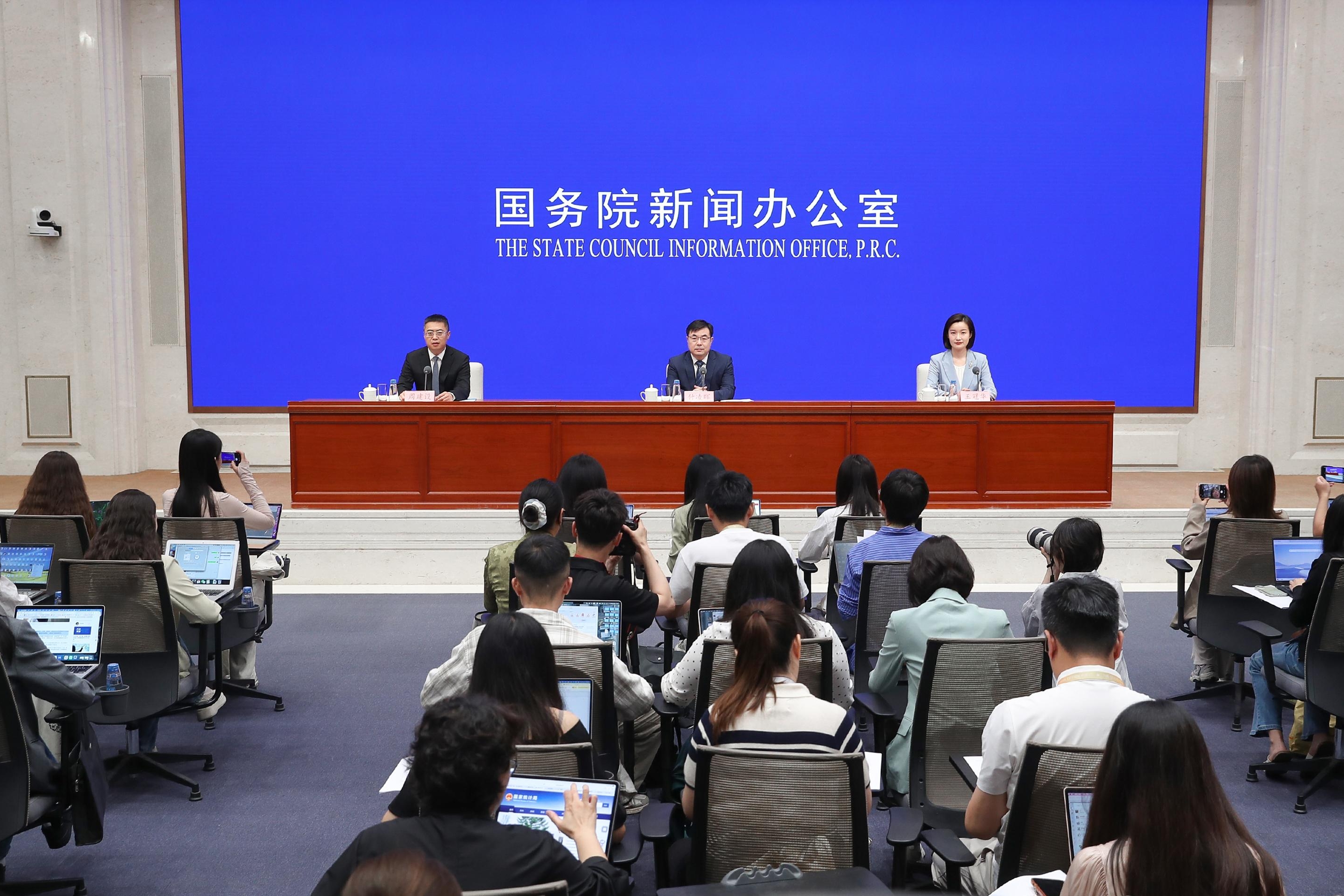
I would like to invite Ms. Wang to answer your questions.
Wang Guanhua:
Thank you for your questions. The accelerated transformation from old growth drivers to new ones is a prominent feature of the current economic operation. This year, China has made new progress in quality improvement in industries, digital empowerment and green transition. The cultivation and development of new quality productive forces have not only provided important support for economic growth, but also effectively improved the quality, resilience and sustainability of development.
First, a large number of innovation outcomes have emerged. China relies on investment in innovation to empower high-quality development. In 2025, the intensity of research and experimental development expenditure, which is the ratio of total R&D expenditure to GDP, exceeded the average level of OECD countries for the first time. With strong support from innovation resources, innovative achievements have been emerging in large numbers in fields such as aerospace, artificial intelligence, quantum computing and biomedicine. Recently, the quantum computing prototype Jiuzhang 4.0 broke the world record for optical quantum computing, and the domestically developed 600-kilogram thrust turbofan engine successfully completed its maiden flight test. The application of innovative achievements provides technological support for industrial leapfrogging. At the same time, various regions are paying more attention to removing obstacles to the application of sci-tech advances and improving the efficiency, so that innovation outcomes can truly move from the laboratory to the production line. From January to May, China granted 372,000 invention patents, up 12.1% year on year, with a number of high-value patents being rapidly implemented in intelligent and green industrial scenarios.
Second, industrial upgrading has accelerated. As the industrial structure transitions toward high-end, intelligent, green and integrated development, the overall industrial competitiveness is improving. From January to May, high-tech manufacturing contributed nearly 40% of industrial growth, and equipment manufacturing contributed nearly 60% of industrial growth, demonstrating a prominent leading role. From major engineering achievements such as airplanes, high-speed trains and ships, to everyday products like cellphones, computers and cars, all rely on the development of the equipment manufacturing industry. It can be said that equipment manufacturing not only supports the core strength of manufacturing development, but also integrates into the daily lives of ordinary people, truly changing all aspects of our production and life. Meanwhile, with the deep integration of the digital economy and the real economy, new scenarios such as the "5G Plus," "AI Plus" and "Industrial Internet Plus" are emerging rapidly. In addition, more Chinese companies are increasingly visible in new arenas such as large AI models, quantum technology and embodied intelligence. The upgrading of the industrial structure also drives the coordinated development of producer services such as information technology, modern finance, modern logistics and business services. In May, the production index for information transmission, software and information technology services, leasing and business services, and the financial industry increased 11.3%, 10.9% and 7% year on year, respectively. These seemingly intangible services are precisely the key soft power for enhancing the hard power of the manufacturing industry.
Third, emerging demands have been released. In terms of investment, emerging fields such as high-end equipment, smart manufacturing and green energy have seen continued investment. From January to May, investment in electronic circuit manufacturing, lithium-ion battery manufacturing and aircraft manufacturing increased 50.9%, 24.9% and 19.7% year on year, respectively. In terms of consumption, residents' concepts of consumption have been upgrading. They are no longer content with access to goods, but increasingly prioritize high-quality, excellent experiences. New energy vehicles, high-efficiency home appliances and smart products are increasingly favored by consumers. From January to May, the retail sales of smart wearable devices, including smart glasses, more than doubled year on year. In terms of foreign trade, a wide variety of high-quality Chinese products have proven to be widely popular, and high-end, intelligent, green and low-carbon products have become new calling cards for China's foreign trade. From January to May, exports of electromechanical products with high technological content and high added value accounted for more than 60%, making them the main driver of export growth.
Fourth, development quality has continued to improve. With the orderly shift from old growth drivers to new ones, the quality and efficiency of China's economic development have also been improved and enhanced. For example, energy consumption per unit of added value for industrial enterprises above designated size continued to decline in May, which means that the energy consumed per unit of industrial output continued to decrease. This is attributed to ongoing efforts to advance the green and clean transformation of traditional industries, as well as China's sustained development of a clean and efficient energy supply system over the years. For another example, despite a decline in automobile production from January to May, the added value of automobile manufacturing enterprises above designated size still maintained growth, reflecting the continuous optimization of product mix in the automobile industry and the increasing proportion of high value-added models.
Overall, new growth drivers and strengths in China's economy have been continuously fostered, and the shift from old to new growth drivers has yielded phased results. At the same time, this transformation is a long-term, systematic undertaking that cannot be accomplished overnight, and the process will be accompanied by certain pressures and growing pains. This also reminds us to maintain resolve, build on the momentum and persevere. We must continuously deepen reforms, strengthen innovation, vigorously cultivate new growth drivers, and transform and upgrade traditional growth drivers. These efforts will promote higher-quality and more sustainable economic development throughout the process of transformation and upgrading. Thank you.