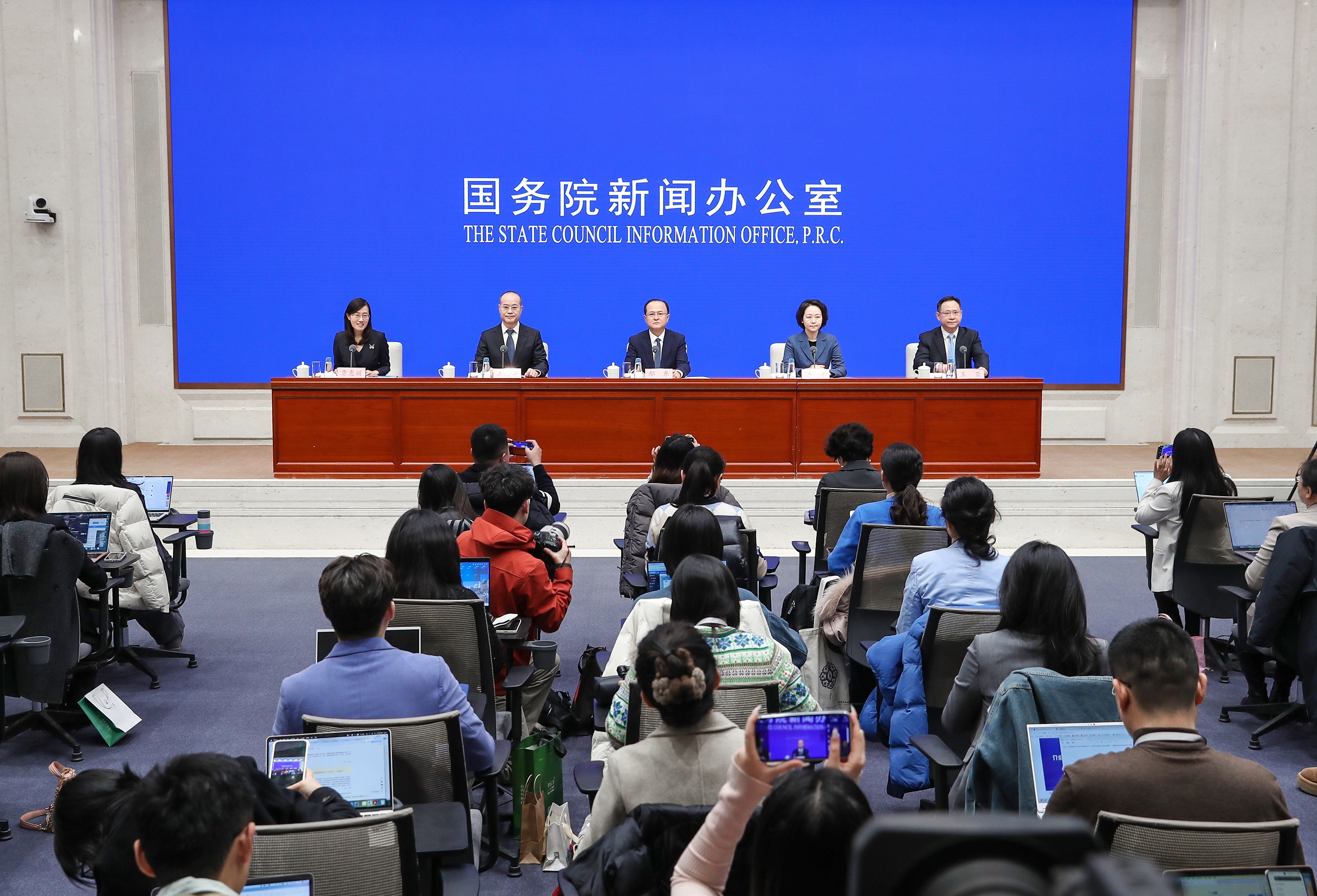
China.org.cn | March 17, 2026


China Business Journal:
Consumption is an important engine of economic growth. We have observed that in 2025, China's consumer market saw improvements in both scale and quality. Could you please introduce the specific highlights and characteristics of the consumer market in 2025? Thank you.
Yang Mu:
I will answer this question. First of all, thank you for your interest in the consumption work. In 2025, the national commerce system vigorously promoted consumption-boosting initiatives, thoroughly implemented consumer goods trade-in programs, promoted high-quality development of service consumption, and organized a series of "Shopping in China" activities, continuously unleashing consumption potential. Overall, consumption maintained a steady development trend. As Mr. Yan just mentioned, the total retail sales of consumer goods reached 50.1 trillion yuan, breaking the 50 trillion yuan mark for the first time. Consumption contributed 52% to GDP growth, continuing to serve as the primary engine of economic development. The main characteristics are as follows:
First, consumption of bulk durable goods grew rapidly. In 2025, driven by the consumer goods trade-in policy, retail sales by enterprises above designated size of related goods such as home appliances, communication equipment and furniture grew by 11%, 20.9%, and 14.6%, respectively, while retail volume of passenger vehicles increased by 3.8%.
Second, new types of consumption boomed. New types of consumption, such as digital consumption, green consumption and health-related consumption, continue to heat up, with new business formats, new models and new scenarios constantly emerging. Online retail sales of physical goods increased by 5.2%, and the market penetration rate of new energy passenger vehicles reached 53.9%.
Third, rural consumption was robust. County-level commercial systems were continuously improved, accelerating the release of consumption potential. Retail sales of consumer goods in rural areas reached 6.8 trillion yuan, an increase of 4.1%, outpacing the growth rate in urban areas by 0.5 percentage point.
Fourth, inbound consumption has risen. With the expansion of the visa-free transit policy and the optimization of the departure tax refund policy, "Travel in China" and "Shopping in China" remained highly popular. Sales of departure tax-refunded goods nearly doubled. Since the implementation of the 240-hour visa-free transit policy one year ago, the number of visa-free entries by foreign nationals has increased by nearly 30%.
That's all from me for this question. Thank you.