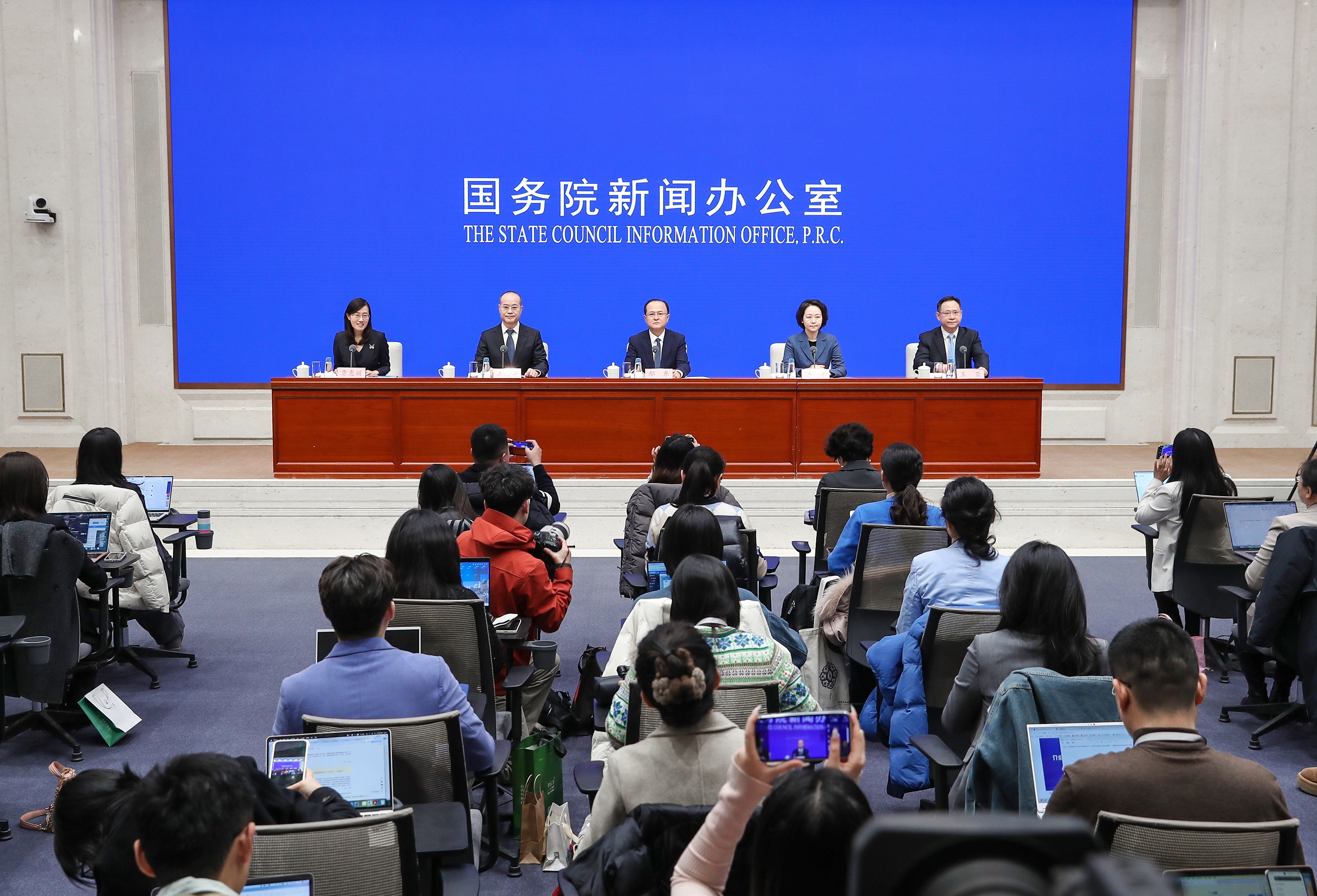
China.org.cn | March 17, 2026


Speakers:
Mr. Yan Dong, vice minister of commerce
Ms. Yang Mu, director general of the Department of Market Operation and Consumption Promotion of the Ministry of Commerce
Mr. Wang Zhihua, director general of the Department of Foreign Trade of the Ministry of Commerce
Mr. Wang Ya, head of the Department of Foreign Investment Administration of the Ministry of Commerce
Chairperson:
Ms. Jia Huili, deputy director general of the Press Bureau of the State Council Information Office (SCIO) and spokesperson of the SCIO
Date:
Jan. 26, 2026
Jia Huili:
Ladies and gentlemen, good afternoon. Welcome to this press conference held by the State Council Information Office (SCIO). Today, we have invited Mr. Yan Dong, vice minister of commerce, to brief you on China's commerce work and performance in 2025 and to take your questions. Also present today are Ms. Yang Mu, director general of the Department of Market Operation and Consumption Promotion of the Ministry of Commerce; Mr. Wang Zhihua, director general of the Department of Foreign Trade of the Ministry of Commerce; and Mr. Wang Ya, head of the Department of Foreign Investment Administration of the Ministry of Commerce. Now, I'll give the floor to Mr. Yan for his introduction.
Yan Dong:
Good afternoon, everyone. First of all, thank you for your interest in and support for the commerce work. I am very pleased to have the opportunity to meet with all of you today along with my colleagues to discuss the development of the commerce work.
The year 2025 that just passed was an extraordinary one. Under the strong leadership of the Central Committee of the Communist Party of China (CPC) with Comrade Xi Jinping at its core, we have resolutely implemented the decisions and arrangements of the CPC Central Committee and the State Council. Guided by the three important positions of the commerce work, we overcame difficulties and worked hard, achieving overall stability and steady progress in commerce development. This has made positive contributions to the continuous recovery and improvement of the economy. The outcomes of this year's work are mainly reflected in the following aspects:
First, efforts to boost consumption have shown more notable results. We closely integrated improving people's livelihoods with promoting consumption. Driven by both policies and events, we created the "Shopping in China" brand and continuously unleashed consumption vitality. The total retail sales of consumer goods for the year exceeded 50 trillion yuan for the first time, reaching 50.1 trillion yuan, an increase of 3.7%, with consumption contributing 52% to economic growth, up by 5 percentage points. In terms of commodity consumption, we have expanded and improved the scope of the consumer goods trade-in programs, with sales of automobiles, home appliances, cellphones and other related products reaching 2.61 trillion yuan, benefiting 366 million people. Regarding service consumption, we have carried out campaigns to improve the quality and benefit of service consumption, with annual service retail sales increasing by 5.5%, and retail sales in areas like culture and sports, leisure, tourism consulting and rentals, and transportation maintaining double-digit growth. In terms of innovative consumption scenarios, we have piloted the development of international-level consumption environments, optimized the tax refund policy for overseas visitors, and seen sales of tax-refundable goods nearly double.
Second, foreign trade has maintained its resilience. We effectively responded to external shocks and challenges, coordinated the development of the "three main pillars" of goods, services and digital trade, vigorously expanded diversified markets, and promoted the innovative development of trade. The scale reached a record high, with annual goods imports and exports totaling 45.47 trillion yuan, up 3.8%; while services imports and exports in the first 11 months reached 7.2 trillion yuan, an increase of 7.1%. Enterprises became more active, with over 780,000 business entities having import and export records, among which private enterprises accounted for 57.3% of the total foreign trade value. Greater emphasis was placed on balanced development of imports and exports. We successfully held major exhibitions such as the China International Import Expo (CIIE), organized a series of events under the theme "Big Market for All: Export to China" series of activities, and promoted high-quality products from overseas to "come in" and "sell well."
Third, bilateral investment space has continued to expand. In terms of attracting foreign investment, we intensified efforts to attract and utilize foreign capital, expanded autonomous opening in the service sector in an orderly manner, and continued to enhance the "Invest in China" brand. Over 70,000 foreign-funded enterprises were established throughout the year, up 19.1%. Utilized foreign capital amounted to 747.69 billion yuan, with high-tech industries accounting for 32.3% of the investment. Regarding outbound investment, we promoted international cooperation in industrial and supply chains, facilitated integration of trade and investment, and deepened Belt and Road economic and trade cooperation. We improved the comprehensive service system for overseas operations, achieving 1 trillion yuan in outbound non-financial direct investment for the year, up 1.6%, and signed new contracts for foreign contracted projects worth 2.1 trillion yuan, up 8.5%.
Fourth, multilateral and bilateral cooperation have achieved notable results. On the bilateral front, under the strategic guidance of head-of-state diplomacy, China-U.S. economic and trade consultations have achieved positive results, giving the world economy a sense of reassurance. We also signed the China-ASEAN Free Trade Area (FTA) 3.0 Upgrade Protocol, put into effect a free trade agreement with the Maldives, and advanced unilateral opening-up measures such as 100% zero tariffs for African countries with diplomatic ties to China, injecting more certainty and positive energy into global development. To date, China has signed 24 FTAs with 31 countries and regions, with FTA partners accounting for 45% of China's total goods trade. On the multilateral front, China announced that it will not seek new special and differential treatment in current and future negotiations with the World Trade Organization (WTO). We promoted practical economic and trade development outcomes within United Nations agencies, APEC, the Shanghai Cooperation Organization (SCO), BRICS countries, the G20, and other frameworks. The International Economic and Trade Cooperation Initiative on Green Mining and Minerals released by China has attracted participation from more than 20 countries and international organizations, actively fostering win-win cooperation.
Next, the Ministry of Commerce will thoroughly implement the major arrangements of the Central Economic Work Conference. Focusing on strengthening domestic circulation, facilitating domestic and international dual circulation, and expanding the international circulation, we will strive to promote high-quality development in commerce, making new contributions to a good start and a solid first step for the 15th Five-Year Plan.
That is all for my introduction. Next, my colleagues and I will be happy to take your questions. Thank you.
Jia Huili:
Thank you, Mr. Yan. The floor is now open for questions. Please identify the news outlet you represent before asking your question.