China.org.cn | December 22, 2025


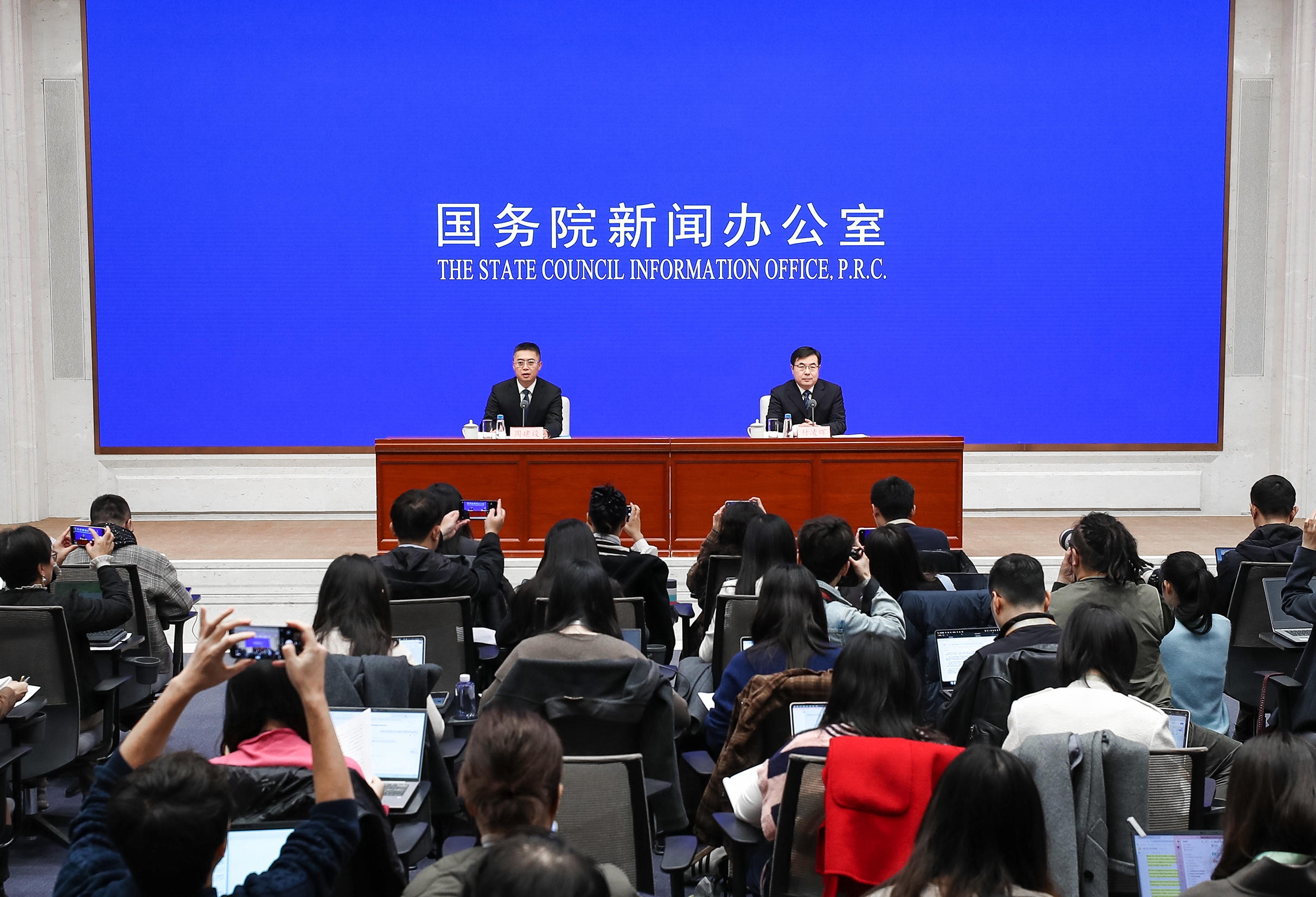

Speaker:
Mr. Fu Linghui, spokesperson and chief economist of the National Bureau of Statistics (NBS) and director general of the Department of Comprehensive Statistics of the NBS
Chairperson:
Mr. Zhou Jianshe, deputy director general of the Press Bureau of the State Council Information Office (SCIO) and spokesperson of the SCIO
Date:
Nov. 14, 2025
Zhou Jianshe:
Ladies and gentlemen, good morning. Welcome to this press conference held by the State Council Information Office (SCIO). This is a regular briefing on China's economic data. Today, we are joined by Mr. Fu Linghui, spokesperson and chief economist of the National Bureau of Statistics (NBS) and director general of its Department of Comprehensive Statistics. Mr. Fu will brief you on China’s economic performance in October 2025 and then take your questions.
Now, I'll give the floor to Mr. Fu for his introduction.
Fu Linghui:
Thank you, Mr. Zhou. As usual, I will start by briefing you on the main economic indicators for October 2025 and then take your questions.
In October, the national economy remained generally stable, with steady improvements.
In October, under the strong leadership of the Central Committee of the Communist Party of China (CPC) with Comrade Xi Jinping at its core, all regions and departments earnestly implemented the decisions and plans made by the CPC Central Committee and the State Council, adhered to the general principle of pursuing progress while ensuring stability, stepped up efforts to stabilize employment, enterprises, markets and expectations, made thorough efforts to develop a unified national market, and actively promoted unimpeded domestic and international economic flows. As a result, production and supply remained generally stable, employment was broadly steady, prices showed improvements, new growth drivers were cultivated and expanded, and the national economy maintained overall stability with steady progress.
First, industrial production continued to grow, with strong momentum in equipment manufacturing and high-tech manufacturing.
In October, the value added of industrial enterprises above designated size grew by 4.9% year on year, or 0.17% month on month. In terms of sectors, the value added of the mining industry increased by 4.5%, that of manufacturing was up by 4.9%, and that of the production and supply of electricity, thermal power, gas and water grew by 5.4% year on year. The value added of equipment manufacturing grew by 8.0%, and that of high-tech manufacturing increased by 7.2%, which were 3.1 percentage points and 2.3 percentage points faster than the total value added of industrial enterprises above designated size, respectively. In terms of ownership, the value added of state-holding enterprises increased by 6.7% year on year; that of share-holding enterprises rose by 5.2%; that of enterprises funded by foreign investors or investors from Hong Kong, Macao and Taiwan increased by 4.0%; and that of private enterprises grew by 2.1%. In terms of products, the production of 3D printing devices, new-energy vehicles, and industrial robots increased by 30.8%, 19.3% and 17.9% year on year, respectively. From January to October, the total value added of industrial enterprises above designated size grew by 6.1% year on year. In October, the Manufacturing Purchasing Managers’ Index was 49.0%, and the Production and Operation Expectation Index was 52.8%. From January to September, industrial enterprises above designated size recorded total profits of 5,373.2 billion yuan, up by 3.2% year on year.
Second, the service sector grew steadily, and the modern service industry developed well.
In October, the Index of Services Production increased by 4.6% year on year. In terms of sectors, that of information transmission, software and information technology services, leasing and business services, and financial intermediation rose by 13.0%, 8.2% and 5.6% year on year, respectively, which were 8.4 percentage points, 3.6 percentage points and 1.0 percentage point faster than that of the Index of Services Production. From January to October, the Index of Services Production increased by 5.7% year on year. From January to September, the business revenue of service enterprises above designated size grew by 7.6% year on year. In October, the Business Activity Index for Services was 50.2%, and the Business Activity Expectation Index for Services was 56.1%. Specifically, the Business Activity Index for railway transportation, air transportation, postal services, accommodation, and culture, sports and recreation stayed within the high expansion range of 60.0% or above.
Third, market sales expanded, and growth of service retails accelerated.
In October, the total retail sales of consumer goods reached 4,629.1 billion yuan, up by 2.9% year on year, or 0.16% month on month. Analyzed by different areas, the retail sales of consumer goods in urban areas were 4,002.1 billion yuan, up by 2.7% year on year, and that in rural areas reached 627.0 billion yuan, up by 4.1%. Grouped by consumption type, the retail sales of goods totaled 4,109.2 billion yuan, up by 2.8%, and the income of catering was 519.9 billion yuan, up by 3.8%. Basic living consumption and some upgraded consumption items grew relatively quickly. Retail sales of grain, oil and food, communication equipment, cultural and office supplies, and sports and recreational goods by enterprises above designated size increased by 9.1%, 23.2%, 13.5% and 10.1% year on year, respectively. From January to October, total retail sales of consumer goods reached 41,216.9 billion yuan, up by 4.3% year on year. Online retail sales reached 12,791.6 billion yuan, up by 9.6% year on year. Specifically, online retail sales of physical goods were 10,398.4 billion yuan, up by 6.3%, accounting for 25.2% of the total retail sales of consumer goods. From January to October, retail sales of services increased by 5.3% year on year, 0.1 percentage point faster than that in the first three quarters. Specifically, retail sales of culture, sports and leisure services, communication information services, tourism consultation and rental services, and transportation services grew relatively quickly.
Fourth, fixed-asset investment declined year on year, while investment in the manufacturing sector continued to grow.
From January to October, fixed-asset investment (excluding rural households) reached 40,891.4 billion yuan, down 1.7% year on year. Excluding real estate development investment, fixed-asset investment increased by 1.7%. Specifically, investment in infrastructure decreased by 0.1% year on year, manufacturing investment increased by 2.7%, and real estate development investment declined by 14.7%. The floor space of newly-built commercial buildings sold was 719.82 million square meters, down by 6.8% year on year, and the total sales of newly-built commercial buildings were 6,901.7 billion yuan, down by 9.6%. By industry, investment in the primary industry grew by 2.9% year on year, that in the secondary industry increased by 4.8%, and that in the tertiary industry declined by 5.3%. Private investment fell by 4.5% year on year, but increased by 0.2% with the investment in real estate development deducted. Among high-tech industries, investment in information services, aerospace vehicle and equipment manufacturing, and computer and office device manufacturing increased by 32.7%, 19.7% and 4.1% year on year, respectively. In October, fixed-asset investment (excluding rural households) decreased by 1.62% month on month.
Fifth, imports and exports of goods continued to grow and the trade structure continued to be optimized.
In October, the total value of imports and exports of goods was 3,702.8 billion yuan, up by 0.1% year on year. Specifically, exports fell 0.8% to 2,171.6 billion yuan and imports rose by 1.4% to 1,531.1 billion yuan. From January to October, the total value of imports and exports of goods was 37,309 billion yuan, a year-on-year increase of 3.6%. Specifically, exports increased 6.2% to 22,114.6 billion yuan and imports reached 15,194.4 billion yuan, remaining unchanged year on year. From January to October, the imports and exports in general trade went up by 2.3%, accounting for 63.4% of the total value of imports and exports. Imports and exports with Belt and Road Initiative partner countries grew 5.9%. Imports and exports by private enterprises increased 7.2%, accounting for 57% of the total value of imports and exports, 1.9 percentage points higher than that of the same period last year. Exports of mechanical and electrical products went up 8.7%, accounting for 60.7% of total exports.
Sixth, employment remained generally stable and the surveyed urban unemployment rate declined.
From January to October, the average surveyed urban unemployment rate nationwide was 5.2%. In October, the national surveyed urban unemployment rate was 5.1%, which was 0.1 percentage point lower than that of the previous month. The surveyed unemployment rate of population with local household registration was 5.3%, while that of population with non-local household registration was 4.7%, among which, the rate of the population with non-local agricultural household registration was 4.5%. The surveyed urban unemployment rate in 31 major cities was 5.1%, which was 0.1 percentage point lower than that of September. The average weekly working hours for enterprise employees nationwide was 48.4 hours.
Seventh, consumer prices turned from a decline to an increase and the decline of producer prices for industrial products narrowed.
In October, the consumer price index (CPI) went up 0.2% month on month, compared to a decline of 0.3% in the previous month; it rose by 0.2% year on year. By category, prices for food, tobacco and alcohol decreased 1.6% year on year, clothing increased 1.7%, housing rose 0.1%, household goods and services grew 1.9%, and transportation and communication declined 1.5%. Prices for education, culture and recreation went up 0.9%, health care rose 1.4%, and other goods and services increased 12.8%. In terms of prices for food, tobacco and alcohol, the price of pork dropped 16.0%, fresh vegetables fell 7.3%, fresh fruit decreased 2.0%, and grain declined 0.7%. The core CPI, excluding the prices of food and energy, grew 1.2% year on year, 0.2 percentage point higher than that of September. From January to October, the national CPI went down by 0.1% year on year.
In October, the national producer price for industrial products fell 2.1% year on year, with the decline narrowing by 0.2 percentage point from the previous month, and rose 0.1% month on month. The national purchasing price for industrial producers dropped 2.7% year on year, with the decline narrowing by 0.4 percentage point, and rose by 0.1% month on month. In the first 10 months, the national producer price and purchasing price for industrial products decreased 2.7% and 3.2% year on year, respectively.
Overall, the national economy operated steadily in October, while transformation and upgrading were advanced solidly, and new growth drivers continued to grow. It should also be noted that due to instabilities and uncertainties in the external environment and significant pressure in domestic structural adjustment, the Chinese economy faces many challenges in terms of stable operation. In the next phase, we must adhere to the guidance of Xi Jinping Thought on Socialism with Chinese Characteristics for a New Era, thoroughly implement the guiding principles from the fourth plenary session of the 20th CPC Central Committee, and persist in the general principle of pursuing progress while ensuring stability to comprehensively expand domestic demand. We will focus on stabilizing employment, enterprise operations, markets and expectations, actively promote the continuous implementation and effectiveness of macro policies, comprehensively deepen reform and opening up, and further propel innovation-driven development, so as to both improve the quality of growth and appropriately increase output.
Thank you.

