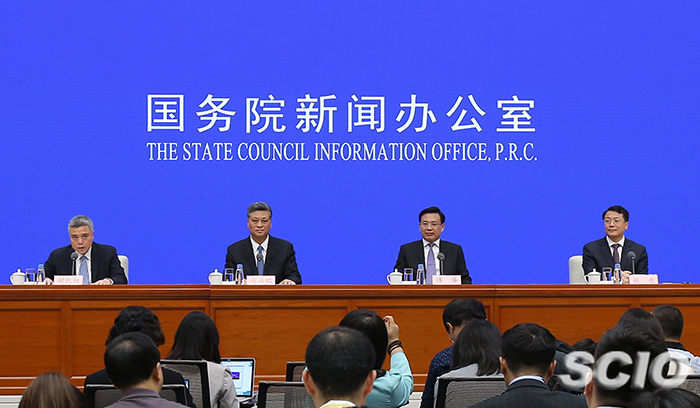
SCIO briefing on Guangdong province's development
Speakers:
Ma Xingrui, vice secretary of the CPC Guangdong Provincial Committee, governor of Guangdong province;
Fu Hua, member of the Standing Committee of the CPC Guangdong Provincial Committee, head of the Publicity Department of Guangdong province;
Zhang Hu, vice governor of Guangdong province;
Chairperson:
Hu Kaihong, spokesperson of the State Council Information Office of China
Date:
June 3, 2019
Hu Kaihong:
Ladies and gentlemen, good morning. Welcome to this press conference. This is one of a series of press conferences for provinces, autonomous regions and municipalities directly under the central government that mark the 70th anniversary of the founding of the People's Republic of China.
Present at this press conference are: Mr. Ma Xingrui, vice secretary of the Communist Party of China (CPC) Guangdong Provincial Committee and governor of Guangdong province; Mr. Fu Hua, a member of the Standing Committee of the CPC Guangdong Provincial Committee and head of the Publicity Department of Guangdong province; and Mr. Zhang Hu, vice governor of Guangdong province. They will speak about Guangdong's reform, opening up and innovation-driven development, and answer some of your questions.
Now I'll give the floor to Mr. Ma.
Ma Xingrui:
Friends from the media, ladies, gentlemen, friends, it's a great pleasure to take this opportunity to brief you on Guangdong's development. First of all, on behalf of the provincial Party committee and provincial government, I want to express sincere gratitude to all of you for your long, enthusiastic attention to Guangdong.
Since the founding of the People's Republic of China 70 years ago, the country has witnessed radical changes, and achieved remarkable success in its development. Guangdong is a typical example of this change. Following are some highlights of Guangdong's development.
First, economic development has maintained rapid growth. The provincial GDP increased from 2.03 billion yuan in 1949 to 9.7 trillion yuan in 2018, ranking among the top few across China for nearly 30 years. This year, the figure is estimated to exceed 10 trillion yuan.
Second, provincial financial power has grown stronger. The revenue in the general public budget (in comparable prices) increased from 320 million yuan in 1950 to 1.2 trillion yuan in 2018, making the province the first in China to have a revenue in the general public budget exceeding 1 trillion yuan.
Third, the province has continued to enhance opening up to the outside world. In 2018, total imports and exports of the province reached 7.16 trillion yuan, accounting for one-fourth of the national total, and ranking first in the nation for 33 years in a row. A total of US$447 billion in foreign investments were utilized, accounting for more than one-fifth of the national total.
Fourth, a world-class manufacturing center has been established. There are approximately 47,500 industrial enterprises that have annual revenue of 20 million yuan or more from their main business operations. From traditional to advanced manufacturing, such as electronic information, green petrochemicals, automobiles, intelligent home appliances and robots, Guangdong has established a relatively complete and well-supported modern industrial system. The output of the electronic information industry accounted for 34% of the national total.
Fifth, both rural and urban development have been significantly enhanced. A comprehensive transportation network has taken shape. Guangzhou, Shenzhen and other major cities in the Pearl River Delta have formed a modern city cluster with an urbanization rate that has reached 70.7%. All counties are connected by expressway, and all cities will soon be connected by bullet train.
Sixth, people's livelihoods have improved continuously. The average life expectancy has been extended to 77.2 years. The revenues of urban and rural residents have increased continually and absolute poverty has been eliminated. More than 2.4 million people previously recognized by the provincial government as living in relative poverty have risen out of poverty.
You may wonder, how Guangdong is able to achieve such success despite having no special natural resources, with no foundation for development initially. Please allow me to share some of my views on this issue. Our achievements should be attributed to our system, political path, and the introduction of reform and opening up policies.
Since the founding of New China in 1949, the establishment of socialism has created the fundamental political conditions and the institutional foundation for achieving all development and progress in China today. Under the strong leadership of the CPC Central Committee, Guangdong has carried out socialist transformation smoothly, promoted socialist advancement vigorously, and established a relatively sound system for economic and social development, laying a solid foundation for the province's progress to come.
The introduction of reform and opening up policies in 1978 marked a new awakening and great revolution of the CPC, which propelled the Party into a great innovation from theory to practice, and boosted a tremendous advancement in promoting Socialism with Chinese characteristics. Comrade Deng Xiaoping, the chief architect of reform and opening up, chose Guangdong as the pioneer in the campaign after careful consideration. He required us to forge ahead despite all difficulties. The forerunners in the province, with Xi Zhongxun, former secretary of the CPC Guangdong Provincial Committee, as their representative, were dauntless in exploration and innovation. Thanks to their efforts, Guangdong started the glorious journey of leapfrog development.
Under the strong leadership of the CPC Central Committee, the provincial Party committee and provincial government of all sessions have united and led all officials and the general public in Guangdong to establish special economic zones, carry out reform and opening up policies, and promote the development of the market economy. We implemented the central authorities' strategic plan of reform and opening up innovatively, and made great achievements in this area. We have served as a window showing China's progress to the world, as a pilot ground for reform and opening up policies, and as a pacesetter of development in China.
Since the 18th Communist Party of China (CPC) National Congress in 2012, the CPC Central Committee with Comrade Xi Jinping at its core has demonstrated tremendous political courage and a powerful sense of mission. It has united and led all Party members and all the Chinese people of all ethnic groups in applying a new vision of development, implementing the five-sphere integrated plan and the four-pronged comprehensive strategy. With this, it has prompted historic shifts and achievements in the cause of the Party and the country, and steered socialism with Chinese characteristics into a new era.
Attaching great importance to the development of Guangdong province, General Secretary Xi Jinping visited Guangdong in his first inspection trip outside Beijing after the 18th CPC National Congress. He has joined deputies from Guangdong in panel discussions during two sessions of the National People's Congress, paid two visits to Guangdong, attended the signing ceremony of the framework agreement on the development of the Guangdong-Hong Kong-Macao Greater Bay Area and the opening ceremony of the Hong Kong-Zhuhai-Macao Bridge. He has delivered important speeches and gave important instructions on the development of Guangdong, designating it as a leading province in four areas (building institutions for high-quality economic development, developing a modern economy, pursuing opening up on all fronts and creating a social governance model based on collaboration, participation, and common interests), and a window for China to showcase its achievements in reform and opening-up as well as for the international community to observe the progress of the endeavor.
With General Secretary Xi Jinping's requirements in mind, we embarked on a new journey of the reform and opening-up drive, striving to break new ground in the new era.
First, we made sweeping efforts to strengthen Party leadership and Party building, taking a clear political stand and fostering a healthy political atmosphere of integrity. We worked to ensure that all the officials in Guangdong keep in mind the need to maintain political integrity, think in big-picture terms, follow the leadership core, keep aligned, strengthen our confidence in the path, theory, system, and culture of socialism with Chinese characteristics, resolutely uphold General Secretary Xi Jinping's core position in the Party Central Committee and in the Party as a whole, and resolutely uphold the Party Central Committee's authority and its centralized, unified leadership.
Second, we took comprehensive steps to deepen reform and opening-up, improve the socialist market economy, enable the government to play a better role and create a more favorable business environment.
Third, the building of the Guangdong-Hong Kong-Macao Greater Bay Area got off to a good start. The development plan is being fully implemented. The Hong Kong-Zhuhai-Macao Bridge and the Guangzhou-Shenzhen-Hong Kong high-speed railway has come into operation. The bay area is attracting an inflow of talent, capital, technology and enterprises.
Fourth, innovation has become an essential force in driving Guangdong's economic growth. In 2018, Guangdong's R&D spending exceeded 250 billion yuan; its PCT (the Patent Cooperation Treaty) applications accounted for about half of the country's total; and the provincial regional innovation capability has maintained its top place nationwide. Guangdong is home to a large number of world-class enterprises, including Huawei, Tencent, Guangzhou Automobile Group, Gree and Midea.
Fifth, Guangdong's economy has been transitioning to a stage of high-quality development and the province has 45,000 national high-tech enterprises. The value-added of advanced manufacturing accounted for 56.4% of the total of industries above the designated size, and the contribution of the tertiary sector to GDP increased to 58.9%.
Sixth, Guangdong has seen a continuous improvement in its ecological environment, with the PM2.5 concentration falling to 31 mcg/m3. The Pearl River Delta has become China's first national forest city group demonstration zone.
Seventh, we have enhanced our ability to meet people's basic needs. Last year, per capita disposable personal income grew to 35,800 yuan. A provincial management system for aged-care insurance funds has been established. There has been steady progress in the efforts to address the key issues affecting living standards, such as offering easier access to medical and government services.
Eighth, we have improved our capacity to forestall and defuse major risks. With the courage and ability to fight, we have ensured social order and stability.
Ma Xingrui:
The world we live in today has been undergoing tremendous changes which are unseen in the past century, and the global economic order is facing unprecedented challenges. Guangdong will fully implement all major policies and plans made by the Central Committee of the Communist Party of China (CPC) with Comrade Xi Jinping at its core, uniting as one, and continuously focusing on managing China's own affairs well to prepare for any difficulties and challenges. With the strong leadership of Comrade Xi Jinping and the Central Committee of the CPC; the solid foundation established since the PRC was founded 70 years ago and the reform and opening up that was initiated 40 years ago, especially since the 18th CPC National Congress; as well as the capability and experience of market entities and with the united effort of the whole nation, we are fully confident in dealing with the various challenges and risks.
Last October, General Secretary Xi Jinping made major policy speeches during his visit to Guangdong province, giving important instructions in four aspects including pursuing deeper reform and greater opening up, promoting high-quality development, encouraging a balanced and coordinated form of development, and strengthening the leading role of the CPC and Party building. Guangdong province has fully implemented and made further progress in the "1+1+9" Plan, in which the two "ones" refer to the political guarantee of strengthening the leading role of CPC and Party building, and the driving force from pursuing deeper reform and greater opening up. The "nine" in the Plan refers to nine key missions, which are the following -- promoting the construction of the Guangdong-Hongkong-Macao Greater Bay Area; implementing the strategy of innovation-driven development; promoting high-quality development; building a modern economic system; laying a good foundation for the "three critical battles" against potential risks, poverty and pollution; implementing a rural revitalization strategy; improving the regional development plan of "One Core, One Belt, and One Region (i.e.to improve the economic structure of the Pearl River Delta as the core of the area; to foster new sources of growth in east and west Guangdong province which form a costal economic belt with cities along the Pearl River Delta; and to turn the mountainous region in north Guangdong province into an ecological zone.)"; developing a culturally prosperous province; and establishing a social governance model based on collaboration, participation and common interests. General Secretary Xi Jinping has instructed us to continue to be consistent in our efforts and stressed the significance of the tangible outcomes from these projects. General Secretary Xi Jinping has also noted that Guangdong province is an important window, not only for China to showcase to the world the achievements of our reform and opening up, but also for the international society to observe the process of our endeavor. The crucial status has placed Guangdong province under the spotlight, especially in the following aspects:
First, we take the building of the Guangdong-Hong Kong-Macao Greater Bay Area as the guiding principle for Guangdong's reform and opening up in the new era, and will dedicate all of our province's strength to work on it.
We join hands with Hong Kong and Macao to build a world-class city cluster and an international-level bay area, promote the joint pursuit of the Belt and Road Initiative, and bolster the leading role of Guangdong to create a new pattern of high-level comprehensive opening up to the outside world. We place top priority on our work to promote the consistency of rules and regulations among the three places. Under the principle of "one country, two systems," we enact flexible measures in line with local conditions, align our business environment with a high-standard of international economic and trade rules, and promote the smooth flow of people, goods, funds and information between the Greater Bay Area. It can be said that Guangdong in the Greater Bay Area is worth looking forward to.
Second, we focus on promoting innovation-driven development.
We resolutely and calmly respond to challenges and tests of any kind, and we have strengthened our capacity for self-reliance and independent innovation. While aiming to increase core competitiveness, core technologies for key fields and basic research, we will invest more in scientific and technological innovation, and concentrate our efforts to improve the regional technological innovation system with enterprises playing a leading role. At the same time, we will speed up the adjustment of industrial structures and promote the transition of Guangdong from a manufacturing-orientated to an innovative province with high-quality development. It can be said that a Guangdong province with high quality development is worth looking forward to.
Third, we pursue a more balanced form of development across the regions as well as the rural and urban areas.
We will vigorously implement the strategy for rural revitalization, make good strides in the battle against poverty, and pursue coordinated development of Pearl River Delta region, coastal economic belt and mountainous area of North Guangdong.. We will show even greater resolve, make greater efforts, and take more practical measures to support the revitalization of the old revolutionary base areas and the development of areas with concentrations of ethnic minorities. According to the provincial financial plan, in 10 years and over different phases, we will invest 160 billion yuan to strengthen the weak links in rural infrastructure and basic public services, and speed up the improvement of rural life. It can be said that a Guangdong province with coordinated development is worth looking forward to.
Fourth, we pursue the balanced development and mutual reinforcement of material and cultural and ethical progress.
We have launched activities to enhance cultural and ethical progress in the new era, and promote the building of the system of public cultural services. For example, we will promote the innovative development of the traditional Lingnan culture (a prominent culture in South China), based on the approach of respecting others' cultural characteristics while pursuing their own so as to progress together as the Chinese nation. It can be said that a Guangdong province with cultural prosperity is worth looking forward to as well.
Fifth, we will unswervingly advance the construction of an ecological civilization. We will implement China's new concept for development in an all-encompassing way and put into practice General Secretary Xi Jinping's instruction that "lucid waters and lush mountains are invaluable assets." We will adopt a holistic approach to conservation programs aimed at protecting our mountains, rivers, forests, farmlands, lakes, and grasslands, and apply the most stringent rule of law in this process. We will put in place key measures of protecting the environment, conserving energy, reducing emissions, promoting green development, pursuing a low-carbon and circular economy, and advancing ecological civilization. Our goal is to make Guangdong province a homeland with beautiful mountains, waters and nostalgic memories. An ecologically beautiful Guangdong is worth looking forward to.
Sixth, we will create a social governance model based on collaboration, participation, and common interests. We will implement the general plan of the rule of law and further make Guangdong a place that is safe and based on the rule of law. We will strengthen social governance and make our business environment more internationalized, convenient and based on the rule of law. We aim to make Guangdong one of China's safest and most stable, fair, and just areas. We will continue to increase the people's sense of gain, happiness and security. A safer and more harmonious Guangdong is worth looking forward to.
On our new journey in the new era, Guangdong will hold high the great banner of socialism with Chinese characteristics, rally even closer around the Central Committee with Xi Jinping at its core, follow the guidance of Xi Jinping Thought on Socialism with Chinese Characteristics for a New Era and fully implement the spirit of General Secretary Xi Jinping's speeches and instructions on Guangdong. We will remain true to our original aspirations and keep our mission firmly in mind. We will continue our hard work, forge ahead, and write a new chapter in the new era of Guangdong's reform and opening up. We will strive to meet the requirement for Guangdong to become a national leader in four areas – establish institutions favorable for high-quality economic development, build a modern economic system, break new ground in pursuing the opening up on all fronts, and create a social governance model based on collaboration, participation, and common interests. Guangdong will also serve as two important windows – a window to showcase China's achievements in its reform and opening-up to the world and a window for the international community to observe China's reform and opening-up. By doing this, we will make our contributions to helping realize the Chinese Dream of national rejuvenation.
Thank you again, friends from the press. Thank you for attending today's press conference. Now my colleagues and I will begin to take your questions.
Hu Kaihong:
Thank you, Mr. Ma. Now we open the floor to questions. Please identify your media organization before raising your question.
CCTV:
Society has placed a great deal of attention and expectation toward the construction of the Guangdong-Hong Kong-Macao Greater Bay Area. So how Guangdong will take the opportunity of building the Greater Bay Area to advance its reform and opening-up? Thanks.
Ma Xingrui:
Thanks for the question. Indeed, people are very concerned about this effort. The Greater Bay Area has been planned, deployed and promoted by General Secretary Xi Jinping himself as a significant strategy of national importance. Xi personally witnessed the signing of the Greater Bay Area framework agreement and clearly pointed out that Guangdong should mobilize resources from the whole province to promote the construction of the Greater Bay Area, and it is an important historic opportunity for Guangdong to renew its efforts in reform and opening-up. It is expected that Guangdong, Hong Kong and Macao can make concerted efforts to turn the Greater Bay Area into a world-class city cluster and a first class bay area, which can rival the New York Bay Area, the San Francisco Bay Area, and the Tokyo Bay Area, so as to further improve Guangdong's competitiveness and help realize high-quality development.
The Party Central Committee and the State Council unveiled the Outline Development Plan of the Guangdong-Hong Kong-Macao Greater Bay Area on Feb. 18, which clarifies the Greater Bay Area's five identities — a vigorous world-class urban agglomeration, an international science and technology innovation center with global influence, an important support for the construction of the Belt and Road, a demonstration zone for in-depth cooperation between the mainland and Hong Kong and Macao, and a world-class city cluster that promotes a high quality of life, where people can live, work and travel happily.
Under the leadership of the Party Central Committee and the State Council, Guangdong has formed a close cooperation model with Hong Kong and Macao. We deeply feel that the reform and opening-up since 1978 has brought great changes to Guangdong, and the construction of the Greater Bay Area presents Guangdong with another important opportunity to carry on its reform and opening-up. Our work will be carried forward in the following five aspects.
First, the business environment will be improved through interlinked rules. We will adhere to the principle of "one country" and make good use of the benefits of "two systems" to interlink the rules in the market economy system, and pave the way for the linkage of various factors. The objective is to ensure that personnel, logistics, capital and information can flow efficiently and orderly. There is still huge potential in this aspect.
Second, the construction of the Greater Bay Area into an international science and technology innovation center will be expedited. This is a key task that people are deeply concerned about. The Tokyo Bay Area, the New York Bay Area and the San Francisco Bay Area are stronger than the Greater Bay Area in terms of original innovation. This is also our shortcoming. But we have the foundation that has been laid over the past 40 years' of reform and opening-up and over the past 70 years of the New China's development. Hong Kong and Macao have several world-class universities, and if combined with the innovation ability of Guangdong's real economy, they can effectively boost the construction of the international science and technology innovation center. In particular, all relevant departments of the central government attach great importance to the job, such as the building of major scientific and technological infrastructure, large scientific installations, national key laboratories, and national laboratories, etc. In addition, there are also certain favorable tax policies customized for science and technology staff. For example, we are working to make it possible that talents from Hong Kong and Macao can be taxed according to Hong Kong and Macao tax policies in Guangdong. In a word, scientific and technological innovation is a major task for us.
Third, the Greater Bay Area should be built into an important support structure for the construction of the Belt and Road. It is known that the three places have their respective advantages. Hong Kong is an international center of finance, trade and shipping. Macao is a world tourism and leisure center, and has a link with Portuguese-speaking countries. Guangdong is a manufacturing powerhouse and a major province in international trade. So, in the construction of the Belt and Road, the Greater Bay Area can play a very important role.
Fourth, infrastructure facility interconnectivity will be promoted. As we know, the Guangzhou-Shenzhen-Hong Kong high-speed train service opened last year, which implements the system of "one place and two inspections." It takes only 47 minutes to travel from Hong Kong to Guangzhou by train, while before its opening, we took more than four hours by car. There are also some key infrastructure facilities under construction, such as the Liantang/Heung Yuen Wai Boundary Control Point, and a new port connecting Macao and Zhuhai, both of which will be completed before the end of this year. In particular, we are advancing the coordinated development of high-speed railway, harbors and airport clusters in the region. There are three major airports — Hong Kong Airport, Guangzhou Baiyun International Airport and Shenzhen Baoan Airport, which handle more than 70 million, nearly 70 million and over 45 million passenger trips a year respectively.
Fifth, an environment with a high quality of life where people can live, work and travel happily will be created. Guangdong will provide sound environment for the youth from Hong Kong and Macao to pursue innovation and start new businesses. Meanwhile, we will also make great efforts to improve the ecological and living environment, since there is still room for improvement in these aspects.
As for information on the Greater Bay Area, you must already be familiar with it as the media has reported widely on it. Due to the tight schedule, I would like to stop here. Thanks.
China Daily:
We learned that the GDP of Guangdong province is expected to surpass 10 trillion yuan in 2019. So my question is what achievements has Guangdong made in promoting high-quality economic development and building a modern economic system, especially in the layout of emerging industries? Thanks.
Ma Xingrui:
Thanks for your question. The GDP of Guangdong province has ranked first in the country for 30 years in a row. As you mentioned, this year it will hit 10 trillion yuan. But for Guangdong, there still remains problems in achieving high-quality development.
First, it must be reflected in the economic system. Since the 18th National Congress of the CPC, General Secretary Xi Jinping has visited Guangdong twice and attended the plenary sessions of the Guangdong NPC delegation twice. He made a series of important instructions, clearly requiring Guangdong to play a leading role in building the system and mechanism to promote high-quality development and a modern economic system. Currently, we should ensure that the market plays its decisive role in resource allocation, and we should give better play to the role of the government, which were also clearly pointed out at the third plenary session of the 18th Central Committee of the CPC. In accordance with the requirements of the Party Central Committee, we are deepening the supply-side structural reform. In this respect, the government is to provide an institutional environment of rule of law and with preferential policies for companies, especially for the real economy. In recent years, we published a series of policies in support of the real economy, private economy, foreign trade, and employment as well. For example, Guangdong took the lead in overall planning of pension for employees working for local enterprises, bringing benefits to companies and people.
Second, we must focus on developing market players. Guangdong is now home to 11.46 million individual business and companies, with nearly 5 million companies among them, ranking it first in China. Currently, a total of 12 companies in Guangdong have entered the Fortune Global 500 list and the revenue from the main business operations of 29 companies has exceeded 100 billion yuan. So I think all of these are very important. Meanwhile, to develop the market economy, we must focus on developing industrial clusters. Now we already have two industrial clusters which have a total output value of more than one trillion yuan and are engaged in electronic information and green petrochemical. We also have seven emerging industrial clusters with an output value of over 100 billion yuan respectively. There are many examples like these.
First, we took the lead in pushing the development of the 4K UHD (ultrahigh definition) video industry. In the past, we had 1K and 2K, and now we have 4K, bringing many benefits to technology, industries and the lives of people. Now the output of 4K TV accounts for about half of the country.
Second, we are sparing no effort to develop the robotics industry. Now around 20% of industrial robots are made in Guangdong. In 2018, the total output of industrial robots reached 32,000 sets, accounting for 22% of the total. In the first quarter of 2019, the output of Topstar Technology Co., Ltd, one of the tech companies that produces industrial robots in Guangdong, generated a year-on-year growth of 36%, maintaining a good momentum.
Third, we support the new energy automobile industry. I used to work in Shenzhen where we worked to ensure that all buses were powered by electricity within three years. This was also realized in Guangzhou and Zhuhai, which promotes the development of new energy automobiles. The emission of a bus that fueled by diesel is equivalent to that of 40 cars. So the development of new energy automobiles will help to improve the air quality. You can take a look in Shenzhen and Guangzhou, there are now many changes.
Fourth, we promote the development of the industrial internet. Guangdong is a province that based on information. We encourage companies to improve themselves with the help of information technology, especially that of the industrial internet. A total of 3,000 companies now have access to the cloud platform, and that number will reach 10,000 in the future.
Fifth, we are making efforts to develop the mobile communication industry. The output of smartphones now accounts for 43.9 % of the total output in the country. Most of the mobile phone brands, like Huawei, OPPO, VIVO and Apple, have established their production lines in Guangdong. In addition, we are stepping up the building of the 5G network. This year, we will set up base stations for the commercial use of 5G in Shenzhen.
Generally speaking, high-quality development is the key to building a modern economic system. We also need to give full play to the market and government. In addition, we need to target strategic emerging industries and future industries like artificial intelligence.
Phoenix Satellite TV:
I have two questions. First, what measures will Guangdong take to jointly promote cultural development in the Guangdong-Hong Kong-Macao Greater Bay Area, which is stressed in the area's development plan? Second, as you just said, Guangdong is fully confident in its ability to develop its economy and cope with its challenges. How much impact does the economic and trade friction between China and the United States have on Guangdong, since there are many high-technology enterprises in the province? What measures have you taken to ease the impact? Thank you.
Ma Xingrui:
Now Mr. Fu Hua will answer your questions. He is a member of the Standing Committee of the CPC Guangdong Provincial Committee and head of the Publicity Department of Guangdong province. He is in charge of related works.
Fu Hua:
Jointly promoting cultural development in the Guangdong-Hong Kong-Macao Greater Bay Area is a significant part of the area's development. As you know, Guangdong, Hong Kong and Macao share the same culture, making it easy to promote cultural development in the area. Besides, over the past 40 years of reform and opening-up, the three regions have enjoyed increasingly close and active cultural exchanges. These have laid the foundation for jointly promoting cultural development and spreading cultural values in the bay area.
According to the requirements of the Development plan for the Guangdong-Hong Kong-Macao Greater Bay Area, certain arrangements and considerations have been made by Guangdong province in jointly building a cultural Bay Area. Not long ago, we published a Three-year Plan of Guangdong province to establish a circle of culture in the Greater Bay Area. We will be carrying out certain preliminary policies from 2019 to 2022 based on the following three aspects. First, as the shared wealth and the cultural basis of Guangdong, Hong Kong and Macao, Lingnan culture should be treated as a bridge to carry forward China's fine traditions and to promote its innovative transformation and development. Second, the rich cultural resources in the Bay Area will be fully utilized, and the rich cultural products of the new era should be put forward. Third, Guangdong, Hong Kong and Macao should focus on cultural communication by presenting the story of China and its Bay Area in a more compelling way.
In terms of specific works concerned, our vision is as follows:
First is to promote the development of a culturally prosperous province. The cultural capacity of Guangdong needs to be further developed in order to collaboratively build a cultural Bay Area. With the initiative of the Party committee and the government of Guangdong province, a Three-year Plan to develop the cultural prosperity of Guangdong has been created, which consists of 10 key programs and 50 projects, including the inheritance and innovation of Lingnan culture, the promotion of the high-quality development of the cultural industry in Guangdong, and the endeavor to elevate the culture and arts of Guangdong to a new level in the new era. Among all the fine arts of Guangdong, it is necessary for the excellences to stand out to present the essentials of the new era.
Second is to deepen cultural exchange and cooperation, which is of great significance. So far, our concerns have been mainly focused on five aspects as follows. First, we will co-host the cultural festival of the Greater Bay Area, organizing public galas and events to promote Lingnan culture, notably the Cantonese opera, dragon boat, martial arts and Guangdong lion dance. Second, we will work with Hong Kong and Macao to protect our cultural heritage and to raise people's awareness in this regard. Third, we will promote the in-depth integration of our cultural industry into tourism, by innovating on the industrial chain and developing a world-class resort in the Bay Area. Fourth, we will collaboratively work to improve the cultural and creative industries. As over 300 industrial parks in these fields are in Guangdong province, the cultural and creative industries have room to thrive in the Bay Area. Finally, we will build the Alliance for Art and Culture of the Greater Bay Area in order to promote the collaboration of Guangdong, Hong Kong and Macao in producing films, TV series, literature, music and artworks to present the development of the Bay Area. More cultural icons with characteristics of the Bay Area should be created.
Third is to provide more support for, and to create a better environment in the area of public opinion on the development of the Greater Bay Area. We are aware that on May 19, the first Media Summit of the Guangdong-Hong Kong-Macao Greater Bay Area was organized in Guangdong province. The summit was a success, and over 110 media outlets from Guangdong, Beijing and Taiwan covered the summit, which was attended by a total of more than 600 media professionals and guests. During this one-day event and three days of interviews, we achieved a lot. This can be seen not only in the over 3,000 original news reports on the development of the Bay Area, but also in the consensus among many media outlets on how to present the first-class Bay Area. In this regard, we will work hard to make further progress in the gathering of media resources. Because the Greater Bay Area is a new area of growth, it will surely be under the spotlight. We hope that media around the world will pay more attention to the construction of the Greater Bay Area, thereby attracting more resources for its development in order to jointly contribute to an environment with first-class media and public opinion. Thank you.
Ma Xingrui:
Just now, Mr. Fu answered your first question. In order to create a strong cultured province, I think another point is also important - that is that advanced culture needs to be promoted by advanced technology. In my opinion, the cultural industry or cultural undertakings not only provide us with nourishment for our mind, but also stimulate technological development. Next, we are planning to popularize 4K, 8K and 5G, which will surely bring huge benefits to cultural communication. Therefore, the cultural industry has great demands and significant driving forces for technology.
I would like to answer the second question briefly. Recently, the trade friction between China and the U.S. has become an extremely important international issue. Yesterday, the State Council Information Office (SCIO) of China published a white paper clearly indicating China's stance on trade consultations. It said that the trade friction is provoked unilaterally by the U.S. and is not in line with related international rules. The continuous escalation of trade friction is not only detrimental to economic and social development, enterprises and people on both sides, but is also harmful to the world's economy. Guangdong is a big province in regard to international business and economics, because we account for about one fifth of the total trade value between China and the U.S. Currently, enterprises and the market economy in Guangdong still have relatively high economic vitality. Tested by the 2008 international financial crisis, they have become more resilient and are better equipped to resist risks and support economic development. Guangdong has paid much attention to intellectual property (IP) protection, we have IP courts and established a standardized IP trading system. In addition, we have a bunch of enterprises that demonstrate a strong ability to innovate, such as Huawei which is a world leader in cutting edge 5G technology. Trade friction between China and the U.S. does have some effect on Guangdong, but it's generally within control. Thank you.
CGTN:
Guangdong regards digital government as an important driver for reform. It has proposed a series of innovative measures, including launching a government service app Yueshengshi in Guangdong. Could you tell us more about Guangdong's progress in its building of a digital government? Thanks.
Ma Xingrui:
Thank you for the question. Let me invite Guangdong Vice-Governor Zhang Hu to answer the question.
Zhang Hu:
Thank you for your concern on Guangdong's digital reform and construction. President Xi Jinping pays great attention to applying information technology in state governance. He has emphasized many times the role of information technology in the state governance, and that promoting the modernization of the state governance system and governance capability by the use of information technology, so as to better serve the country's economic and social development and improve people's livelihoods.
Guangdong's building of a "digital government" is an important deployment of General Secretary Xi's important instructions and spirit in this regard. It is significant for the province to foster an "internet plus government services", modernize the government's governance system and governance capability as well as playing up and creating new strengths in the business environment. After more than two years' work, the reform and construction of our "digital government" has achieved remarkable results. In April, the General Office of the State Council's e-governance office entrusted third party agencies to assess the online government service capabilities of provincial-level governments. Guangdong was ranked first in the assessment. I would like to introduce it through the following three aspects:
First, why this reform? Guangdong has always placed great significance to the informatization of governance and has launched government service applications with Guangdong characteristics. But in the light of the new situation and new requirements, we still have four prominent issues to resolve. Firstly, the construction and management mechanism lags behind. There is no department directly affiliated to the provincial government to lead and plan the deeper integration of informatization within the provincial-level government. There is also insufficient coordination and collaboration among the relevant governments at the city- and county-level. There is no vertical planning and collaboration so synergy is lacking between the superior and subordinate departments, and among different departments in one place that are related to the undertaking. Second, sporadic and repetitive construction is common. Before the reform, every department directly affiliated to the provincial government had its own information center, and there were as many as 1,068 such information systems, which were separated from each other. This led to the existence of many isolated information islands. Third, the services for enterprises and people are not in place. Because the data resources of different units are separate, and there was no unified management and effective sharing, the people and business owners often complained that they had to go to different departments and repeatedly provide certification materials to deal even with a simple matter related to the government. Fourth, the staff are not professional enough. The professional structure of talents on the informatization in government departments is comparatively basic. Statistics show the proportion of talents in the middle- and high-level professional ranks is not high, which does not match with Guangdong's status as a major province of the information industry.
Secondly, how do we advance this reform? In response to the aforementioned prominent issues, the CPC Guangdong provincial committee and the Guangdong provincial government initiated the "digital government" reform. At the end of 2017, it was labeled as the first of the 18 key tasks for Guangdong's deepening of reforms. Guangdong Party chief Li Xi presided over the work conference to examine and settle on the final reform plan, and made detailed deployments. Guangdong Governor Ma Xingrui held the post as the leader of the team to deepen reform, and has conducted inspections many times to create the master plan and the construction plan to advance the reform. Our efforts are mainly in these four aspects:
First, we have deepened institutional reforms. Governance service data administrative bureaus were established at the governments of the province, city and county level, which form a coordinated informatization administrative body connecting the superior and subordinate government bodies. The functions such as local office of government set-up committee's responsibilities in promoting the administrative approval system reform, the development and reform commission's duties in initiating and approving projects related to informatization, and the supervision of public resource trading platforms are now assigned to the government data service bureaus, so that a vertical and intensive management system that features the integration of technology and operations is formed.
Second, we have established a model featuring the "collaboration of government and enterprises, and division of administration and operations". We have integrated the resources of Tencent, China Mobile, China Unicom and China Telecom and founded the Digital Guangdong, which is in charge of the building, operation and maintenance of the "digital government". We have brought together a group of talents in big data, networks, operations and development and resolved the shortage of talent and the rigidity of the government system in starting a business.
Third, we have strengthened the platform's role as a powerful support and efficient service provider. Building a unified government cloud and big data platform, promoting inter-department and cross-level data sharing, and reinforcing the foundation for a digital government. Based on this foundation, we have advanced the platform's applications in three aspects — Yueshengshi app, Guangdong governance service website (gdzwfw.gov.cn), and coordinated office platform, in a bid to realize "the 'clouding' of data and the delivering of services".
Fourth, we place greater emphasis on the role of think tanks. A "digital government" reform and construction expert board was set up. We invited Wang Qinmin, who is the former vice chairman of the National Committee of the Chinese People's Political Consultative Conference, and director of the State Council's e-governance expert committee, to head the board, which consists of more than 100 experts and provides strong technological support in the construction of "digital government" for Guangdong.
Third, how about the effect of the reform? The Yueshengshi app has made it possible for users to deal with 630 government-linked issues relating to their everyday lives through their smartphone. For 86% of these issues, people now do not need to go to government departments in person, saving them considerable time and costs. For example, the photos people needed to take at the border exit-entry is now free of charge, which saves people's time, and nearly 100 million yuan ($14.49 million) a year. In the first year of the app's launch, more than 12 million people have logged on it. In terms of services for enterprises, the Guangdong governance service website has covered all service items related to governments at the village, township, county, city and provincial levels. This has greatly enhanced the working efficiency and reduced the amounts of materials enterprises have to submit by nearly 56%, according to our statistics, and reduced the amount of the time for registering a new business to five days at most. In addition, in terms of government coordination, the integrated collaborative office platform has been promoted for use in 21 cities in the province, as well as 42 departments directly affiliated to the provincial government, among which more than 90% has initiated cloud-based work platforms. Our survey indicates the time for handling department documents has dropped by about 40%, and the efficiency of administrative approval and services have markedly improved.
Currently, Guangdong has entered a key phase in its "digital government" reform and construction. Although we have made some progress, there are still many more tasks to be done. We will act strictly according to the CPC Central Committee and the State Council's deployment and requirements, learn the good experience and working methods from other provinces, and unswervingly deepen reform and seek innovation — like hitting the nail on the head — to take Guangdong's "digital government" reform and construction to another level. That's all I have to say about the topic. Thanks.
Ma Xingrui:
As for the "digital government", I would like to say more. First, it is important for us to implement the deployment of the "Digital China", as it represents the direction for guiding and pushing forward the development of the digital economy. Second, we need to build a public cloud platform and public data platform, breaking the former state in government work in which there was a lack of coordination among different departments. Third, we founded Digital Guangdong, a network construction company employing 1,200 people, which is a joint venture involving Tencent, China Mobile, China Telecom and China Unicom and operating according to market laws. Meanwhile, we founded a governance service data administrative bureau, which is indeed a tough institutional breakthrough. That's all.
South China Morning Post:
I have two questions about the China-U.S. trade friction. First, what specific measures will Guangdong take to cushion the impact of the U.S. moves? You said the provincial government had introduced some important measures to meet the economic challenges that emerged in 2008. What measures has the government taken or plans to take to hedge against the impact of the current trade friction? Second, Guangdong plays a key role in promoting innovation, and you said the province plays a leading role in the innovation-driven development of the Guangdong-Hong Kong-Macao Greater Bay Area. So, what impact will the trade friction exert on Guangdong’s role as an innovation driver for the Greater Bay Area?
Ma Xingrui:
As to your first question, I think we need to let the market play the decisive role in resource allocation, along with the government playing its supervisory role better.
First, we will pursue greater opening-up in accordance with the requirements of the CPC Central Committee. On several occasions, General Secretary Xi Jinping has stressed that China will broaden its opening-up. The occasions include the Boao Forum for Asia, the first China International Import Expo and the second Belt and Road Forum on International Cooperation. Guangdong, as an important window for China's opening-up and construction of the Greater Bay Area, must take more resolute measures to ensure broader opening-up.
Second, we will further relax controls on market access, act to promote the foreign investment law passed at the second session of the 13th National People's Congress this year and implement an across-the-board management system based on pre-establishment national treatment and requirements of the negative list. We have also introduced a series of other measures to ensure stability of our foreign trade and better utilization of foreign investment.
Third, we will continue to expand the overseas market. Last year, Guangdong, Hong Kong and Macao jointly hosted a promotional event in Paris, which was attended by some 600 to 700 companies. This year's promotion in Tokyo was larger, drawing more than 1,200 participants. Lam Cheng Yuet-ngor, chief executive of the Hong Kong Special Administrative Region (SAR), Chui Sai On, chief executive of the Macao SAR and myself attended the event. We have been organizing such events since we became fully aware that, in the age of economic globalization, no country can achieve development if its door is closed to the outside world. Judging by the current situation, foreign trade in Guangdong is steady.
Regarding your second question: First, speaking from both long-term and current perspectives, Chinese technological development must be achieved by self-reliant innovation. Of course, self-reliance doesn't mean cutting ourselves off from the rest of the world. The U.S. has no legitimate grounds for placing Huawei on its Entity List. For many years, Guangdong has been strengthening the role of enterprises in innovation, and we have made solid progress that is demonstrated by at least four figures of "90%" coming from enterprises, namely the percentage of R&D investment, the percentage of R&D personnel, the percentage of R&D institutes and the percentage of patent applications and approvals. Guangdong was ranked first in the comprehensive capacity of regional innovation among Chinese provinces in both 2017 and 2018.
Second, weak points affecting Guangdong's innovation capacity lie in basic research and application-oriented basic research. We have increased our efforts to develop platforms for technological innovation and promoted the establishment of several key scientific facilities, national and key laboratories. We have founded a provincial foundation for basic research and application-oriented basic research. We have also promoted technological breakthroughs in nine key areas (rail transit equipment, high-end vessels and ocean engineering equipment, smart robots, smart vehicles, sophisticated modern agricultural machinery, high-end medical appliances, new materials, smart manufacturing, and major technical equipment). Unremitting efforts are required for further progress.
Third, we have been focusing on providing a relaxed development environment for talent. So far, we have attracted a number of academicians and experts, innovation groups and entrepreneurial teams to Guangdong, and we also encourage enterprises to promote global allocation of technological resources.
Fourth, we attach great importance to intellectual property protection. Priority should be given to promoting the transfer and trade of technological outputs. The annual trade volume of technical contracts in Guangdong province has now reached more than 100 billion yuan.
Firth, we have made continuous efforts to improve Guangdong's ecosystem for innovation. This requires persistent efforts that cannot be achieved overnight. So, we encourage experts and academics to concentrate on their research rather than seeking fame and wealth. We are working to create an enabling environment in which failure is tolerated and exploration is constantly encouraged particularly in basic research. At the same time, we will always take resolute disciplinary action against academic misconduct. Thank you.
Economic Daily:
The uneven development between urban and rural areas and between various regions in Guangzhou has always been a challenge for the province. Last year, General Secretary Xi Jinping made requirements for Guangdong during his visit to the province. To address the challenge, what measures have been taken and how do they work? Thank you.
Ma Xingrui:
Thank you for your question. The most daunting challenges facing Guangdong are the uneven development between regions and the urban-rural dual structure. Since the 18th National Congress of the CPC, General Secretary Xi Jinping has set very clear requirements for Guangdong's integrated development for multiple times. Especially during his visit from Oct. 22 to 25 last year, Xi asked us to take efforts to resolve the urban-rural dual structure, narrow the gap between the Pearl River Delta and the region of south Guangdong, west Guangdong and north Guangdong, and push for balanced and coordinated development. Those three areas occupy 70% of the land in the province, but account for only 20% of the provincial GDP, while the remaining 80% goes to the Pearl River Delta. Uneven development has been a longstanding issue. Guangdong still has a huge gap between urban and rural areas, as the ratio of rural income to urban income stands at 1:2.58. As a result, we will work hard to resolve the two issues.
Regional coordinated development means further focusing on relative strategies. The provincial government designed the new development pattern of "One Core, One Belt and One Region," —the Pearl River Delta as "One Core," the coastal economic belt as "One Belt," and the ecological development zone in north Guangdong as "One Region." Regional coordinated development also means we will increase support for east Guangdong, west Guangdong and north Guangdong. For example, we will advance the construction of the high-speed transit connecting the Pearl River Delta with the three parts of Guangdong, as well as a high-speed railway. We will also facilitate the construction of airports in Zhanjiang, Jieyang and Shaoguan. We are funneling more S&T resources to those three areas of Guangdong, and supporting their development of basic public services, including medical care, employment and education. On July 1, 2017, Guangdong was the first province to implement a coordinated basic pension system for employees. We will build 30 top-notch hospitals in the province, and now there are already 22 such hospitals, among which five are in the three core areas. The provincial government has invested 50 billion yuan in building a community-level medical service system. We will develop various education especially professional education. Moreover, we are optimizing the industrial structure. For instance, Zhanjiang and Jieyang are introducing a number of investment projects each worth tens of billions of yuan.
As for urban-rural development, we will roll out policies and mechanisms to address the unevenness. We will stick to the principle that "urban areas support rural development, and industry promotes agriculture." The province will invest 160 billion yuan over the next 10 years to reshape the rural areas. We will do a good job to offset cultivated land used for other purposes, ink the amount of urban and rural land designated for construction to that of land returned to cultivation, and put returns from the land trade in the fund used to develop rural areas. We will push forward demolition and reclamation projects in rural areas. We are making efforts to advance industrial revival. We have built 150 modern provincial agriculture industrial parks, each granted 50 million yuan in subsidies to develop special agriculture and help raise the income of farmers. We will work hard to improve living conditions in urban and rural areas. We are confident that there will be significant progress within three years, huge achievements within five years, and fundamental changes within 10 years. Thank you.
Hu Kaihong:
Due to the time limit, the last question will be for journalists.
Hong Kong Economic Herald:
Hong Kong youth entrepreneurship on the mainland has progressed to the version 2.0 under the background of the Greater Bay Area. What will Guangdong do to take forward the development of youth entrepreneurship and employment bases for Hong Kong and Macao? Thank you.
Ma Xingrui:
Thank you for your question. I have never heard of the version you mention. However, I can give you a brief introduction of the relevant work. First, during the development of the Guangdong-Hong Kong-Macao Greater Bay Area, the CPC Guangdong Provincial Committee and Guangdong provincial government have always sought to meet the requirements of the central leadership in ways suiting the needs of Hong Kong and Macao, proactively promote the development of youth entrepreneurship and employment bases and provide services for the youth of Hong Kong and Macao. The Greater Bay Area consists of the Hong Kong Special Administrative Region (HKSAR), the Macao Special Administrative Region (Macao SAR) as well as the municipalities of Guangzhou, Shenzhen, Zhuhai, Foshan, Huizhou, Dongguan, Zhongshan, Jiangmen and Zhaoqing in Guangdong Province (known as the "nine Pearl River Delta municipalities"), covering a total area of 56,000 square kilometers and with a combined population of approximately 70 million. Their combined gross domestic product (GDP) has been around $1.6 trillion. In recent years, we have established the Shenzhen-Hong Kong Science and Technology Innovation Special Cooperation Zone in Qianhai of Shenzhen, attracting a large number of young people from Hong Kong to take up innovation as well as entrepreneurship in Guangdong with great success. Now, all the Pearl River Delta municipalities have provided great opportunities to promote youth innovation and entrepreneurship for Hong Kong and Macao. Recently, I attended the Hong Kong-Guangdong Cooperation Joint Conference with Madam Carrie Lam Cheng Yuet-ngor, the fifth-term Chief Executive of the HKSAR, and the Guangdong-Macao Cooperation Joint Conference with Mr. Chui Sai On, the fourth Chief Executive of the Macao SAR. All the relevant work is now well underway and our cooperation has made good progress.
Second, we have been working hard to make it convenient for youth from Hong Kong and Macao to find a job, study and go to hospital here. For example, we have so far helped 100,000 citizens from Hong Kong and Macao to apply for mainland residence permits. In the areas of medical and endowment insurance, local governments from the three [pillars of the Greater Bay Area] vow to strengthen communication and improve relative supporting policies.
Third, we are always striving to provide convenience for youth from Hong Kong and Macao to incubate their scientific and technological achievements. For example, Da-Jiang Innovations (DJI) has grown in strength in Guangdong. At the beginning, the founder of DJI, Wang Tao, and his tutor got the idea in Hong Kong, but they chose Guangdong to incubate their achievement thanks to its highly-qualified manufacturing industry and mature industrial chain. Another example is UBTECH. Its innovative team had spent years trying to find a suitable place to produce robots, and finally chose Guangdong as its headquarters because of the mature industrial chain it offered. I want to say Guangdong's mature industrial chain helps a lot in transforming the innovation achievements of youth from Hong Kong and Macao. Thank you.
Hu Kaihong:
That's the end of the Q&A section. Now I'll give the floor to Mr. Ma for some closing remarks.
Ma Xingrui:
On behalf of the CPC Guangdong Provincial Committee and Guangdong provincial government, I would like to express my sincere gratitude to the SCIO and all media friends for your concern and support of Guangdong in its development. Welcome all of you to visit Guangdong. Thank you.
Hu Kaihong:
This concludes today's press conference. Thank you, Mr. Ma. Thank you, Mr. Fu and Mr. Zhang. Thank you all.

