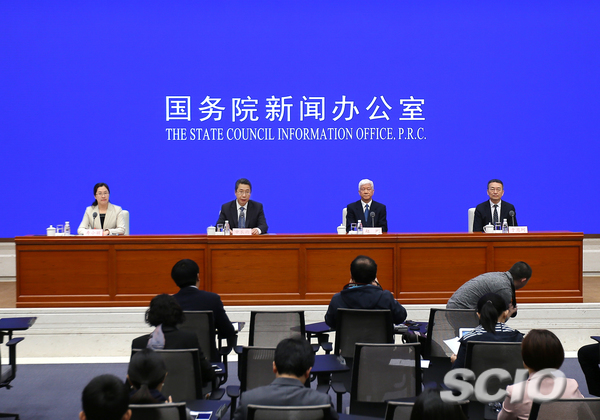
SCIO briefing on China's efforts to protect intellectual property
Speakers:
Shen Changyu, director of the National Intellectual Property Administration;
Zhao Gang, vice director of the National Intellectual Property Administration;
Yu Cike, director of the Copyright Administration under the Publicity Department of the CPC Central Committee
Chairperson:
Shou Xiaoli, Press Bureau of the State Council Information Office
Date:
April 28, 2019
Shou Xiaoli:
Ladies and gentlemen, good morning. Welcome to the press conference. April 26 this year was the 19th World Intellectual Property Day. China's protection of intellectual property has received great public attention. Today, we have invited Mr. Shen Changyu, director of the National Intellectual Property Administration, to introduce China's efforts to protect intellectual property in 2018, and answer some of your questions. Also with us today are Mr. Zhao Gang, vice director of the National Intellectual Property Administration, and Mr. Yu Cike, director of the Copyright Administration under the Publicity Department of the Communist Party of China (CPC) Central Committee.
Now, Mr. Shen will give us a brief introduction.
Shen Changyu:
Thank you, Ms. Shou. Good morning, everyone. First, I wish to thank the State Council Information Office and all our friends from the press for having shown understanding and support for the work on intellectual property rights over all these years. General Secretary Xi Jinping delivered a keynote speech at the opening ceremony of the Second Belt and Road Forum for International Cooperation in Beijing, April 26, 2019. In his speech, Xi announced a series of major reforms and opening-up measures that China will take, stressing that China will intensify its efforts to enhance international cooperation in the protection of intellectual property. According to Xi, China will spare no effort to foster a business environment that respects the value of knowledge, fully improve the legal framework for protecting intellectual property and step up law enforcement. It will also enhance protection of the lawful rights and interests of foreign intellectual property owners, stop forced technology transfers, improve protection of trade secrets, and crack down hard on violations of intellectual property in accordance with the law. Xi's remarks further convey China's stance and attitude toward its efforts to fully protect intellectual property in accordance with the law to the international community. His remarks also provide principles and guidance for the development of China's intellectual property rights, which will be fully studied, grasped and put into practice.
Now, I will give you a brief introduction on the development of China's intellectual property rights in 2018.
In 2018, the CPC Central Committee and State Council elevated IPR protection to an level of importance that is unprecedented. General Secretary Xi Jinping emphasized in his keynote speech at the opening ceremony of the Boao Forum for Asia Annual Conference 2018 that IPR protection is the centerpiece of the system for improving property rights protection, and it would provide the biggest boost to enhancing the competitiveness of the Chinese economy. The State Council has made a series of important decisions on IPR protection. Over the past year, the departments of the Chinese government and local authorities have worked to implement a series of important decisions on IPR by the CPC Central Committee and State Council, so as to move faster to transform China into a country that is strong on intellectual property rights, and to ensure new progress can be made in all works.
First, we made stable efforts to transform China into a country that is strong on intellectual property rights. We earnestly implemented last year's plan on deepening the national IPR strategy and building China into a country that is strong on IPR. We started to formulate the Outline of the National Intellectual Property Strategy for 2035. We completed an evaluation of the implementation of the current version of the Outline of the National Intellectual Property Strategy as well as a mid-term evaluation on the plan for IPR protection and utilization in the 13th Five-year Plan Period (2016-2020). We also restructured the National Intellectual Property Administration, which is now also responsible for the administrative adjudication of patents, trademarks and geographical indications, while affairs related to copyrights are now administered by the Publicity Department of the Communist Party of China (CPC) Central Committee. The quality and efficiency of IPR examination continues to rise: The examination process for trademark registration has been cut to six months, and for high-quality patents the process has been cut by 10%. A total of 5.86 billion yuan in patent application fees was exempted or reduced over the past year. A national appeal court for IPR cases was inaugurated at China's Supreme People's Court so as to better strengthen IPR protection and management.
Second, the protection of intellectual property rights has been comprehensively strengthened. The draft amendment to the Patent Law passed the first review of the Standing Committee of the National People's Congress. The draft established a punitive compensation system for infringement and has greatly increased infringement costs. We have been actively promoting the revision of the Copyright Law and initiated the revision of the Trademark Law. The Regulation on Patent Agency and the Regulations on the Protection of New Varieties of Plants were revised. The Action Plan for the "Internet Plus" Intellectual Property Protection was formulated. A total of 38 ministries and commissions have carried out joint punishment for serious discredit conducts in the field of intellectual property (patents). The administrative law enforcement of intellectual property rights continued to strengthen, with 77,000 patent administrative law enforcement cases being handled, up 15.9% year-over-year. Altogether 31,000 trademark violation cases were investigated and handled, with a total case value of 550 million yuan. 2,500 infringement and piracy cases were filed and investigated. 3.77 million pieces of pirated products were seized, and 1.85 million infringing links were deleted. Customs at all levels detained altogether 44,550 batches of infringing goods. The number of infringing goods was 23.18 million, with a total worth of 200 million yuan. The courts of all levels received 301,279 first instance IPR cases, up 41.13% year-over-year. The public security organs of all levels registered nearly 28,000 cases of infringement and counterfeit crimes. Of them, 19,000 cases were solved, and 28,000 suspects were arrested. The case value amounts to 9.87 billion yuan. The procuratorates of all levels approved the arrest of more than 5,600 people who were involved in more than 3,300 IPR infringement cases. More than 4,400 cases involving more than 8,300 people were brought to public prosecution.
Third, the amount and quality of intellectual property creations have risen. We further implement the patent quality improvement project and trademark brand strategy, and severely crack down on non-normal patent applications and trademark preemptive registration and hoarding behaviors. The number of domestic invention patents (excluding Hong Kong, Macao, and Taiwan) reached 1.6 million pieces, an increase of 18.1% year-on-year. The ownership number of invention patents per 10,000 population reached 11.5 pieces, and the number of Patent Cooperation Treaty (PCT) international patent applications received and processed was 55,000, a year-on-year increase of 9%. The number of valid domestic trademark registrations reached 18.05 million, a year-on-year increase of 32.8%. The number of applications for international trademarks registration according to the Madrid Agreement Concerning the International Registration of Marks was 6,594, a year-on-year increase of 37.1%. A total of 2,380 geographical indication products and 4,867 registered geographical indication trademarks were approved. A total of 1,990 new varieties of agricultural plants and 405 new varieties of forestry plants were awarded, an increase of 34% and 153.1% respectively. The number of registrations of works and computer software copyrights reached 2.35 million and 1.1 million, an increase of 17.48% and 48.22% respectively. According to the Global Innovation Index 2018 Report published by the World Intellectual Property Organization (WIPO), China ranked 17th in the world and became the only middle-income economy to enter the top 20.
Fourth, the use of IPR has been greatly improved and is now more efficient. We have improved the national public service platform for the trading of IPR and launched IPR trading systems in 16 major cities. We have rolled out a set of measures to use IPR to promote the innovative development of private enterprises. The fund raised by pledging patents and trademarks totaled 122.4 billion yuan, up 12.3% year-over-year. We issued 40 golden awards to patents and external designs, and 20 golden awards to copyrights. We checked 8,179 enterprises for their use of geographic indication in products with a total output value of 1 trillion yuan. From 2016 to 2018, the export of IPR royalties reached US$11.51 billion, achieving the goal set in the 13th Five-Year Plan ahead of schedule.
Fifth, we have deepened the international cooperation on intellectual property rights. We hosted the 2018 High-level Conference on Intellectual Property for Countries along the Belt and Road, took an active part in multilateral activities under the framework of the World Intellectual Property Organization (WIPO) and the World Trade Organization. We have also enhanced cooperation with international organizations such as the International Union for the Protection of New Varieties of Plants, and improved international rules regarding intellectual property rights. Together with the WIPO, we established a Technology and Innovation Support Center. We tried to promote an earlier implementation of the Beijing Treaty on Audiovisual Performances, as 23 countries have either ratified or joined the treaty. We held the Global IP Protection and Innovation Development Conference during the first China International Import Expo. The number of China's partners in the Patent Prosecution Highway (PPH) program has increased to 28. China's valid patents have also been officially registered in Cambodia, and the results of our patent examination are recognized in Laos.
The above is the development of China's intellectual property rights in 2018. Now I'm ready to take your questions. Thank you.
Shou Xiaoli:
The floor is now open to questions. Please identify your media outlet before asking questions.
CCTV:
During the Second Belt and Road Forum for International Cooperation, President Xi Jinping said more efforts will be made to promote international cooperation on intellectual property protection. My question is for Mr. Shen. What is the current status of the cooperation on intellectual property protection under the Belt and Road Initiative? What will be done to improve the cooperation in the future? Thank you.
Shen Changyu:
Thank you for your question. As you said just now, during the Second Belt and Road Forum for International Cooperation, General Secretary Xi Jinping expounded on China's major principles and policies regarding intellectual property protection, and pledged to strictly protect intellectual property under the law, which has won international praise. The National Intellectual Property Administration is now working hard to study related issues and develop feasible and tailored measures to ensure an effective implementation of these policies.
Regarding cooperation in this field under the Belt and Road Initiative, we have cooperated with other departments and held the High-level Conference on Intellectual Property for Countries along the Belt and Road in 2016 and 2018 respectively. General Secretary Xi wrote congratulation letters for both meetings. So far, a regular mechanism for cooperation has been established to promote intellectual property protection under the BRI. Practical cooperation projects in eight fields, including communication on macro policies, intellectual property examination, development of fundamental capabilities, and exchange of information and data, have been carried out.
So far, steady progress has been made in every project, many of which have achieved significant results as a result of cooperation. For instance, the applications of patents and trademarks of China and countries along the route of the BRI are rapidly and continuously increasing. In addition, as I've mentioned, the validation of the patents authorized by China in Cambodia, and Laos' recognition of the results of the examination of Chinese patents, have greatly enhanced bilateral economic and trade cooperation, as well as technological and cultural exchanges. China has established a postgraduate program - a masters in intellectual property for students from countries along the route of the BRI, and students in the first class under this program have graduated. In addition, we have launched the portal for the cooperation of intellectual property under the BRI, which has access to our Patentcloud examination system. We agree to strengthen and build closer communication on global intellectual property issues in order to promote the development of open, inclusive, balanced and effective international rules of intellectual property, as well as to further support the joint construction of the BRI.
Next, we will put into practice the principles outlined in General Secretary Xi Jinping's keynote speech, and deliver more substantial and concrete outcomes of intellectual property cooperation under the BRI. The third High-Level Conference on Intellectual Property for Countries Along the Belt and Road will be held next year. And we will take the principles outlined in General Secretary Xi Jinping's keynote speech as our guide to review the progress of intellectual property cooperation projects in eight aspects in the past two years. On this basis, we will draw up a blueprint of the relevant projects and issues relating to intellectual property cooperation under the BRI in the upcoming conference. This will allow us to provide a better ecosystem of innovation to support technological exchanges and cooperation on a national-level in accordance with market principles and laws. Thank you.
China Radio International:
Some reports say that among China's 10 million or more valid registered trademarks, some of them are malicious trademark registration and trademark hoarding, which have disturbed the standard registration procedure and violated the principle of fair competition. What measures will the National Intellectual Property Administration take to combat malicious trademark registration and hoarding?
Shen Changyu:
Thanks for your question. We have done a lot of work in this aspect. Now, I would like to invite the deputy commissioner of the National Intellectual Property Administration, a trademark expert, to answer this question.
Zhao Gang:
Thank you. Just as you mentioned, China ranks first in the world with its large number of registered trademarks. However, a small portion of the registration is driven by malicious intent, which we usually call them "malicious trademark registration." It has been divided into two categories. The first category is for people who register names of famous brands on irrelevant products or services or register some popular international brands in China. The second category is for people who register trademarks and then sell them for a profit. This is what we call the "hoarding of registered trademarks." The former type of malicious registration, which is clearly defined in relevant laws, has been effectively contained in recent years thanks to our great efforts to crack down on it. Regarding the hoarding of registered trademarks, however, in spite of principle provisions, law enforcement is difficult due to lack of direct, specific, and operable articles.
In recent years, the former State Administration for Industry and Commerce and the newly restructured State Intellectual Property Office have paid close attention to and taken solid strides on the crackdown on hoarding registered trademarks for profit. In accordance with the Trademark Law, we declare the invalidity of a large number of hoarded trademarks that lie unused, especially those resembling famous registered trademarks. In some cases where trademark infringement cannot be dealt with through application or complaint processes, we will declare invalidity after registration in accordance with Article 44 of the Trademark Law. Both administrative organs and people's courts agree that a trademark can be canceled, if the holder has registered a large number of trademarks but is not using them. However, the implementation involves many challenges before registration.
Therefore, the Standing Committee of the National People's Congress revised the Trademark Law on April 23. As you may have noticed, the revision aims to stop at the source those registration applications that are not intended for use. The Trademark Office of National Intellectual Property Administration can directly reject applications during the review phase. If the Trademark Office of National Intellectual Property Administration fails to spot such cases during the review phase, as long as an objection is raised, the application can be stopped. Even if registration has been approved, it can be dismissed through another procedure. The procedure that determines whether the application is valid is very powerful. And the revised Trademark Law also stipulates that, for those who register a trademark maliciously, in addition to their trademark being rejected and invalidated, they may also face administrative penalties such as warnings and fines. I believe that after the revision, the Trademark Law will be more effective in combating behaviors such as hoarding of trademarks and malicious registration. In the next stage, we must also step up the development of supporting measures to ensure implementation of this revised Trademark Law. Thank you.
Science and Technology Daily:
Just now, Mr. Shen, you introduced China's intellectual property rights development of 2018. Could you please give more information on the achievements and progress made by our country in IPR protection? Thanks.
Shen Changyu:
Thank you for your question. IPR protection is crucial for the system to improve property rights protection, so our entire society pays close attention to this issue. In 2018, the achievements our country made in IPR protection were evident in the following areas.
First, the understanding of IPR has been deepened. Last year, General Secretary Xi Jinping emphasized in his keynote speech at the opening ceremony of the 2018 annual Boao Forum for Asia that IPR protection is the centerpiece of the system to improve property rights, and it would provide the biggest boost to enhancing the competitiveness of the Chinese economy. The statement leads us to a much deeper understanding on IPR protection and provides us with a fundamental principle.
Second, the duty of IPR protection has been optimized and readjusted. Through reform of institutions, the centralized management of trademarks, patents and geographical appellation of origin has been realized. The law enforcement team of the State Administration for Market Regulation is in charge of unified law enforcement on trademarks and patents. Meanwhile, the National Intellectual Property Administration is responsible for construction of the system to improving property rights protection, guidance of law enforcement for trademarks and patents and judging standards for patent and trademark infringement. All of these raise the effectiveness of law enforcement for IPR protection.
Third, a punitive compensation system for IP infringements has been introduced, which demonstrates significant progress in this regard. This punitive compensation system has been specifically written into the draft amendment to the Patent Law, by which fines could be imposed up to five times for malicious IP infringement. In the recently-passed amendment to the Trademark Law, the max compensation limit for malicious trademark infringement was been raised to a quintupled level, which is a fairly high standard globally.
Fourth, the credibility and efficiency of IP examination has been enhanced, the notable progress of which was also been seen last year. During the first China International Import Expo in Shanghai in 2018, General Secretary Xi Jinping made a clarion call on the need for enhanced credibility and efficiency of IP inspection. The State Council has conducted certain deployments, noting that in the next five years, the time it takes to finish trademark inspections should be reduced from eight months to less than four months, an efficiency level which would rank top among the OECD countries. Also, examination times for inventions and patents should be reduced by one-third, while for high-value patents the time could be cut by half, which will mean a ranking of the most efficient in the world. All of these strategies will contribute to strengthening the protection of IP from its source.
Fifth, joint punitive mechanisms have been built. Together with another 37 departments, the National Intellectual Property Administration of China has built joint punitive mechanisms against bad faith in the fields of IP that maximizes continuous negative influence on businesses involved in IP infringement. The mechanism is said to be the strictest punitive measure in the history of IP, and has forcefully deterred the practice of IP infringement. I believe all of the points mentioned above constitute fundamental reform of IP protection in China, and they have drawn wide attention to different quarters of our society. Thank you.
HKTV:
The United States and some other western countries have accused China of not doing enough in cracking down on infringements. There are also cases of stealing and infringing intellectual property rights. May I ask Mr. Shen, what is your response to this? How do you view China's determination to crack down on infringement?
Shen Changyu:
Thank you for your question. First of all, I should say that some accusations about China's intellectual property protection are groundless. They have not seen the tremendous progress and achievements that China has made over the years in terms of intellectual property protection.
In fact, since the reform and opening up, especially since the 18th CPC National Congress, China has upped the ante in IPR protection, insisting on the equal treatment and protection of IPR of domestic and foreign enterprises. China has made great progress, which is recognized by the world. The U.S. intellectual property authorities and relevant media also said that China's IPR environment is at the forefront of developing countries and is becoming the preferred place for multinational corporations to initiate intellectual property litigation in global range. The reason they do so is because they believe that they can be treated equally in China.
It should be said that there's no limit in improving IPR. At present, there's still room for China to make improvements, and we are stepping up efforts to resolve these problems. At the same time, we must realize that the issue of intellectual property infringement is a worldwide problem. The issue exists in every country, only that different countries at different stages of development have different manifestations. All countries should strive to improve their business environment and solve their own problems.
Of course, apart from the efforts of individual countries, international cooperation is also needed to solve the problem of intellectual property infringement. We are willing to work with Western countries including the United States, to strengthen communication and cooperation in the field of intellectual property protection. We hope to work jointly to combat all kinds of infringements and create a good business environment, because strengthening IPR and cracking down on infringements are not only the need for fulfilling our international obligations but also the inherent need of China's implementation of innovation-driven development. Therefore, we must work together to promote a good international business environment and promote the prosperous development of the world. Thank you.
China News Service:
I want to ask Mr. Yu this question. The issue of film piracy during the Spring Festival this year has aroused widespread concern in society. What actions has the National Copyright Administration taken to combat piracy? In addition, what further governance actions will the National Copyright Administration take against such issues in the future? Thank you.
Yu Cike:
Thank you for your question. Chinese theaters screened eight domestic films during the Spring Festival, which were widely popular, and the films also set new box office records for the Spring Festival film season. However, it is true that the issue of film piracy has also triggered widespread concern in society. In order to maintain good copyright order and ensure the healthy and prosperous development of the film industry, the National Copyright Administration has taken many effective measures along with the State Film Administration, the Ministry of Public Security, the Cyberspace Administration of China, and the Ministry of Industry and Information Technology, strengthening copyright protection of theatrical film releases.
First, we cracked down rigorously on stealthy recording and the spread of piracy and infringement. The National Copyright Administration and the Ministry of Public Security formed a special task force to check 11 key provinces and cities such as Beijing and Jiangsu province, conducting case investigations, cracking down on covert recordings and various websites, apps and e-commerce platforms that spread pirated movies. Currently, we have cracked down on 22 major cases of pirated theatrical film releases with help from public security organs. Among them, we hunted down a major stealthy recording case in Yangzhou city, Jiangsu province, knocking out a criminal gang that pirates theatrical releases and arresting 52 suspects.
Second, we dealt quickly with infringing web links. We increased the monitoring of film piracy, carefully screened public reports, and quickly deleted unlawful information. Until now, we have deleted more than 30,000 links of pirated Spring Festival films, with help from the relevant government departments.
Third, we increased copyright pre-warning protection. Since March, the National Copyright Administration has released two lists of key released films protected by cinema copyrights, bringing 15 theatrical releases (including 7 overseas films) under our pre-warning protection, requiring relevant network service providers to take effective measures to deal with infringement and piracy in a timely manner.
Fourth, we promoted social co-governance of copyright protection. We promoted the establishment of a theatrical releases copyright protection alliance on April 26, World Intellectual Property Day, and guided producers, distributors and commercial websites to carry out copyright cooperation to take full advantage of collective action to protect IP rights.
Next, the National Copyright Administration will carry out special action on theatrical releases copyright protection, further increase efforts to crack down on infringement and piracy of theatrical releases, strengthen self-discipline and actions of rights protection in the film and television industries, and promote relevant internet enterprises to take the lead responsibility. At the same time, regarding the current situation that a large number of small piracy websites have servers located outside of China, we will strengthen cross-border law enforcement cooperation with relevant countries and regions to jointly crack down on internet infringement and piracy. Thank you.
Wall Street Journal:
China and the U.S. will hold trade talks next week. What kinds of progress in IPR protection will promote the bilateral talk? Is there any progress made that is targeted to the U.S. concerns? Are there any enforcement measures in place to guarantee more progress in IPR protection? Is it possible to say that China's potential progress in IPR protection will prompt the U.S. side to cancel its tariff toward China?
Shen Changyu:
Thank you for your question. The China-U.S. high-level trade talks are of concern in both countries, as well as in the international community. Not long ago, the two sides made new progress in the ninth round of negotiations, as they implemented the important consensus made by the two heads of state during their meeting in Argentina and held talks on the text of the agreement. IPR protection is an important part of that text, according to releases by related departments. I think their releases also cover the answers to your questions.
Since the country's reform and opening up, and especially after the 18th CPC National Congress, China has strengthened IPR protection and achieved recognizable achievements as it committed to provide equal treatment to domestic and foreign companies. It is fair to say that IPR protection is not only a focus of the China-U.S. trade talks and an issue of international concern, but also a necessity for China's wider opening up and its next step for innovation-driven development. This year, we will take further steps to comprehensively strengthen IPR protection, which may contain answers to your questions.
First, to improve related laws and regulations. We will promote amendments to the patent law and improve the punitive compensation system to significantly raise the cost to offenders. We will impose a fine of up to five times for serious IPR infringements, a high penalty compared to the international standard. The amendments to the Trademark Law that we just completed have increased the punitive compensation for serious trademark infringements.
Second, to strengthen the source protection system. We will improve the quality and efficiency of IPR inspections, cut the process for trademark and patent inspections, and provide timely authorization and sturdy rights. Stricter enforcement measures will also be taken to fight against abnormal patent applications, as well as unethical trademark applications and trademark hoarding. Mr. Zhao Gang already answered questions related to that topic.
Third, to improve law enforcement measures. We will strengthen our market supervision and law enforcement team, improve the judgement criteria for trademarks and patents infringements, and increase effectiveness of law enforcement.
Fourth, to improve the co-governance system. We will take joint punitive actions against serious violators. "Once discredited, violators will face restrictions everywhere." Like I just said, this is among the strictest punitive measures in IPR history.
Fifth, to improve the coordination mechanism to ensure quick authorization, confirmation, and rights protection. We will provide more efficient, easier and less costly channels to safeguard the rights of market entities.
These works are essential to IPR protection and major concerns of the China-U.S. trade talks, and we are going to promote them throughout the year. Therefore, a large part of the trade talks coincides with what we are doing and will continue to do in the future. And we will strive to advance those related works. Thank you.
Guangming Daily:
World IP Day was celebrated on April 26 this year, with the theme of "IP and Sports." With the scheduled opening of the Winter Olympics in China approaching, my question is about the protection of IP for the Olympic Games. Would you please provide an overview of the pertinent issues?
Shen Changyu:
Thank you. The theme of this year's IP Day was "Reach for the Gold: IP and Sports," which, by my view, is a high integration of IP culture and athletic spirit. It has created a general environment tailored to the Winter Olympics and Winter Paralympic Games scheduled to be hosted in China in 2022.
Actually, IP is closely related to sports, which can be exemplified by the massive adoption of new high-tech in sports fields, upgraded facilities and new materials, many of which are patented products. In addition, copyright protections are highly relevant in the rebroadcast of sports events, brands of sports products, and the ability to generate increased profits from trademark protections.
The protection of IP rights at the Olympic Games has always been a big concern of China. As early as 2002, we issued "Regulations on the Protection of Olympic Symbols," which was amended last year. Regarding the Winter Olympics, we have greatly endeavored to protect its IP rights since China won the bid. We have launched all-around and multi-dimensional protections of the patent, trademark and copyright of the emblem, as well as related symbols.
In the next stage, we'll focus on the IP protection of the Winter Olympics in two underscored aspects. First, we'll endeavor to protect the IP rights of its torch and mascot. Second, we'll establish a system, particularly in Beijing and Hebei provinces, to report on and prosecute any violations relevant to the Games. Meanwhile, we'll also make growing efforts to crack down on any infringements to ensure a splendid Winter Olympics. Thank you.
People's Daily:
Mr. Shen, the Outline of National Intellectual Property Strategy released in 2008 might expire in 2020. So what are our next steps? Thanks.
Shen Changyu:
Thank you for your question. I believe you are an expert in the field of intellectual property, especially in that you know IP strategy very well. In 2008, China issued the Outline of National Intellectual Property Strategy, which is the first strategy outline in its field. Since its implementation ten years ago, China's IP industry has achieved rapid growth and great results, showcasing the plan's leading role.
Last year, we completed a thorough review of the strategy's implementation. It revealed that the major goals and tasks designed for the year 2020 will be realized successfully, and some of them have already been met. A report of this review was published a few days ago, and provides a systematic display of the achievements made by implementing the strategy outline over the past 10 years. Generally speaking, progress was made in the following aspects:
First, the creation of IPR has been advanced in both quantity and quality, making China a major IPR country. Second, IPR protection has been strengthened and the environment for business and innovation has improved, leading to a steady increase in social satisfaction with IPR protection. Third, the utilization of IPRs has produced a powerful effect, offering a strong impetus for economic development. Fourth, a model of IP management based on China's national conditions has been established, and the performance of regulations and capacity of public services have seen a continual increase. In terms of international IPR cooperation, China has remained a strong defender, major participant and active builder of international trade rules. In addition, since the Outline of the National Intellectual Property Strategy was issued in 2008, public awareness of IPR protection has significantly improved. We have made considerable progress.
To ensure the continuity of the strategy's implementation, to ensure this strategy can keep playing a leading role, and guided by the "two-step" strategy adopted at the 19th National Congress of the CPC and the related policies developed by the State Council, we are working hard to formulate the Outline of the National Intellectual Property Strategy for 2035. We are trying our best to make our country more robust on intellectual property rights, and ensure the continuous implementation of the strategies on intellectual property. The first draft of the outline will be finished at the end of the year and we welcome the participation, support and attention from all parts of society till then. Thank you.
Shenzhen Satellite TV:
Last year, patent application cases in Shenzhen reached 228,600, or approximately 90 patented inventions per 10,000 people on average, nearly 10 times the number of the national average. Additionally, the city has taken the lead among mid- and large-sized cities in the number of applications for the Patent Cooperation Treaty (PCT) for 15 years in a row. At the same time, the "Regulations on IP Protection in Shenzhen Special Economic Zone" is the first comprehensive set of regulations for IP protection in the country. An IP tribunal was also established in the city's Qianhai area. Mr. Shen, how would you evaluate the city's achievements in patent application and IP protection? What's your opinion of the "Shenzhen phenomenon"? Thank you.
Shen Changyu:
Thanks for your questions. During the past few years, Shenzhen has indeed made notable progresses in creating, protecting, using and managing IP rights, particularly with its leading role in the number of PCT applications.
In my view, those achievements should be attributed to the strong creativity of the city, and local innovative entities are important driving forces. Secondly, they should be attributed to the intensive local awareness of IP protection, in support of which a slew of measures have been adopted there. More to the point, awareness of IP rights is strong in Shenzhen. Those factors combined have fueled the rapid development of local IP businesses.
As you said, the number of patent applications, especially those for the PCT in Shenzhen, has continued to boom, which is probably caused by local enterprises' international strategies for global business. Meanwhile, many local companies have developed well in the global market. They have paid substantial attention to international patent applications, which is highly relevant to corporate operations,.
We hope the city can make more progress in regards to IP operation. Shenzhen is a model city in this particular sector country-wide, a competitive place for the IP industry and a pilot zone for experimental IP projects. We'll increasingly support it in its endeavors in IP development. Thank you.
China Intellectual Property News:
During the "Two Sessions" this year, some NPC deputies and CPPCC National Committee members suggested the amendment to the Patent Law should grant jurisdiction to the court for prosecution of patent invalidity, in order to address the issue of the long duration of patent prosecution. As far as we know, the National Intellectual Property Administration of China is responsible for the prosecution of patent invalidity. What's your opinion on this situation?
Shen Changyu:
Thank you for your question. Indeed, the issue was raised regarding the amendment to the Patent Law during the "Two Sessions" this year. We appreciate their attention to the amendment to the Patent Law. The prosecution of patent invalidity is a fairly professional and complex issue.
As you've said, currently the National Intellectual Property Administration holds responsibility for the prosecution of patent invalidity. Speaking from the nature of the Patent Law, judgment on patent invalidity in China is an important component of the administrative process of patent right confirmation. The procedure is a subsequent administrative oversight and error-correcting program for the earlier authorization and examination act, which is similar to a special kind of administrative reconsideration. Such a system is both a legally mandated duty of the National Intellectual Property Administration and an institutional arrangement that has lasted for decades in China. Also, such duty is practiced by the patent administrations of the majority of countries around the world. China is not the only case in this regard.
Some experts believe that the long duration of patent prosecution is partly caused by judgment on patent invalidity. Patent prosecution indeed takes a long time, but the reasons for specific cases vary. I think one important reason is that patent cases are generally complicated and involve great technical complexity, thus increasing the difficulty of prosecution.
Some attribute it to the problem of system design, while others believe it's the result of "parallel system," which means that the determination of both patent right and the infringement are charged with different authorities. These type of opinions were discussed in articles and at meetings. However, it doesn't seem quite objective. According to the analysis of the statistics, 93% of the cases on patent infringement judged in 2018 are not influenced by invalid procedures. That is to say, the "parallel system" is not the pervasive factor causing the long period for patent protection.
Some people believe that circulation in patent litigation is another cause for the unreasonable delay in filing patent infringement litigation. This type of opinion also lacks evidence. According to the statistics from 2010 to 2018, only around 30 cases of invalidation application were caused by such reason, accounting for only 0.1% of the total during the same period. So, it is not the major cause for such delay.
However, it still requires more studies from various parties to find out the specific reason. Since we brought up the issue today, I'd like to brief you about China's examination on cases of invalidation application. Currently, China examines efficiently on cases of invalidation application. In 2018, it took 5.1 months on average to examine a case of invalidation application, the shortest in the world. About 97% of the cases of invalidation application will be resolved in the administrative procedures, which supports the intellectual property protection and is widely recognized by the relevant parties.
Shou Xiaoli:
The press conference ends here today. Thanks to Mr. Shen and our guest speakers, and thank you, everyone.
By Li Xiaohua, Chen Xia, Li Xiao, Wang Yanfang, Guo Yiming, Li Huiru, Zhang Rui, Wu Jin, Zhang Liying, Zhu Bochen, Gong Yingchun, Wang Qian, Li Shen, Zhou Jing, Jennifer Fossenbell, Laura Zheng

