SCIO briefing on China's economic performance in July 2026
China.org.cn | October 28, 2026
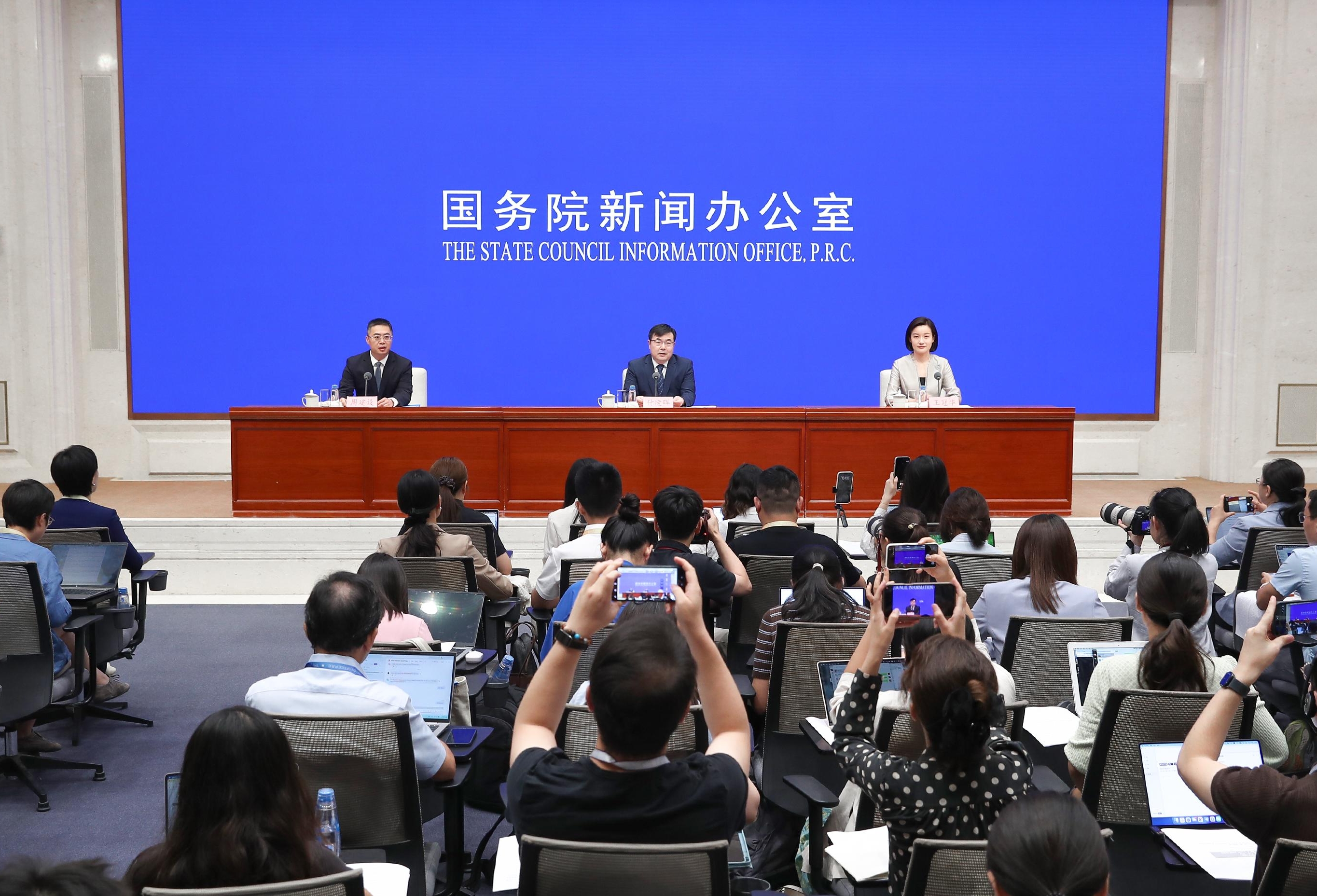

Dazhong Daily:
Currently, China's economic structural transformation has entered a critical phase. Some analysts believe that structural upgrading will help create new advantages for economic development. What were the main highlights of economic restructuring in July? What data is worth noting? Thank you.
Fu Linghui:
Thank you for your questions. Economic restructuring is an issue that many people are concerned about. In recent years, China's economic structural optimization and upgrading has been quite evident. This is not only a necessary part for pursuing high-quality development, but also an integral part of our efforts to improve the quality and efficiency of economic development. Data from the first seven months of the year shows that China's economy maintains steady growth, and the structural optimization continues to gain momentum. This is creating new advantages for economic development and underpinning the economy's positive momentum going forward.
First, the demand structure continues to optimize. From the perspective of consumption, as consumer demand shifts from basic quantitative needs to higher quality and standards, the shares of service consumption and quality consumption have been rising. In the first half of the year, per capita spending on services increased its share of total consumer expenditure by 0.2 percentage point year on year. This trend is also reflected in market sales over the first seven months, during which retail sales of services increased by 5% year on year from January to July, significantly outpacing retail sales of goods, indicating that the share of retail sales of services in total market sales is increasing. Within goods consumption, the share of upgraded consumer goods is also expanding. In the first seven months, retail sales of upgraded goods, such as communication equipment, cultural and office supplies and cosmetics, saw their combined share of retail sales of enterprises above designated size increased by 2.6 percentage points year on year. On the investment front, a sustained focus on the real economy has channeled high-quality resources into manufacturing, driving up its share of total investment. From January to July, manufacturing investment accounted for 26.6% of total investment, an increase of 1.4 percentage points year on year. Investment is playing a crucial role in optimizing the supply structure, with an expanding share flowing into innovation and the development of new quality productive forces. From January to July, investments in high-tech industries and intellectual property products saw their share of total investment rise by 1.2 and 2.1 percentage points year on year, respectively. Turning to foreign trade, the structure of exports in goods and services continues to improve, moving steadily up the global value chain. In the first seven months, China's mechanical and electrical products accounted for 63.8% of total goods exports, an increase of more than 3 percentage points year on year. Meanwhile, in the first half of the year, knowledge-intensive service exports accounted for more than half of total service exports, reaching 53.5%. Together, these figures indicate that China's goods exports are transitioning from labor-intensive items to high-tech, high-value-added products, while service exports are shifting from labor-intensive services to knowledge-intensive ones, reflecting a clear climb up the value chain for both goods and services exports.
Second, industrial upgrading continues to progress. On the agricultural front, the share of protected agriculture and large-scale livestock farming in China's total production has continued to expand in recent years. In the industrial sector, the transition toward high-end manufacturing is steadily gaining ground, and the strength of equipment manufacturing is improving. Both high-tech manufacturing and equipment manufacturing account for a growing share of industrial output. In the first seven months, high-tech manufacturing and equipment manufacturing accounted for 17.9% and 37.2% of total value-added output by industrial enterprises above designated size, up by 1.5 and 1.7 percentage points year on year, respectively. In the service sector, modern services are gaining momentum, driven by upgrading consumer demand and industrial transformation and upgrading, as well as next-generation information technologies such as artificial intelligence and big data. In the first half of the year, the value-added output of information transmission, software and IT services, along with leasing and business services, each increased their share of GDP by 0.3 percentage point compared with a year earlier. Data from July shows that such rising share has carried over into the month.
Third, urban-rural and regional development has improved. From an urban-rural perspective, comprehensive rural revitalization has advanced steadily, with a range of measures taken to strengthen agriculture, revitalize rural areas and raise farmers' incomes. The urban-to-rural per capita disposable income ratio continued to narrow, standing at 2.37 in the first half of the year, down 0.05 from a year earlier. As county-level commercial systems develop rapidly, logistics, distribution and information networks are reaching further into rural areas, and consumption in lower-tier markets is gaining momentum. From January to July, rural sales accounted for 13.4% of total retail sales of consumer goods, up 0.2 percentage point year on year. From a regional perspective, the coordinated regional development strategy and major regional strategies have been further implemented. Regions have given full play to their comparative advantages, unleashing stronger development momentum, and major economic provinces have played a leading and stabilizing role in the national economy. The eastern region is accelerating its development into a hub for innovation, while the central and western regions continue to demonstrate their late-mover advantages. Overall, high-quality development is showing sound momentum. Some emerging industries in the eastern region have outperformed the national average. Meanwhile, data from the first seven months shows that industrial growth in many central and western provinces outpaced it as well.
We must also recognize, however, that improving and upgrading the economy cannot be achieved overnight; it requires sustained, long-term effort. Going forward, we will fully, accurately and comprehensively implement the new development philosophy, deepen reform and opening up, promote innovation, develop new quality productive forces in light of local conditions, continue to optimize the economic structure, and promote coordinated economic development. Thank you.