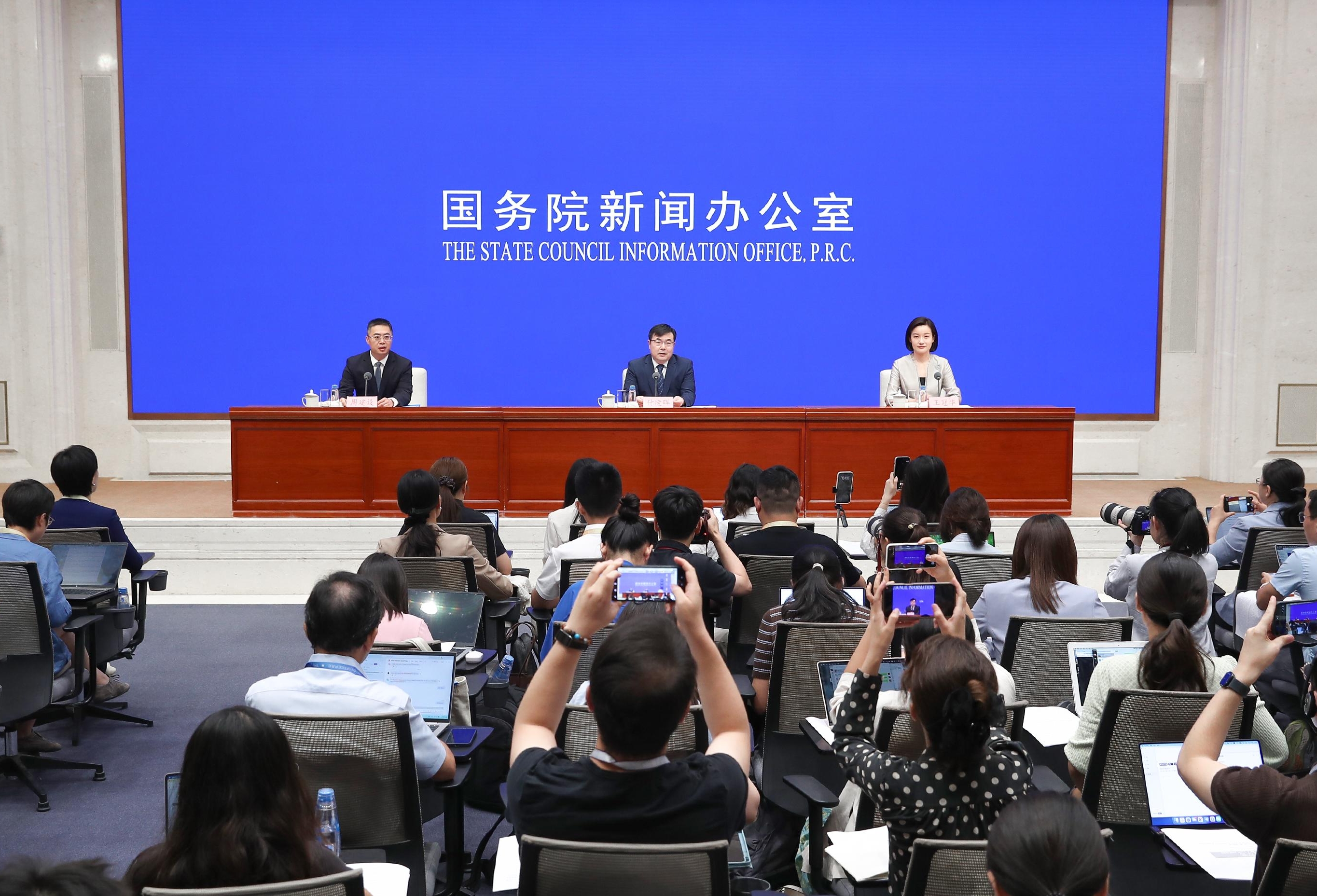
SCIO briefing on China's economic performance in July 2026
China.org.cn | October 28, 2026

China Business Journal:
In July, the year-on-year increase in PPI narrowed. What were the main reasons for that? Could you walk us through the highlights in the PPI data? What are the new characteristics of industrial product prices in China? Thank you.
Fu Linghui:
I would like to invite Ms. Wang to answer your questions.
Wang Guanhua:
Thank you for your questions. Since the beginning of this year, under the combined effect of international and domestic factors, China's producer price index for industrial products (PPI) emerged from its downward range in March and has now risen year on year for five consecutive months. We can look at industrial product prices in July from three aspects.
First, the widening month-on-month decline and the slowdown in the year-on-year increase in PPI mainly reflect the pass-through effect of falling international commodity prices. In July, international crude oil and non-ferrous metal prices fluctuated downward. Domestically, month-on-month prices fell 11.8% for petroleum extraction, 8.4% for refined petroleum product manufacturing and 4.2% for organic chemical raw material manufacturing. Prices also fell 2.1% for non-ferrous metal mining and beneficiation and 1.7% for non-ferrous metal smelting and rolling processing. Preliminary calculations show that these five industries combined cut the month-on-month PPI by approximately 0.65 percentage point. On a year-on-year basis, they accounted for about 0.64 percentage point of the slowdown in PPI growth. Imported international factors were therefore the main driver of the month's PPI change. Seasonal factors also affected prices in some industries. The national average temperature in July this year was higher than the average for July in previous years, with more rainfall and frequent typhoons. As a result, construction projects in some areas slowed down, and prices in the ferrous metal smelting and rolling processing industry and the non-metallic mineral products industry both declined compared to the previous month.
Second, industrial transformation and upgrading, together with improvements in the quality and scale of consumption, have provided strong support for industrial product prices. The PPI emerged from its downward trend in March, when the year-on-year change turned positive. At that time, only 13 out of the 41 major industrial categories saw price increases. By July, that number had reached 23, steadily broadening the share of industries with rising prices. In particular, prices in fields related to new quality productive forces, such as AI and high-end equipment, rose significantly. Prices in the electrical machinery and equipment manufacturing industry rose 5.7% year on year, and those in the computer, communication and other electronic equipment manufacturing industry rose 4.4% year on year, with both increases widening compared to the previous month. Growing demand for smart and quality consumption drove smart home consumer device manufacturing prices up 15.5% year on year, virtual reality device manufacturing prices up 2.5%, and beauty and cosmetic product manufacturing prices up 1.2%.
Third, comprehensive measures to curb rat-race competition have continued to yield results. As those measures and capacity management in key industries take effect, supply and demand have come into better balance in some industries. In July, lithium-ion battery manufacturing prices rose 8.9% year on year, while photovoltaic equipment and components manufacturing rose 2.8%.
Going forward, we will further expand domestic demand, optimize supply, and focus on cultivating and strengthening new growth drivers. We will also take comprehensive measures to curb rat-race competition, create a market environment for fair competition and continue efforts to ensure market supply and stable prices, so as to maintain steady industrial product prices. Thank you.
Zhou Jianshe:
That concludes today's press conference. Thank you to our two speakers and friends from the media for joining us. Goodbye.
Translated and edited by Zhu Bochen, Zhang Tingting, Lin Liyao, Gong Yingchun, Liu Jianing, Liu Caiyi, Yang Chuanli, Zhang Yuxin, Xu Kailin, Liu Sitong, Li Huiru, Liu Qiang, Wang Qian, Fan Junmei, Li Xiao, Wang Wei, David Ball, Jay Birbeck, and Tudor Finneran. In case of any discrepancy between the English and Chinese texts, the Chinese version is deemed to prevail.