Expert: High population density crucial to urban development
Urban planning expert Zhou Muzhi said some urban planners overemphasize the negative impact of high population density on the environment, but underrate its significance to urban development.
By He Shan
Some urban planners overemphasize the negative impact of high population density on the environment, but underrate its significance to urban development, said Zhou Muzhi, a professor of economics at Tokyo Keizai University and head of Cloud River Urban Research Institute.
His statement came during the recent release event of the "China Integrated City Index 2018" report in Beijing.
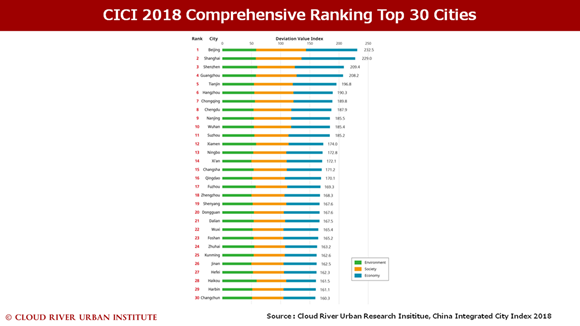
Zhou said he believes population density is crucial to a city's economic and social development, and its impact on the urban environment is not as grave as some city planners and scholars have indicated.
The professor pushed for setting record straight on this misconception, and suggested boosting the vitality of a city by improving the quality and scale of Densely Inhabited Districts (DIDs), which refers to districts with a population density of more than 5,000 inhabitants per square kilometer.
The "China Integrated City Index 2018" report, authored by Zhou and his team, adeptly draws on the concept of DID to assess China's 298 prefecture-level cities in terms of their environment, social progress, and economy, thus giving fine-grain insight to and building a data-based frame of reference for China's city development.
After comparing DIDs with a series of indexes, the report found that the population in a DID is highly correlated with the vitality of a city.
"Actually, the more optimized a city's DIDs are, the faster its economy grows, and the more capable social and environmental governance is," Zhou asserted.
Zhou's view reflects China's long-time divergence on choices of path of urbanization. China has undergone counter-urbanization over the past few decades, and only in recent years has city-cluster-based urbanization come in as a national policy. However, there is still a lack of awareness of the upside of high population density.
Looking at how related the number of a city's listed companies on China's main market with certain key indexes, the report finds that the number is strongly correlative with DID at a coefficient of 0.85.
Zhou's conclusion: A public company thrives on a lot of resources, especially a considerably big population density.
Cities with a dynamic DID tend to have high concentration of listed companies, he said.
The report shows 70 percent of China's listed companies are located in its top 30 cities with the most listed companies.
The report also compares the urban areas of Beijing and the Tokyo Metropolitan Area (including Tokyo, and neighboring Kanagawa, Chiba and Saitama). It finds that despite having twice the urban area and a permanent population 60 percent of Greater Tokyo, Beijing's GDP only accounts for 50 percent of its Japanese counterpart.
The contrast led Zhou to a conclusion that Beijing urgently needs to implement the metropolitan-cluster-driven strategy to optimize its DID, and economic structure.
He asserted that high population density does not necessarily lead to a well-running city. India's Mumbai and Brazil's San Paulo, for instance, are struggling with grim slum problems despite large population sizes.
Zhou said the problem actually is with the "city intelligence," meaning the capabilities of city managers.
He explained good urban planning is not merely about spatial planning, but more about how to manage a city's infrastructure, transportation, energy, social life, and the environment.

