Xinhua | September 19, 2025


V. Contributing to the Global Advancement of Women
China upholds the vision of building a community with a shared future for humanity, aligns with the prevailing global trends towards peace, development, cooperation, and mutual benefit, and actively advances the implementation of the Global Development Initiative, the Global Security Initiative, the Global Civilization Initiative, and the Global Governance Initiative. Through close cooperation with other countries, China is helping accelerate the creation of an international environment conducive to women's development and a better world for all.
1. Participating in Global Governance on Women's Issues
China plays a leading role in implementing the spirit of the UN Fourth World Conference on Women and advances global governance on women's issues through concrete actions.
Supporting the central role of the United Nations. China has co-hosted the Global Leaders' Meeting on Gender Equality and Women's Empowerment with UN Women to encourage countries to fulfill their commitments and inject new momentum into the global advancement of women. At the UN Human Rights Council, China has repeatedly delivered joint statements on promoting and protecting women's rights, pushed for the adoption of relevant resolutions, and called on countries to work together to implement the Beijing Declaration and the Platform for Action. China consistently sends high-level delegations to the sessions of the UN Commission on the Status of Women and collaborates with UN organizations and agencies to conduct seminars on women's poverty reduction, the digital economy, inclusive finance, technology empowerment, and gender equality amid demographic changes, sharing China's experience in promoting women's development. Since 2015, China has donated US$20 million to UN Women and carried out practical cooperation with multiple UN specialized agencies on women's issues. In partnership with UNESCO, it has established the Prize for Girls' and Women's Education and implemented projects in Africa focusing on digital and health education for girls. Chinese women hold important positions and serve as experts in the UN system, contributing their expertise to global governance on women's issues.
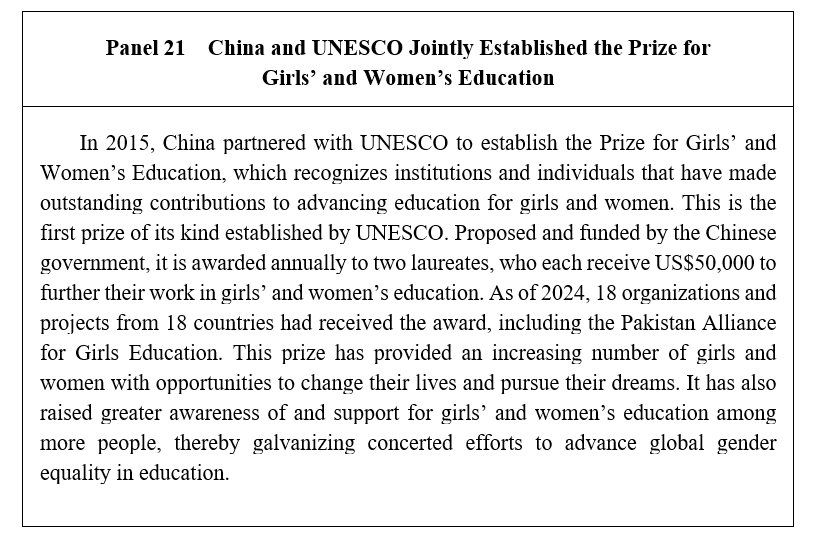
Firmly fulfilling international obligations. China fulfills its obligations under international conventions such as the Convention on the Elimination of All Forms of Discrimination Against Women, regularly submits national implementation reports, and actively participates in review processes to promote gender equality and women's development. It actively implements the Beijing Declaration and the Platform for Action, continuously improves women's living conditions and expands their development prospects, and has achieved the poverty reduction and health-related targets of the UN 2030 Agenda for Sustainable Development ahead of schedule. Through these efforts, China has not only improved the lives of Chinese women, but has also offered the international community its approach to safeguarding women's human rights.
Leading and advancing multilateral and regional agendas for women's development. At the Third Belt and Road Forum for International Cooperation, China proposed the Global AI Governance Initiative, emphasizing the need to avoid gender bias in AI development. The country also facilitated the adoption of the Resolution on Enhancing International Cooperation in Capacity-Building of Artificial Intelligence at the 78th session of the UN General Assembly, which underscores ensuring universal benefits from AI, enhancing digital inclusion and achieving gender equality while empowering women and girls. Since 2012, China has hosted 29 women's conferences under frameworks including APEC, G20, BRICS, Shanghai Cooperation Organization (SCO), China-ASEAN, China-Africa, China-Arab States, China-Central Asia, and Lancang-Mekong Cooperation. Through these mechanisms, China has deeply engaged in cooperation on women's issues, focusing on topics including poverty reduction, development, employment, business startup, education empowerment, and pandemic response. These efforts have facilitated targeted experience-sharing, dialogues, and collaborative actions, enabling China to advocate actionable propositions for advancing women's comprehensive development, inclusivity, and sustainable development.
2. Deepening Cooperation and Exchanges to Advance Women's Development
China integrates the deepening of women's development cooperation into the frameworks of high-quality Belt and Road Initiative (BRI) and South-South cooperation, to jointly promote women's sustainable development.
Advancing women's development in BRI participating countries. China actively promotes high-quality BRI cooperation. Initiatives such as the Silk Road E-commerce have created employment opportunities and pathways for women in these countries, and digital technology enablement program for women in ASEAN countries - alongside other related programs - have supported women in the region in seeking employment and starting businesses. For 10 consecutive years, China and partner countries have jointly hosted a series of events under the theme "Pool Women's Strength for Belt and Road Cooperation", encouraging women in these countries to become supporters, participants, contributors, and beneficiaries of the BRI.
Supporting women's poverty reduction and development in South-South cooperation. China supports developing countries in improving women's living conditions and development environment. It has implemented 100 maternal and child health projects and 100 happy campus projects, along with a series of small but effective public wellbeing programs focusing on housing, rural roads, and technology training to empower women and girls. Through the Global Development and South-South Cooperation Fund, China has carried out women-related projects worth nearly US$40 million across over 20 countries. Additionally, the Lancang-Mekong Cooperation Special Fund has allocated RMB12 million to support women's development programs. Through foreign aid training and technical assistance, Juncao technology has helped women in 106 countries gain meaningful employment.
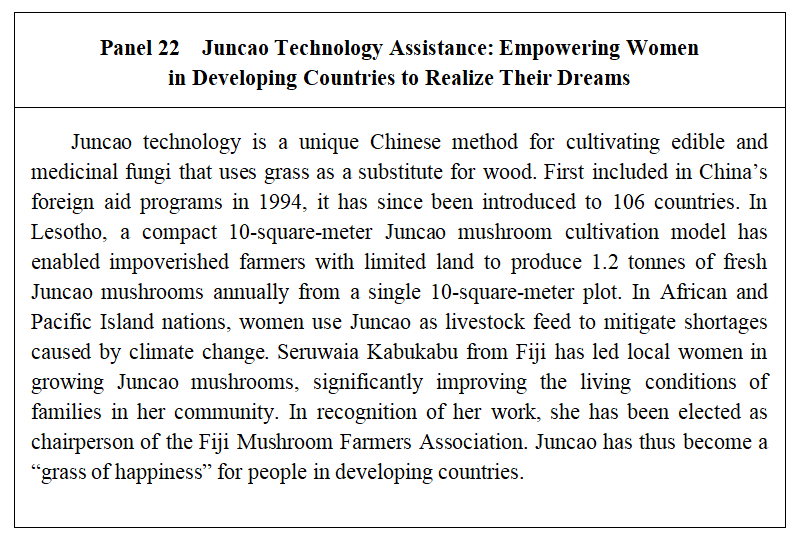
Deepening international cooperation in women's capacity building. China continues to strengthen and expand support training programs focused on women and children in developing countries. Since 2018, it has implemented over 100 programs in this domain, including the Seminar on Promoting Maternal and Child Health Under Global Development Initiative, and the Seminar on Implementing the 2030 Agenda for Sustainable Development in Developing Countries - Women and Children. Additionally, China has launched degree programs in women's leadership and social development, training nearly 4,000 outstanding professionals in the field of women's development. An exchange and training base for global women's development cooperation has been established in Beijing to design tailored empowerment programs for women in developing countries. Training and exchange centers for Chinese and foreign women have been set up in collaboration with 15 countries, and through international cooperation in vocational education, the Luban Workshops have trained 5,944 female students, who account for 23.25 percent of all participants in the project.
Solid progress in people-to-people exchanges in the field of women's affairs. China has actively developed global partnerships and engaged in comprehensive, multi-channel friendly exchanges with women's organizations and institutions from over 140 countries. It has conducted dialogues with foreign female political leaders, spouses of heads of state, and female government ministers, organized high-level delegations for overseas visits, and pioneered new approaches to high-level women's foreign exchanges. China has deepened women's exchanges under its cultural and people-to-people exchange mechanisms with other countries, holding thematic seminars on women's entrepreneurship, economic empowerment, education, anti-domestic violence, and family culture, while strengthening cooperation in areas such as women's rights and interests, bridging the digital gender divide, and promoting women's participation in sci-tech innovation and sustainable development. The Female Diplomats' China Adventures series has been launched to share the practical experiences of Chinese women in economic development and grassroots governance, and exchange insights on promoting gender equality. China supports women's participation in cross-cultural exchanges, with women accounting for 80 percent of dispatched Chinese-language teachers and 90 percent of volunteers in international Chinese language education.
3. Actively Addressing Global Challenges
China supports women in playing an active role in maintaining peace and security, and in addressing challenges including climate change, public health crises, and humanitarian disasters.
Supporting women's participation in maintaining peace and security. China has taken concrete actions to implement UN Security Council resolutions on "Women, Peace and Security", supporting women's important roles in conflict prevention, peace negotiations, and post-conflict reconstruction. In 2022, the China-UN Peace and Development Trust Fund initiated a training program for senior female talent to promote gender equality in high-level positions within UN peacekeeping operations. China has deployed over 1,200 female peacekeepers and more than 100 female police officers to UN missions, who have participated in medical support, liaison and coordination, mine clearance, patrols and observation, and efforts to advance gender equality and protect women.
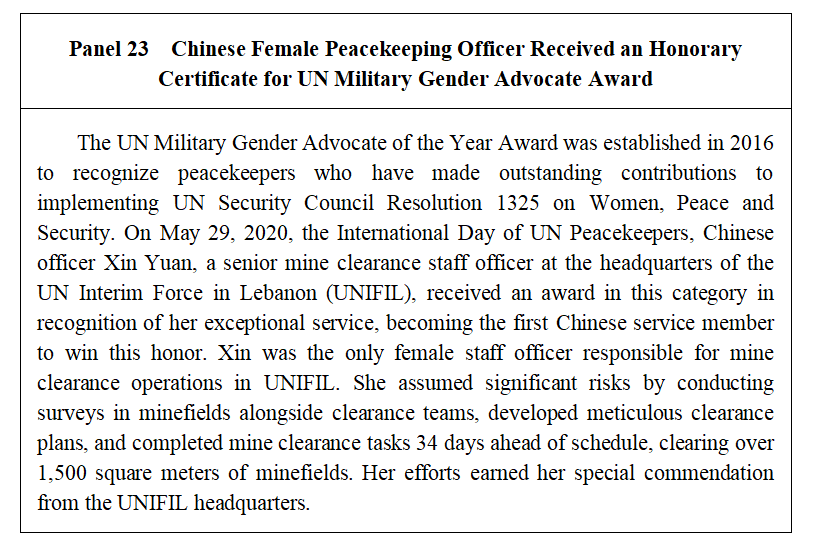
Empowering women to address climate change. China has consistently organized training programs on South-South cooperation for climate change response, implementing a gender-balanced enrollment policy. Since 2022, nearly 300 female officials, experts and scholars from developing countries engaged in climate change projects have participated in training programs in China. From 2012 to 2024, China conducted nearly 100 foreign aid training projects in meteorological monitoring, forecasting, and services, with women accounting for 36.72 percent of the trainees. It has donated 5,000 household solar photovoltaic power generation systems and 10,000 clean cooking stoves to Myanmar, reducing indoor air pollution and its associated health risks while supporting the country's low-carbon transition. The Lancang-Mekong Cooperation Special Fund supported Cambodia in implementing a project on gender mainstreaming in climate action, enhancing rural women's climate adaptability and resilience.
Addressing women's needs in international humanitarian assistance. In efforts to alleviate migrant and refugee crises, China has placed high priority on women and children, encouraging women to register as recipients of household assistance supplies and providing special care for pregnant and breastfeeding women. Projects in the Republic of Congo specifically target pregnant and breastfeeding women as beneficiaries, effectively reducing malnutrition rates among women and children. In 2023, China provided over 120,000 hygiene kits, valued at US$1.5 million, to Rohingya women and girls seeking refuge in Bangladesh, benefiting more than 60,000 women and girls.

