Xinhua | September 19, 2025


III. Sharing in the Fruits of Modernization
Eradicating poverty, improving living standards, and achieving common prosperity are essential tasks of socialism. China has made continuous efforts to ensure people's access to childcare, education, employment, medical services, eldercare, housing, and social assistance, meeting women's expectation for a better life.
1. Elimination of Absolute Poverty
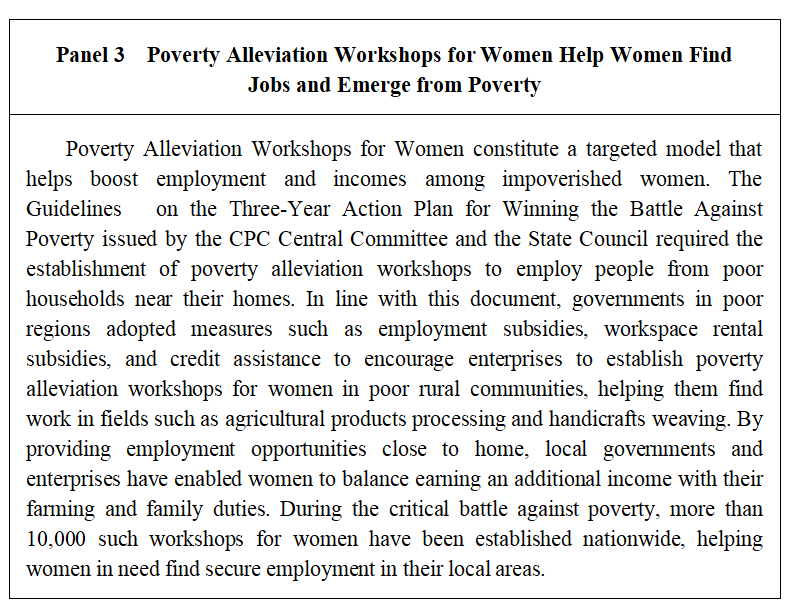
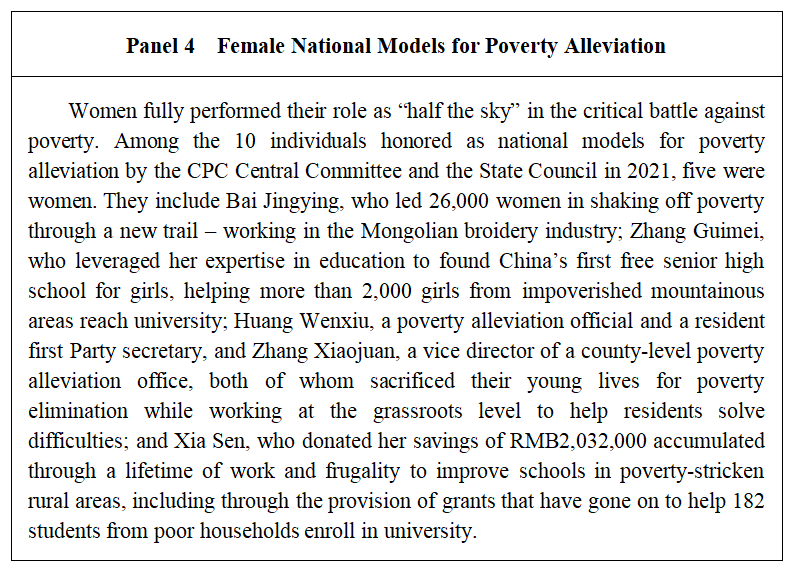
China has organized the largest and most intensive poverty alleviation campaign in human history, benefiting the greatest number of people. By the end of 2020, it had successfully eliminated absolute poverty throughout the country, meeting the poverty reduction target of the UN 2030 Agenda for Sustainable Development 10 years ahead of schedule. On this epic journey of poverty reduction, China has honored its solemn commitment that no one should be left behind, specifically targeting women as a key group to widen their path towards prosperity.
Taking targeted measures to guarantee basic living needs. China has adopted a targeted strategy in poverty alleviation. Under this framework, it maintains detailed records on the distribution of impoverished populations, the underlying causes of poverty, the specific categories of poverty, and the expectations of the poor. This approach guarantees the implementation of targeted efforts in six areas: identification of those in need, project arrangement, capital utilization, the introduction of household-specific measures, the dispatch of officials to villages based on local conditions, and the achievement of set goals. As a result, women, who comprise approximately half of the impoverished population, have benefited from targeted resource allocation.
The Health Program for Poverty Alleviation and its health promotion campaigns have guaranteed access to basic medical and health services for impoverished rural women.
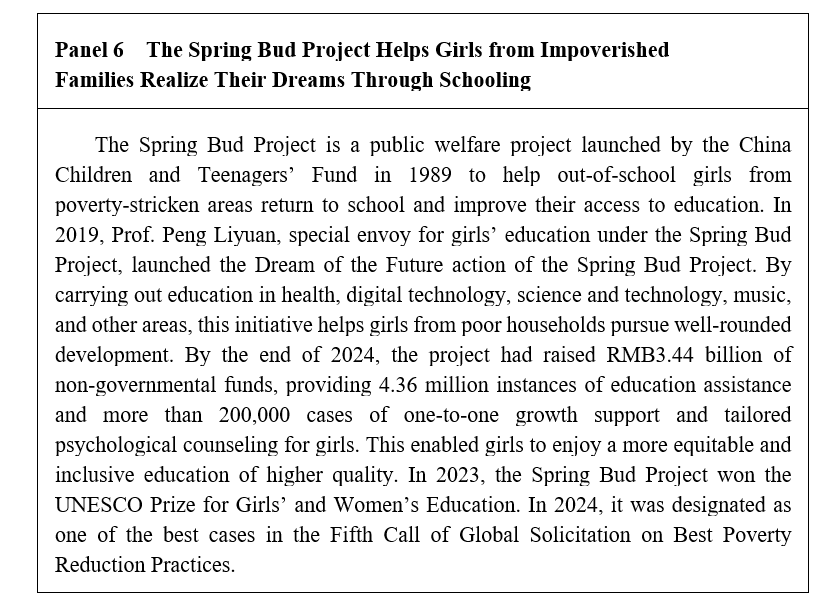
Through education initiatives for poverty alleviation, compulsory education in impoverished areas has been steadily improved, ensuring that no school-age girls from poor families drop out of school due to poverty.
Social security systems have been strengthened to ensure eligible women on the list of the registered poor receive subsistence allowances or assistance and support for the extremely poor.
Renovation of dilapidated houses in rural areas, particularly in severely impoverished areas, has been subsidized by the government. Relocation projects have helped over 9.6 million people, who originally lived in inhospitable areas, to emerge from poverty and seek development.
The basic food and clothing needs of impoverished women have been guaranteed, and their access to compulsory education, basic medical services, and safe housing has been ensured.
After winning the battle against absolute poverty, the country initiated a five-year transition period during which poverty alleviation support policies remained in effect to buttress areas and populations that had recently emerged from poverty. Based on the stable operation of such policies, a robust dynamic monitoring and assistance mechanism has been established to prevent any relapse into or occurrence of poverty, and support remains in place for women lifted out of poverty and those in low-income areas to participate in the local economy, seek more employment opportunities, and increase incomes.
Boosting the economy to create job opportunities for women and raise their income. China is committed to the policy of development-driven poverty alleviation to empower impoverished women.
It has strengthened industrial support by facilitating the gradient transfer of labor-intensive industries such as food processing and clothing manufacturing, benefitting 98.9 percent of poor households. By advancing east-west cooperation in labor services, setting up poverty alleviation workshops, and creating public-interest rural jobs, the country has provided job opportunities for poor women with the will and ability to work. In its efforts to alleviate poverty, China has leveraged new forms of business and industries such as e-commerce programs, photovoltaic technology, and tourism to help impoverished women find good jobs within their local communities. In ethnic minority areas, the transition of the hand-knitting business from a purely traditional craft to a driver of the local economy has transformed the lives of the women embroidery artisans in the Miao and Yi communities.
China has increased fiscal and financial support. In the critical battle against poverty, special supportive polices such as offering subsidized loans requiring no collateral or guarantee and tax reductions or exemptions were introduced. Cumulatively, over RMB450 billion in guaranteed microloans and poverty alleviation microcredit were disbursed to women in need, and 8.7 million impoverished women saw their income increased through entrepreneurship. From 2021 to 2024, the country sustained a flow of microcredit designated for people recently lifted out of poverty, of which RMB76.83 billion were offered to nearly 1.93 million women.
Efforts in skills training have been strengthened, with training courses on vocational skills, entrepreneurship, and practical agricultural technology being held through multiple channels, at multiple levels, and in multiple forms. As of 2020, training programs had been organized for a total of 10.21 million impoverished women and female technicians. From 2023 to 2024, the Rain and Dew Program sponsored 632,000 women to receive vocational education, allowing them to continue their march out of poverty.
Increasing input to break the bottlenecks constraining women's development. China has advanced infrastructure development, fundamentally solving many of the issues impeding women's development in impoverished areas, such as insufficient access to transport, electricity, water and communications. Where conditions permit, all towns, townships, and administrative villages have been connected to paved roads and provided with bus and postal services. Full coverage of reliable power supply has been largely realized in rural areas. All counties have access to gigabit internet, all townships to 5G services, and all villages to broadband connections. By the end of 2024, 94 percent of the rural population had enjoyed access to tap water.
2. Notable Improvement in Health
Prioritizing people's health in its development strategy, China makes all-out efforts to build a healthy China, with women's and children's health the cornerstone of this work. By consolidating and improving institutional arrangements and optimizing resource allocation, the country provides women with full life-circle health services.
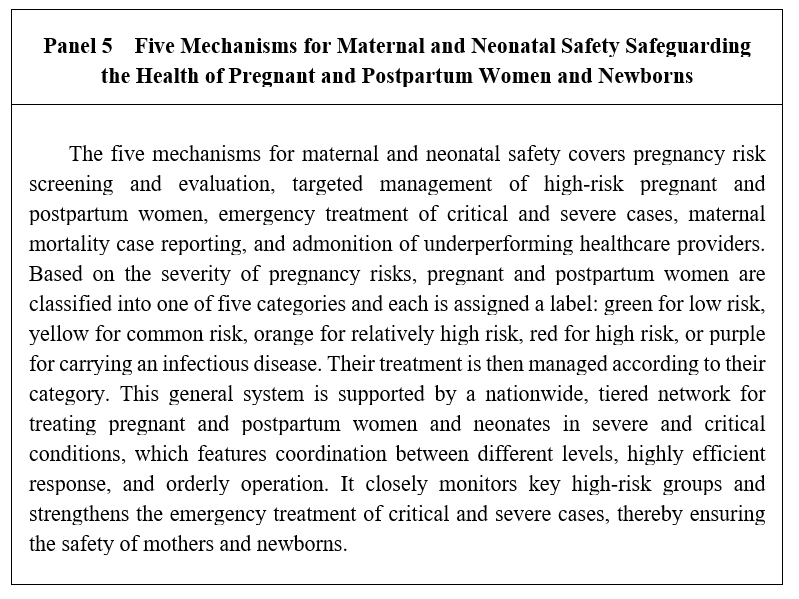
Continuous improvement of the maternal and child healthcare system. China has integrated its maternal and child healthcare network into its national medical and healthcare framework that covers its 1.4 billion people. A service system for maternal and child healthcare has been built, with maternal and child healthcare institutions as the core, community-level medical and healthcare institutions as the foundation, and medium and large hospitals and research institutes as the pillars.
From 2012 to 2023, the number of health professionals at maternal and child healthcare institutions increased from 277,000 to 537,000, with an annual growth rate of over 6 percent; the actual number of beds rose from 187,000 to 295,000, up by nearly 60 percent. At present, China has 3,081 maternal and child healthcare institutions, 3,491 treatment centers for high-risk and critically ill pregnant and postpartum women, and 3,221 treatment centers for critically ill neonates. More than 2,600 traditional Chinese medicine hospitals at Grade II and above have gynecological departments.
The "internet plus maternal and child healthcare" service model has been developed, and training sessions and guidance for treating pregnant and postpartum women in severe and critical conditions have been provided through 31 provincial-level "cloud-based maternal and child healthcare" telemedicine platforms, making maternal and child healthcare services much more equitable.
Breakthroughs in solving key issues in women's health. China has strengthened its resource coordination to integrate the prevention of mother-to-child transmission of HIV, syphilis and hepatitis B into major public health service programs. In 2024, the rate of mother-to-child HIV transmission in China fell to 1.2 percent, meeting the targets for eliminating mother-to-child HIV transmission.
China has promoted the comprehensive prevention and treatment of cervical cancer and breast cancer. Between 2009 and 2024, 342 million free screenings for cervical cancer and 245 million free screenings for breast cancer were carried out nationwide, and between 2012 and 2024, the central government allocated RMB3.01 billion for treatment and support for women with these forms of cancer. HPV vaccination has been incorporated into the government's public welfare initiatives in 18 provinces as of June 2025, benefiting 5 million girls of eligible age annually through free vaccination programs.
A group of specialty branches and outpatient departments focusing on women's healthcare have been established, covering the entire process of childbearing and women's full life cycle.
A reproductive health promotion campaign has been carried out. By the end of 2024, youth health education services had been provided in more than 10,000 elementary and high schools and more than 1,000 higher education institutions across the country.
The campaign to raise national health awareness, the initiative to build healthy families, the Healthy China: Mother's Action, and other initiatives have been rolled out to guide women to lead their family members and the wider society in raising health awareness and health management capacity.
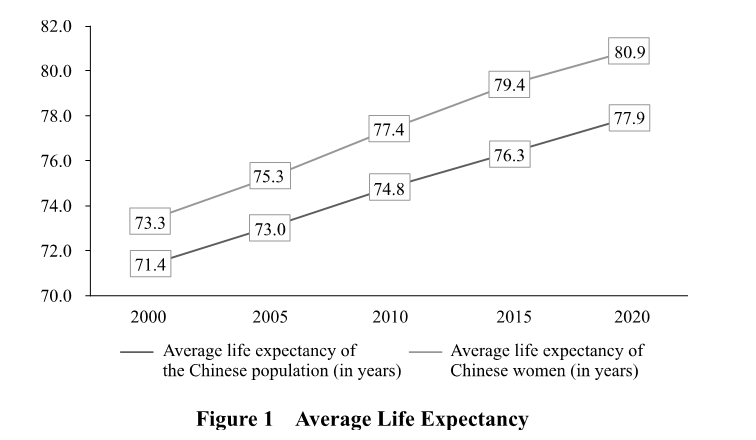
Remarkable improvement in women's health. In 2020, the average life expectancy of women in China rose to 80.9 years.
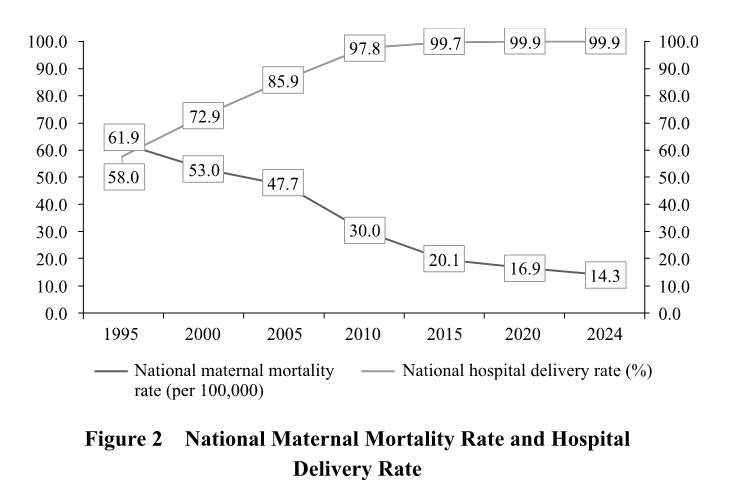
Since 2012, the national hospital delivery rate has remained above 99 percent, and in 2024, the systematic maternal management rate reached 94.9 percent. The maternal mortality rate has dropped by 76.9 percent, from 61.9 per 100,000 in 1995 to 14.3 per 100,000 in 2024 - far below the global average.
In terms of core maternal and child health indicators, namely maternal, infant, and under-five mortality rates, China ranks among the top in global upper-middle-income countries. It has met the relevant targets of the UN 2030 Agenda for Sustainable Development ahead of schedule and has been recognized by the World Health Organization as one of the 10 high performing countries in maternal and child health outcomes.
3. Substantial Increase in Women's Education Level
In building up its strength in education and coordinating integrated reforms of educational, sci-tech and talent systems and mechanisms, China has made tremendous efforts to ensure women's equitable access to education of all categories and levels, raise women's scientific literacy and promote life-long education for them. As a result, women's right to education has been effectively guaranteed.
Gender divide in basic education has been largely eliminated. China has implemented four consecutive preschool education action plans. In 2024, girls accounted for 47.3 percent of children in kindergartens, totaling 16.94 million.
China promotes the high-quality and balanced development of compulsory education, and has accelerated efforts to narrow the educational gaps between regions, schools, groups, and between urban and rural areas. The net elementary education enrollment rate of school-age girls stays above 99.9 percent, and in 2024, girls made up 46.98 percent of students of nine-year compulsory education.
The Plan to Popularize Senior High School Education (2017-2020) and the Action Plan to Develop County-level Senior High Schools During the 14th Five-Year Plan (2021-2025) Period have been implemented nationwide, and the proportion of girls among the senior high school population is continuing to rise, standing at 49.3 percent in 2024.
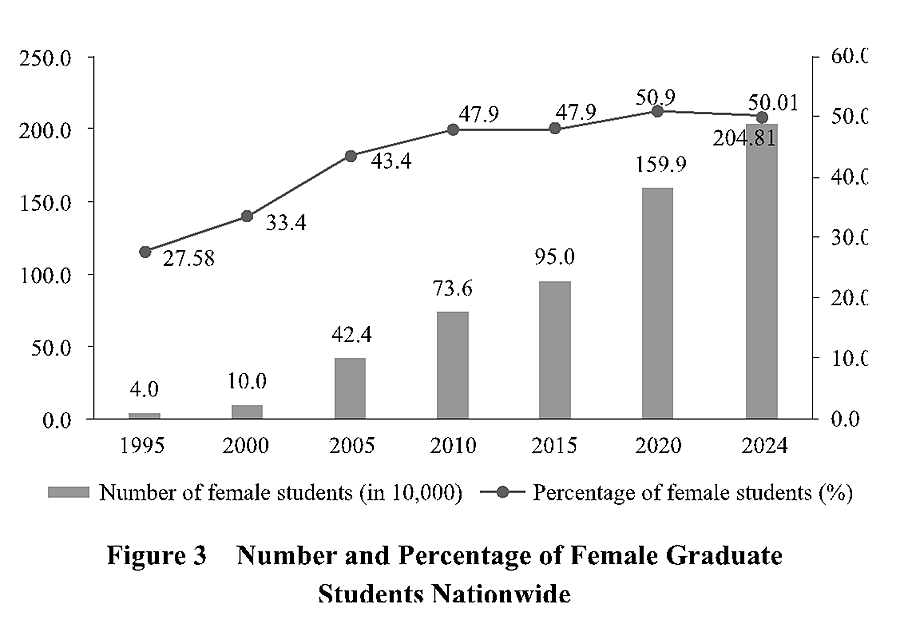
A rough balance between male and female students in higher education has been achieved. China has made sustained efforts to develop the world's largest higher education system, cement and advance accessibility in higher education, and ensure gender equality in the enrollment of regular institutions of higher learning. In 2024, female students in these institutions made up 50.76 percent of the total, 14.15 percentage points higher than in 1995. Among them, female graduate students accounted for 50.01 percent, an increase of 22.43 percentage points from 1995.
Women enjoy higher-quality vocational education and life-long education. China has speeded up its efforts to build a modern vocational education system and offers assistance to eligible students in the form of tuition exemptions, scholarships, grants, and student loans. As a result, women are enjoying more and better access to high-quality vocational education. In 2024, female students accounted for 47.9 percent of higher vocational school students at the undergraduate and junior college levels, and 45.2 percent of secondary vocational school students.
The women's life-long learning system has become more open and flexible, with the establishment of the national smart education platform for life-long education offering a more convenient and accessible channel that meets women's diverse learning needs. The number of women receiving adult education continues to rise steadily year on year, and in 2024, female students at adult education institutions at the undergraduate and junior college levels numbered 5.13 million, 54 percent of the total, representing an increase of 1.96 million compared to 2012. In 2020, the average length of schooling for female citizens at or above the age of 15 reached 9.59 years.
Women's scientific literacy is on the rise. The Chinese government has promulgated the Outline of the Action Plan for Improving Scientific Literacy for All (2021-2035), which covers raising women's scientific literacy.
It has issued the Guidelines for Science Education in Elementary and High Schools, improved the curriculum, textbooks, experimental teaching, teachers' training, and extra-curricular activity programs of these schools, and enhanced the coordination and transformation of science education resources.
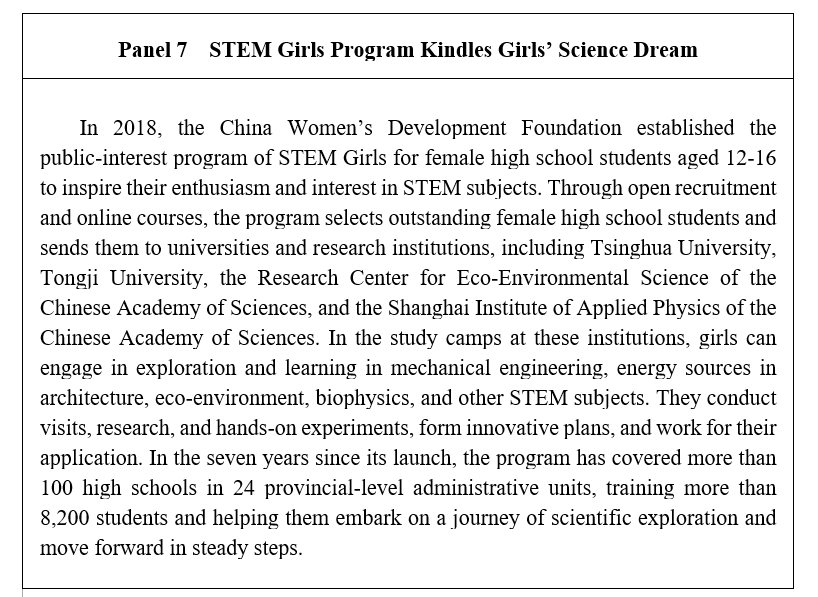
To inspire and cultivate female students' interests in science, public-interest programs aimed at female students have been rolled out, including the Science Lovers Program for Female College Students, Science Empowering Girls, Spring Bud InnoGirls Program, STEM Girls, and Her Science.
A program for raising the capabilities of female employees has also been implemented, and, in particular, efforts have been made to help them improve digital skills.
Thanks to these initiatives and more, the gender gap in scientific literacy is continuing to narrow. The female sci-tech talent pool continues to expand in scale, improve in structure, and grow in capability, with female scientists now regularly making outstanding contributions in various fields, including basic theory, applied technology, and engineering. In 2024, female R&D professionals numbered 2.85 million, representing an increase of 1.69 million from that in 2012.
4. Continuous Improvement in Social Security
China has established the world's largest social security system. Built on the principle of ensuring universal coverage for all eligible individuals, the system aims to narrow urban-rural disparities, improve social security policies for key groups, strengthen support for women in difficulty, and steadily raise benefit levels. As a result of this system, women now enjoy more comprehensive, reliable and equitable social security.
Medical and old-age insurance systems achieved full coverage. China's healthcare security system has been continuously improved, supported by increased government subsidies for individual contributions to basic medical insurance among rural and non-working urban residents.
In 2024, 651 million women were covered by basic medical insurance, accounting for 49.1 percent of all participants. Additionally, 260 million women were covered by basic pension insurance for rural and non-working urban residents, representing 48 percent of all enrollees, while 260 million women participated in the basic pension scheme for urban employees, constituting 48.2 percent of the total.
More women are protected against unemployment and work-related injuries. Efforts have been made to safeguard employees' employment security, occupational safety, and health protections. By the end of 2024, approximately 105 million women were enrolled in unemployment insurance, accounting for 42.7 percent of all participants and reflecting a 70 percent increase since 2012. Additionally, about 117 million women were covered by work-related injury insurance, comprising 38.6 percent of all enrollees, and reflecting a 60 percent increase since 2012.
Specific measures have been introduced to ensure that workers in new forms of employment receive effective assistance and compensation in case of occupational injuries. Real-time settlement of medical expenses for work-related injuries incurred outside the provincial-level unit where the patient is insured has been fully implemented, protecting the rights and interests of female workers and better meeting their healthcare needs.
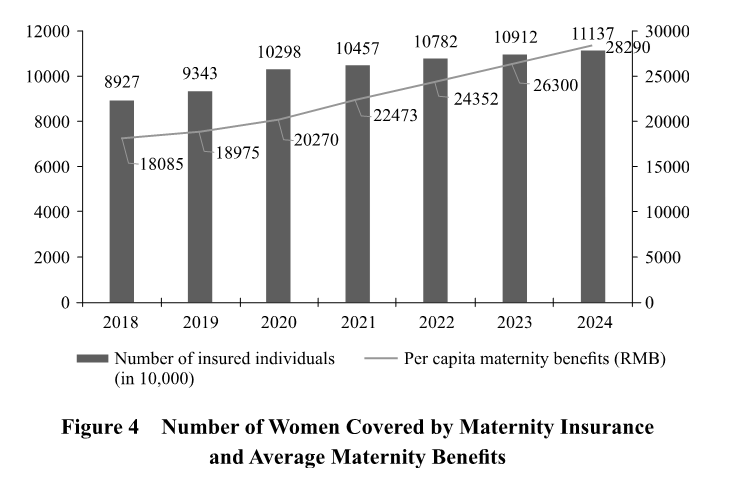
Maternity protection for women has improved significantly. The integrated implementation of maternity insurance and basic medical insurance for employees has been fully advanced, and continuous efforts have been made to expand employer participation in maternity insurance and to gradually extend its coverage. Regions with the necessary conditions have been guided to include flexibly employed people in maternity insurance. For unemployed women, the unemployment insurance fund pay their maternity insurance contributions on their behalf during their period of unemployment benefit eligibility, while non-working women are covered for maternity medical benefits through their participation in the basic medical insurance scheme for rural and non-working urban residents. By the end of 2024, 111 million women were covered by maternity insurance. All 31 provinces, autonomous regions, and municipalities directly under the central government, as well as the Xinjiang Production and Construction Corps, have included eligible assisted reproductive technologies (ART) in their medical insurance schemes.
Social security for women in need is further strengthened. Subsistence allowance standards have continued to rise, with the national average urban and rural subsistence allowance standards in 2024 140 percent and 240 percent higher than those of 2012, respectively.
Financial assistance or premium payments are provided for women from eligible disadvantaged groups, such as those receiving subsistence allowances or classified as extremely impoverished individuals, to participate in basic medical and pension insurance schemes for rural and non-working urban residents.
A comprehensive system of living subsidies for persons with disabilities facing financial difficulties and nursing subsidies for those with severe disabilities has been established. In 2024, about 9.40 million women received these subsidies, accounting for 46 percent of all recipients.
Targeted assistance and support initiatives have been implemented for rural stay-behind women in difficult circumstances, including efforts to establish records, ensure basic living standards, promote employment and income generation, and enrich cultural lives.
5. Improved Family Lives
China places emphasis on fostering family culture, values, and traditions, recognizing the unique role of women in both social and family life. Efforts continue to be made to leverage women's distinctive contributions in promoting traditional Chinese family virtues and establishing positive family traditions. Policies supporting family development are continuously improved, enhancing families' capacity for development and creating favorable conditions for women to enjoy better family lives.
More equal and harmonious family relations in the new era. Laws and regulations including the Civil Code, the Law on the Protection of Women's Rights and Interests, and the Anti-Domestic Violence Law have been promulgated to protect women's rights within marriage and the family.
A new marital and childbearing culture is widely promoted. Marriage and family counseling services are widely available at marriage registration authorities at or above the county level nationwide. Over 2,000 pilot units are advancing marriage customs reform, and activities such as "bringing new marriage and childbearing norms into households" are continuously carried out to promote values including gender equality, mutual respect, and shared parenting responsibilities between couples.
The Fourth Survey on the Social Status of Women in China shows that 90 percent of married women participate in decision-making on major family matters, an increase of approximately 15 percentage points compared to 2010. The gender gap in time spent on household chores has narrowed, and there is a growing emphasis on marital relationships based on mutual respect and trust.
A family-friendly society gradually in shape. To meet the demands of high-quality population development and family wellbeing, measures have been introduced to improve childbirth support policies and develop a childbirth-friendly society.
The childbirth leave system has been enhanced, with local regulations extending maternity leave and paternity leave and introducing parental childcare leave. Special additional deductions for individual income tax have been implemented, covering expenses for under-three children nursing, eldercare, and children's education. A childcare subsidy system has been established and implemented, while free pre-school education has been promoted in a phased way.
Employers are encouraged to create "family-friendly workplaces" by adopting flexible working hours or remote work options after negotiating with employees to support them in both career development and childcare.
Nursing facilities have been provided. By the end of 2024, 403,000 enterprises and public institutions with trade unions had set up nursing rooms for female employees. The provision of baby care rooms in public places has also been expanded, and design standards such as the Uniform Standard for the Design of Civil Buildings, the Standard for the Design of Office Buildings, and the Code for the Design of Railway Passenger Station Buildings now include requirements for such facilities. By the end of 2024, 1,449 baby care rooms had been established in railway stations; 5,371 in highway service areas (including parking areas); 286 on passenger ships and in port passenger terminals; 2,308 in secondary and above-grade bus stations; 2,599 in urban rail transit stations; and nursing rooms in all civilian airports with an annual passenger throughput of 5,000 or more.
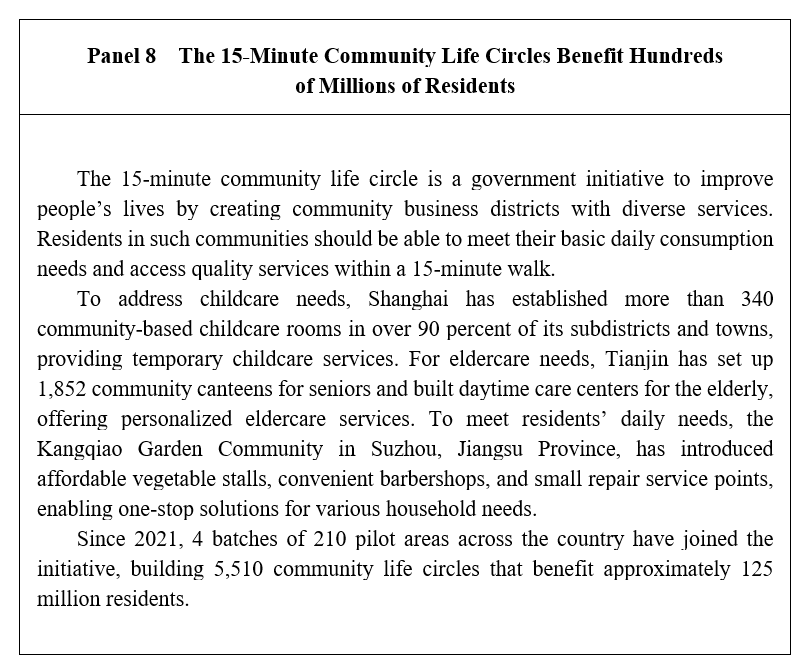
More diverse services to reduce family care burden. A variety of childcare services are provided to families, including full-day, half-day, and temporary care options, and employers are also supported in establishing childcare facilities. By the end of 2024, there were 5.74 million childcare slots nationwide, with 4.08 slots per 1,000 people for children under three.
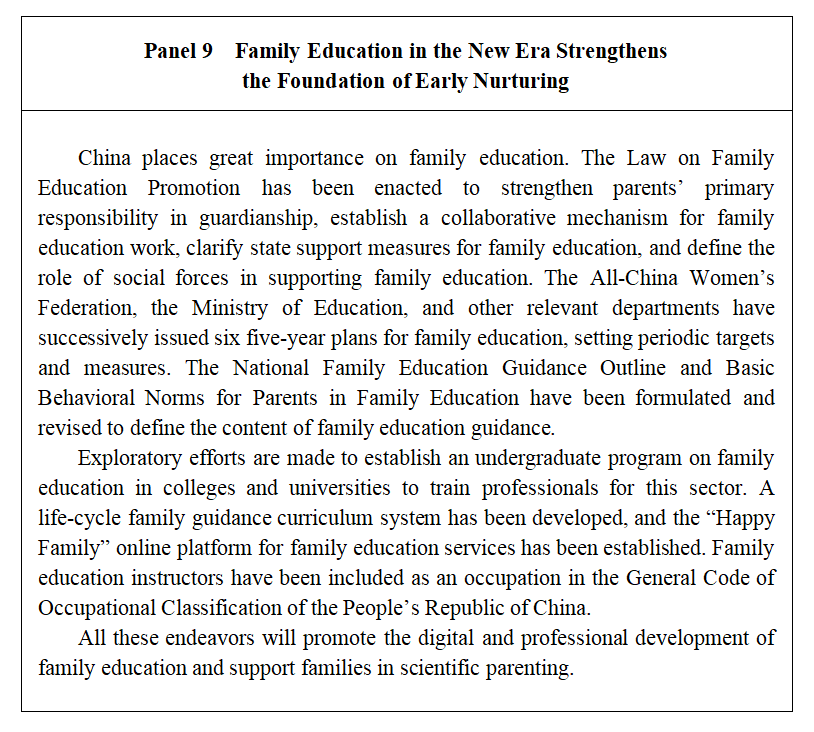
A family education guidance service system covering both urban and rural areas has been established. Relying on over 400,000 parent schools in urban and rural communities and more than 20,000 online new media platforms, family education guidance service teams have worked to organize rich and diverse parent-child activities, bringing scientific family education guidance services directly to households and communities.
The eldercare framework has been optimized, where home care is supported by communities and professional institutions, featuring a combination of medical care and eldercare services. Services such as meal assistance, bathing aid, home modifications for the elderly, and barrier-free renovations for financially difficult families with members with severe disabilities have become more accessible.
The domestic service sector continues to improve in quality and expand in scale. By the end of 2023, there were approximately 600,000 domestic service entities and 16,000 women-led domestic service community stations. National domestic service vocational skills competitions have been held to encourage skill enhancement among people working in this sector, provide a growth platform for more of them, and deliver high-quality services to families.

