Xinhua | September 19, 2025


IV. Advancing Women's Development to the Forefront of the Times
On the new journey of Chinese modernization, every individual plays a key role. Connecting their own future with that of the country and the nation, Chinese women have devoted themselves to the building of a great modern socialist country that is prosperous, strong, democratic, culturally advanced, harmonious, and beautiful. They have attained major achievements in the new era, creating a better life through action and hard work.
1. Achievements in Promoting High-Quality Economic Development
In promoting high-quality economic development, China is committed to expanding channels for women's participation, improving their capabilities, and stimulating their creativity. Women are "holding up half the sky" and playing an increasingly prominent role.
Realizing potential in employment and entrepreneurship. Upholding employment as a priority, China has increased fiscal investment, and implemented initiatives such as the Women's Action for Entrepreneurship and Innovation and the Action for Promoting Women's Employment and Entrepreneurship. Special recruitment sections and events for women have been held, sponsored by the National Employment Promotion Action and Spring Breeze Action, aiming to help more women find better jobs.
Gender discrimination in employment has been placed under the scrutiny of labor protection supervision. The System of Special Labor Protection for Female Employees in the Workplace (Reference Text) and the System for Eliminating Sexual Harassment in the Workplace (Reference Text) have been formulated as guidelines for employers to improve their corresponding systems for protecting female employees' lawful rights and interests.
By the end of 2024, RMB640 billion in loans had been provided to support 8.49 million women in realizing their entrepreneurial dreams. Since 2012, women have accounted for about 43 percent of the total employed population. According to the fifth national economic census in 2024, 42.6 percent of the employees in government agencies, public institutions, and state-owned enterprises were women, an increase of 3.6 percentage points compared to the fourth census.
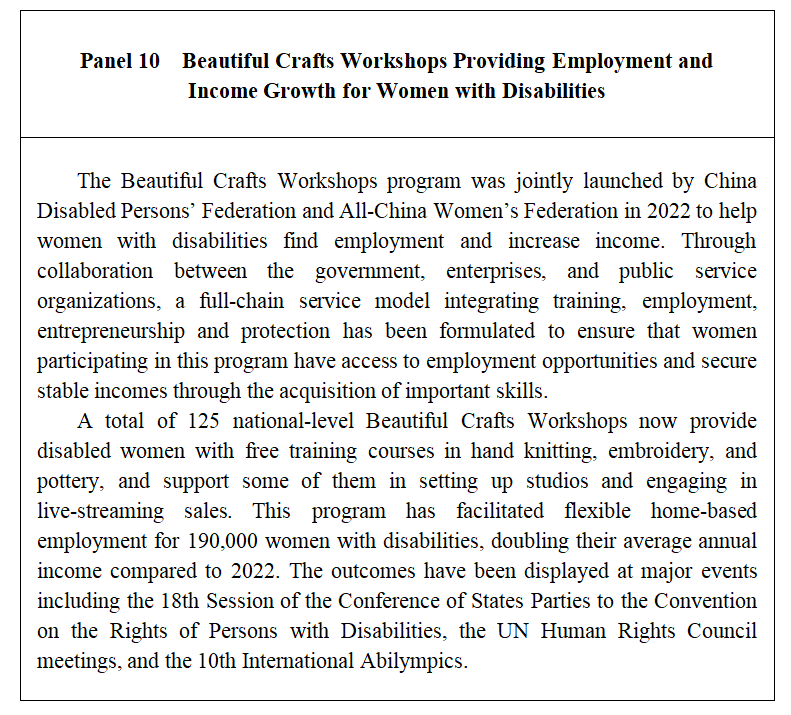
The scale of women's accomplishments is reflected in their significant representation among national honorees: They constitute 34 percent of the National Moral Models and 30.9 percent of the Most Beautiful Souls and National Exemplary Educators. Since 2012, a total of 1,821 women have been awarded the titles of National Model Workers and Advanced Workers, 1,957 have received the National May 1st Labor Medal, 5,001 have been honored as National March 8th Red-Banner Pacesetters, and 6,489 recognized as National Role Models for Women's Achievements.
Pioneering innovation in science and technology. As part of the efforts to implement the Women's Action for Scientific and Technological Innovation, China has formulated the Measures on Supporting Female Talent to Play a Greater Role in Sci-Tech Innovation, which outline 16 concrete measures, including supporting female scientists to undertake national sci-tech projects and participate in decision-making on sci-tech development, as well as improving evaluation and incentive mechanisms for them.
The National Natural Science Foundation has appropriately relaxed the age limits for female applicants in Categories A, B and C of the Young Scientists Fund, raising the maximum age thresholds by three years, two years, and five years respectively, compared to their male counterparts. Leveraging platforms such as the Zhongguancun Forum, Pujiang Innovation Forum, and World AI Conference, China has launched summits and forums for women working in science and technology, and hosted the Women Technicians Forum and a range of training programs for high-caliber female sci-tech professionals. These actions have created platforms for women in STEM fields to conduct professional exchange and learning, apply their research outcomes, and serve the public.
Today, women account for 45.8 percent of all sci-tech researchers in China. They are tackling tough problems and achieving breakthroughs in pioneering fields, overcoming daunting obstacles, and scaling new heights at the forefront of innovation, and making significant contributions to building China into a sci-tech powerhouse with greater strength and self-reliance in science and technology.
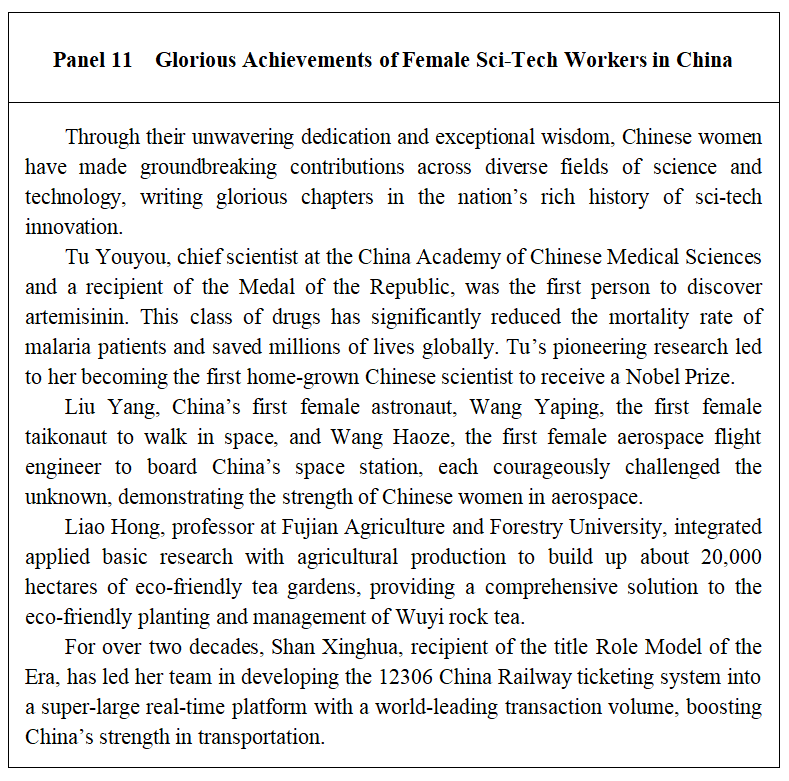
Taking the lead in rural revitalization. Through the Women's Action for Rural Revitalization, China has strengthened quality training to empower women farmers. Since 2017, the High-quality Farmer Training Program has trained over 2.24 million women farmers, and between 2022 and 2024, the project for cultivating leaders for rural industry revitalization trained 12,000 female individuals.
The achievements of women in rural revitalization have been recognized through initiatives like the Double Hundred and Double Thousand Initiative, which recognizes outstanding rural craftspeople, 100 of whom in the first batch were women, accounting for 36.6 percent of the total. In the final round of the first National Farmers’ Skills Competition, female participants comprised 69.5 percent of all winners. Furthermore, by the end of 2024, 134,000 female workers responsible for extending agricultural technologies and services had obtained professional titles, representing 35.4 percent of the total.
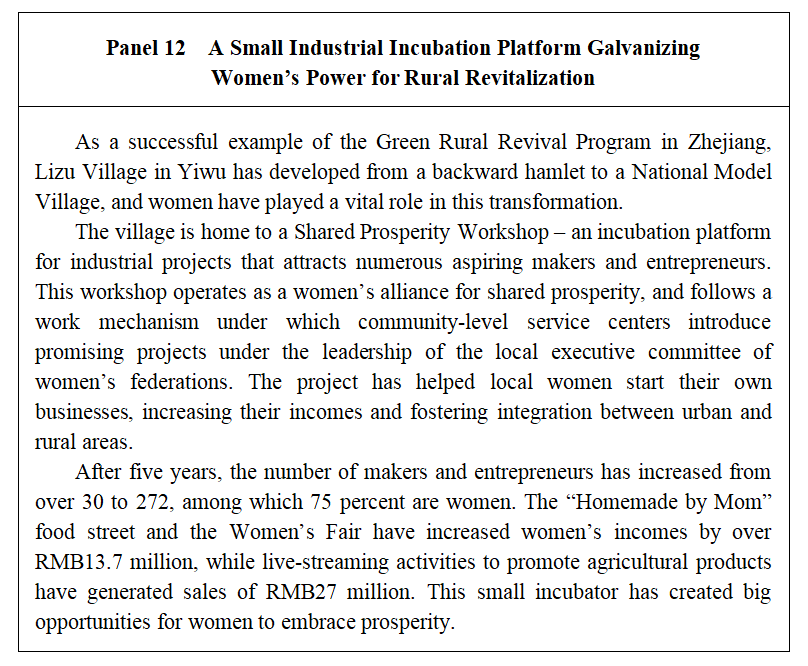
Pursuing excellence in the digital economy. China has issued the Action Plan for Strengthening the Digital Literacy and Skills of the General Public and the Action Plan for Digital Rural Development, which include measures such as carrying out digital literacy education and skills training for women and developing women-led e-commerce brands. Chinese women have answered the call of the digital age, and are committed to developing the digital economy, with 14,147 women obtaining the vocational skills certificates for AI trainers in 2024 alone – comprising 42.3 percent of the yearly total. Women represent over half of the entrepreneurs in the internet sector and about one third of the workforce engaging in new business forms such as digital trade, e-commerce, and live streaming. As the digital economy advances, it is providing more opportunities for women.
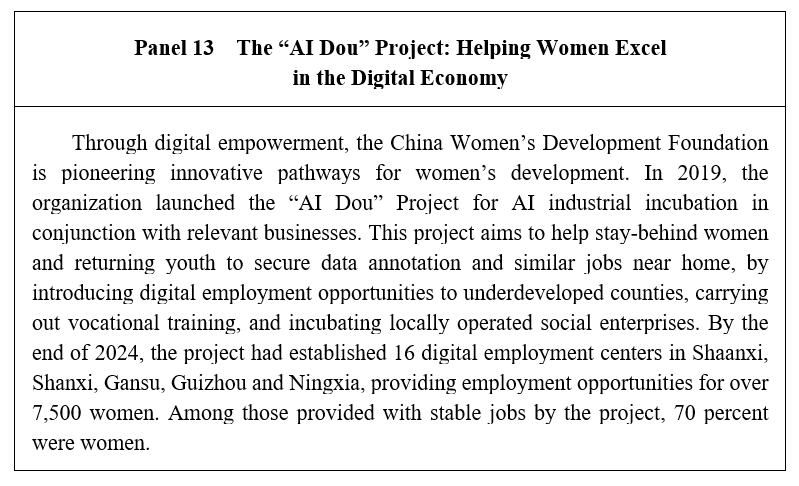
2. Equal Participation in Whole-Process People's Democracy
As China advances whole-process people's democracy, it remains committed to increasing women's participation in the management of state, economic, cultural and social affairs. Women enjoy equal political rights and actively participate in democratic practices, contributing their strengths with great enthusiasm.
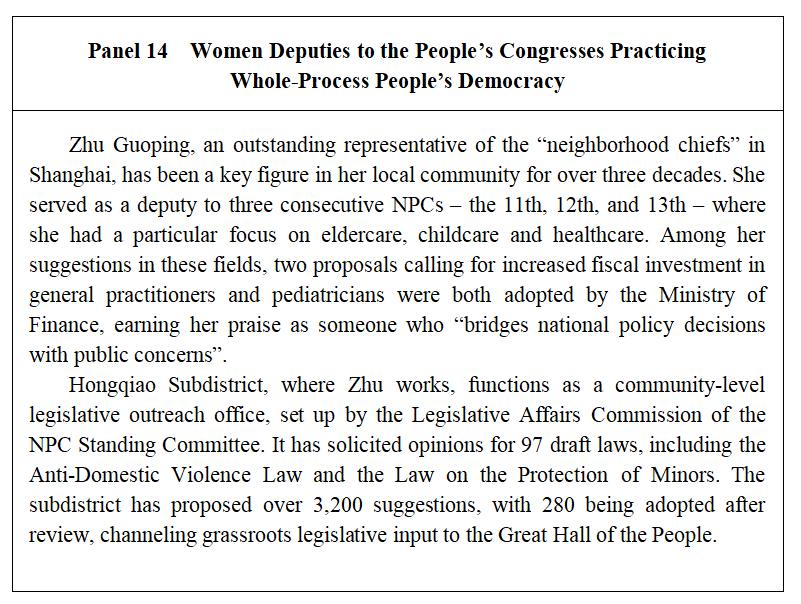
Exercising state power through the people's congresses. The proportion of women in people's congresses at all levels continues to rise. In the 14th NPC convened in 2023, there were 790 women deputies, accounting for 26.5 percent of the total. This represents an increase of 3.1 percentage points from the 12th NPC and 1.6 percentage points from the 13th NPC. At the county and township levels, women constitute 31.64 percent and 32.36 percent of deputies, respectively. These women deputies fulfill their duties in accordance with the law, soliciting and reflecting public opinion from all sectors of society. Between 2018 and 2025, NPC women deputies put forward 29,328 suggestions, criticisms and opinions, accounting for 42.3 percent of the total.
Discussing state affairs and making suggestions at consultative meetings of the CPPCC. The proportion of female members in the CPPCC National Committee and local committees has seen a consistent increase. In 2023, 487 female members served on the National Committee of the 14th CPPCC, accounting for 22.4 percent of the total - an increase of 4.6 percentage points and 2 percentage points from the 12th CPPCC and 13th CPPCC, respectively. In the same year, there were 5,401 female members on the provincial-level committees of the CPPCC, accounting for 27.36 percent of the membership at this level. The female members fulfill their duties in full and play a major role in political consultation, democratic supervision, and the deliberation and administration of state affairs. Since the 14th CPPCC National Committee, female members have submitted 4,282 proposals, representing 26.6 percent of the total.
Actively engaging in decision-making and administration. China attaches importance to the cultivation and selection of female officials and the recruitment of women into the CPC. It has formulated and implemented outlines for strengthening Party and government leadership teams and on women's development, which set specific quantitative and proportional requirements for the appointment of female officials and female heads of leadership bodies. These goals are expected to be met while strict quality standards are upheld.
The proportions of women among the CPC membership and delegates to the Party congresses are increasing. In 2024, 30.9 percent of CPC members were female, an increase of 7.1 percentage points compared to the 2012 level. Female Party members accounted for 27 percent of the delegates to the 20th CPC National Congress, an increase of 4 percentage points from the Party's 18th National Congress in 2012. Women represent 42.3 percent, 43.78 percent, and 51.5 percent of all the judges, prosecutors and jurors nationwide.
Extensively participating in grassroots democracy. Effective measures have been taken in the villagers committee elections to expand women's membership. In 2022, women constituted 26.1 percent of villagers committee members and 54.3 percent of urban residents committee members, an increase of 4 percentage points and 5.5 percentage points, respectively, from 2012 levels.
Female workers play an active role in democratic management in enterprises. In 2023, women employees made up 37.7 percent, 41.9 percent, and 34.2 percent of the boards of directors, boards of supervisors, and workers' congress representatives, increasing by 11.4 percentage points, 14.9 percentage points, and 4.4 percentage points, respectively, compared to 2012. A total of 431,000 councils of women have been established in urban and rural communities, facilitating extensive consultations on public affairs concerning women's immediate interests.
3. Excellence in a Flourishing Culture
In developing a thriving socialist culture, China has given full play to women's role in creating cultural wealth and cultivated female talent in the cultural sector. Through innovation and with creativity, women have made a significant contribution to preserving cultural heritage and promoting the best of traditional Chinese culture.
Demonstrating vitality at the forefront of culture and communication. Women have become a pillar of cultural prosperity and development and are playing an increasingly important role in cultural creation, communication and studies. Female writers and artists have produced masterpieces that have shaped the image of women in the new era, as varied as the Peking Opera Mother, ballet Yimeng, prose works My Altay, TV series She and Her Girls, movie Huang Wenxiu, documentary Aunt Haiyun, variety shows The Daughters of Chinese Villages and Sisters Who Make Waves 2024, and short drama Got Old Recently.
By the end of 2023, about 456,900 women across the country were employed in the radio, television, and online audio-visual sectors, comprising 43.14 percent of the total employees. In the senior professional title evaluations for the journalism section organized by the National Press and Publication Administration in 2024, women accounted for 44.1 percent of those receiving senior professional titles and 50.6 percent of those gaining associate senior ones.
Women constitute 27.5 percent of participants in key talent initiatives in the field of public communication and culture, including 45.2 percent of successful candidates in the cultural talent program and 42.5 percent in the youth cultural talent program under the National Cultural Talent of Excellence Initiative. Through their work in culture and communication, women have vigorously committed themselves in the promotion and practice of the core socialist values.
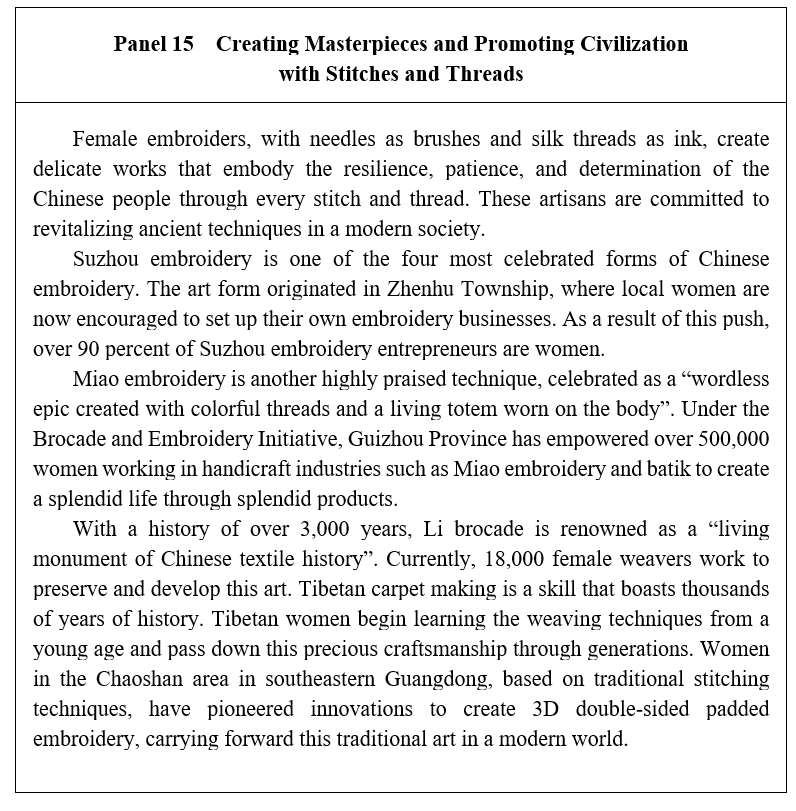
Showing strengths in preserving and vitalizing ethnic cultures. By passing down traditional crafts and facilitating cultural innovation and dissemination, women are injecting new vitality into ethnic cultures. Among the 3,997 recognized representative bearers of the intangible cultural heritage (ICH) items on the national list, 25 percent are women. The research and training program for ICH bearers has provided training for 51,000 people, with women accounting for 57 percent. Under the plan on revitalizing traditional Chinese craftsmanship and the specialized initiatives to revitalize rural areas by promoting ICH, many women have played a leading role in transforming local natural resources and rural cultural assets into cultural products and industries. Handicraft brands such as "Dove Flower: Songtao's Miao Embroidery" in Guizhou and "Weiyuan Tu Ethnic Coiling Embroidery" in Qinghai are shining examples of this transformation.
New business models - often fronted by women - such as "ICH plus guesthouses", "ICH plus cultural products", and "ICH plus study trips" have also been launched in recent years, breathing new life into traditional ethnic cultures. The rise of digital technology has allowed traditional culture to flourish again, and an increasing number of young women now play a central role in promoting the "China-Chic" trend and preserving and vitalizing ICH, facilitating ICH's integration in modern life and helping it reach a global audience.
Excelling in both competitive and mass leisure sports. The Outline for Building a Strong Sporting Nation has explicitly set the goal of achieving balanced development between men's and women's events. The Beijing Organizing Committee for the 2022 Olympic Winter Games issued a Gender Equality Commitment covering 14 specific areas, including equal participation, gender-equal and fair portrayal, and gender equality in leadership and workforce.
The number of female elite athletes in China has witnessed rapid growth, and the proportion of international-level female athletes has remained above 50 percent. Since 2012, across the four consecutive Summer Olympic Games, female athletes have accounted for over 55 percent of competitors and won over 60 percent of the medals. During the same period across the four Paralympic Games, women have made up 50.22 percent of participants and secured 55.62 percent of the medals. Female athletes fight for their nations, collaborate in unity, and challenge their limits, playing an equal role as their male counterparts in competitive sports. The fighting spirit of the Chinese women's volleyball team has inspired the Chinese people to this day.
Extensive fitness-for-all programs are carried out nationwide, and a program of cultivating female community sports instructors in rural areas has provided training for over 65,000 women in 10,000 villages. By the end of 2024, there were about 3.71 million community sports instructors across the country, among which 56.1 percent were women, demonstrating women's leadership and responsibility in advancing China's fitness-for-all initiative in the new era.
4. Women's Undertakings in Grassroots Social Governance
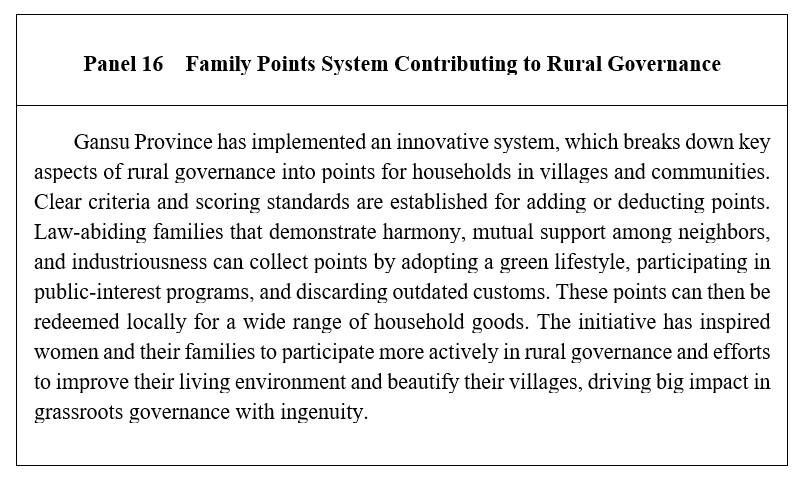
In building a grassroots social governance model based on collaboration, participation, and common interests, China has attached great importance to the role of women and women's organizations, expanded the channels for their orderly participation in grassroots governance, and ensured their involvement in managing grassroots-level public affairs and public-interest undertakings in accordance with the law. Chinese women have excelled in these roles, becoming a major force in grassroots governance.
The positive role of family ties, values, and traditions in grassroots governance. China has improved mechanisms that help to foster family virtues, facilitate education cooperation between families, schools and society, deliver more accessible family services, and resolve marital and family disputes, supporting women in nurturing harmony within households, and thus contributing to a more peaceful and harmonious society for all.
Family virtue cultivation activities such as the selection of the "Most Beautiful Families", "Model Families", and "Five-Virtue Families", and initiatives like "Share Your Family Rules, Mottoes, and Values", "Family Virtues in Letters", and "Family Education Cultivates Values and Virtues" have been organized. These activities champion the new socialist family morality and values, emphasizing love for the country and family, mutual care, devotion to progress and kindness, and joint efforts with shared benefits. A total of 1,597 households have been honored as "National Model Families", 6,258 as "National Five-Virtue Families", and 16.48 million as the "Most Beautiful Families". Additionally, more than 500,000 lectures, exhibitions and performances on family values and traditions have been hosted around the country, attracting a combined attendance of 250 million people.
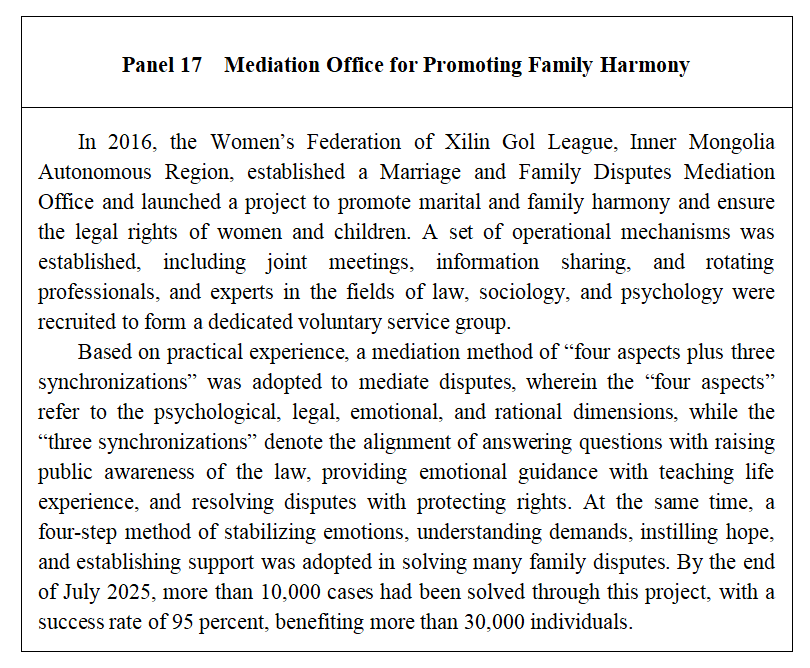
Women's extensive participation in building a peaceful and harmonious community. Women actively participate in the comprehensive maintenance of public order and contribute to resolving problems and disputes at the grassroots level. Local governments have been exploring a "Women's Federations Plus" mediation model. By the end of 2024, 3,690 mediation commissions above the county level for resolving marriage and family disputes had been established under the leadership of women's federations. Marriage mediation organizations now provide service at comprehensive governance centers, litigation service centers, and community police offices, and marriage mediation offices have been established at the village and community level. Since 2016, nearly 1.36 million cases have been resolved through mediation. In 2023, 295 women mediators were commended by the Ministry of Justice as National Model Mediators, accounting for 29.5 percent of those recognized.
Women also play an active part in patrols for maintaining order and in supervision. The "Jiangdong Aunties" team in Jingkou District, Zhenjiang City, Jiangsu Province has completed 5,000 hours of voluntary patrols and participated in over 1,000 public service activities since its establishment in 2017. The "Xicheng Aunties" in Beijing and women community liaisons in Weinan City, Shaanxi Province, have promptly identified and reported potential risks for social governance, working at the forefront of conflict resolution at the grassroots level. Women acting as community workers, grid managers, and residential building chiefs have made significant contributions to building a peaceful and harmonious community.
Active engagement in voluntary service and other public-interest programs. China emphasizes the healthy development of voluntary services and social organizations, among which women play an active role. In 2024, there were 24 million women registered as volunteers and 350,000 women volunteer teams. These volunteers play an important role in promoting national strategies, improving the people's wellbeing, and strengthening social governance. They have provided nearly one million voluntary services, covering all 17 goals of the UN 2030 Agenda for Sustainable Development. The number of women in social organizations is on the rise. In 2023, women comprised 42.3 percent of the staff and 26.3 percent of the heads of social organizations respectively, up by 13.3 and 4.9 percentage points from 2012.
5. Women's Contributions in the Eco-environmental Field
China upholds and acts on the principle that lucid waters and lush mountains are invaluable assets, and promotes modernization based on harmony between humanity and nature by following a path of green development that gives priority to eco-environmental conservation. Women play an important role in building a beautiful China, and are continuing to develop the awareness and skills required to drive forward eco-environmental protection.
Promoting ecosystem protection and restoration. China pursues the integrated protection and systematic management of mountains, waters, forests, farmlands, grasslands and deserts, with the aim of establishing an overarching framework that extends from the mountaintops to the oceans. Women play a significant role in the nation's ecosystem protection and restoration. Among the 17,000 eco-environmental guardians working at the 190,700 sq km Sanjiangyuan National Park, 33.3 percent are women. The Women Tree-Planting Team in Changjiang Li Autonomous County of Hainan Province has been dedicated to planting more than six million coastal defense trees, establishing a forest spanning over 2,000 hectares in the desert after 30 years of trial and error. The women's militia company for sand control in Shaanxi Province has converted more than 933.33 hectares of barren deserts into oases covered with rows of trees over the past five decades. The women's volunteer team in Helan County of Ningxia Hui Autonomous Region conducts regular activities to protect rivers, shoals, and birds, and the Women's Action for the Yangtze River Protection is an ongoing activity in Nanjing City of Jiangsu Province to provide vital protection for China's longest river. Women's perseverance and wisdom are shown in many aspects of eco-environmental protection, from green coverage expansion and desertification prevention and control, to the protection of forests, rivers, and biodiversity.
Accelerating the green transformation of production models. China upholds green and low-carbon development as a fundamental approach to resolving environmental problems, and promotes a sound economic structure that facilitates green, low-carbon, and circular development. Women actively participate in the efforts to promote green development in industry, shift the production model of agriculture, and improve the sustainable level of the service industry. By 2024, the number of companies in the green economy sector invested in by women entrepreneurs had reached 445,000, accounting for 27.4 percent of the total. These companies cover a range of market segments, including clean energy, organic agriculture, and eco-conservation. Scientific management of fertilizer and pesticide use and innovative ecological planting serve to save agricultural resources, improve the eco-environment of agricultural production areas, and supply high-quality green agricultural products, promoting the triple-win of less pesticide use, more income, and better environment. New models of eco-environmental businesses have been established, including urban modern agriculture, leisure agriculture, eco-tourism, high-quality homestays, and rural complexes. By the end of 2024, the number of family farms run by women reached 487,000, and women accounted for 68.6 percent of all holders of vocational skill certificates in rural homestay housekeeping.
Living a green lifestyle. Green development is closely connected to each of our lives. Chinese women advocate the values of eco-civilization and encourage simple, moderate, green, low-carbon, sound and healthy ways of life and consumption by integrating these concepts into everyday routines. They have played a leading role in building green families through saving water and electricity, participating in the "Clear Your Plate" campaign, using green modes of transport, and engaging in waste sorting. Women also actively participate in developing beautiful courtyards and harmonious villages, guided by standards such as tidy rooms, hygienic kitchens and toilets, neat courtyards, abundant greenery, and harmonious families. To date, more than 12 million households have been awarded the title of "Beautiful Courtyard". Women are consistently in the frontline of enhancing public awareness of environmental protection and improving community environment. For example, in Shanghai, a themed campaign was launched to find 10,000 families living a green lifestyle and recruit 100,000 family waste sorting volunteers, creating a good atmosphere for the million families participating in this endeavor.
Participating in disaster prevention and mitigation. China regards people's lives and safety as the primary goal of disaster prevention and mitigation. It boosts public participation and improves the capabilities of the whole society to defend and respond to disasters, and women play a key role in this - particularly in investigation and identification of potential risks and hidden dangers, early warning and treatment, and information reporting. In 2024, women accounted for 23.6 percent of disaster information assistants nationwide, totaling 267,000, and comprised 61.6 percent of national chief meteorological experts. Women actively participate in disaster relief operations and public education on disaster prevention and mitigation, and promote family education in relevant fields. There are 13.71 million registered women fire volunteers nationwide, representing 52.4 percent of the total. The National Natural Disaster Emergency Relief Plan put forward requirements for safeguarding the rights and interests of special groups. Through the collaborative efforts of the government and society, material guarantee for special needs, such as women's hygiene products and supplies for pregnant and postpartum women, has been strengthened.

