China.org.cn | December 16, 2025


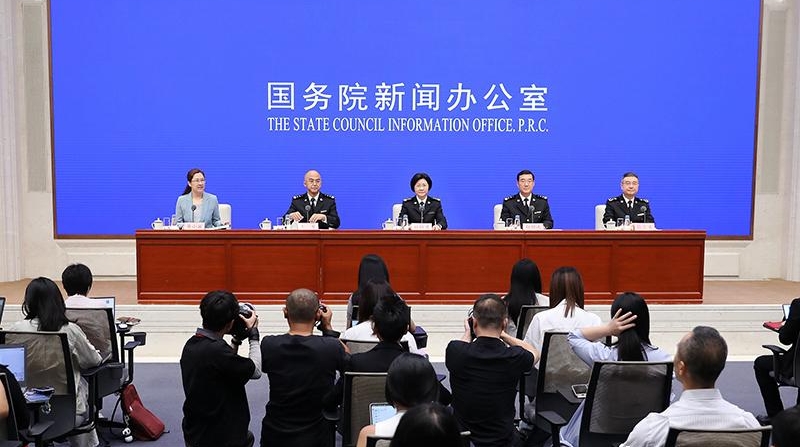

China Media Group:
We have noticed that in recent years, the GAC has led special actions to promote cross-border trade facilitation for several consecutive years. Could you please introduce the achievements of these special actions? Moreover, in what aspects has the GAC further enhanced the sense of gain for foreign trade enterprises? Thank you.
Sun Meijun:
Thank you for your question. It is an excellent one, and I addressed this point in my previous remarks. Cross-border trade facilitation is an essential requirement for high-level opening-up, a key means to optimize the business environment and respond effectively to external shocks, and an objective requirement to fulfill WTO commitments and uphold the multilateral trading system. During the 14th Five-Year Plan period, the GAC, in collaboration with more than 20 national ministries and commissions, has led annual special actions to facilitate cross-border trade. These initiatives have expanded to 25 cities in 17 provinces. A total of 108 reform and innovation measures have been introduced, aiming to create a more convenient, secure and predictable trade environment. These efforts have yielded remarkable achievements and have been widely welcomed by enterprises. According to a World Bank survey released in April this year, China received the highest rating for customs and trade regulation perceptions among the 53 economies surveyed. Our main tasks focus on several key areas:
First, we have simplified customs clearance procedures and enhanced market competitiveness. We have reduced approvals and streamlined procedures in accordance with the law, implementing 24/7 appointment-based customs clearance. For example, for LCL export cargo, we adopt the principle of pre-shipment inspection, significantly reducing repeated loading and unloading, helping enterprises move quickly and capture market opportunities.
Second, we have optimized the supervision model to speed up cross-border logistics. For example, in the Guangdong-Hong Kong-Macao Greater Bay Area, we introduced the one-stop clearance supervision model, cutting port transfer times from five to seven days to two to three days. A green channel for agricultural product imports has been set up at ports, allowing fresh fruits from neighboring countries such as Thailand and Vietnam to reach Guangzhou in as little as seven hours and Beijing in 30 hours.
Third, connectivity has been strengthened, making economic and trade exchanges more convenient. In terms of hard connectivity, China has advanced the development of major international logistics corridors and improved capacity and quality at key hub ports. In terms of soft connectivity, the national single window for international trade has been linked with the business systems of 30 departments and agencies, offering 964 online services and enabling one-stop processing across all stages of cross-border trade. The platform now has 11 million registered users and processes an average of 26 million declarations per day. China has also expanded international cooperation under the single window framework, achieving interconnectivity with 15 countries and regions, meeting the targets set in the 14th Five-Year Plan on schedule, and conducting information exchanges with multiple countries.
Fourth, institutional innovation has been advanced to support the development of new forms of foreign trade. For example, to meet the needs of industrial transformation and upgrading, China has expanded the catalog of products eligible for bonded maintenance in comprehensive bonded zones. From January to July, the total import and export value of the bonded maintenance sector nationwide increased 8.7% year on year. We have also eliminated the filing requirement for overseas warehouses in cross-border e-commerce and implemented a tax rebate policy under which export tax refunds are processed upon the goods' departure, with final settlement after sales. Cross-border e-commerce continues to grow steadily. Customs authorities and platform enterprises are working together to promote the healthy and well-regulated development of new business models in cross-border e-commerce.
Fifth, services for enterprises have been further refined to help them reduce costs and improve efficiency. We have strengthened joint incentive measures for Authorized Economic Operator (AEO) enterprises with high credit ratings. More than 3,000 AEO enterprises have benefited from preferential and convenient measures such as bank financing guarantees, credit facilities and export credit insurance. China has also achieved AEO mutual recognition with 57 countries and regions, enabling enterprises to enjoy the same level of customs clearance facilitation in those countries.
There is always room for improvement in the business environment. Customs will continue to work with relevant departments to continue building a first-rate business environment at the port that is market-oriented, law-based, and internationalized. We will pursue openness to gain new advantages, promote facilitation to expand markets, and rely on the rule of law to provide strong support for high-quality development and high-standard opening-up.
Thank you.

