China.org.cn | December 16, 2025


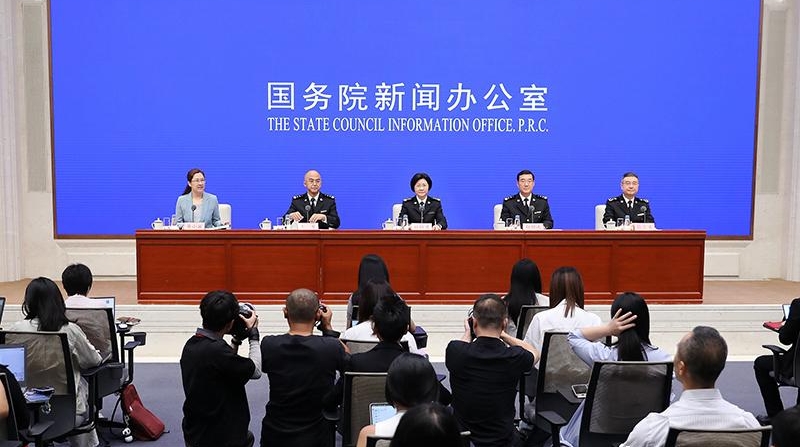

Hong Kong Bauhinia Magazine:
Customs have adopted new technologies and equipment in their regulatory work, and we have seen robotic dogs and drones utilized by customs authorities at certain ports. Could you please elaborate on the new technologies applied in customs work? Thank you.
Sun Meijun:
Thank you for your question and your interest in customs work. The robotic dogs and drones you just mentioned are applications as part of our smart customs initiative. In the first year of the 14th Five-Year Plan period, General Secretary Xi Jinping put forward the important concept of "Smart Customs, Smart Borders and Smart Connectivity," pointing out the direction for the modernization of customs work. We have since adhered to the "dual-engine drive" of institutional innovation and technological empowerment to accelerate smart customs development. And now a new form of customs supervision services is taking shape and features networked interconnection, digital perception, intelligent analysis, and automated operations. This has substantially enhanced supervision efficiency and service standards, putting us among the global leaders. As I mentioned earlier, we have launched the online cooperation platform Smart Customs Community Portal, with 142 registered countries and regions, contributing China's solutions to global customs governance. The main characteristics of this aspect are as follows:
First, we have used more intelligent equipment and facilities. Inspection robots and non-intrusive inspection equipment are widely used. Take imported iron ore as an example. We have installed near-infrared spectrometers, high-speed image recognition systems, and automatic sampling robots at the unloading lanes, allowing checks for solid waste and other stuff mixed in while unloading, thus shortening customs clearance time by more than 15 hours on average. You may have also noticed that we deployed H986 container inspection systems and CT inspection equipment for luggage and postal items at ports. Through intelligent image review, false declarations, undeclared goods and prohibited items can be quickly identified.
Second, digital empowerment has become more in-depth. Big data and artificial intelligence have been deeply integrated into all links of customs supervision. For example, in the field of cross-border e-commerce supervision, we have opened up data channels between customs, platform enterprises and payment institutions, realizing intelligent comparison of three key documents—electronic orders, payment records, and logistics manifests. Compliant goods are examined and cleared within seconds, with a maximum speed of processing 85,000 customs declarations per minute, meeting the demand for efficient and optimized customs clearance. Earlier, we also launched a one-stop platform for handling inbound and outbound mails, offering free and convenient online services that have been well-received by users.
Third, risk prevention and control are targeted. We have developed a big data intelligent risk control model that conducts real-time risk identification for each customs declaration across more than 100 dimensions. The system automatically intercepts high-risk declarations, increasing the detection rate by 16 percentage points compared to random inspections. Relevant cases have been included in the World Customs Organization's Revised Kyoto Convention Guidelines.
Fourth, customs clearance services are more efficient. We focus on the needs of enterprises and the expectations of the public, using technology to provide better services. For example, we have introduced a remote video inspection model enabling enterprises to undergo inspections via remote video links as soon as declarations are submitted. This approach has reduced customs clearance waiting times by over 80%,helping enterprises reduce costs and improve efficiency. Additionally, we have implemented electronic declaration, connected temperature monitoring, and image recognition technologies, allowing passengers to undergo seamless and expedited clearance during entry and exit procedures. I believe many travelers have experienced this firsthand.
Throughout the development of smart customs, we have gained a clear understanding of how the deep integration of China's scientific and technological innovation with industrial innovation has provided robust support for this initiative. The extensive scope, long chains, broad coverage, and diverse nature of China's customs supervision operations create a rich array of real-world scenarios ideally suited for the application of smart technologies. During the 15th Five-Year Plan period, we will further strengthen the guiding and supporting role of technology, accelerate the integrated development of smart customs, carry out systematic restructuring of business models, and fully advance the modernization of customs operations. We also hope that our friends from the media will continue to pay attention to customs work, and actively contribute insights and suggestions for the modernization of customs during the 15th Five-Year Plan period.
Thank you.

