China.org.cn | October 23, 2025


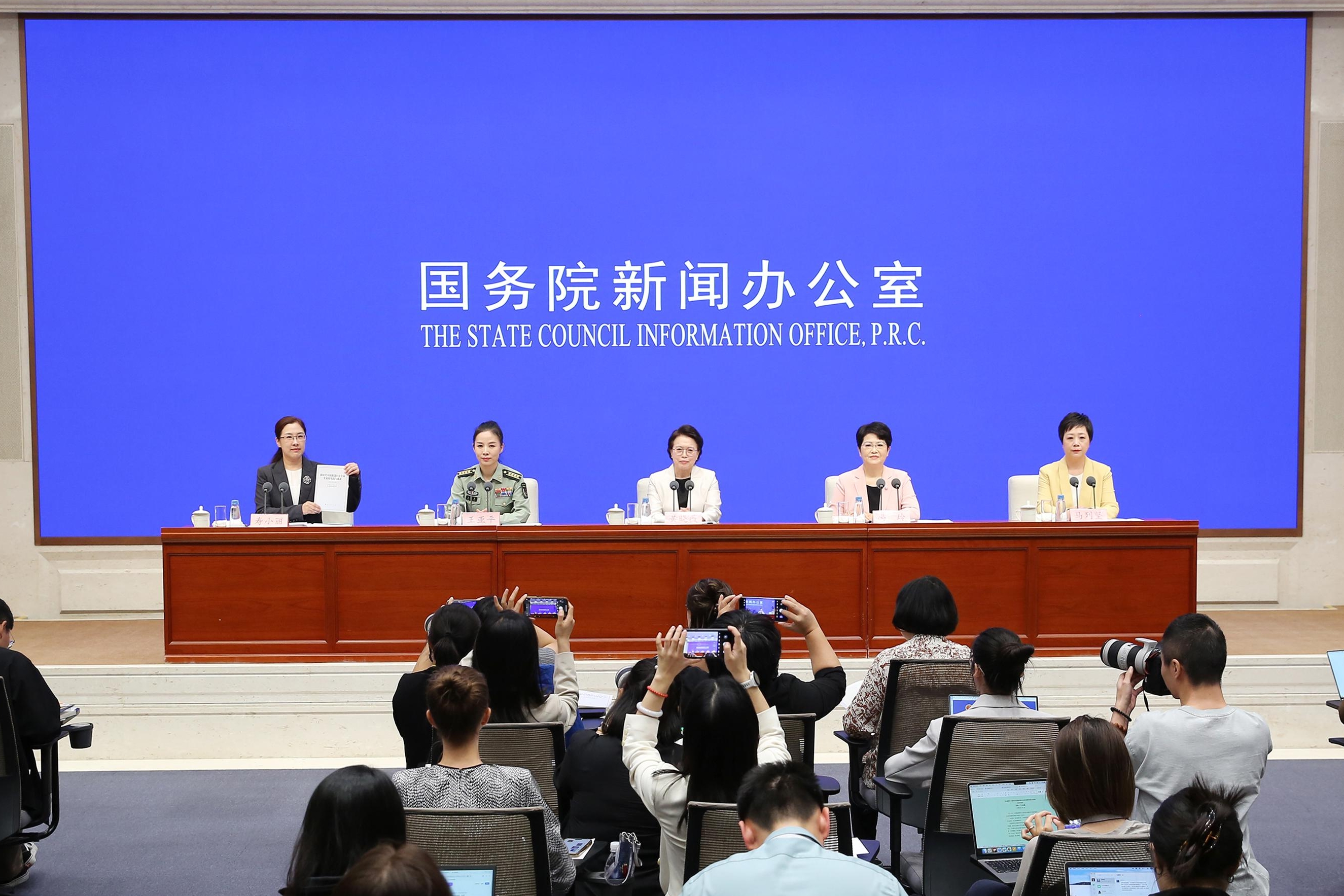

Speakers:
Ms. Huang Xiaowei, deputy head of the National Working Committee on Children and Women under the State Council, vice president of the All-China Women's Federation (ACWF), and first member of the Secretariat of the ACWF
Ms. Feng Ling, vice president of the ACWF and a member of the Secretariat of the ACWF
Ms. Wang Yaping, vice president of the ACWF (part-time) and a member of the Taikonaut Corps of the People's Liberation Army of China
Ms. Ma Liejian, a member of the Secretariat of the ACWF
Chairperson:
Ms. Shou Xiaoli, director general of the Press Bureau of the State Council Information Office (SCIO) and spokesperson of the SCIO
Date:
Sept. 19, 2025
Shou Xiaoli:
Ladies and gentlemen, good afternoon. Welcome to this press conference held by the State Council Information Office (SCIO).
Today, the SCIO has organized this press conference to release the white paper titled "China's Achievements in Women's Well-Rounded Development in the New Era" and to present and interpret its main content.
The white paper presents a systematic account of China's philosophy on advancing women's development. It highlights the remarkable progress made in promoting gender equality and women's development since the 18th National Congress of the Communist Party of China (CPC), particularly over the past five years, and outlines China's active contributions to the global advancement of women.
The white paper consists of preface, main body and conclusion, totaling around 27,000 Chinese characters. The main body comprises five chapters: Development of China's Endeavors Concerning Women, Boosting the Well-Rounded Development of Women as a National Campaign, Sharing in the Fruits of Modernization, Advancing Women's Development to the Forefront of the Times, and Contributing to the Global Advancement of Women.
The white paper is published in eight languages: Chinese, English, French, Russian, German, Spanish, Arabic and Japanese. It is published by the People's Publishing House and Foreign Languages Press, and is available at Xinhua Bookstores nationwide.
To help you better understand the contents of the white paper, we are honored to have with us Ms. Huang Xiaowei, deputy head of the National Working Committee on Children and Women under the State Council, vice president of the All-China Women's Federation (ACWF), and first member of the Secretariat of the ACWF. She will brief you on the paper and take your questions.
Also attending today's press conference are Ms. Feng Ling, vice president of the ACWF and a member of the Secretariat of the ACWF; Ms. Wang Yaping, vice president of the ACWF (part-time) and a member of the Taikonaut Corps of the People's Liberation Army of China; and Ms. Ma Liejian, a member of the Secretariat of the ACWF.
Now, I'll give the floor to Ms. Huang for her introduction.
Huang Xiaowei:
Thank you. Ladies and gentlemen, friends from the media, good afternoon. I am delighted to join you in witnessing the release of the white paper "China's Achievements in Women's Well-Rounded Development in the New Era." First, I would like to take this opportunity to express my heartfelt thanks to all friends for your long-term concern about the issue of women's development and the work of the ACWF.
In line with the initiative of General Secretary Xi Jinping, a Global Leaders' Meeting on Gender Equality and Women's Empowerment will soon be held again in Beijing. To mark the 30th anniversary of the Fourth World Conference on Women, the United Nations convened a high-level meeting in Geneva on Sept. 8 and will convene another meeting in New York on Sept. 22. We are releasing this white paper today to offer a full account of China's results in implementing the Beijing Declaration and Platform for Action, and to present China's philosophy, practices and achievements in promoting gender equality and women's well-rounded development in the new era.
Since the 18th CPC National Congress, the CPC Central Committee with Comrade Xi Jinping at its core has incorporated the advancement of women's cause into the overall framework of Chinese modernization. General Secretary Xi Jinping has presented important ideas and proposals on work related to women, children and women's federations, as well as on fostering strong family ties, values and traditions. These constitute an integral part of Xi Jinping Thought on Socialism with Chinese Characteristics for a New Era. A series of major initiatives of pioneering vision, overarching significance and long-term impact have been implemented, which have led to historic achievements in women's cause in China. Women's development in China has been comprehensively advanced, and the Chinese socialist path for women's development has demonstrated great vitality and distinctive strengths. This has contributed a vivid example of China's governance to the world, injecting new elements into human civilization and opening up new pathways. Here, I would like to summarize the situation through "four unprecedented advances."
First, the attention and support from the Party and the state for women's cause are unprecedented. In the new era, China has closely integrated the course of national development and progress with the promotion of gender equality. The Party's leadership has been comprehensively strengthened. The reports to the 18th, 19th and 20th CPC National Congresses all emphasized "upholding the basic national policy of gender equality and protecting the lawful rights and interests of women and children." General Secretary Xi Jinping has given a series of important instructions, and Party committees at all levels hold special meetings every year to deliberate on women's work, providing strong political guarantees for the development of women's cause. The will of the state has been fully demonstrated. The Civil Code, including a Marriage and Family section, has been promulgated; the Anti-Domestic Violence Law has been enacted; the Law on the Protection of Women's Rights and Interests has been comprehensively revised; and the Criminal Law and the Law on Land Contract in Rural Areas, among others, have been amended. A gender equality review mechanism has been established at the national level and across provinces, autonomous regions, and municipalities directly under the central government. Planning has played an increasingly guiding role. A planning system has been formed, led by national development plans, with the outlines for women's development as the mainstay, supported by special plans in related fields and at local levels. This system ensures horizontal coordination and vertical integration, with quantifiable objectives, operable measures, concrete tasks and measurable outcomes. The working mechanisms have become more robust and effective. A structure has taken shape in which Party committees exercise leadership, governments assume primary responsibility, working committees on women and children play a coordinating role, women's federations work in collaboration, relevant departments provide support, and the whole of society participates. These efforts have translated institutional strengths into effective drivers for the development of women's cause.
Second, women's sense of fulfillment, happiness and security has reached unprecedented levels. In the new era, China has adhered to safeguarding women's rights and interests through development and improving women's well-being via concrete progress. More than 690 million women have simultaneously become part of our moderately prosperous society in all respects. Women from previously impoverished areas now have access to safe housing, clean water and broadband internet, radiating confidence from within. Women's health has improved dramatically. Average life expectancy has reached 80.9 years, an increase of 3.5 years since 2010. The systematic maternal management rate has risen to 94.9%, up 7.3 percentage points since 2012. The maternal mortality rate has dropped 41.6% compared to 2012. China has been recognized by the WHO as one of the 10 countries with high performance in maternal and child health. Women enjoy balanced and high-quality education. Gender gaps in basic education have essentially been eliminated, and female students now account for 50.76% of students in higher education enrollment. Education in science, technology, engineering and mathematics has empowered girls to reach new heights, making education empowerment the primary driving force of women's success in life. Social security for women is comprehensive and practical. Medical and pension insurance systems have achieved universal coverage in China, with women representing over 48% of total participants in insurance programs. Female participation in unemployment and work-injury insurance has increased 1.7-fold and 1.6-fold, respectively, since 2012. The safety net for women in difficult circumstances is solid and comprehensive. Women equally across the country share in the achievements of modernization, developing with greater confidence.
Third, women's role in "holding up half the sky" has been more comprehensively demonstrated across all fields than ever before. In the new era, China regards women as an important force in advancing Chinese modernization, guiding them to become builders of great undertakings, advocates of civilized practices, and courageous pursuers of their dreams. In terms of high-quality development, women account for 43% of employed personnel and 45.8% of scientific and technological workers. Among participants in emerging sectors such as digital trade, e-commerce and livestreaming, women make up one-third of practitioners. In frontier areas such as domestically produced large passenger aircraft, biomedicine, deep-sea exploration and artificial intelligence, women have made outstanding contributions. The currently popular movie "Shenzhou 13" was co-produced by female astronaut Wang Yaping, who is sitting here on stage with us, and her colleagues. In terms of political participation, the proportion of women among deputies to the 14th National People's Congress, members of the National Committee of the Chinese People's Political Consultative Conference, and delegates to the 20th CPC National Congress has reached historic highs. Women account for 54.3% and 26.1% of neighborhood and village committee members, respectively, up 5.5 and 4 percentage points from 2012. This vividly reflects the most extensive, genuine and effective democratic practice. In terms of cultural development, women account for 45.2% of successful candidates in the cultural talent program and one-quarter of national-level intangible cultural heritage inheritors. Female cultural talents and their outstanding works continue to emerge in great numbers. Yu Lei, who was the chief director of this year's V-Day commemorations on Sept. 3, is also a woman. In primary-level social governance, there are more than 431,000 women's deliberative councils, over 7 million ACWF executive committee members, and more than 24 million registered female volunteers active in urban and rural communities. They resolve conflicts "at the doorstep," deliver services "to the heart," and integrate family, family education and family values into daily life. In ecological and environmental protection, women guide their families and inspire children to actively participate in afforestation activities, the "Clear Your Plate" campaign, waste sorting, and environmental improvement. To date, more than 12 million households have been awarded the title of "Beautiful Courtyard," contributing to a greener, more beautiful China.
Fourth, China's deep participation in global governance on women's affairs has reached unprecedented levels. In the new era, China upholds the concept of building a community with a shared future for humanity, and has translated the four major global initiatives proposed by General Secretary Xi Jinping into concrete actions to promote the comprehensive development of women. We have firmly fulfilled international conventions, supported the United Nations in prioritizing women's work, jointly established the Prize for Girls' and Women's Education with the U.N., and held the Global Leaders' Meeting on Gender Equality and Women's Empowerment. We are expanding our circle of friends for women's cooperation, maintaining friendly exchanges with over 140 countries, more than 420 women's organizations and institutions, and various U.N. agencies. We have implemented empowerment projects worth over $40 million in more than 20 countries, trained more than 200,000 female talents from more than 180 countries and regions, supported women's employment in over 100 countries, established the Global Exchange and Cooperation Center for Digital Empowerment of Women, and held training courses for Chinese and foreign female entrepreneurs. These actions demonstrate our practical efforts to bridge the digital gender gap. In the face of global challenges, China has sent more than 1,200 female military personnel to participate in U.N. peacekeeping operations, continuously conducted specialized training on climate change, and provided humanitarian assistance to women and children affected by conflicts and disasters, reflecting the responsibilities of a major country.
Ladies and gentlemen, friends:
Modernization is the shared pursuit of all peoples, and it requires harnessing the broadest possible strength of women and promoting gender equality and women's comprehensive development at a higher level. China is willing to join hands with countries around the world to accelerate action and create a bright future for women's development, writing a new chapter in the global advancement of women!
That concludes my briefing. Thank you.
Shou Xiaoli:
Thank you, Mrs. Huang, for your opening remarks. We will now move to the Q&A session. Please identify the media outlet you represent before asking your questions. Please raise your hand to ask questions.

