Full text: Carbon Peaking and Carbon Neutrality China's Plans and Solutions
Xinhua | November 8, 2025

Preface
Earth is the only home of all humanity, and tackling climate change and promoting sustainable development are vital to our survival and future. Since the Industrial Revolution, great material wealth has come at the cost of faster depletion of natural resources and disruption to the ecological balance, intensifying the tensions between humanity and nature. In recent years, the harmful effects of climate change have grown more prominent, making a coordinated global response ever more urgent.
The major decision to achieve peak carbon dioxide emissions and carbon neutrality was made by China out of a strong sense of responsibility for human civilization and the intrinsic demands of China's sustainable development. President Xi Jinping has affirmed many times China's resolve to meet the goals of peak carbon and carbon neutrality on major multilateral and bilateral occasions. On September 22, 2020, at the general debate of the 75th Session of the United Nations General Assembly, President Xi announced that China would strive to reach peak carbon dioxide emissions before 2030 and carbon neutrality before 2060. On December 12, 2020, he presented China's 2030 Nationally Determined Contributions (NDCs) at the Climate Ambition Summit. On September 24, 2025, at the UN Climate Summit, President Xi further clarified China's 2035 NDCs, injecting greater impetus and more certainty into the global climate governance and demonstrating China's stance as a responsible major country that champions integrity.
China always honors its commitments. Five years after the announcement of its ambitious peak carbon and carbon neutrality goals, the country has achieved historic results in advancing the green and low-carbon transition through concrete action and painstaking efforts, adhering to the principle that lucid waters and lush mountains are invaluable assets.
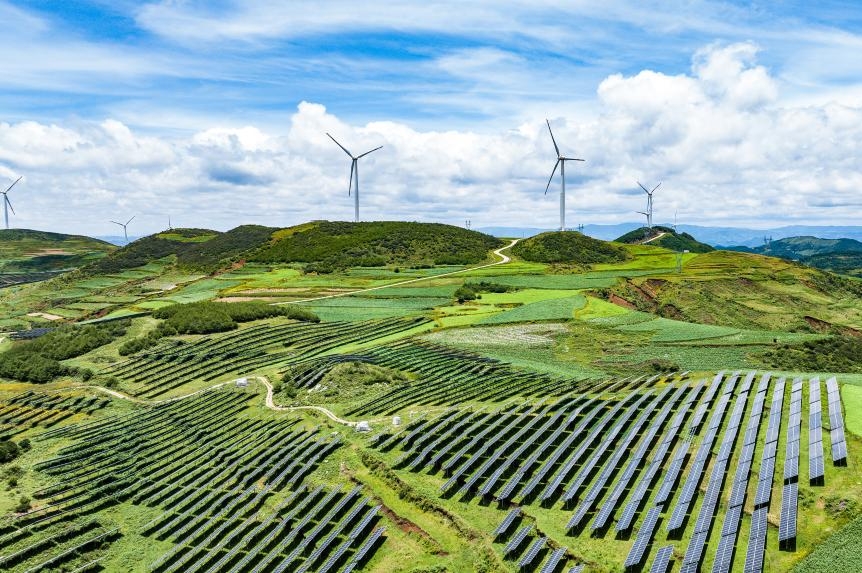
China has established the most systematic and comprehensive carbon reduction policy framework in the world, built the largest and the fastest-growing renewable energy system, the largest and most complete new energy industrial chain, and achieved the world's largest and fastest promotion and adoption of new energy vehicles. It has contributed about one-fourth of the newly added green areas worldwide, and ranks among the countries with the fastest decline in energy consumption intensity. China has blazed a viable trail for developing countries to pursue green and low-carbon development, thereby making significant contributions to global climate action and the sustainable development of humanity.
The year 2025 marks the 10th anniversary of the Paris Agreement. Over the past decade, despite ups and downs in global climate governance, green and low-carbon development has become an unstoppable trend. Currently, global transformation on a scale unseen in a century is accelerating, and global climate governance has entered a new and critical phase. Concrete efforts are better than empty rhetoric and inaction. Only through concrete measures and solid actions can we turn the goals of tackling climate change into reality, and only then can we better protect Earth, the shared home of humanity.
The Chinese government is publishing this white paper to present a comprehensive overview of China's major achievements in pursuing peak carbon and carbon neutrality over the past five years, and to share China's approaches, actions, and experience.